English

If you need a reliable LED display board manufacturer in Delhi right now, here is the direct verdict: do not look for companies claiming to fabricate silicon LED chips locally, because chip-level wafer fabrication doesn’t happen in Northern India. Instead, you want top-tier integration and assembly manufacturers clustered around Okhla Industrial Area (Phases I, II, and III), Patparganj, and the Noida extension corridor. For commercial-grade video walls, dynamic 3D outdoor billboards, and retail signage, the established manufacturers worth shortlisting are Delta Displays (their regional Northern India engineering hub), Pioneer Corporation, Truknox Technologies, and specialized custom cabinet fabricators like Sign-D-Craft in South Delhi. The key is making sure they build with genuine Nationstar or Kinglight LEDs, pair them with authentic Mean Well power units, and run full NovaStar calibration before crating.
Ever tried getting a clear quote from an industrial electronics supplier halfway across the globe? You shoot out five inquiries, and within three hours you have twenty different brokers on WhatsApp sending grainy photos, each claiming they own the biggest automated factory in the National Capital Region (NCR). When we are using offshore or regional suppliers for high-stakes visual projects, sorting the actual fabrication plants from the middleman trading shops gets messy fast. Some people want rock-bottom prices, while others need rock-solid hardware that won’t fry in Delhi’s brutal summer heat. So what should you do? Let's dive in and break down what’s actually happening on the factory floors across Delhi.
To understand how LED display boards are made in Delhi, you have to discard the myth that these companies are growing LED crystals in cleanrooms. They aren't. What Delhi-NCR excels at is structural engineering, precision sheet metal fabrication, power distribution integration, weather-proofing, and optical calibration.
The core components—the surface-mount diode (SMD) modules, driver integrated circuits (ICs), and printed circuit boards (PCBs)—are imported in massive batches from high-throughput facilities in Shenzhen and Taiwan. Once those modules land at Indira Gandhi International Airport or clear customs via the Inland Container Depot (ICD) at Tughlakabad, the local manufacturers take over.
They engineer the heavy-duty computer numerical control (CNC) cabinets, weld the steel mounting sub-frames, wire the custom alternating-current (AC) distribution panels, apply conformal coatings for tropicalized moisture resistance, and configure the display controllers. A top-flight Delhi workshop isn't just bolting parts together; they are adapting sensitive microelectronics to survive some of the most hostile ambient operating environments in the world.
Think about what an outdoor screen faces in Delhi: ambient air temperatures hitting 47°C (116°F) in June, followed by 90% relative humidity during monsoon season, followed by heavy winter smog laden with corrosive airborne particulates. If an assembler uses cheap thermal grease or cuts corners on cabinet air intake filtration, that screen will suffer thermal throttling and color degradation within six months. When local engineering is done right, the end product handles brutal thermal expansion cycles better than standard off-the-shelf imports that were only bench-tested in temperate climates.
When you start scheduling factory audits or sending local procurement agents to inspect facilities, you will quickly notice that the manufacturers aren’t scattered randomly. They are concentrated in four specific industrial zones, each with its own trade character and pricing structure.
Situated in South Delhi, Okhla is the historical heartbeat of light engineering and commercial electronics in the capital.
The Vibe: Dense, bustling multi-story industrial compounds.
What They Do Best: Premium indoor retail displays, high-resolution fine-pitch video walls (P1.2 to P2.0), and bespoke architectural digital installations.
Why Source Here: Many of the engineering teams here have deep backgrounds in broadcast electronics and high-end sign systems. They tend to maintain cleaner assembly rooms, employ trained surface-mount solder technicians, and keep genuine inventory of branded control gear.
Located in East Delhi, right along the border with Uttar Pradesh.
The Vibe: Tight, fast-moving production shops focused heavily on turnarounds.
What They Do Best: Commercial outdoor advertising boards, transit displays, scrolling text units, and standard P4 to P10 perimeter hoardings.
Why Source Here: Cost efficiency. If you are building standard roadside unipoles or retail shop fascias and need high volume at competitive rates, Patparganj fabricators run very lean operations.
West Delhi's heavy mechanical zones.
The Vibe: Metal stamping presses, laser cutters, industrial powder-coating lines.
What They Do Best: Extreme heavy-duty outdoor cabinets, cold-rolled close-annealed (CRCA) steel enclosures, IP67 front-access enclosures, and custom stadium ribbon housings.
Why Source Here: When structural integrity in heavy wind loads matters more than microscopic pixel pitch, Naraina workshops deliver rugged, over-engineered enclosures that withstand severe weather events without flexing.
Technically across the state border in Uttar Pradesh, but functionally part of Delhi’s industrial footprint.
The Vibe: Modern industrial parks with dedicated loading docks and clean assembly lines.
What They Do Best: Turnkey commercial video wall integration, government command-and-control visual setups, and rental/staging die-cast aluminum panels.
Why Source Here: Floor space. Because facilities in Noida are larger than in crowded central Delhi, these manufacturers can lay out 500-square-meter screens for complete 72-hour burn-in tests without stacking panels on top of each other.
To help make sense of where your specific project fits, here is how the primary manufacturing zones stack up across key commercial criteria:
| Industrial Zone | Primary Specialization | Typical Pixel Pitch Focus | Average Turnaround (50–100 sqm) | Relative Cost Index | Best Suited For |
|---|---|---|---|---|---|
| Okhla (Phases I–III) | High-end retail, broadcast, indoor fine-pitch | P1.25 – P3.0 | 2 to 3 weeks | Moderate to High | Corporate lobbies, luxury showrooms, broadcast studios |
| Patparganj | Standard outdoor billboards, highway hoardings | P4.0 – P10.0 | 1 to 2 weeks | Competitive / Budget-conscious | Commercial real estate signboards, fuel stations, retail fronts |
| Naraina / Mayapuri | Custom metal enclosures, structural frames | P6.0 – P16.0 (outdoor) | 2 to 4 weeks | Moderate | Harsh outdoor sites, rooftop hoardings, high-wind zones |
| Noida (Sectors 63/80) | Large-scale integration, rental staging screens | P1.9 – P4.0 | 3 to 4 weeks | Mid to High | Massive event staging, command centers, municipal projects |
When looking through manufacturer catalogs, every spec sheet lists "High Brightness," "Wide Viewing Angle," and "Long Lifespan." Those generic marketing labels mean nothing until you unpack the exact bill of materials (BOM) sitting behind the acrylic mask.
Inside every SMD LED package (whether it's a 1921, 2727, or 3535 package for outdoor, or a 1010/1212 for indoor), a microscopic wire links the semiconductor die to the lead frame.
Gold-Wire Bonding: Top-tier assemblers specify gold wire. Gold resists oxidation, handles thermal expansion gracefully, and maintains stable ohmic contact during temperature spikes.
Copper/Alloy Wire: Cheaper workshops often quote boards using copper-wire LEDs. Copper oxidizes rapidly if microscopic moisture penetrates the epoxy lens, and its thermal expansion rate causes stress fractures at the weld points during freeze-thaw or intense solar heat cycles. That's how you get random dead pixels within three months. Always ask your supplier to state the wire bonding material in the commercial invoice.
If you shoot a smartphone video of an LED screen and see dark horizontal bands rolling down the frame, the board is using low-end driver ICs.
High-grade boards use driver ICs from makers like Macroblock (MBI5153 or MBI5252) or Chipone (ICN2153), delivering refresh rates of 3,840 Hz or higher. This eliminates camera flicker and preserves smooth grayscale gradations at low brightness levels.
Budget builds use entry-level ICs running at 960 Hz to 1,920 Hz. They look okay to the naked human eye from twenty feet away, but they look terrible on camera and struggle to render deep shadow details without posterization.
LED boards run on low-voltage direct current (typically 4.2V or 5V DC). A standard 10-square-meter outdoor display can draw thousands of watts at peak load.
Reputable Delhi integrators use authentic Mean Well power supplies (such as the LRS, UHP, or RSP series) with built-in power-factor correction (PFC) and overload protection.
Low-cost suppliers often install generic, unbranded silver-box power units labeled "For LED Display Use." These generic units run hot, have high failure rates during summer voltage fluctuations, and lack passive safety protections against electrical shorts.
Here is a straightforward reference guide comparing the component tiers you will encounter when reviewing proposals from Delhi manufacturers:
| Component | Budget Tier (Cost-Cutting Build) | Mid-Market Standard | Enterprise / Commercial Spec |
|---|---|---|---|
| LED Packaging | Generic unbranded SMD (copper-wire) | Kinglight / Mulinsen (copper-wire) | Nationstar / Cree / Nichia (gold-wire) |
| Driver IC | Basic generic (960 – 1,920 Hz refresh) | Chipone standard (1,920 – 3,840 Hz) | Macroblock high-end (3,840 – 7,680 Hz) |
| Power Supply Unit | Unbranded 5V clones (no active PFC) | Chuanglian / Megmeet standard | Mean Well UHP slimline with active PFC |
| Cabinet Construction | Basic mild steel, manual spray paint | Standard CRCA sheet, powder-coated | Die-cast aluminum or CNC marine-grade steel |
| Controller System | Entry-level asynchronous card | NovaStar TB series / Colorlight | NovaStar NovaPro / Brompton processing |
| Expected Lifespan | 12 to 18 months before noticeable drift | 3 to 4 years of reliable output | 5 to 7+ years with minimal lumen decay |
When you visit a shop floor in Delhi—or when your third-party quality inspector walks in on your behalf—there are clear signs that separate professional engineering outfits from slapdash assembly garages.
The first thing to look at is the workshop’s environment. LED module assembly and calibration require reasonable dust control and static-dissipative surfaces. If workers are handling bare receiving cards and SMD panels directly over concrete floors without anti-static wrist straps or ESD floor mats, walk away. Electrostatic discharge often damages modern micro-pitch driver ICs in ways that don't cause instant failure; instead, it leaves latent micro-fractures that fail after 500 hours of runtime in the field.
Next is the burn-in bay. A display must not be packed into wooden crates directly off the assembly bench. Reliable manufacturers will assemble the completed display into its final structural cabinet layout, wire up the power units, and run an uninterrupted 72-hour burn-in cycle.
[Arrival of Modules & Raw Steel]
           │
           ▼
[SMD Testing & Cabinet CNC Laser Cutting]
           │
           ▼
[Assembly & Wiring to Mean Well Power Supplies]
           │
           ▼
[Continuous 72-Hour Full-White Burn-in Test]
           │
           ▼
[Thermal Imaging Scan for Hot Driver ICs]
           │
           ▼
[Packaging in Moisture-Sealed Plywood Flight Cases]
During that burn-in run, they should cycle through solid red, solid green, solid blue, and—most importantly—solid white at 100% brightness for at least 24 straight hours. Solid white draws peak amperage, which pushes the power supplies and thermal dissipation paths to their limits.
Walk through the aging line with a handheld thermal imaging camera. If you spot single modules or terminal blocks glowing bright orange (above 75°C) while surrounding units sit at 48°C, that's an immediate red flag for uneven electrical loading, a bad batch of solder paste, or misaligned ribbon cables.
Question: Can a Delhi-based manufacturer handle customized curved or irregular 3D screens?
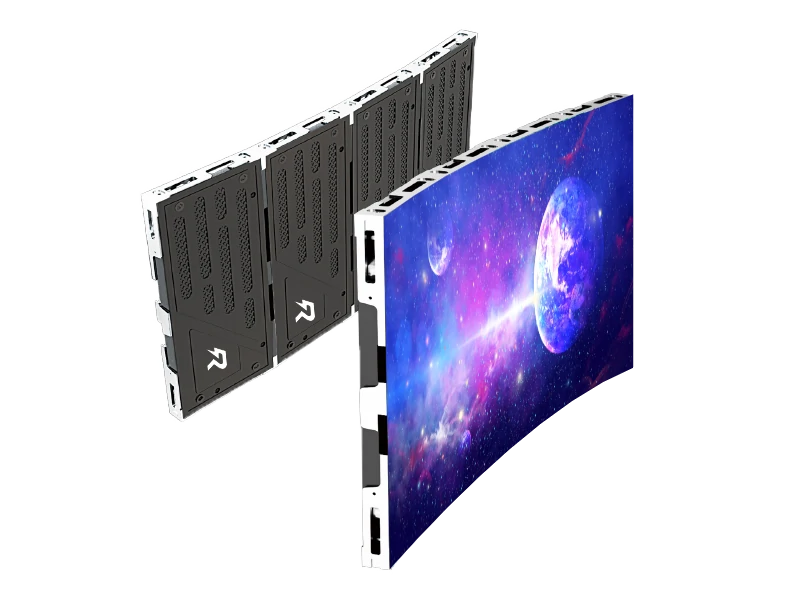
Answer: Yes, but this depends entirely on the cabinet fabrication shop they work with. Flat screens use standard rectangular modules, but curved facades require faceted cabinets or flexible rubber-substrate SMD modules. While the flexible modules themselves are imported, the complex curved steel skeleton, rear service hatches, and angular edge brackets must be drafted in 3D CAD and laser-cut locally. Fabricators in Naraina and Okhla Phase II are particularly adept at custom architectural shapes because of their access to precision sheet metal equipment.
Question: Why do some displays show visible grid lines between modular blocks?
Answer: That’s cabinet tolerance stacking. When a shop uses cheap stamping dies or welds their steel frames by hand without precision jigs, each cabinet might be off by just 0.5 millimeters. You bolt ten cabinets together in a row, and by the end of the line, that 0.5-millimeter variance compounds into a noticeable 5-millimeter gap. From a distance, that gap shows up as a dark line cutting through your image. Insist on die-cast aluminum cabinets or CNC-folded frames with sub-millimeter indexing pins.
Question: How do you handle spare parts when sourcing from Delhi?
Answer: Never accept an order without contractually locking in a batch-matched spare parts kit. LEDs are manufactured in batches known as "color bins." Even if you order the exact same model number from the same manufacturer a year later, the new bin might have a slightly warmer color temperature or different forward-voltage curve. When you swap in a new module, it will stick out like a sore thumb. Demand that the manufacturer provides 3% to 5% extra modular tiles, two extra power supplies, and at least one configured receiving card drawn from the exact same production lot as your primary screen.
When buying directly from Delhi manufacturers, quotes are usually issued in Indian Rupees (INR) per square foot or per square meter, though international commercial buyers will often negotiate in US Dollars (USD).
To give you an idea of real-world pricing benchmarks:
Indoor Commercial P2.5 Video Wall: Typically ranges between $65 and $110 (approx. ₹5,500 to ₹9,000) per square foot, depending on whether you choose cast aluminum cabinets and gold-wire Nationstar LEDs or basic sheet metal with standard Kinglight components.
Outdoor P6 to P10 Advertising Billboard: Generally runs between $50 and $85 (approx. ₹4,200 to ₹7,000) per square foot, including high-brightness outdoor modules (6,000+ nits), IP65 waterproof front-and-rear access cabinets, and basic sending controllers.
Fine-Pitch P1.5 to P1.8 Indoor Walls: Expect quotes between $130 and $220 (approx. ₹11,000 to ₹18,000) per square foot. These require high-precision die-cast cabinets, low-noise fanless power supplies, and advanced video processing.
Watch out for hidden omissions in the initial quote. Lower-tier suppliers frequently exclude the main video processor (such as a NovaStar VX400 or VX1000), external cabling, shipping crates, and local sales tax (18% GST within India). Make sure your proforma invoice is explicitly itemized as fully operational hardware with controllers, cables, and crating included.
When you are working through specs with Delhi manufacturers, keep a few hard-won rules in mind:
First, avoid getting distracted by claims of "imported Japanese technology." It’s an old sales line in regional trade circles. Virtually all raw LED modules come through the same primary supply chains in Greater China; what matters is the component tier and how cleanly the local team integrates it.
Second, pay close attention to after-sales service and warranty logistics. If you are installing the screen overseas, a warranty that requires you to ship defective modules back to an industrial estate in Delhi for rework is functionally useless due to international freight and customs delays. Instead, negotiate for a higher percentage of ready-to-run spare modules upfront (aim for 5% instead of 2%) and have them include a dedicated module repair tool—like a vacuum-suction front maintenance tool for fine-pitch indoor walls.
Third, ensure that all structural steel and secondary frames are either hot-dip galvanized or coated with high-grade architectural powder. Bare paint over steel will rust through rapidly during heavy rainy seasons, and rusty runoff dripping down the front of an LED display will stain the polycarbonate masks and ruin the screen's visual clarity.