English

Wholesale LED mesh display manufacturers must be evaluated primarily on five non-negotiable engineering benchmarks: verified structural transparency (50% to 80%), true IP67 or IP68 modular silicone potting, certified wind-load permeability tested up to Beaufort scale 12 (over 120 km/h), Tier-1 LED packaging with gold-wire bonding (Nationstar or Cree/Nichia) paired with high-refresh driver ICs (Macroblock MBI5153 or Chipone ICN2153), and a contractually guaranteed 3% to 5% single-bin spare module batch. If a factory cannot immediately provide unedited third-party test reports for these five items, walk away—regardless of how cheap their square-meter pricing looks on paper.
Picture this realistic scenario: you just secured a 450-square-meter architectural media façade retrofit on a premier commercial high-rise in downtown Chicago or Frankfurt. The project developer demands an ultra-lightweight, high-transparency curtain screen that doesn't block indoor daylight for office tenants, doesn't overload the building's curtain wall dead-load engineering, and holds up against punishing freeze-thaw cycles and torrential windstorms. You jump online, search for wholesale led mesh display manufacturers, and within forty-eight hours your inbox is flooded with sixty different quotes ranging wildly from $280 to $1,400 per square meter. Every sales rep claims their factory is the top source in Shenzhen, their products are "Grade A", and their warranty is rock solid. What happens when your procurement team picks a lowball vendor, the panels arrive on site, and within four months of exposure to high-altitude wind shear and winter freezing, cheap silicone potting cracks, water seeps into the strip ribbons, and entire twenty-foot sections go dark?
Replacing failed modules thirty stories in the air requires specialized swing-stage rigs, street-closure permits costing thousands of dollars per day, and endless finger-pointing across time zones. To help you navigate the noisy supply chain and protect your commercial margins, let's break down the exact engineering trade-offs, factory vetting protocols, and hidden cost drivers you need to master.
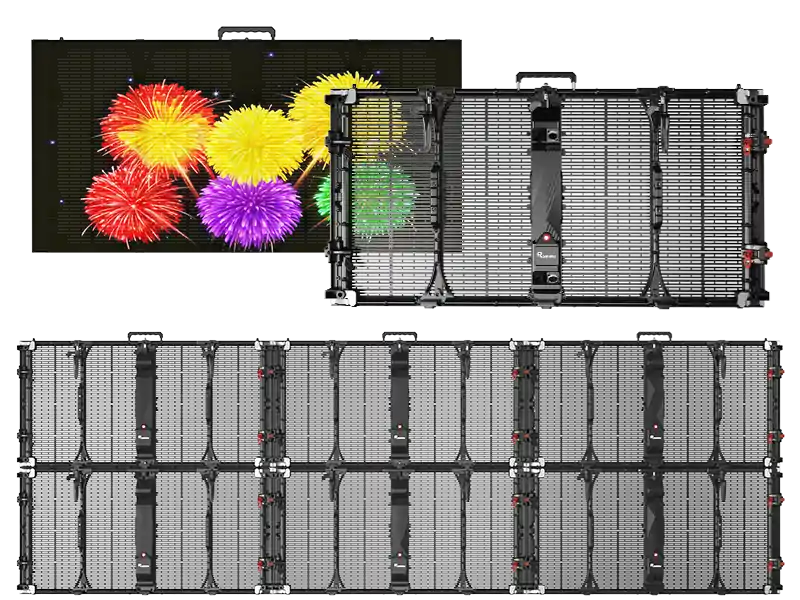
When we are installing digital media displays on modern commercial real estate, standard die-cast aluminum cabinets are rarely an option. Standard LED cabinets weigh between 35 kg and 55 kg per square meter, create an impervious solid wall that acts like a massive sail in high winds, and completely eliminate natural interior illumination. Architectural LED mesh—often called curtain displays, strip screens, or pixel grid façades—relies on an open-slat or flexible ribbon architecture.
The core advantage comes down to structural permeability and weight reduction. A properly engineered mesh system drops the dead weight down to roughly 8 kg to 14 kg per square meter. Because the horizontal or vertical spaces between the LED strip bars allow ambient light and turbulent air to pass straight through, building engineers can sign off on structural wind-load permits without requiring massive, multimillion-dollar secondary steel reinforcement trusses.
"Under International Building Code (IBC) guidelines and European Eurocode 1 (EN 1991-1-4) structural wind action mandates, any exterior cladding installed above 20 meters must account for localized wind pressure coefficients (Cpe) exceeding 1.8 to 2.4 kPa. Solid displays generate destructive vortex shedding; mesh displays with certified aerodynamic permeability above 50% reduce drag loads on curtain wall anchor mullions by up to 60%."
However, this open-air exposure creates severe environmental stress. Traditional cabinets seal all electronics inside a climate-controlled enclosure with internal fans. LED mesh, by contrast, hangs directly in the elements. Every single LED diode, PCB strip, data ribbon, and connector must survive relentless UV radiation, freezing rain, salt spray, and extreme thermal expansion and contraction cycles. That is where subpar wholesale suppliers cut corners that will not show up until six months after the final installation.
Picking the wrong pitch or transparency ratio is the fastest way to burn your client's budget. Lower pitch means sharper images, but it drops your transparency and increases dead-load weight. Below is a practical reference matrix based on field data across successful commercial installations:
| Pixel Pitch (H × V mm) | Structural Transparency (%) | Calibrated Brightness (Nits) | Minimum Viewing Distance | Average System Weight | Primary Commercial Application |
|---|---|---|---|---|---|
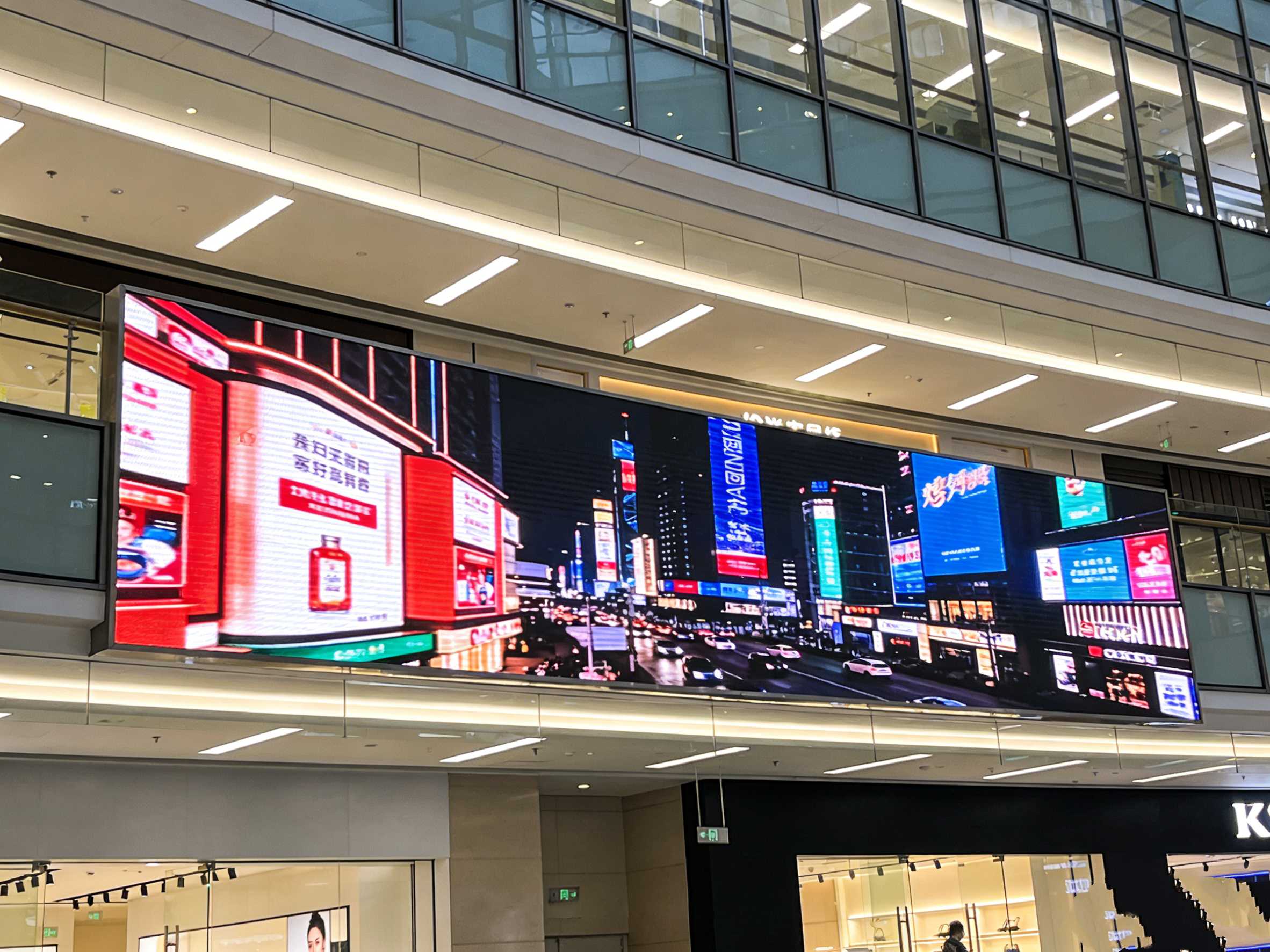
| P15.625 × P15.625 | 45% – 52% | 6,500 – 8,000 | 15 meters (49 ft) | 12 – 14 kg/m² | High-traffic urban retail podiums, daylight-direct storefront glass |
| P16 × P31.25 | 60% – 68% | 7,500 – 9,500 | 25 meters (82 ft) | 9 – 11 kg/m² | Mid-rise glass office façades, arena perimeter advertising ribbons |
| P25 × P25 | 65% – 72% | 6,000 – 8,500 | 25 meters (82 ft) | 8 – 10 kg/m² | Large corporate headquarters, highway-facing building wrappers |
| P31.25 × P31.25 | 70% – 78% | 5,500 – 7,500 | 35 meters (115 ft) | 7 – 9 kg/m² | High-rise skyscraper towers, landmark observation decks |
| P50 × P50 | 80% – 88% | 5,000 – 6,500 | 50 meters (164 ft) | 5 – 7 kg/m² | Massive stadium exterior wraps, ultra-large low-res ambient media |
| P100 (Flex Mesh/Dots) | 85% – 92% | 3,500 – 5,000 | 80 meters (262 ft) | 3 – 5 kg/m² | Artistic kinetic lighting, 3D curved architectural contour mapping |
In our procurement work across various commercial projects, we have seen almost every trick used by lower-tier exporters to shave 20% off manufacturing costs. When you are sourcing from wholesale led mesh display manufacturers, watch out for these specific issues:
Copper Wire vs. Gold Wire Bonding Inside the LED Package: This is the biggest hidden cost cutter in the LED industry. Top-tier manufacturers specify LED packages using 99.99% pure gold bond wires connecting the semiconductor die to the lead frame. Discount factories use copper or alloy wire. Copper oxidizes rapidly under moisture ingress, and its thermal expansion rate mismatches the epoxy resin, causing micro-fractures during winter freezes. Within twelve to eighteen months, you end up with random dead pixels popping up across your façade like a bad case of acne.
Cheap Silicone Potting vs. Optical Polyurethane: The waterproofing on LED mesh bars relies on automated potting injection. Inexpensive silicone potters use high concentrations of industrial filler oils. Under harsh summer ultraviolet radiation, this cheap compound hardens, turns yellow (which ruins your white-balance calibration), shrinks, and pulls away from the aluminum profile, creating micro-capillary paths for rainwater to hit the circuit board.
Ghosting and Choppy Video from Inferior Driver ICs: Some factories try to cut costs by using basic display driver ICs intended for static indoor signage rather than architectural video. If the driver IC does not support a minimum refresh rate of 3,840 Hz (preferably 7,680 Hz for 2026 broadcast standards) and high gray scale under low brightness (16-bit processing), passersby will see flickering, distracting horizontal scan lines on smartphone camera videos, and awful ghosting on fast-moving content.
The "Fabricated" Wind Tunnel Certificate: Never accept a generic, low-resolution PDF of an aerodynamic wind test. Many trading companies alter old test certificates issued for another company's product. Insist on a verifiable test report issued by an accredited laboratory (such as TÜV Rheinland, SGS, or Intertek) that clearly identifies the exact model number, bar spacing, and structural clamping system you are purchasing.
Mismatched LED Color Binning (The Patchwork Effect): If a factory buys leftover LED diode batches from multiple binning lots to fulfill your order, the screen might look uniform in pure green or pure blue, but the moment you display a flat white or subtle skin-tone background, you will see jarring color blotches across different sections.
Undersized Central Power Distribution: Mesh screens rely on distributed or central DC power boxes (typically 24V or 48V DC) to minimize the profile thickness of the exterior display strips. Some suppliers provide under-engineered power supplies running constantly at 95% capacity without active power factor correction (PFC < 0.90). In high summer ambient temperatures, these power supplies overheat, trip thermal breakers, or blow internal capacitors.
The Post-Delivery Spare Parts Disappearance: You buy a 300-square-meter screen, and the supplier includes only 1% spare parts. Two years later, when a localized power surge or lightning strike damages twenty modules, you reach out to the factory for replacements, only to be told that the specific LED bin or PCB revision is discontinued. You are left with an unfixable black hole in the middle of your screen.
When you are committing tens or hundreds of thousands of dollars to an offshore wholesale order, hope is not a strategy. You must enforce an uncompromising quality-control and factory-acceptance-testing (FAT) workflow before releasing the final balance payment.
[Factory In-Take & Raw Material Verification]
                     │
                     ▼
[SMT Automated Optical Inspection (AOI) & First Article Testing]
                     │
                     ▼
[IP68 Water Immersion & High-Pressure Jet Chamber Test]
                     │
                     ▼
[72-Hour Continuous White Balance & Thermal Aging Cycle]
                     │
                     ▼
[Pre-Shipment Calibration, Binning Validation & Packaging Review]
Before production starts, lock down the bill of materials (BOM) in your contract. Specify the LED package brand and model (e.g., Nationstar 1921 or 2727 gold wire), the driver IC (e.g., Macroblock MBI5153), the power supply brand (e.g., Mean Well or Great Wall), and the PCB thickness (minimum 4-layer FR4 with 2oz copper weight). Require the manufacturer to provide written material certificates for that specific production run.
During production, every single SMT board must pass automated optical inspection (AOI) to catch cold-solder joints and bridging. Once the LED strips are assembled and potted into their aluminum extrusions, pull random sample bars from the line and subject them to an actual IP67 submersion test: fully immersed in one meter of water for thirty minutes, followed by an immediate insulation resistance test.
Reputable wholesale led mesh display manufacturers will run the entire screen array in their assembly bay for a minimum of 72 continuous hours before packing. This burn-in cycle must include:
24 hours of full-raster white screen at 100% brightness (this stresses the power supplies and thermal dissipation to the absolute limit).
24 hours of alternating RGB primary patterns to identify dead sub-pixels, color drift, and cold solder connections.
24 hours of dynamic, high-contrast video playback.
During the full-white burn-in test, walk the factory floor with a calibrated FLIR thermal camera. If individual driver ICs or DC terminal blocks are spiking above 75°C in a 25°C ambient room, the PCB layout has poor thermal dissipation, and those components will prematurely fail in field conditions.
Before dismantling the display array for crating, the supplier must run camera-based pixel-level calibration (chroma and luma calibration). This process measures the optical output of every single diode and writes correction coefficients into the receiving card flash memory, guaranteeing seamless edge blending between adjacent modular cabinets.
Architectural mesh bars are long, slender, and vulnerable to bending during maritime or intermodal freight handling. Ensure the contract mandates custom-molded high-density EPE foam cradles inside reinforced export plywood crates, complete with moisture-absorbing desiccant packs and exterior tilt/shock watch indicators.
When we're rigging these panels up on thirty-story glass curtains, structural issues matter just as much as electrical specs. Back when we tested earlier generation flexible mesh strips on a coastal project subject to severe Gulf Coast humidity, we learned a few hard lessons the hard way.
First, always verify the mechanical thermal expansion allowance of the aluminum mounting bars. Aluminum expands roughly 2.3 mm per meter across a 50°C temperature swing. If your installation crew bolts long, rigid vertical mesh sections together across structural expansion joints on a building without mechanical slide brackets, the summer heat will warp the entire façade, buckling panels outward and snapping internal data ribbon headers.
Second, pay close attention to secondary steel requirements. A huge selling point of mesh is avoiding heavy support frames, but you still need vertical drop cables or structural outriggers. We recommend stainless steel wire rope suspension systems (Grade 316 for coastal zones) with turnbuckles that allow your field crew to tension each column independently. That way, you can easily pull the entire display taut, preventing unsightly panel fluttering or wind-induced resonance during seasonal storms.
Question: Will an exterior LED mesh display block natural sunlight and ruin the outdoor view for interior office workers?
Answer: No, provided you select the appropriate transparency ratio and pixel pitch for the building's floor-to-ceiling glass layout. At a pitch of P16/P31.25 or P31.25/P31.25 with transparency between 65% and 75%, people standing inside the building two to three feet away from the glass barely notice the horizontal louvers. The human eye focuses past the thin, dark horizontal bars to the exterior horizon. Furthermore, the perforated design actually provides passive solar shading, reducing the solar heat gain coefficient (SHGC) of the building envelope and lowering indoor air conditioning loads during hot summer months.
Question: How do you handle maintenance if a single LED bar or driver fails on the 20th floor?
Answer: You must decide between front-maintenance and rear-maintenance designs during initial procurement. If the screen is installed against structural glass that does not open, rear maintenance is completely impossible unless your client wants to pay for exterior window-washing cradle access every time a diode fails. In this scenario, insist on a 100% front-serviceable system where individual LED strip bars can be unlocked using a specialized magnetic tool or front-release hex latch and swapped out in less than two minutes directly from an interior access window or minimal staging platform.
When reviewing manufacturer quotations, understanding the raw bill-of-materials (BOM) helps you spot predatory markups and suspiciously cheap shortcuts. The table below details where production capital is allocated across different quality tiers:
| Component Category | Typical Share of BOM | Low-Budget Spec ($250 – $400/m²) | Mid-Range Spec ($450 – $750/m²) | Tier-1 Architectural Spec ($800 – $1,400/m²) | What You Sacrifice at the Low Tier |
|---|---|---|---|---|---|
| LED Diodes | 30% – 38% | Generic alloy-wire SMD, unbranded sorting | Nationstar copper-wire SMD, standard binning | Nationstar Gold-Wire / Cree / Nichia, single-bin | Extreme color degradation, dead pixels within 12 months |
| Driver IC & PCB | 18% – 24% | Dual-layer PCB, generic low-refresh IC | 4-layer FR4 PCB, Chipone / Macroblock mid-tier | 4-to-6 layer heavy copper PCB, Macroblock MBI5153 | Severe video ghosting, thermal hot spots, low refresh rates |
| Power Distribution | 14% – 18% | Low-cost unbranded PSUs, no PFC | Great Wall / Mean Well standard series | Mean Well UHP / RSP series with active PFC (>0.95) | High failure rates, fire hazards, massive harmonic distortions |
| Housing & Optics | 12% – 16% | Recycled aluminum, cheap silicone potting | Standard 6063-T5 aluminum, decent silicone | Marine-grade 6063-T6 aluminum, optical PU potting | Rapid UV yellowing, warping, water ingress, frame corrosion |
| Control System | 8% – 12% | Basic synchronous sending card, no backup | NovaStar / Colorlight standard series | Dual-loop redundant NovaStar A8s/A10s cards | Screen goes black on single cable break, zero HDR support |
| Quality Control | 4% – 8% | 12-hour factory burn-in, spot check | 48-hour burn-in, basic optical check | 72+ hour burn-in, thermal imaging, IP68 submersion | You become the factory's unpaid beta tester on the jobsite |
Many engineering teams spend 90% of their time evaluating pixel pitch and brightness, and only 10% thinking about data topology and power delivery. This oversight consistently leads to disastrous project delays.
On tall building envelopes, you cannot simply drop 110V or 230V AC lines directly onto delicate exterior strip bars without violating local electrical codes (such as NEC Article 600 in North America or CE Low Voltage Directives in Europe). You have two primary structural options:
Centralized DC Distribution: Power boxes are placed indoors on mechanical plant floors, and low-voltage lines (typically 36V to 48V DC) run out through curtain wall weep holes to the mesh. While this keeps bulky power electronics indoors for easy maintenance, you must calculate electrical resistance and voltage drops carefully. A run exceeding 15 meters on undersized copper cables can result in voltage dipping below operational thresholds, causing the modules at the end of the line to dim or flicker.
Integrated Slimline IP67 Enclosures: Sealed power boxes are mounted directly behind the screen structural mullions. This eliminates long DC drops, but every single power unit must be engineered to withstand exterior ambient temperatures ranging from -30°C in winter to +55°C in direct summer sunlight.
[Main Video Server / Scaler]
              │
              ▼ (Fiber Optic Backbone)
[Primary Master Controller (NovaStar MCTRL4K)]
     │                               │ (Redundant Loop)
     ▼                               ▼
[Sub-Controller Receiver A] ────► [Sub-Controller Receiver B]
     │                               │
     ▼                               ▼
[LED Mesh Column 1 - 10]       [LED Mesh Column 11 - 20]
For any display over 100 square meters, running simple copper Cat6 patch cables from the control room will fail due to the 100-meter distance limitation and electrical noise interference from nearby elevator shafts and HVAC chillers. Insist on a multi-strand single-mode fiber-optic backbone running from your primary media server to localized distribution boxes.
From there, configure a continuous closed-loop signal redundancy architecture. If a maintenance worker or wind event damages the primary data line running into cabinet five, the secondary receiving card loop immediately detects the signal drop and feeds video data from the opposite end of the chain in less than one frame cycle. The general public never even notices a glitch.
When you are ready to issue your request for proposal (RFP) to potential wholesale led mesh display manufacturers, how you structure your procurement terms will determine whether the supplier takes your project seriously or treats you like an easy mark.
Never Buy Off a Catalog PDF: A standard glossy brochure tells you nothing. Always order a paid 1-square-meter fully operational golden sample cabinet built with the exact LED binning, power supply, and frame material specified for your main project. Test this sample independently in an environmental testing chamber.
Contractually Lock the "Golden Sample" Benchmark: State explicitly in the purchase agreement that the final production shipment must match or exceed the optical, thermal, and electrical performance of the approved sample. If the production batch fails third-party inspection, the supplier bears the cost of rework or refund.
Require 3% to 5% Single-Bin Spares: Do not settle for loose LEDs in little plastic bags. Demand complete, factory-calibrated, ready-to-hang strip modules, power modules, and receiving cards manufactured from the exact same wafer production run.
Structure Milestone Payments Against Verified Milestones: The standard overseas manufacturing payment structure is 30% deposit upon order, and 70% balance before shipment. Never wire the final 70% until your designated third-party inspection team (such as Bureau Veritas, QIMA, or an independent local engineer) has walked the factory floor, verified the 72-hour burn-in, run thermal scans, and signed off on the serial numbers of the packed crates.