English

If you are looking for the direct, bottom-line answer before digging into the technical weeds: sourcing directly from wholesale building led display manufacturers generally divides into three clear tiers. For flagship civic landmarks, international airport terminals, or seven-figure stadium installations, publicly traded titans like Absen, Unilumin, Leyard, and INFiLED provide turnkey institutional security, global branch offices, and verified UL 48 and ETL listings. However, for roughly 90% of commercial real estate projects, shopping mall facades, corporate headquarters, and digital out-of-home (DOOH) roadside building signs, specialized Tier-2 export OEM/ODM engineering factories—such as Dicolor, Gloshine, Uniview LED, CreateLED, and Lamp—deliver virtually identical visual brilliance, high-refresh driver processing, and rugged environmental weatherproofing at 30% to 45% lower capital costs.
To protect your balance sheet and avoid catastrophic job-site delays, the non-negotiable rule is never buying off an unverified FOB price sheet alone. You must legally lock down your Bill of Materials (BOM) in the commercial contract to mandate gold-wire bonded LEDs (such as Nationstar RS or high-grade Kinglight), energy-saving Common Cathode power architecture, fanless aluminum or magnesium alloy chassis, and an on-site 5% pre-calibrated spare module cache from the exact same diode manufacturing batch.
Now, let us walk through how this global wholesale manufacturing ecosystem really works, how to choose the right hardware architecture for your building facade, and how to negotiate directly with overseas factory engineering desks like a seasoned procurement veteran.
Have you ever walked past a multi-story commercial building in downtown Chicago or Frankfurt and noticed an enormous LED screen looking like an unwashed patchwork quilt? You know the look: three panels in the upper center have faded into an awkward yellowish-pink haze, dark lines slice through the video loop, and several modules have completely blacked out after a routine rainstorm. When you calculate the crane rental costs, lane closure permits, and municipal safety escorts required just to swap out a single twenty-dollar receiving card eighty feet in the air, a "bargain" screen turns into a financial nightmare in a hurry.
That is why navigating the wholesale market for building-integrated digital facades can feel like walking through a minefield. When you search for wholesale building led display manufacturers, every supplier promises 7,000 nits of blinding daylight brightness, an IP65 waterproof guarantee, and an effortless 100,000-hour operational lifespan. Yet when the actual factory quotations land on your desk, one builder quotes $1,100 per square meter while another quotes $2,900 for what looks like the exact same 8mm outdoor pitch.
Where does that massive price spread come from? Is the expensive quote simply bloated corporate overhead, or is the budget quote cutting corners that will cause the screen to catch fire or fail local electrical inspections? Having audited assembly lines across Shenzhen and Huizhou and spent plenty of cold mornings supervising facade installations, I can tell you that the difference always boils down to structural engineering, silicone chemistry, diode packaging metallurgy, and power architecture.
Before reaching out to any factory floor, you have to decide which physical display medium matches your host building's architectural engineering. Building-mounted video walls are not one-size-fits-all installations. Mounting a heavy solid steel cabinet onto an older brick structure can overload structural load limits, while installing an ultra-light mesh screen on a low-rise luxury retail storefront might leave you disappointed with low pixel resolution.
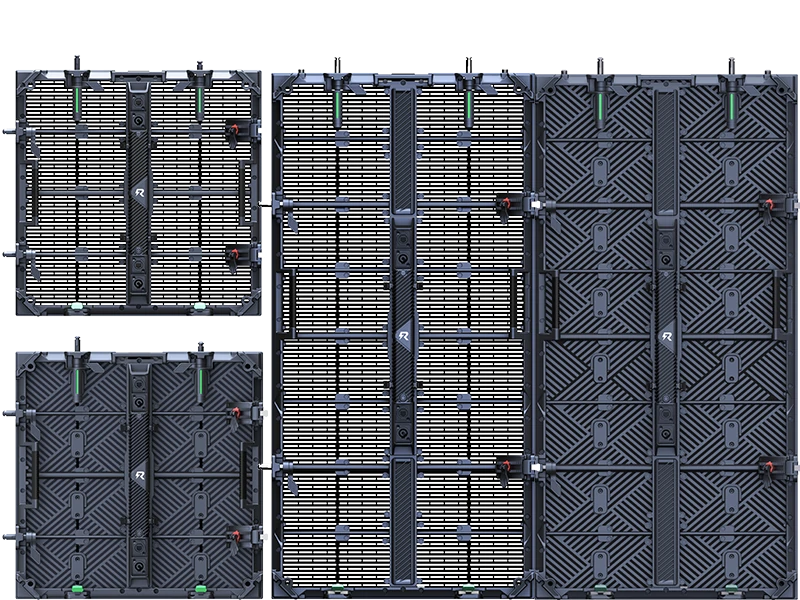
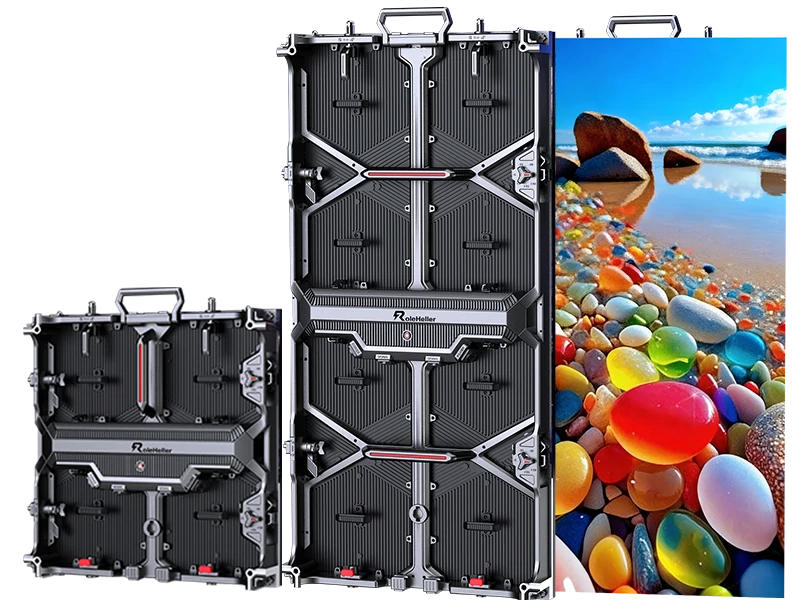
This is the workhorse of commercial building advertising. Solid cabinets feature an opaque, fully sealed aluminum or sheet-metal housing.
The Advantage: Solid cabinets deliver maximum visual contrast and punchy color saturation because the black optical louvers block all background light. They easily achieve calibrated brightness levels from 6,500 to 10,000 nits, punching clean through direct summer afternoon glare.
The Limitation: They are heavy (typically 30 to 45 kg per square meter) and act as an impermeable solid sail against oncoming winds. If you mount a 100-square-meter solid wall on a building facade, your structural engineer must design heavy secondary steel framing to handle massive structural dead loads and lateral wind-shear forces. Furthermore, they completely block natural sunlight from entering any windows behind them.
Mesh displays utilize lightweight aluminum or flexible polymer louvers with hollow open strips between each horizontal row of LEDs.
The Advantage: Mesh systems provide 40% to 70% optical transparency, allowing natural daylight to illuminate interior offices while people inside can still see outside. Because the wind passes freely through the hollow strips, wind load resistance is cut by over 60%, drastically reducing the weight of structural steel support required. Weighing only 12 to 18 kg per square meter, they can cover entire skyscraper elevations without threatening structural integrity.
The Limitation: Due to the physical gaps between strips, pixel pitches are generally coarser (P10 to P25). They look magnificent from 50 to 300 feet away on a multi-story facade, but if pedestrians walk within 20 feet of the glass, the image breaks apart into individual horizontal light strips.
Engineered primarily for storefronts and glass curtain walls, these screens are mounted on the interior side of high-rise architectural glass.
The Advantage: By installing inside the building envelope, you avoid exterior municipal signage permitting, scaffolding permits, and expensive IP66 exterior waterproofing costs. The display is protected from rain, snow, and vandalism inside an air-conditioned lobby. With transparency ratings reaching 70% to 85%, the display looks practically invisible from the sidewalk when content is black.
The Limitation: Brightness is capped between 3,500 and 5,500 nits to prevent heat accumulation against interior glass panes. Also, interior ambient light reflections on double-paned Low-E architectural glass can sometimes reduce perceived contrast during direct midday sun.
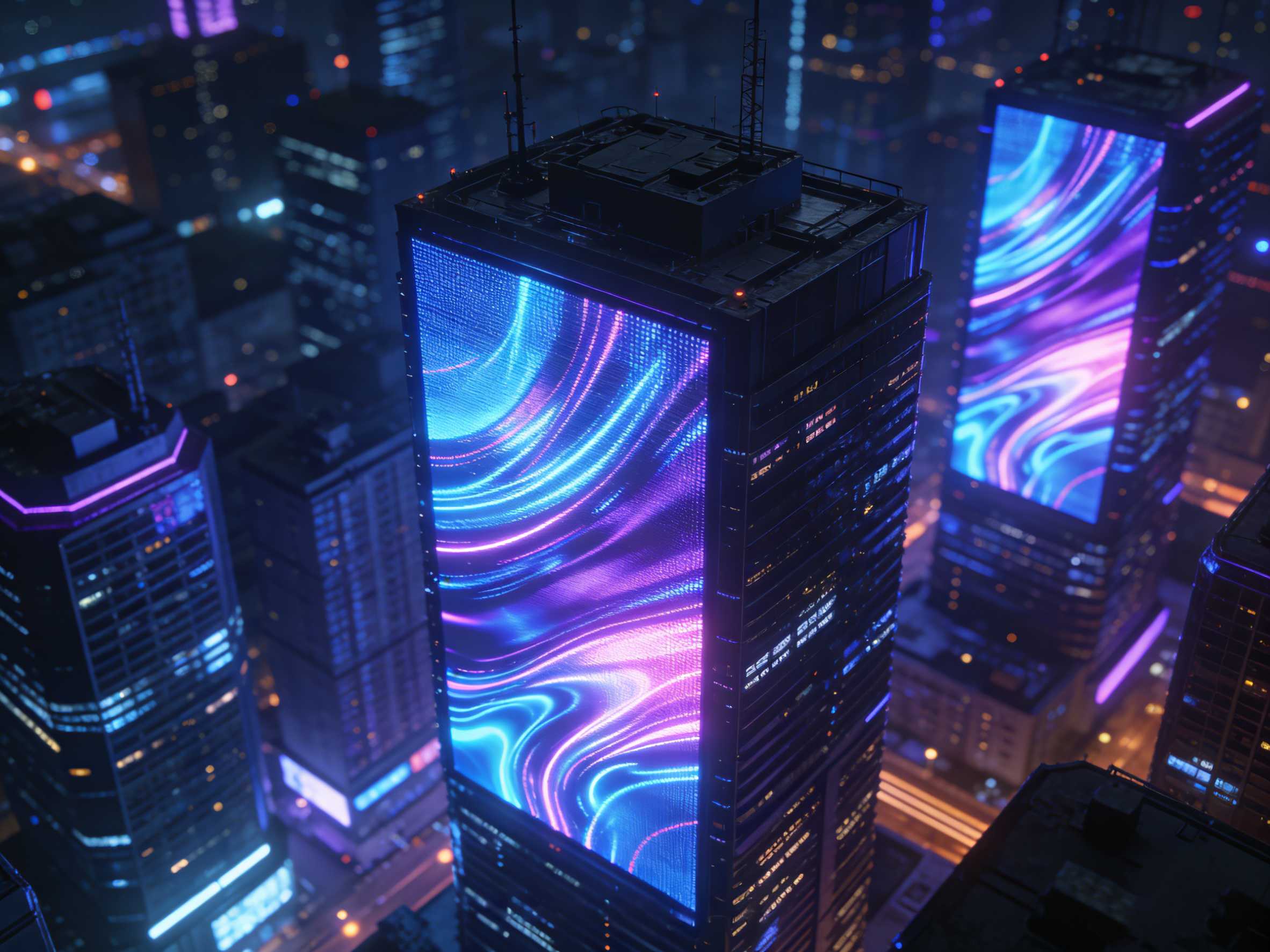
Made famous by massive retail installations in Tokyo, Seoul, and New York, these screens wrap around 90-degree building corners using custom curved or mitered edge cabinets.
The Advantage: When paired with custom anamorphic video content, they generate mind-bending, three-dimensional illusions that attract viral social media attention and command premium advertising rates.
The Limitation: They require ultra-precise CNC-machined die-cast cabinets with zero-tolerance seam alignment at the corner. Even a 1-millimeter gap or misalignment along the vertical corner joint breaks the optical perspective and ruins the 3D effect.
To help visualize how these four architectural form factors stack up across critical engineering parameters, review this operational breakdown:
| Technical Metric | Solid Outdoor Cabinet (P4–P8) | Architectural Mesh / Curtain | Interior Transparent Glass | Naked-Eye 3D Curved Facade |
|---|---|---|---|---|
| Typical Pixel Pitch | 4.0mm – 8.0mm | 10.0mm – 25.0mm | 2.8mm – 7.8mm | 4.0mm – 6.0mm (Smooth Curve) |
| Average System Weight | 32 – 45 kg / m² | 12 – 18 kg / m² | 10 – 14 kg / m² | 28 – 38 kg / m² |
| Optical Transparency | 0% (Completely Solid) | 40% – 70% Open | 65% – 85% Clear | 0% (Solid Contrast Face) |
| Calibrated Brightness | 6,500 – 9,500 nits | 5,500 – 8,000 nits | 3,500 – 5,500 nits | 6,500 – 8,500 nits |
| Wind Permeability | Zero (High Sail Effect) | High Wind Permeability | Not Applicable (Indoor) | Zero (Requires Structural Reinforcement) |
| Daylight Harvesting | Blocks Windows Completely | Allows Interior Sunlight | Preserves 75%+ Natural Light | Blocks Windows Completely |
| Typical Wholesale Cost | $1,200 – $2,200 / m² | $800 – $1,600 / m² | $1,400 – $2,400 / m² | $1,800 – $3,200 / m² |
| Best Architectural Use | DOOH Highway & Retail Facades | Skyscraper Skin, Giant Arenas | Car Dealerships, Glass Malls | Flagship Retail Street Corners |
When procurement managers discuss the wholesale LED display supply chain, nearly all roads lead to the Pearl River Delta in Guangdong, China—specifically the industrial corridors of Shenzhen, Huizhou, and Dongguan. Over 85% of the planet's commercial building displays are engineered and assembled here. But not every factory operates on the same quality plane.
+--------------------------------------------------------------------------+
|             THE WHOLESALE BUILDING LED MANUFACTURING LANDSCAPE           |
+--------------------------------------------------------------------------+
|  [TIER 1: Public Enterprise Giants] Absen, Unilumin, Leyard, INFiLED     |
|   -> Massive multi-building cleanrooms, global tech support offices      |
|   -> Best for: Major transport hubs, sports stadiums, civic landmarks    |
|   -> Reality: 30% to 50% brand markup; slow to adapt custom framing      |
|--------------------------------------------------------------------------|
|  [TIER 2: Export OEM/ODM Engineering Specialists] Dicolor, Gloshine,     |
|           Uniview LED, CreateLED, Lamp, AOTO                             |
|   -> High-precision SMT lines, flexible engineering, direct factory pricing |
|   -> Best for: Commercial plazas, retail facades, DOOH media networks    |
|   -> Reality: Exceptional value-to-performance ratio; requires strict BOM |
|--------------------------------------------------------------------------|
|  [TIER 3: Low-Cost Domestic Assemblers & Trading Brokers]                |
|   -> Fast assembly, white-label generic modules, bottom-dollar pricing   |
|   -> Best for: Short-term temporary signs with minimal durability needs  |
|   -> Reality: Alloy-wire LEDs, rapid color shift, zero western code audits|
+--------------------------------------------------------------------------+
Companies like Absen, Unilumin, and Leyard are publicly traded multi-billion-dollar conglomerates.
Why choose them? If you are working on a massive public infrastructure project—like an international terminal at JFK or a Premier League stadium facade—where the general contractor requires comprehensive international bonding, local branch office liability insurance, and globally audited certifications, Tier-1 brands give project lenders peace of mind.
The Catch: You are paying for that corporate footprint. Their hardware carries a noticeable price premium, and if your project requires custom non-standard cabinet angles or unique mechanical brackets, getting their standardized automated assembly lines to retool for a small run can take months.
Builders like Dicolor, Gloshine, Uniview LED, CreateLED, and Lamp are the hidden backbone of the international commercial AV market.
Why choose them? These facilities focus heavily on export-oriented commercial installations and professional rental staging. They run automated Panasonic and Yamaha SMT pick-and-place lines, conduct strict optical binning, and hold genuine ETL and CE-EMC laboratory certifications. Their corporate overhead is leaner, meaning you get access to Tier-1 grade internal components (like Nationstar Gold-wire diodes and Macroblock driver ICs) at direct factory wholesale rates. Even better, their mechanical engineering teams can turn around custom 3D CAD drawings for complex architectural building corners in two to three business days.
The Catch: You cannot treat them like a consumer retail outlet. You need to provide clear, uncompromising technical specifications in your Request for Proposal (RFP) so their sales engineers configure their enterprise-grade BOM rather than their entry-level value options.
Scattered across industrial parks in outer Shenzhen and regional manufacturing zones, these assemblers churn out standard plastic modules by the tens of thousands. They primarily supply domestic Chinese roadside shops and price-sensitive regional contractors. They rely heavily on thin 2-layer PCBs, copper-alloy diode bonding wires, and unbranded switching power supplies. Buying from this tier for a high-value commercial building facade is asking for premature diode failures, water leaks, and rejected building permits.
| Component / Standard | Tier-1 Enterprise Public Brands | Tier-2 Export Engineering OEM/ODM | Tier-3 Budget Wholesale Assemblers |
|---|---|---|---|
| LED Packaging Quality | Nationstar Gold Wire / Cree / Nichia | Nationstar Gold or Copper / Kinglight | Generic Unbranded / Scrap Silicon Alloy |
| Driver IC Architecture | Macroblock MBI5359 / Chipone 2065 | Chipone ICND2153 / Macroblock 5153 | Low-cost basic dual-latch IC |
| Cabinet Construction | CNC Die-Cast Aluminum or Magnesium | Precision Die-Cast Aluminum Profile | Cold-Rolled Stamped Sheet Iron |
| Power Supply Brand | Mean Well UHP / G-Energy Fanless | Mean Well LRS / Chuanglian High-Eff | Unbranded Generic Switching PSU |
| Power Architecture | Common Cathode Energy-Saving Standard | Common Cathode Dual-Rail (Optional) | Traditional 5V Common Anode (High Heat) |
| Electrical Safety Codes | Certified UL 48, ETL, FCC, CE, RoHS | Genuine ETL / UL 48 / CE Listed | Self-declared unverified CE marks |
| Average Operational Life | 80,000 to 100,000 Hours (Stable) | 60,000 to 80,000 Hours | 20,000 to 35,000 Hours |
| Typical Price (P6 Outdoor) | $1,900 – $2,800 / m² | $1,200 – $1,700 / m² | $700 – $950 / m² |
When you bolt hundreds of square feet of active electronics to the side of a multi-story commercial building, you are dealing with structural, thermal, and environmental forces that don't exist in standard indoor display jobs. Here are the engineering realities that will make or break your installation:
A building facade screen runs twelve to sixteen hours a day under direct solar exposure. In a traditional Common Anode system, a uniform 5.0-volt electrical circuit feeds all three diode chips (Red, Green, and Blue). However, a Red LED chip only requires roughly 2.1 to 2.8 volts to emit light, while Blue and Green chips need 3.2 to 3.8 volts.
Where does all that leftover voltage go in the Red diode circuit? It turns directly into raw heat. On a 100-square-meter screen, that excess heat bakes the internal ribbon cables, dries out the silicone waterproof potting, and accelerates diode color decay.
TRADITIONAL COMMON ANODE (5.0V Shared Rail)
[Power Supply 5.0V] --------> [Red Chip (Needs 2.4V)]  ===> Drops 2.6V as RAW HEAT!
                    --------> [Green Chip (Needs 3.6V)] ===> Drops 1.4V as Waste Heat
                    --------> [Blue Chip (Needs 3.6V)]  ===> Drops 1.4V as Waste Heat

MODERN COMMON CATHODE (Dual-Rail Dedicated Voltage)
[Rail 1: 2.8V Line] --------> [Red Chip (2.4V-2.8V)]   ===> NEAR-ZERO WASTED HEAT!
[Rail 2: 3.8V Line] --------> [Green/Blue (3.6V-3.8V)] ===> MAXIMUM ELECTRICAL EFFICIENCY!
By mandating Common Cathode technology, the power supply sends separate, dedicated voltages to the diodes. This reduces overall power consumption by 25% to 40% and drops the operating temperature on the front surface of the display by 10°C to 15°C. Over a five-year operational lease on a prominent commercial facade, this single engineering choice will save your client tens of thousands of dollars in commercial electricity while eliminating the need for expensive, noisy rooftop cooling chillers.
The higher your display sits on a building elevation, the more brutal the wind becomes. Wind pressure increases exponentially with altitude. A standard solid cabinet display acts as an impenetrable wind block, transferring tremendous torsional stress into the building's structural columns.
If your display is going above the fourth floor, your wholesale manufacturer must provide comprehensive structural CAD load calculations and finite element wind-tunnel analysis. In hurricane-prone zones (such as coastal Florida or East Asia's typhoon belts), specifying an architectural mesh curtain display with 50%+ open wind permeability is often the only way the local city structural engineer will approve your building permit.
How will your technicians reach a broken module or power supply three years down the road?
Rear Maintenance Cabinets: Require an internal steel catwalk behind the screen with at least 700mm to 900mm of walking clearance, access ladders, safety harness tie-off cables, and weather-sealed rear doors. If the building facade does not have existing structural depth to house a rear catwalk, this approach is physically impossible.
Front Maintenance Cabinets: Allow every single LED module, receiving card, and power supply unit to be removed from the front face using an electric vacuum suction tool or front-facing mechanical Allen keys. The entire display can be mounted virtually flush against an existing concrete or brick exterior, saving thousands of dollars in secondary structural steel framing.
Let us tackle the critical engineering questions that project managers and general contractors run into during the procurement cycle.
This is one of the quickest ways to get fined by local municipal zoning boards. A screen running at 7,500 nits during a bright summer noon is perfectly calibrated to overcome solar glare. But if that same screen runs at 7,500 nits at ten o'clock at night, it will illuminate surrounding residential apartments like a sports stadium, causing immediate regulatory backlash.
The Solution: Never rely on manual software dimming. Your wholesale hardware package must include at least two independent, weatherproof exterior ambient optical light sensors mounted on opposite corners of the building facade. These sensors communicate directly with the NovaStar or Colorlight master processor, running an automated algorithmic brightness curve that continuously ramps display luminance from 100% (7,500 nits) at high noon down to 15%–20% (1,000–1,500 nits) at dusk, smoothly adjusting for overcast cloud cover throughout the day.
Inside the microscopic epoxy resin cup of every surface-mount diode (SMD), hair-thin bonding wires connect the light-emitting semiconductor wafer to the external copper contact legs.
Industrial-grade packaging uses 99.99% pure gold bonding wire. Gold is chemically inert, highly conductive, and completely impervious to oxidation. Cheap wholesale builders cut costs by swapping in copper or copper-alloy bonding wire. In an outdoor environment, trace moisture molecules gradually migrate through the porous epoxy resin. When copper wire is exposed to heat and moisture, it oxidizes, forming non-conductive copper oxide. This leads to broken circuits, intermittent flickering, and dead sub-pixels that spread across the facade within twelve to eighteen months. Always insist on factory-certified gold-wire packaging from proven packaging houses like Nationstar or Kinglight.
In North America, local building inspectors (AHJs - Authorities Having Jurisdiction) will red-tag and shut down an unlisted outdoor sign installation on the spot. Slapping a generic "CE" sticker on a power supply does not satisfy National Electrical Code (NEC) requirements.
For the United States and Canada, the entire assembled display system—not just the internal power supplies—must carry a legitimate UL 48 (Standard for Electric Signs) or ETL equivalent listing (intertek verified). For Europe, you need accredited third-party CE-EMC (electromagnetic compatibility) and CE-LVD (low voltage directive) test reports from recognized inspection bodies. Reliable Tier-2 wholesale manufacturers maintain these listings and will provide the corresponding certification directory numbers before you wire your initial deposit.
To ensure your overseas order arrives on site exactly as specified without unexpected component downgrades, execute this four-step procurement sequence:
+--------------------------------------------------------------------------+
|                  FOUR-STEP WHOLESALE VERIFICATION PROTOCOL               |
+--------------------------------------------------------------------------+
|  [ ] STEP 1: Contractual BOM Annex Binding                               |
|      - Lock diode brand, driver IC, PSU model, and PCB copper thickness  |
|      - Include explicit financial penalties for unapproved substitutions |
|--------------------------------------------------------------------------|
|  [ ] STEP 2: Pre-Production Tooling & Structural Review                  |
|      - Verify CAD drawings for mounting brackets and cable pass-throughs |
|      - Cross-reference wind load calculations with local building codes  |
|--------------------------------------------------------------------------|
|  [ ] STEP 3: Mandatory 72-Hour Full-Load Continuous Burn-In              |
|      - 24 hrs full white balance (thermal and power stress test)         |
|      - 24 hrs pure primary colors (identifies defective sub-pixels)      |
|      - 24 hrs dynamic high-motion video content (driver timing check)    |
|--------------------------------------------------------------------------|
|  [ ] STEP 4: Pre-Shipment Ingress & Calibration Audit                     |
|      - High-pressure water spray test across sealed cabinet seams        |
|      - Export and archive master chromatic bin calibration data on USB   |
+--------------------------------------------------------------------------+
When reviewing video verification of your assembled display during the 72-hour burn-in phase, look closely at the white balance uniformity across the entire wall. A uniform pure-white image reveals everything: if different cabinets show subtle shifts in color temperature (some appearing slightly greenish while others look pinkish), the factory has mixed different LED binning batches. Reject that configuration immediately; every single module on your building facade must originate from the exact same diode luminous intensity and wavelength bin.
Over the years, I have seen plenty of commercial buyers lose their shirts trying to save eight or ten percent on the initial hardware purchase. In the architectural LED game, the upfront equipment invoice only accounts for about 50% to 60% of the true five-year total cost of ownership. The rest is consumed by structural steel engineering, municipal permit applications, high-voltage electrical hookups, scissor-lift rentals, and ongoing field maintenance.
If an overseas sales rep offers you an outdoor P6 or P8 building screen at a price that seems too good to be true compared to the rest of the market, they didn't discover some revolutionary production breakthrough. They simply downgraded the copper weight on the internal PCBs from 2oz to 1oz, swapped out gold bonding wires for copper, selected unbranded power supplies that will burn out during their first summer heatwave, and skipped the mandatory 72-hour burn-in cycle.
My straightforward advice? Partner with an established Tier-2 engineering manufacturer. Treat them like an extension of your own technical team. Provide them with detailed structural drawings of your building facade from day one, insist on Common Cathode architecture, lock down the internal Bill of Materials in writing, and mandate a 5% pre-calibrated spare parts package. When you handle the procurement process with clear engineering discipline, your building display will run bright, sharp, and profitable for years to come.
Have you ever managed a commercial building screen project or run into headaches with municipal sign permits and wind-load calculations? Drop your thoughts or project questions in the comments below—I'd love to hear how your job sites are handling facade displays!
You can verify the certification directly through the issuing testing laboratory's online public directory. For ETL listings, look up the manufacturer's corporate legal name or multiple-listing account number in the Intertek Directory of Listed Products. For UL listings, search UL's Product iQ database. The certificate must explicitly cover outdoor electric sign assemblies rather than just individual low-voltage switching power supplies.
For standard die-cast aluminum cabinet systems using readily available pixel pitches (such as P6, P8, or P10), production typically requires 20 to 30 business days, which includes the mandatory 72-hour continuous aging and burn-in testing cycle. Fully customized architectural mesh curtains, non-standard cabinet dimensions, or bespoke 90-degree curved corner cabinets generally require 35 to 50 business days for structural tooling and validation.
An architectural LED mesh curtain generally weighs between 12 and 18 kg per square meter (roughly 2.5 to 3.7 lbs per square foot), whereas a standard solid outdoor aluminum cabinet weighs between 32 and 45 kg per square meter (6.5 to 9.2 lbs per square foot). This 60%+ weight reduction substantially cuts structural engineering reinforcement and steel installation costs on multi-story building elevations.
Pixel pitch selection depends strictly on the minimum viewer distance from the sidewalk or highway. A reliable engineering rule of thumb is 1 millimeter of pixel pitch per 1 meter (roughly 3.3 feet) of viewing distance. For low-rise retail storefronts where pedestrians walk within 15 to 20 feet (4 to 6 meters), choose a P4 or P6. For elevated highway billboards or mid-rise facades viewed from 30 to 80 meters away, a P8 or P10 provides excellent optical clarity. For massive skyscraper wraps viewed from hundreds of meters away, P16 to P25 mesh is standard.
The standard international commercial payment structure is a 30% T/T deposit upon formal contract signing to trigger raw material procurement and production, and the remaining 70% balance payment due after production is finished and independently verified via pre-shipment quality inspection, prior to dispatch from the factory dock. For large institutional contracts, an Irrevocable Letter of Credit (L/C at sight) is frequently accepted by Tier-1 and established Tier-2 manufacturers.
Top-tier factories utilize automated high-resolution CCD optical calibration camera systems in their testing halls. The system photographs the fully assembled display across various grayscale and primary color patterns, calculates precise luminance and chromatic coefficient variations down to the individual sub-pixel, and generates a master calibration file. This file is loaded into the NovaStar or Colorlight receiving cards, ensuring edge-to-edge color uniformity across the entire building facade.
In coastal cities located within five to ten miles of the ocean, salt-laden sea air accelerates galvanic and electrolytic corrosion across exposed copper circuit traces and connector pins. High-reliability manufacturers apply a thick, automated acrylic or polyurethane conformal coating across both sides of the driver PCBs, utilize gold-plated connector pins, specify marine-grade anodized aluminum alloys for the cabinet frames, and mandate SUS316 stainless-steel exterior fasteners.
Yes. Modern display processors (such as the NovaStar NovaPro UHD or Taurus multimedia series) support industrial Ethernet communication protocols, SNMP telemetry, and RESTful API integration. This allows building facility engineers to monitor real-time power consumption, cabinet internal temperatures, smoke sensor warnings, and automated ambient brightness controls directly through central BMS dashboards.
Your commercial purchase contract must mandate an on-site spare parts package of at least 5% spare LED modules, 5% spare switching power supply units, 2% to 3% spare receiving cards, along with matching flexible data ribbon cables, waterproof power interconnects, front-service vacuum extraction tools, and a full assortment of proprietary silicone waterproof gaskets and cabinet hardware. Crucially, all spare LED modules must come from the exact same diode manufacturing batch as the main wall.
Commercial DOOH controllers feature prioritized network override channels. Connected via secure 4G/5G cellular modems or hardwired fiber connections, the system allows municipal authorities or building operators to interrupt scheduled commercial advertising loops instantly to display emergency weather alerts, amber alerts, or building evacuation notices via encrypted cloud-based content management platforms.