English

Have you ever stood in the middle of a packed venue at 9:00 PM with the bass shaking the floorboards, only to watch half of your main DJ backdrop flicker into a nasty shade of cyan? Finding reliable wholesale party led display manufacturers feels like walking through a minefield when every second sales pitch promises Grade-A diodes, aerospace-grade cabinets, and zero failure rates.
When you are buying fifty or a hundred square meters of modular video wall to rent out for weddings, nightlife parties, corporate banquets, and music festivals, a pretty catalog means nothing. What matters is whether those panels survive being slammed into flight cases at 3:00 AM by exhausted stagehands, sprayed with champagne, rigged in thirty-minute setup windows, and powered up night after night without missing a beat.
Let's be completely honest about how party production gear gets treated in the real world. Unlike fixed architectural billboards bolted to a highway pylon, mobile event gear takes absolute punishment. If you pick the wrong vendor because their per-square-meter quote was seventy dollars cheaper, that discount evaporates the first weekend you are forced to refund an event organizer because your video processor lost sync halfway through a headline set. Some friends want the lowest upfront price, but what should you do when maintenance costs start piling up? Let's look down together and break down the component physics, cabinet mechanics, factory vetting steps, and rental realities so you can invest your capital with complete confidence.
When we are deploying video screens for private celebrations, corporate annual dinners, luxury club pop-ups, or outdoor festival stages, the working environment is unpredictable. Stage rigging happens in cramped service elevators, venue air conditioning fails under high patron density, and outdoor garden parties can turn into humid downpours within twenty minutes.
Party video walls fail primarily from physical trauma and thermal strangulation:
Mechanical Shearing during Teardown: Roadies pull locking pins fast, and panels bump against aluminum trussing. If panel edges lack protective flip-out corners, perimeter surface-mount diodes get sheared clean off the printed circuit board.
Atmospheric Contaminants: Party atmospheres mean artificial smoke, haze fluid, spilled cocktails, and dust kicked up from dance floors. Standard indoor modules have bare printed circuit boards on the rear; once oily smoke fluid deposits a greasy film across driver IC pins, micro-shorts trigger intermittent line dropouts that are impossible to troubleshoot during a live performance.
Thermal Stress & Overheating: Thermal dissipation inside crowded indoor venues is brutal. When screens run high-energy visual loops, strobes, and full-white flash cues, low-tier power supplies overheat inside sealed cabinets. Without fanless structural heatsinks or intelligent convection paths, the internal temperature climbs past 65°C, causing driver chips to throttle, desynchronize, or burn out mid-event.
A major mistake first-time wholesale buyers make is purchasing standard fixed-installation cabinets because the factory rep told them "they work fine for events." They do not. Fixed cabinets are heavy, use tedious screw-mounted rear doors, and have zero fast-locking alignment pins. When you have two hours before guests arrive in a hotel ballroom, you cannot spend six minutes bolting each tile together.
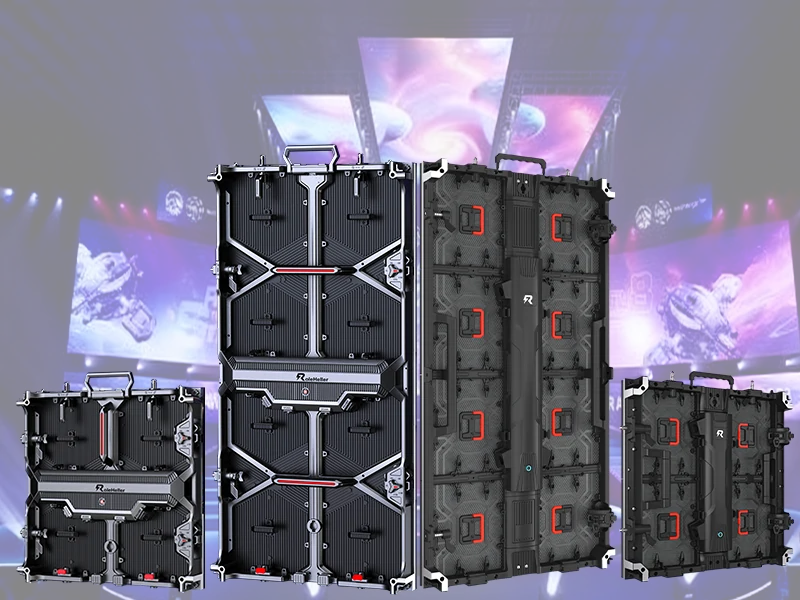
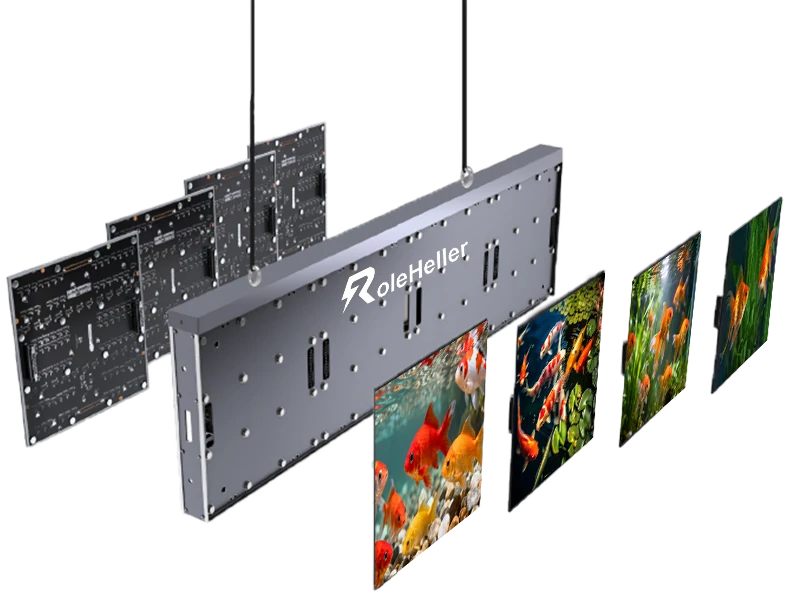
Chassis Metallurgy & Weight: A true rental party cabinet relies on high-precision die-cast aluminum or magnesium alloy chassis. The weight must stay between 6.5 kg and 7.8 kg for a standard 500 mm by 500 mm panel, or around 12 kg to 14 kg for a 500 mm by 1000 mm panel. If a cabinet weighs more than that, your rigging points will max out early, and your crew's backs will be broken before the truss even flies.
Fast-Locking Latches: Top-tier manufacturers install single-action, hardened steel quick-locks with audible click detents. You slide panel B against panel A, pull one ergonomic lever, and internal cam-gears lock the frames together with sub-millimeter precision. Budget workshops skimp here by using soft zinc alloy castings; after fifteen gigs, the teeth wear down, leaving glaring black seams between panels that ruin high-resolution visuals.
Precision Curve-Locks: Modern party stages rarely stay completely flat. Designers want concave backdrops wrapping around DJ booths or convex columns hugging dance floor pillars. Professional rental panels feature angle-adjusting disc locks built directly into the side frames, allowing smooth angle variations from -10 degrees concave to +10 degrees convex in precise 2.5-degree steps.
When reviewing specification sheets from wholesale party led display manufacturers, you must look past the sales brochures and inspect the silicon:
Standard Surface Mount Device (SMD 1921 or SMD 2121) packages are fine for fixed indoor screens, but for party rentals, GOB (Glue-On-Board) technology is rapidly becoming the commercial standard. In GOB production, after the diodes are soldered to the PCB, an automated machine injects a transparent, optical-grade epoxy shield across the entire module face. This creates a rock-solid, IP65 waterproof front face that resists beer spills, direct finger impacts, high-velocity confetti cannons, and rough transit bumps. Cleaning a GOB screen after a wild party requires nothing more than a damp microfiber cloth, whereas wiping a bare SMD screen can easily snap delicate solder joints.
Party venues are packed with people filming on smartphones for Instagram and TikTok. If your screen runs on cheap dual-latch driver ICs at 1,920 Hz refresh rate, every smartphone video taken near the stage will show rolling black scan bars and flickering bands. That is an immediate red flag for party promoters. You must specify constant-current driver ICs with PWM control, such as the Macroblock MBI5153 or Chipone ICN2053, running at 3,840 Hz minimum, and preferably 7,680 Hz for high-end stages. High refresh rates ensure silky-smooth camera capture, zero shutter banding, and rich 16-bit low-brightness grayscale so ambient lounge visuals do not posterize into blocky color bands.
Party screens undergo rapid load fluctuations—from pitch black to blinding white flash cues in a fraction of a second. Budget power supplies lack adequate transient load headroom, causing DC voltage dips that flicker the display or trip venue breakers. Demand high-efficiency power supplies with active Power Factor Correction (PFC > 0.95), such as Mean Well or Megmeet slimline units. For mission-critical party events, request dual-power and dual-data loop backup. If one data cable gets kicked loose backstage, the receiving card automatically pulls the video feed from the return loop without dropping a single frame.
Pixel pitch determines the balance between visual sharpness and capital expenditure. In party environments, viewers stand anywhere from three feet away at a dance floor edge to sixty feet away in lounge VIP booths.
Pixel Pitch P1.95 mm: Ideal for luxury corporate banquets, indoor VIP club backdrops, and interactive photo-wall zones. Delivers ultra-crisp text and 4K capability in modest screen sizes, but requires GOB protection because fine diodes are extremely fragile during frequent handling.
Pixel Pitch P2.6 mm: The undisputed industry workhorse for indoor rental and party production. It strikes the perfect balance between razor-sharp visual resolution at ten feet, high durability, manageable processing loads, and competitive wholesale pricing.
Pixel Pitch P2.9 mm to P3.9 mm: The go-to choice for large mobile festival stages, outdoor lawn parties, and expansive DJ backdrops where viewers are positioned at least twelve to twenty feet away. Offers exceptionally high brightness (up to 4,500 to 5,500 nits in outdoor configurations) and robust physical stability.
To help you navigate incoming quotations from different factories, the comparison table below outlines the structural and technical differences you will encounter across the wholesale landscape:
| Engineering Specification | Low-Cost Budget Workshop | Mid-Tier Standard Factory | Tier-1 Rental Manufacturer |
|---|---|---|---|
| Wholesale Price (P2.6 Rental) | $380 – $520 per m² | $650 – $850 per m² | $1,050 – $1,600+ per m² |
| Cabinet Frame Material | Rough Die-Cast Aluminum | Precision Die-Cast Aluminum | CNC-Milled Magnesium Alloy |
| Cabinet Weight (500x500mm) | 8.5 kg – 9.2 kg (Heavy) | 7.2 kg – 7.8 kg | 6.2 kg – 6.8 kg (Ultra-Light) |
| Module Surface Shielding | Bare SMD, no edge protection | Standard SMD with corner flaps | Full GOB optical shield + corner locks |
| Driver IC & Refresh Rate | Basic dual-latch, 1,920 Hz | Chipone ICN2053, 3,840 Hz | Macroblock MBI5252, 7,680 Hz |
| Curve-Lock Capabilities | Fixed flat only (0 degrees) | Basic pin adjustments (-5 to +5°) | Precision rotary disc (-10 to +10°) |
| Power Distribution | Unbranded 5V, manual wiring | Chuanglian/Megmeet standard | Mean Well UHP fanless with Active PFC |
| Data/Power Connectors | Cheap plastic twist-locks | Standard aviation connectors | Neutrik PowerCON & EtherCON True1 |
| Spare Parts Provision | 1% loose modules, mixed bins | 3% spare parts, matched lot | 5% single-bin spares + full tool kit |
| Field Maintenance Speed | Rear-service only (10+ min/tile) | Front & rear magnetic (3 min) | True 10-second quick-swap modules |
When calculating your wholesale procurement budget, do not make the mistake of looking only at the cabinet price. A video wall cannot fly without hardware, and cheap ancillary accessories will destroy your field operational efficiency.
Electrical Cabling: Party stages are dynamic, fluid environments. Stage crews trip over cables, and equipment gets dragged across floors. If your wholesale manufacturer supplies brittle PVC-jacketed power links with cheap plastic twist connectors, the locking tabs will snap off during the second teardown, leaving loose electrical pins exposed to live voltage. Demand heavy-duty rubber-sheathed cables with authentic Neutrik PowerCON True1 or IP65-rated Seetronic connectors. These can be plugged and unplugged thousands of times under load without arcing or cracking.
Rigging Hardware: Hanging bars (fly bars) must be constructed from certified high-tensile 6061-T6 aluminum extrusion with load-tested lifting eye-bolts. Never purchase generic steel hanging bars that lack stamped Working Load Limit (WLL) ratings; if a municipal safety officer or venue manager asks for your rigging structural engineering certificate and you cannot produce one, the screen will not be allowed to fly.
Flight Cases: Many overseas suppliers try to cut shipping weight by packing panels into thin 7 mm plywood cases lined with soft foam. After three interstate trips in a cargo truck, the internal wood dividers splinter, and the foam collapses, allowing cabinets to grind against each other in transit. Insist on professional 9 mm to 12 mm road-ready flight cases fitted with heavy-duty Penn Elcom hardware, recessed spring handles, deep caster wheel dishes on top for secure stacking, and high-density CNC-cut EVA foam cradles. An 8-in-1 flight case must feature heavy-duty 4-inch blue polyurethane swivel casters with dual brakes capable of handling 400 kg gross weights smoothly across cobblestones and ramp thresholds.
The physical LED wall is only half the system; the brains live in the video processor. When sourcing from wholesale party led display manufacturers, your choice of receiving cards and master controllers dictates system reliability:
NovaStar (utilizing receiving cards like the A5s Plus or A8s, paired with VX-series all-in-one processors or NovaPro UHD controllers) represents roughly 85% of the worldwide rental market. It is highly cost-effective, extremely versatile, and familiar to almost every freelance video technician on the planet. For party rentals, wedding production, and mobile staging, a NovaStar setup provides rock-solid performance, simple cloud backup, and straightforward chroma calibration at an accessible price point.
Brompton (utilizing Tessera R2 or R2+ receiving cards paired with Tessera SX40 or S8 processors) is the undisputed gold standard for enterprise concert touring, high-end broadcast, and virtual production. It offers unmatched low-brightness color accuracy, frame-rate multiplication, and sub-pixel edge smoothing. However, Brompton processing carries a significant price premium—often adding $15,000 to $30,000 to a medium-sized video wall system. For standard party and club environments, Brompton is usually an over-investment unless you are building an inventory to cross-rent to major television productions and global concert tours.
Wiring a thirty percent deposit is easy; getting high-grade hardware loaded into a shipping container requires strict quality enforcement. Never rely on glossy sales pictures or verbal assurances from factory sales representatives. Follow this step-by-step auditing protocol before authorizing the remaining balance:
Before paying your initial deposit, ensure your commercial proforma invoice lists exact, non-substitutable brand names and component model numbers. Vague phrases such as "Nationstar or equivalent" are completely unacceptable. Specify:
LED Diode: Nationstar 2121 Black Shell, Gold Wire bonding, Single Bin.
Driver IC: Macroblock MBI5153 with integrated PWM, 3,840 Hz refresh.
Power Supply: Mean Well UHP-350-5 with active PFC > 0.95.
Receiving Card: NovaStar A5s Plus (genuine, with factory serial tracking).
Surface Shielding: Optical GOB coating with matte anti-glare finish.
Electronics follow the classic bathtub failure curve: if a driver chip, diode solder joint, or electrolytic capacitor has a microscopic manufacturing flaw, it will fail within the first forty-eight hours of electrical stress. Require the factory to assemble your complete screen order onto aging racks and run an uninterrupted 72-hour test cycle:
24 hours of 100% full-raster white screen to max out the power rails and stress thermal dissipation.
24 hours of cycling red, green, and blue screens to identify dead sub-pixels, color drift, and dim diodes.
24 hours of high-frame-rate dynamic video content with strobe cues to test processor stability.
Demand an unedited, continuous video walkthrough showing your specific order running this test, clearly displaying your company name and order serial number on a physical whiteboard in front of the active screen.
During the 24-hour full-white burn-in phase, request a thermal camera scan of the cabinet backs. An adequately engineered rental panel will show uniform heat distribution across the chassis, with no single driver IC or power terminal exceeding 65°C in a 25°C ambient room. If the thermal scan shows localized hot spots spiking past 80°C, the PCB copper planes are too thin, and modules will overheat during prolonged summer shows.
Require the factory to assemble a 4-meter by 3-meter test wall from your batch using random panels pulled from different crates. Check the seam tolerances between cabinets: they must not exceed ±0.1 mm. The video image must look like a seamless, continuous canvas without dark lines or bright borders. Test the quick-release magnetic modules: using a front-service vacuum extraction tool, a single technician must be able to remove and replace any individual module in under fifteen seconds.
In the commercial rental industry, the direct answer is: proceed with extreme caution. Even when buying from the same factory, LED semiconductor wafers vary from batch to batch in forward voltage, dominant wavelength, and lumen output. If you buy fifty panels in January and order another fifty in August, connecting them together without high-end chroma calibration will make your screen look like a mismatched checkerboard. If you plan to expand later, negotiate with the manufacturer to reserve diodes from the exact same wafer lot, or ensure you use advanced calibration systems (such as NovaStar A8s or Brompton Tessera) that can measure and map new panels to match your existing inventory's color profile.
If you are doing outdoor garden weddings, rooftop pool parties, or open-air festivals, standard indoor rental panels cannot be used—even under a canopy tent. Humidity and windblown spray will penetrate the rear ventilation holes and short out live 5V electrical rails. For outdoor events, you must buy true outdoor rental panels rated at IP65 front and IP54 or IP65 rear. These feature fully potted waterproof modules, sealed aluminum rear power boxes, and waterproof Seetronic or Neutrik connectors. Furthermore, outdoor party screens must produce at least 4,500 to 5,500 nits of calibrated output to remain punchy under midday sunlight, whereas indoor screens operate at 800 to 1,200 nits.
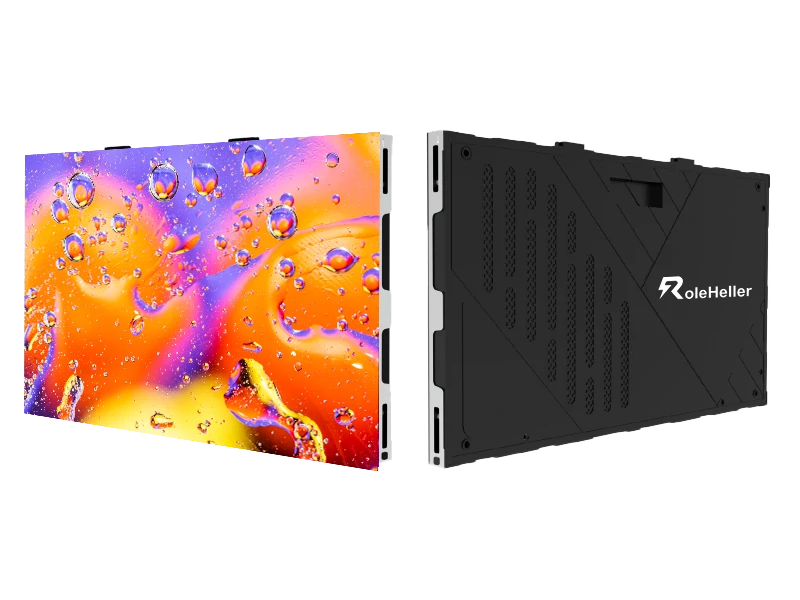
Rear-service panels require you to open a rear door or unlatch modules from behind the display. This is fine if your screen is flown in the middle of a stage with open catwalk access. But in party venues, screens are frequently pushed flush against ballroom walls, recessed into tight decorative alcoves, or integrated into custom wooden DJ booths. In those situations, rear access is impossible. Fully front-service rental panels allow a technician to pop a faulty module or swap a dead power supply directly from the front face using a magnetic tool in seconds, without dismantling the entire truss structure. For maximum operational flexibility, always specify dual-service (front and rear) cabinets.
Having spent years troubleshooting commercial stage hardware, managing tight event turnarounds, and watching rental operators burn through their hard-earned cash, here is my direct advice: never buy from a trading company that operates out of a generic commercial office without a real assembly floor. Trading companies will promise you the world, mark up prices by twenty percent, and vanish the moment you need component-level technical support or custom calibration files. Work directly with dedicated, mid-to-large-scale fabrication plants located in established manufacturing hubs like Shenzhen's Bao'an district or Huizhou.
When negotiating payment terms, stick strictly to the international trade standard: 30% deposit to initiate component procurement and SMT assembly, and the remaining 70% balance paid only after third-party factory inspection and video burn-in verification. If a vendor demands a 50% deposit upfront or pushes for 100% payment before you have seen verified footage of your completed screens running on the test floor, walk away immediately.
Always allocate capital for spare parts. I cannot emphasize this enough: insist on a minimum 5% spare module allotment, two spare power supplies per ten cabinets, four spare receiving cards, extra ribbon cables, and fifty spare fast-lock latch pins, all packed inside your initial shipment. Two years from now, when a guest kicks a lower tile or a stagehand drops a flight case down a concrete flight of stairs, having batch-matched spare modules with identical color binning in your warehouse is what keeps your business operating smoothly and profitably.