 English
You are looking at outdoor transparent led display manufacturers because someone showed you a photo of a glass façade with a video floating on it and said "we want that," which is how a lot of bad procurement decisions start. You open a dozen tabs and every single one promises high transparency, high brightness, factory direct price, OEM welcome, and at least three of them are using the same render of a shopping mall atrium that does not exist. Nobody tells you upfront that transparent LED is not one product, it is three different products wearing the same name, and picking the wrong one means you end up with a screen that either blocks the view, cooks the people standing behind the glass, or blows off the building when the first typhoon warning goes up. We have all been there, staring at a mock-up that looked perfect until someone opened the shop behind it.
The short answer before anything else: transparent outdoor LED makes sense when you have existing glass you cannot cover up and you still need advertising surface, or when the landlord will not allow a solid sign. Buying direct from a Chinese maker usually saves money if you are doing more than one or two installations, or if you are an integrator reselling to others. The saving only survives if you lock down transparency rate, brightness, cabinet structure and wind load before you ask for a quote, and if you treat the first job as a trial rather than a commitment. Below is how I would do it, which I have done enough times to have opinions about.
There are broadly three ways this gets done and they behave completely differently in the field.
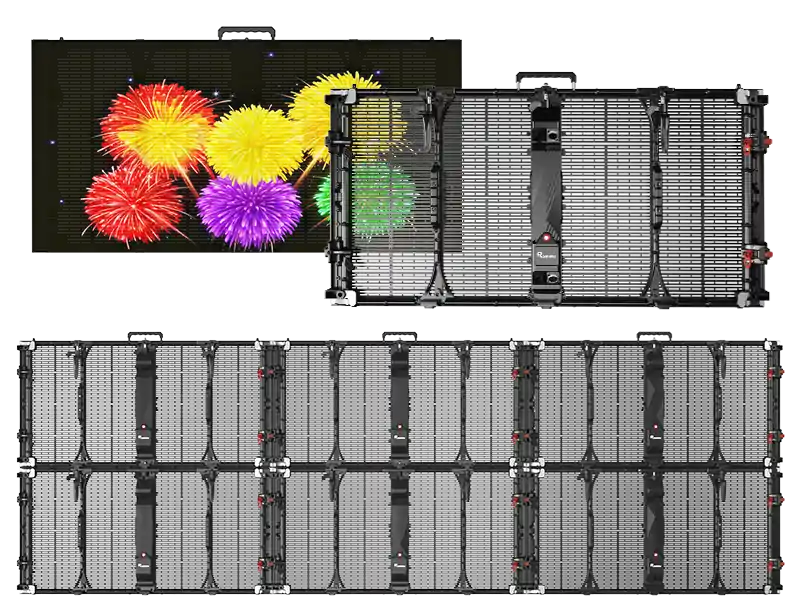
Strip or bar type. Thin aluminium bars with LEDs mounted on them, spaced apart so you see through the gaps. This is the most common outdoor form. It is relatively light, it handles wind reasonably well because air passes through, and it can be hung in front of glass or mounted on a frame. Transparency typically lands between 50% and 70% depending on pitch and bar spacing. This is what most people mean when they say outdoor transparent LED.
Glass panel or laminated type. The LEDs are embedded inside or printed onto actual glass panels that replace or sit over the building glazing. Looks cleaner, higher perceived quality, better for retail where people are close to it. Much heavier, much more expensive, and you are now dealing with structural glazing rules as well as signage rules. Usually not something you retrofit casually.
Mesh or grille type. A metal mesh with modules clipped in. Very good wind permeability, used on very large façades and stadia where the screen is huge and the viewing distance is long. Transparency can be high but resolution is low. Not a retail product.
If you ask for "outdoor transparent LED" without saying which type, you will get four incompatible quotes and nobody will explain why they differ until after the deposit clears. That is the pattern. It repeats.
This is the actual decision. The more open area you have between the LEDs, the more transparent the screen is, and the fewer LEDs you have per square metre, which means lower brightness and lower resolution. You cannot win both. Manufacturers will happily quote you 70% transparency and 7,000 nits in the same sentence and those two numbers do not belong together.
| Type | Typical transparency | Realistic brightness | Best use |
|---|---|---|---|
| Strip/bar P7.8–P10 | 50–70% | 4,500–6,000 nits | Retail façades, mall fronts |
| Strip/bar P15–P25 | 70–85% | 5,000–7,000 nits | Large façades, long viewing |
| Glass/laminated | 30–60% | 4,000–5,500 nits | Premium retail, showrooms |
| Mesh/grille P25+ | 60–90% | 5,000–7,000 nits | Big buildings, stadia |
A useful rule I apply: decide what matters more, the view through the glass or the legibility of the content in full sun. If the tenant behind the glass needs daylight, you sacrifice brightness. If the ad must read at noon, you sacrifice transparency. There is no clever workaround. Anyone who tells you otherwise is selling.
Also worth noting: transparency percentage is measured differently by different factories. Some measure open area of the panel, some measure light transmission with the screen turned off, some measure with it on. Ask how the number was derived. If they cannot tell you, the number is decorative.
Outdoors you want roughly 5,000 to 6,500 nits for full sun, and you absolutely need automatic brightness control with a light sensor. Without auto dimming the thing becomes a glowing nuisance after dark and the tenants below will complain. Complaints arrive faster than invoices.
But here is the part specific to transparent screens: they are often mounted directly in front of glass, which means whatever heat they generate gets trapped against the glazing. A transparent LED wall running at full brightness all day will raise the temperature behind it noticeably. In Hong Kong that is not a minor issue, it is the difference between a comfortable shop and a shop where the air conditioning runs flat out and the staff hate their lives. Ask about the stand-off distance between the screen and the glass, and whether the design allows air to circulate. A gap of even a few hundred millimetres helps a lot. No gap is a problem.
Also ask for average and peak power per square metre and size your circuits for peak. A transparent wall can pull significantly more at white peak than its average figure suggests, and the sparky on site does not care what the brochure said. When you are hanging this on an existing building, available amperage is often the hardest constraint in the whole project. Harder than budget.
Solid outdoor screens catch wind like sails. Transparent ones catch less wind, which is why people choose them for large façades, but "less" is not "none" and the frame still has to transfer everything into the building.
You need the supplier to give you a wind load calculation for your specific site, not a generic number lifted from a datasheet. Give them the height, the exposure, the local code. For Hong Kong that means designing for typhoon conditions and having a written procedure for what happens when a signal goes up — do you derig, do you shut down, who decides, and how long it takes. If the answer is "it will be fine," walk away. Screens come off buildings. It happens regularly enough that insurers ask about it.
Also check the fixing method. Clamping to a mullion, bolting into a slab edge, hanging from a beam — each one changes the hardware, the cost, and whether the landlord will sign off. And speaking of which, get the landlord or building management involved before you order anything. A transparent screen looks like it should be easy to approve because it does not block the glass. That impression is wrong. You are still attaching hardware to someone else's structure and you are still putting a lit surface on their façade. Finding this out after the crates arrive is an expensive conversation.
For transparent strip-type screens the common pitches are P7.8, P10, P15, P16, P20, P25. The old rule of thumb — pitch times 1,000 equals millimetres of minimum viewing distance — still works fine here.
| Pitch | Min. viewing | Works for |
|---|---|---|
| P7.8 | 8–15 m | Retail frontages, close pedestrian areas |
| P10 | 10–20 m | Mall atria, street-level façades |
| P15–P16 | 15–30 m | Mid-rise façades, wider streets |
| P20–P25 | 20–40 m | Large buildings, highways, stadia |
If your audience is mostly pedestrians walking past at arm's length, P7.8 is about as fine as you want to go on a transparent bar type, and even then expect to see the individual bars up close. That is the nature of it. If you need crisp imagery at two metres you do not want transparent, you want a solid screen somewhere else. Honest advice: do not try to force transparent LED to do a job it is not built for. It will disappoint you and the client both.
One thing buyers routinely forget: design the content for the canvas you actually have. Transparent screens have gaps. Fine detail and small text dissolve. Bold shapes, strong contrast, slow movement — that is what reads. Budget for content designed specifically for this medium, because lazy graphics on a transparent wall look worse than mediocre graphics on a solid one.
Three kinds of company, all calling themselves factories.
The actual manufacturer. Runs SMT lines, owns the extrusion or cabinet tooling, has an aging area where panels burn in before packing, and can adjust bar spacing, finish or connector position if your volume justifies it. They want repeat business. Their lead times are genuine and they do not chase single-quote shoppers.
The assembler. Buys the LED bars, power supplies and cards from upstream, builds frames, configures and ships. Nothing dishonest by default. Decent transparent product comes out of these shops and they are often more flexible on odd canvas sizes, which matters a lot in this category because nearly every façade is a different size. But their margin sits on top of someone else's margin, and when a batch starts failing fourteen months later they are calling the same supplier you could have called yourself.
The trader with borrowed photos. Polished site, replies inside the hour, quotes fast and low. Ask something specific — say whether the transparency figure is measured open area or light transmission, and what the rear IP rating is — and the reply arrives a day later phrased slightly differently from your question.
A filter I use that takes thirty seconds: ask what pitches they keep in standard stock for transparent outdoor, and whether their panels are front-service or rear-service. Then ask how many square metres of transparent screen they shipped last quarter. A real operation answers the first part instantly and gives a number on the second that sounds boring rather than impressive. Someone who must confirm with the engineer on basic mechanicals is probably not standing next to the line.
Even good factories buy most inputs in.
LED packages come from a handful of large suppliers. This drives colour consistency and long-term decay. Ask which brand and whether they lock the bin for your run. Bin matching matters more than the brand name.
Driver ICs sourced separately — controls refresh rate and gray scale.
Power supplies are third-party. Cheap supplies are the single most common cause of mid-life failure outdoors, and the easiest place to save twelve dollars.
Receiving cards and processors — Novastar, Colorlight, Linsn. Bought in, sometimes rebranded.
Extrusions and frames — this is usually where the factory's own tooling actually lives. Flatness, weight, corrosion treatment. The part that physically lives in the weather, and it ages faster than the electronics.
So the useful question is not "are you the factory." It is which steps happen under their roof, which are subcontracted, and who signs off on final inspection. A supplier who answers plainly is worth a longer conversation. One who dodges is telling you something too.
Keep it short. Ten minutes to write, tells you more than any brochure.
Which type: strip/bar, glass panel, or mesh. Do not let them be vague here.
Transparency percentage and exactly how it was measured.
Brightness measured value, plus automatic brightness control and sensor included.
IP rating front and rear separately. Outdoor transparent still needs IP65 on the face.
Conformal coating and corrosion-treated hardware for coastal sites.
Refresh rate — if anyone films this, 3,840 Hz or higher.
Average and peak power per square metre.
Panel weight, frame weight, and the fixing drawing showing where the load lands.
Stand-off distance from the glass and ventilation arrangement.
Wind load calculation for your specific site and height.
Service access — front or rear, and how a single bar is replaced at height.
Dead pixel acceptance standard and what triggers a replacement.
Warranty text, not the headline number.
Line-item pricing including spares and rigging.
Numbers do not lie the way adjectives do. "High transparency, high brightness" means nothing. "62% open area measured, 5,500 nits, auto dimming included" means something you can hold someone to.
Per-square-metre pricing for transparent outdoor moves with pitch, transparency level and whether the LED package is a known brand. The jump from P16 to P7.8 is not linear, it feels more like a cliff, because you are adding a lot of bars and a lot of power.
On top of the panel cost you must count: processor and sending cards, custom framing, rigging hardware, spare parts kit, freight, duties, installation labour, access equipment or scaffolding, and content setup. A quote that comes in well under the others has almost always left out one of three things: the processor, the structure, or the spares. Sometimes all three. Ask for a line-item breakdown and compare line by line, not total by total. Boring work, saves real money.
Payment terms matter as much as price. Thirty percent deposit with balance against a copy of the bill of lading is standard for new relationships. Anything demanding full payment upfront on a first order is a signal regardless of how professional the website looks. Insist on a pre-shipment inspection window — even a live video call showing your serial-numbered panels running your own test content. Factories with nothing to hide do not object.
Lead times: standard transparent configurations typically run four to eight weeks plus shipping. Custom sizes push that out, and nearly every transparent job is a custom size because nobody's façade matches anyone else's. Order near a major Chinese holiday period and add time.
MOQ varies. Standard pitches sometimes go as low as a single installation; custom pitches or custom bar spacings push MOQ up. Be honest about your volume and your twelve-month forecast upfront, because the price break at higher volumes is usually meaningful and nobody volunteers it.
Remote buying is normal here. So is getting it wrong.
Ask for a live video call, not a recorded video. Ask them to walk to the aging area and show a running wall with today's date visible somewhere in frame. Recorded videos get recycled between companies. A live call does not. If they cannot manage a live call during their working hours, treat that as information rather than an inconvenience.
Order a sample panel or a short section of bar. Yes it costs money and shipping is awkward. But holding it tells you about weight, extrusion quality, latch feel, and how the bars align in a way no PDF can. Put two samples side by side from two suppliers and the difference becomes obvious inside thirty seconds. You feel it in the joint before you see it on the screen.
Run a burn-in. Power it continuously for a couple of days. Watch for brightness drop, colour shift, and any bar that starts to fade. This catches problems a ten-minute bench test never will.
Check references that are not on their website. Anyone can list three happy clients. Ask for a customer who installed eighteen months ago and is still running the screen outdoors. Then ask what has broken. The answer to "what has broken" is far more useful than the answer to "are you happy."
Start small if you can. One elevation, then scale. Suppliers who survive contact with real weather, real landlords and real tired crews are the ones worth a relationship with.
Q: Is transparent LED really worth it over a solid screen?
A: Only if you have a genuine constraint — existing glass you cannot cover, a landlord who refuses a solid sign, or a design requirement to keep daylight behind the screen. If you have no such constraint, a solid outdoor screen gives you more brightness, more resolution and lower cost. Transparent is a solution to a specific problem, not an upgrade.
Q: Can it really be seen through?
A: Yes, but manage expectations. From a distance the image holds and the glass reads as glass. Up close you see the bars. That is the tradeoff you paid for. Show the client a real installed example at close range before they sign, because this is the number one source of post-install disappointment.
Q: What brightness do I actually need?
A: Full sun, 5,000–6,500 nits with auto dimming and sensor. Shaded or night-dominant locations, 3,000–5,000 is plenty. More than that buys you heat and shorter life, not a better picture.
Q: Will it kill the air conditioning bill?
A: It can, if it is mounted tight against the glass with no airflow. Insist on a stand-off gap and ventilation. This is worth arguing about early.
Q: What about rain and humidity?
A: IP65 front is the baseline, confirm the rear separately, and add conformal coating plus corrosion-treated hardware for coastal sites. Humidity and salt air are the quiet killers here. And store spares somewhere dry.
Q: Realistic lead time?
A: Four to eight weeks plus shipping for standard configurations. Custom sizes take longer, and most transparent jobs are custom.
Q: How do I know if a supplier is a real manufacturer?
A: Request a live video call showing the production floor and aging area with today's date visible, ask technical questions requiring immediate answers, order a sample, run a burn-in, and speak to an existing customer.
Q: Do I need permission?
A: Often yes. Lit façades are frequently classified as signage, subject to permits, brightness limits and curfews. Plus landlord or building management approval for anything attached to the structure. Check both before ordering.
Q: Should I just pick the cheapest quote?
A: Rarely. The price spread between competent suppliers is often smaller than the cost of dealing with a bad batch or a failed power supply at height. What you are really paying for is sealing discipline, bin control, and someone who picks up the phone eighteen months later.
Q: What about maintenance at height?
A: Think about this before you choose front-service or rear-service. If the screen is hung over a public footpath, rear service may require scaffolding every time a bar fails. Front-service costs more upfront and saves money over the life of the install. Almost nobody calculates this properly.
Choosing transparency percentage without deciding whether brightness or the view matters more.
Ignoring wind load and fixing method until the drawing stage.
Mounting the screen flush against the glass with no ventilation.
Assuming the content can be reused from a solid screen campaign. It cannot.
Skipping the sample stage to save a week.
Forgetting auto dimming and getting noise complaints after dark.
Not planning spare parts. Bars, power supplies and cables fail, and you do not want to wait six weeks for a replacement while the wall sits half-lit.
Booking the hardware but not the person who knows how to fix it at height.
Leaving the landlord conversation until after the order is placed.
The best outcome rarely comes from finding the absolute cheapest manufacturer. It comes from finding the one who answers at inconvenient times, who ships a replacement bar without arguing, and whose fixing drawings arrive with the load numbers already worked out. These screens live outside on someone else's building. They get rained on, baked in sun, hit by salt air, argued about by tenants, and looked at by thousands of people who expect the whole thing to just work. You are not buying a product, you are buying a long-term arrangement with a company that needs to still exist three years from now.
I lean toward starting with a modest elevation, running it for a season, and then deciding. Costs a bit more upfront, prevents a lot of expensive disappointment. And if the job is big enough, go see the factory once. Not to audit the SMT line personally, but because the conversation you have standing next to a running wall is qualitatively different from the one over email. People behave differently when they know you have seen where the thing comes from.
One more thing: spend properly on the content. Transparent LED rewards bold, simple, high-contrast material and punishes anything fussy. In daylight, with people walking past at speed, a single strong shape beats a busy layout every time. Budget for that the way you budget for the hardware, because the hardware is only as good as what you put on it.
1. What is an outdoor transparent LED display?
An LED screen designed to be see-through, typically using spaced LED bars or mesh so light and vision pass through the gaps. Used on glass façades, retail fronts, mall atria and large buildings where a solid screen would block the view.
2. How transparent is it really?
Typically 50% to 85% depending on type and pitch. Ask how the figure was measured — open area of the panel or light transmission — because factories calculate it differently.
3. What pixel pitch should I choose?
Match pitch to viewing distance. P7.8–P10 for audiences within 8–20 metres, P15–P16 for 15–30 metres, P20–P25 for large buildings and long viewing distances beyond 30 metres.
4. How bright does it need to be?
Full sunlight requires 5,000–6,500 nits with automatic brightness control and a light sensor. Shaded or night-dominant locations need 3,000–5,000 nits.
5. What IP rating is required?
IP65 on the front face is the common baseline. Confirm the rear rating separately, and request conformal coating plus corrosion-treated hardware for coastal or high-humidity sites.
6. What is the difference between strip, glass panel and mesh types?
Strip or bar type uses spaced LED bars on a frame, the most common outdoor form. Glass panel type embeds LEDs in glazing, heavier and costlier. Mesh or grille type uses a metal mesh, best for very large façades with long viewing distances.
7. Does it affect the building's air conditioning?
It can if mounted flush against the glass. Insist on a stand-off gap and ventilation to let heat escape, otherwise the space behind the screen will run noticeably hotter.
8. What should be included in the quote?
Panels, processor and sending cards, custom framing and rigging hardware, spare parts kit, plus a line-item breakdown. Freight, duty, installation and access equipment are usually separate.
9. Are spare parts necessary?
Yes. Order extra bars or modules from the original production batch along with power supplies, receiving cards and cables. Mixing batches later risks visible colour mismatch.
10. Do I need permission to install one?
Often yes. Lit façades are frequently classified as signage subject to permits, brightness limits and curfews, and you will also need landlord or building management approval for anything fixed to the structure. Check both before ordering.
.jpg "Where to Find Reliable Wholesale Conference LED Video Wall Manufacturers in China?")