 English
You searched best led display manufacturers in china because someone needs a screen, you have a budget, and every list you find looks like it was written by someone who never had to stand under a sign at six in the morning watching row seven go dark. That is fair. The truth is there is no single answer to "who is best," and anyone giving you a ranked top ten is selling something. What exists instead is a way to find the right maker for your specific job.
The short version: stop looking for a leaderboard and start by writing down exactly what the display has to do. Fixed outdoor or rental? Viewed from how far? Does it need EN 12966 photometry or NEMA compliance? Single-sided or double? Once you have those numbers, send the same one-page spec to five suppliers and compare fully commissioned prices instead of unit prices per square metre.
Search results for best led display manufacturers in china tend to be the same twenty names shuffled into different orders, often with dates in the title suggesting nobody has touched the page since some trade show. Most are built around criteria like "brand reputation," "product range," and "service quality," which mean precisely nothing until pinned down.
The deeper problem: these lists treat LED displays as one product. They are not. The factory shipping a thousand square metres of P10 highway boards a month may be completely lost when asked for a double-sided P4 building-face sign with curved cabinets. The company whose P3 looks stunning in a showroom may have no idea how to document wind load for a gantry in a typhoon zone.
So no ranked list here. What follows is a method for building your own shortlist that survives contact with reality.
Fixed outdoor roadside and advertising boards. Highway and arterial road signs, static or variable message, typically P6 to P16. Viewed from distance at speed. Priorities: certified photometry, sun visor design, auto-dimming that works, IP rating covering doors and cable entries, thermal design that does not cook the power supplies in summer.
Building-face and rooftop commercial screens. Often larger, often double-sided, often subject to stricter glare and structural rules. Cabinet flatness across a big surface, weight, wind load calculation, and maintenance access dominate here.
Unipole and monopole signs. Single pole, high up. The steel usually costs more than the display. Wind load and foundation dominate. You need a supplier who understands that the display and the structure are one system.
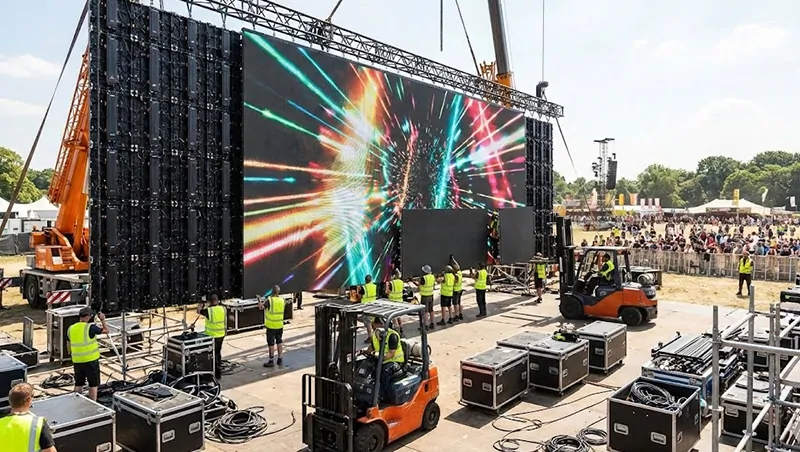
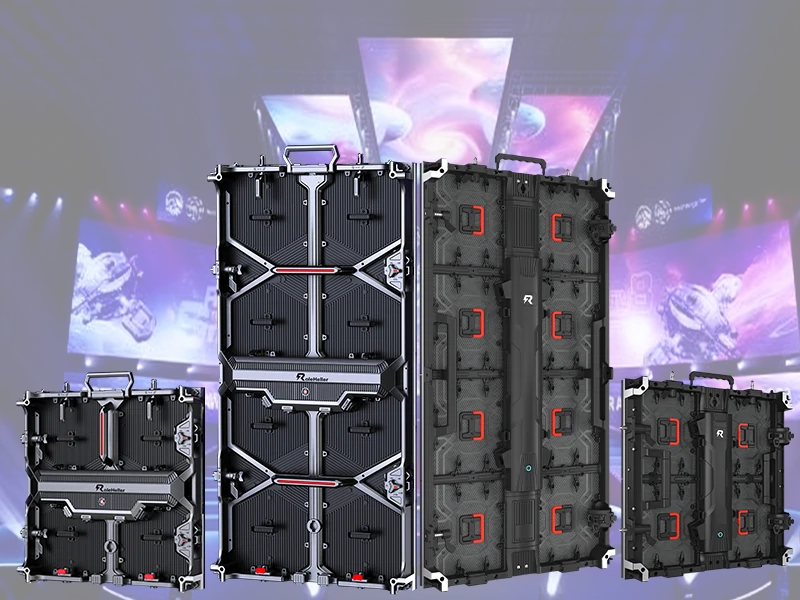
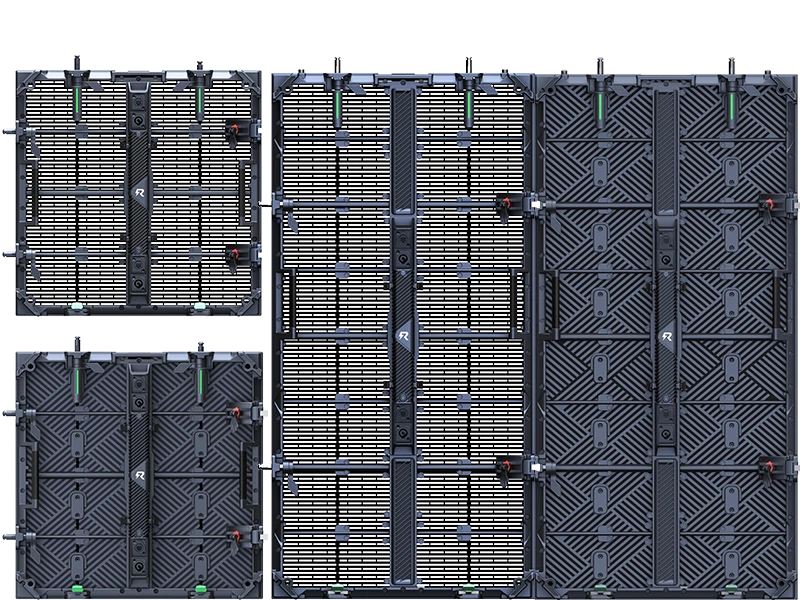
Rental and staging panels. Flown or ground-stacked, assembled for a day, struck, shipped somewhere else. Now weight per cabinet, lock durability, flight case design, and swap speed become the real spec.
Indoor fine-pitch and control-room walls. P1.2 to P2.5, where uniformity, grey scale, colour calibration, and low heat matter more than weatherproofing. Entirely different supply chain again.
Mobile and trailer-mounted boards. Events, construction sites, temporary campaigns. Generator or solar-hybrid power, tow legality, case design, and how fast one person can get it running.
Some suppliers genuinely cover two of these well. Almost none cover all four or five well. If a company tells you they are equally strong across everything, ask for references in each lane and time how long it takes them to reply.
| Parameter | What you usually see quoted | What I push for |
|---|---|---|
| Pixel pitch | P4 / P6 / P8 / P10 / P16 | Set by approach speed and reading distance, not ambition |
| Photometric class | "Class L3/B3" claimed | Third-party test report with report number |
| Brightness | 7,000–8,000 nits | Enough for worst daylight, plus clean auto-dimming curve |
| Uniformity | Rarely stated | Documented; uneven boards look cheap even when bright |
| LED brand and bin | "High brightness SMD" | Named brand and bin grade, recorded on delivery note |
| Driver IC | Unspecified | Named series, constant current, with fault detection |
| Power supply | Generic switching PSU | Branded, wide temperature range, derated, surge protected |
| Cabinet material | "Aluminium" | Alloy and thickness, or hot-dip galvanised steel, paint system specified |
| IP rating | IP65 claimed | Confirmed for whole assembled sign including doors and entries |
| Operating temperature | −20 to +60 °C | Verified for your actual site |
| Wind load | "Typhoon resistant" | Calculated for your mounting height and local wind speed |
| Warranty | 2 years | Parts, freight, labour and response time spelled out |
One thing worth saying plainly: brightness is the most over-sold figure on the entire quotation. A higher peak brightness costs more, generates more heat, accelerates lumen depreciation, and creates a glare complaint that gets the board turned down within a month. What you actually need is enough luminance for the worst daylight condition, plus a dimming curve that keeps the sign readable and legal after dark. Ask for the dimming schedule in writing.
The optical system. Lens design, mask and visor geometry determine legibility far more than raw nits. Two P10 boards can differ noticeably in how clearly a message reads at two hundred metres while carrying identical pitch numbers.
The controller and software. Message library support, priority handling, pre-set messages, fault reporting, and the protocol your traffic or media platform speaks. If your authority requires an audit trail of who changed a message and when, a board without that capability is not compliant.
The management platform. Remote monitoring, scheduling, fault alarms, user permissions, audit logging. Ask whether the platform licence is perpetual or annual, because an annual fee buried in year two is how a good deal turns bad.
Structure and mounting. Pole, gantry, cantilever bracket, foundation bolts, access ladder or platform, lifting points. For a gantry-mounted board the steel and installation often cost more than the display itself.
Power and backup. Mains connection, local distribution, surge protection, whether UPS or solar hybrid is needed. Surge protection is cheap relative to what it saves.
Commissioning and acceptance testing. Photometric verification on site, alignment, brightness calibration, message library loading, handover documentation.
Spares. Modules, power supplies, controllers, fans and door seals from the same production batch. Highest-value line item on the order, first thing cut when a budget gets squeezed.
Compare fully commissioned numbers: sign, controller, platform, structure, power, spares, delivery, installation and acceptance written as one figure.
I stopped asking "are you a factory" years ago. It produces a rehearsed answer and nothing useful.
Integrated manufacturers. In-house cabinet fabrication, LED module assembly, controller development, own photometry lab. Right call when the project is large and publicly visible. Weakness: small enquiries move slowly and custom requests queue up.
Mid-size export specialists. Mostly around Shenzhen, Guangzhou, Dongguan. This is where most wholesale buyers end up. They know the category properly, pricing is workable, they pick up the phone. Quality can vary between batches, which is exactly why inspection matters.
Assembly houses. Buy modules and controllers upstream and put their name on the crate. Not automatically bad, but you need to know who fixes the thing when it breaks.
Trading companies. No production at all. Some are genuinely valuable. Just be clear about who holds the warranty, where spare parts physically sit, and whether they can produce original test reports rather than copies of copies.
A test I use regularly: ask for an unannounced video call during their working hours and request a walk to the production floor, specifically asking to see the current batch being assembled, the LED reel labels, and the ageing room where signs run before dispatch.
In Europe, EN 12966 governs vertical road traffic signs with variable messages — luminance, uniformity, chromaticity, contrast, viewing angles, class designations. Your tender will specify classes and the delivered sign must carry a test report from an accredited body matching those classes. In North America, compliance runs through NEMA TS-4 and relevant ITE standards, with colours and formats governed by MUTCD or local equivalents. Advertising-only billboards fall under different rules, often local authority type approval plus electrical safety marks.
Ask for the report number and the issuing body, then verify it independently. Do not accept a PDF with a logo and assume the job is done.
Check that the report covers the exact configuration you are buying — same cabinet, same optics, same LED package.
Confirm whether the certification covers the complete assembled sign including hood and door seals, or only the module.
Check the business licence and registered address, then look them up on a map. Factory addresses listed on websites sometimes turn out to be office tower floors.
Do the unannounced video walk-through. Ask to see the current batch, the LED reel labels, the controller boards and the ageing racks running.
Pay for a sample unit, not just a sample module. Run it at full brightness, check grey ramps for banding, cycle the brightness from maximum to minimum and check for steps or flicker in the dimming curve, and put it outside in direct sun to see whether the message remains legible.
Lock the bill of materials into the contract. LED brand and bin grade, driver IC model, PCB details, power supply brand, controller model and firmware version, cabinet alloy and thickness, seal type, hinge and latch spec, finish system. Remove "or equivalent."
Hire a third-party inspection during production and again before loading.
Get warranty terms in writing. Parts free or not, freight responsibility, labour responsibility, response time commitment, and whether local third-party servicing voids anything. Pay particular attention to whether the controller and power supplies are covered for the same period as the LEDs. They rarely are.
Letter height and stroke width matched to the approach speed and reading distance. Use the established formulas, do not guess.
Contrast ratio against the background, including the effect of sunlight falling on the face. This is why mask design and matte finishes matter more than an extra thousand nits.
Message length and dwell time. A driver travelling at a hundred kilometres an hour covers a lot of ground while reading. If the message needs two glances, design it so both glances happen before the decision point.
Glare for oncoming traffic and nearby residents. A sign that dazzles gets complaints, and complaints get signs turned down or covered.
Colour accuracy under different lighting conditions. Red and amber must be unambiguous at dawn and at dusk.
These are decisions to make before the order is placed, because changing them later means changing the optics, and changing the optics means a new photometric report.
Q: Should I buy full matrix or fixed legend?
A: Full matrix gives flexibility and future-proofs the installation but costs more. Fixed legend is cheaper, more robust and perfectly adequate if the message set is stable. If messages change with incidents and traffic conditions, go matrix.
Q: Is solar power viable for a billboard?
A: For small roadside units and temporary boards, yes, and it is common. For a full-size highway or building-face board, solar becomes a battery and panel sizing problem that rarely pays off unless grid connection is genuinely unavailable. Be careful with suppliers who promise solar without giving you a proper energy budget broken down by season.
Q: How long will the LEDs last?
A: Quoted figures run to fifty thousand hours and beyond. In real outdoor conditions with full-day operation, expect noticeable brightness drop after four to six years. The electronics will usually need attention before the LEDs themselves fail.
Q: Can the board integrate with our existing traffic or media system?
A: Usually yes, but only if the protocol is agreed before manufacture. NTCIP is the common international route; some authorities use proprietary or legacy protocols. Get the interface specification signed off by both your system integrator and the sign supplier before production starts.
Q: What happens if the controller fails?
A: The sign should default to a safe state — blank, or a defined fallback message — and it should raise a fault alarm remotely. Confirm the fail-safe behaviour in writing and test it during acceptance.
Q: Do I need a local integrator or can I buy direct?
A: For a one-off installation on a public road, a local integrator is usually worth the markup. For a repeat buyer with multiple sites and their own maintenance crew, buying direct is where the savings are genuine.
Q: How do I handle spare parts for a fleet of boards?
A: Order modules, power supplies, controllers, fans and door seals from the same production batch as the installed units, and keep them in a local store with a simple issue log. A replacement module from a different batch will sit there looking slightly wrong.
Q: How do I know if the price is fair?
A: Not from one quote. Send your own spec sheet to several suppliers — same pitch, same photometric class, same lamp grade, same inclusion of controller, structure, spares and commissioning — and the market reveals itself pretty quickly. The outlier low is not a bargain, it is a missing line item.
Confirm crate dimensions and weights before production finishes, not after. Check whether your access road and your crane can handle the largest piece.
Foundation and structure need sign-off before the sign ships. Get the authority or asset owner to approve the location, mounting height and fixing method early.
Confirm voltage and phase match the local supply, confirm the connector types, and have a qualified electrician handle the final connection and surge protection coordination.
Acceptance should be witnessed and recorded. Measure luminance and uniformity, check the dimming curve at several points, verify every message in the library, test the fault alarm by pulling a fuse, and record the baseline readings. Keep those baselines.
Decide whether modules will be replaced from the front or the rear, and make sure the sign is mounted in a way that makes that possible. A rear-service sign on a gantry with no working platform is a sign that stays broken.
Specify the time it should take a trained technician to replace a module, and ask the supplier to demonstrate it.
Plan for cleaning. A dirty lens loses contrast fast, and a sign that looks washed out gets blamed for being dim.
Keep a fault log. The pattern of failures tells you whether you have a bad batch, a power problem, or a design weakness.
If you are buying to resell, volume pricing rarely comes from arguing over unit cost; it comes from standardising. Pick one or two pitches and one cabinet format and buy them repeatedly. That lets the factory plan, gives you consistent lamp bins across orders, and means your spares pool actually works.
MOQ varies widely. Sample units are normally available at near-single-unit pricing. Container loads unlock the real tiers, and the jump between a single container and a standing quarterly order is where meaningful discounts live. Do not ask for the best price on day one — ask what volume commitment unlocks the next tier, then decide honestly whether you can hit it.
Paperwork to secure up front: commercial invoice and packing list with serial numbers, certificate of origin, verifiable CE/RoHS or UL/ETL certificates as your market requires, photometric test reports, firmware version records, and a signed BOM. Keep these in a folder by project.
Freight choice matters more than people expect. Air freight for a sample or an urgent spare makes sense. Sea freight for volume. Confirm Incoterms clearly — FOB Shenzhen is common, but if you are new to importing, DDP to your door may save you from surprises at the port.
If I were spending my own money tomorrow, I would pick a mid-size export specialist with a verifiable production line and recent references for the same type of board in a similar climate, refuse to sign off until I had a third-party photometric report covering the exact configuration being supplied, lock the LED bin and the fail-safe behaviour into the contract, insist the quote included the controller, the platform licence, the spares kit and the acceptance test, and get the authority's written approval for the location and mounting before anything left the factory. Then I would spend the money I saved on better surge protection and a proper stock of same-batch spares held locally.
The sign itself is fairly commoditised now. What separates a clean installation from a frustrating one is everything around the sign: whether the photometry was verified by someone independent, whether the protocol was agreed before production, whether a module can be swapped by one person with the tools they already carry, and whether someone answers the phone when a fault alarm fires at four in the morning. Those are the things worth arguing over in the negotiation. Price per square metre is the easiest number to compare and the least predictive of whether the job works out.
Who are the best LED display manufacturers in China? There is no single best maker. The right choice depends on your specific application — fixed outdoor, rental, stadium, fine-pitch indoor. Look for makers strong in your lane with verifiable certifications, transparent BOM, recent references in similar climates, and warranty terms covering parts, freight and labour.
What pixel pitch should I choose? Set pitch by viewing distance and approach speed, not ambition. P6–P10 for typical roadside advertising at 50–150 m, P10–P16 for highway boards, P3.9–P4.8 for rental stages, P1.2–P2.5 for indoor fine-pitch walls.
What certifications apply to LED displays? EN 12966 for variable message road signs in Europe, NEMA TS-4 and ITE standards with MUTCD colour rules in North America, plus CE/RoHS or UL/ETL electrical marks and IP/IK ratings confirmed on the assembled cabinet. Always verify certificate numbers with the issuing body.
How do I verify an LED display manufacturer? Check business licence and address, conduct an unannounced video factory walk-through, pay for a sample unit, lock the BOM in the contract, verify the photometric test report independently, and use a third-party inspection before shipment.
Is higher brightness better for LED displays? No. Excess brightness increases cost, heat and glare, and accelerates lumen depreciation. What matters is sufficient luminance for the worst daylight condition plus a clean auto-dimming curve.
How do I know if a quote is fair? Send your own spec sheet to several suppliers with identical inclusions — same pitch, lamp grade, controller, structure, spares and commissioning — and compare fully commissioned figures. The outlier low is usually a missing line item.
What spare parts should I order? Modules, power supplies, controllers, fans and door seals from the same production batch as the installed units, stored locally with an issue log. Same-batch spares prevent visible colour mismatch.
How long does production take? Standard orders typically run twenty to thirty-five working days after deposit and drawing approval, with structure, certification documentation and freight often taking longer than the display assembly itself.
Do LED displays need remote management? For most public-road and commercial applications, yes. Remote monitoring, message scheduling, fault alarms and audit logging are frequently required, and the communication protocol must be agreed before manufacture.
Should I buy direct from China or use a local integrator? For a one-off public-road installation, a local integrator covers structure, electrical, commissioning and callouts under one responsibility. For volume resale or multiple sites with in-house maintenance, buying wholesale direct offers genuine savings.
.jpg "How to Find China P3.91 LED Video Wall Screen Manufacturers?")