 English
If you have been searching china outdoor rental led display manufacturers at midnight because a client wants a stage screen for a festival in six weeks and you are not entirely sure whether you need P3.9 or P4.8 or whatever the last guy quoted, you are not alone and you are not behind. This is one of those categories where every supplier's catalogue looks identical — the same glowing rectangle at a concert, the same crowd shot, the same claim of "IP65, lightweight, fast lock" — and the differences that decide whether your show goes smoothly live somewhere a photograph will never show. They live in the weight of a single cabinet when you are rigging it overhead at two in the morning, in whether the locks still click tight after forty load-ins, in whether a single technician can swap a module without tools, and in whether the person who sent you the quotation still answers WhatsApp when a receiving card dies during soundcheck.
The short version: stop looking for a ranked list and start by writing down exactly how the screen will be used. Is it flying or ground-stacked? Indoors-outdoor hybrid or full outdoor in rain? What is the closest viewing distance? Do you need front service? Once you have those numbers, send the same one-page spec to five suppliers and compare fully loaded prices instead of comparing price per square metre.
Search results for china outdoor rental led display manufacturers tend to be the same twenty names shuffled into different orders, often with dates in the title suggesting nobody has touched the page in a long time. Most are built around criteria like "brand strength" and "product range", which mean nothing until pinned down.
The deeper problem: these lists treat rental LED as one product. It is not. The factory that ships five thousand square metres of fixed-install outdoor cabinets a month may be completely lost when asked for a 500×1000 mm die-cast panel that one person can hang from a truss in under a minute. And the company whose rental cabinet looks beautiful in a showroom may have no idea how to pack it so it survives three flights and a monsoon-season road tour.
So no ranked list here. Instead, a way to build your own shortlist that survives contact with reality.
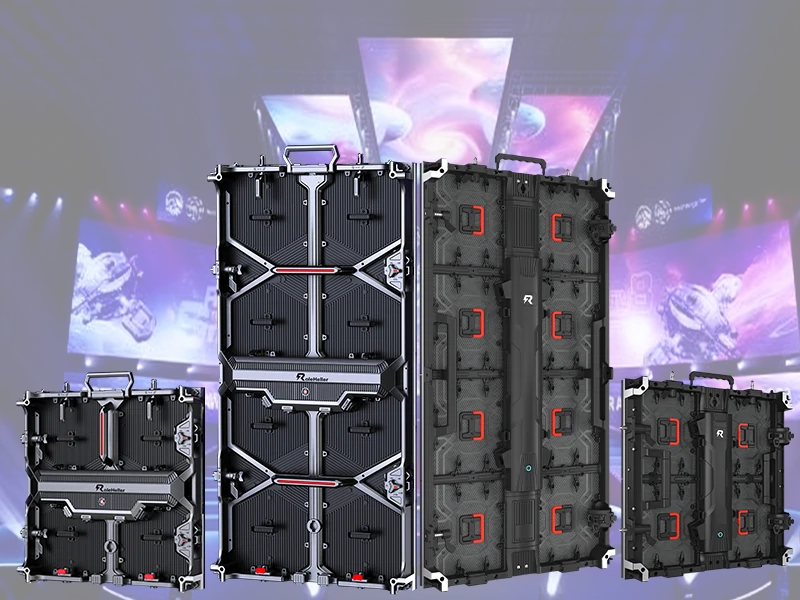
Flying sets for concerts and festivals. Weight per cabinet is everything. Die-cast aluminium, typically 500×1000 mm, target under 25 kg per cabinet for the panel alone. Curved capability matters. Locks must tolerate being hammered into place by tired crew. You want a supplier who understands rigging hardware, safety cables, and the difference between "can be flown" and "is designed to be flown".
Ground-stacked and stage-backdrop sets. Heavier cabinets are acceptable, rear service is fine, and the priority shifts to stability, stacking accuracy, and looking seamless on camera. This is where refresh rate and grey scale matter most.
Outdoor touring sets that live in trucks. Now it is about flight case design, IP rating that survives rain and dust on a loading bay, how well the cases stack in a truck, and whether replacement parts can be sourced locally rather than shipped from Shenzhen mid-tour. A lot of buyers learn this lesson exactly once.
Fixed-lease or semi-permanent installs. Screens that rent to one venue for a season. Here reliability and uniformity across batches matter more than weight, and you should negotiate a spare pool upfront.
Some suppliers genuinely cover two of these well. Almost none cover all four. If a company tells you they are equally strong across everything, ask for references in each lane and time how long it takes them to reply.
| Parameter | What you usually see quoted | What I push for |
|---|---|---|
| Cabinet size | 500×500 / 500×1000 mm | Confirmed; affects aspect ratio and truck packing |
| Weight per cabinet | "Lightweight" | Actual kg stated, panel only and panel plus case |
| Pixel pitch | P2.6 / P3.9 / P4.8 / P6.9 | Set by closest viewing distance, not ambition |
| IP rating | IP65 claimed | Confirmed for assembled cabinet, front and rear |
| Service | Front/rear | Front service mandatory if ground-stacked against a wall |
| Refresh rate | 1,920 Hz | 3,840 Hz+ if cameras film it |
| Brightness | 4,500–5,500 nits | Enough for daylight, with clean auto-dimming |
| Grey scale | 14 bit | 16 bit for smooth gradients on camera |
| Lock mechanism | "Quick lock" | Named system, spare locks included |
| Curving | "Supports curve" | Degrees per connection confirmed, horizontal and vertical |
| Power | Avg/max watts | Real measured draw, so generator sizing is honest |
| Certification | CE/RoHS claimed | Certificate numbers verified with issuing body |
| Warranty | 2 years | Parts, freight, labour and response time spelled out |
One thing worth saying plainly: weight is the most quietly destructive spec on the whole quotation. Everyone talks about brightness. Nobody talks about the rigger's back. A cabinet that is two kilos heavier than advertised does not sound like much until your crew has hung sixty of them overhead in the rain, and suddenly your labour times slip, your rigging plan needs re-certifying, and the next venue refuses the hang. Ask for actual measured weights, per item.
Another thing: power draw. Quoted maximum wattage is almost always optimistic. Get real measured figures at typical brightness and use those to size generators and local distribution. Under-sizing a generator is how you get brownouts during the headline act.
| Closest viewing distance | Sensible pitch range | Notes |
|---|---|---|
| Under 4 m | P2.6 – P2.9 | Heavy, expensive, needs careful handling |
| 4–8 m | P3.9 | The default for good reason |
| 8–15 m | P4.8 – P6.9 | Best value for large stages and facades |
| 15–30 m | P6.9 – P10 | Stadiums, high-mounted, huge formats |
| 30 m+ | P10+ | Only if the space is genuinely big |
A useful reality check: standing closer than the pitch supports does not reveal more detail, it reveals dots. A P4.8 wall viewed from twenty metres looks exactly like a P3.9 would at twenty metres, except you paid more, carried more weight, and broken more locks. Camera compression eats fine detail anyway, which is why throwing money at ultra-fine pitch for a festival main stage rarely pays off.
But there is a flip side. If the screen will be used for corporate events where presenters stand close and cameras push in for tight shots, going finer is not vanity, it is necessary. So the honest answer: it depends on your actual mix of gigs, and if your mix is mixed, P3.9 is the safest single choice.
The cabinet itself. Die-cast quality, flatness tolerance, mask design, whether the doors seal properly after repeated opening. Uneven cabinets show as seams on camera and no amount of calibration fixes that.
The control system. Sending boxes, receiving cards, video processor, media player, cabling, converters. If a quote looks suspiciously low, check whether the controller is included at all.
Flight cases. Good cases cost real money. ATA-style, foam cut to the cabinet, wheels that survive airport ramps, cases that stack in a standard truck. Some suppliers quote cases separately just to make the panel price look attractive.
Spares. Modules, power supplies, receiving cards, locks, cables, and critical little things like spare screws and sealing gaskets. Highest-value line item, first thing cut when a budget gets squeezed.
Commissioning and training. Calibration across cabinets, colour matching, and teaching your crew how to swap a module properly.
Compare fully commissioned numbers — panels, cases, control system, spares, delivery and training as one figure.
I stopped asking "are you a factory" years ago. It produces a rehearsed answer and nothing useful.
Integrated groups. Make cabinets, modules and sometimes controllers in-house, hold large certification packages. Right call when the set is large and frequently flown. Weakness: small enquiries move slowly and custom requests queue up.
Mid-size export specialists. Mostly around Shenzhen, Guangzhou, Dongguan. This is where most wholesale buyers end up. They know rental properly, pricing is workable, they pick up the phone. Quality can vary between batches, which is exactly why inspection matters.
Assembly houses. Buy modules and cabinets upstream and put their name on the crate. Not automatically bad, but you need to know who fixes it when it breaks.
Trading companies. No production at all. Some are genuinely valuable. Just be clear about who holds the warranty and where spare parts physically sit.
A test I use regularly: ask for an unannounced video call during their working hours and request a walk to the production floor, specifically asking to see the current batch being assembled, the LED reel labels, and the ageing room where cabinets run before dispatch.
CE and RoHS for Europe, with the certificate number verified against the issuing body. FCC for the US market.
UL/ETL on power supplies is worth having even where not strictly required, because venues and insurers ask.
IP ratings should be confirmed on the assembled cabinet including doors and cable entries, not on the module alone.
If the set will be flown, ask for the cabinet's load-rating documentation and confirm compatibility with your rigging hardware and safety factors. This is one area where "trust me" is not an acceptable answer.
Confirm voltage ranges and plug types for the markets where the kit will actually run. A rental set that needs rewiring every time it crosses a border is a set your crew will learn to hate.
Check the business licence and registered address, then look them up on a map.
Do the unannounced video walk-through. Ask to see the current batch, LED reel labels, controller boards and ageing racks running.
Pay for a sample cabinet, not just a sample module. Run white at full brightness and watch for dead pixels and colour shift. Run a grey ramp and look for banding. Cycle brightness from maximum to minimum and check for steps or flicker in the dimming curve. Then open and close the door thirty times and see whether the seal still seats and the lock still clicks. That test tells you more about rental life than any datasheet.
Lock the bill of materials into the contract. LED brand and bin grade, driver IC model, PCB details, PSU brand, controller model and firmware version, cabinet alloy and thickness, lock type, case spec. Remove "or equivalent".
Hire a third-party inspection during production and again before loading.
Order spares from the same batch. Ten to fifteen percent spare modules for a touring kit, plus spare power supplies, receiving cards, locks, cables and gaskets, stored in the case pool.
Get warranty terms in writing. Parts free or not, freight responsibility, labour responsibility, response time commitment, and whether local third-party servicing voids anything. Pay attention to whether cases and locks are covered — they rarely are, and they are the things that break.
Q: P3.9 or P4.8 for outdoor rental?
A: If your closest viewers are inside eight to ten metres and cameras push in, P3.9. If the screen is large and viewed from further away, P4.8 saves weight, money and wear. When your gig mix is uncertain, P3.9 is the safer single investment.
Q: Do I really need front service?
A: If the screen will ever be ground-stacked against a wall or a backdrop, yes, absolutely. Rear-service cabinets in that configuration are unusable without striking the whole set. If it only ever flies with rear access, rear service is fine and usually cheaper.
Q: Is 3,840 Hz refresh necessary?
A: Only if cameras shoot it. For naked-eye viewing at a festival, 1,920 Hz looks fine. But most rental work ends up on camera eventually, so I treat 3,840 Hz as standard now.
Q: How many spares do I actually need?
A: For a touring kit, ten to fifteen percent modules, plus at least two spare power supplies and receiving cards per hundred cabinets, plus locks, cables and gaskets. For a house kit that rarely travels, five percent is usually enough.
Q: Can the screen handle rain?
A: IP65 cabinets can, provided the doors and seals are in good condition and the cabinet is correctly oriented. The weak point is never the LEDs, it is the seals after a year of being opened and closed. Build seal inspection into your post-tour checklist.
Q: Should I buy direct or through a local dealer?
A: For a one-off purchase, a local dealer is usually worth the markup — you get someone who answers the phone at inconvenient hours. For repeat buying or building your own inventory, buying direct is where the savings are genuine.
Q: How do I know if the price is fair?
A: Not from one quote. Send your own spec sheet to several suppliers — same pitch, same cabinet size, same inclusion of cases, controller and spares — and the market reveals itself pretty quickly. The outlier low is not a bargain, it is a missing line item.
Q: What about payment terms?
A: Standard is deposit plus balance before shipment or against copy of documents. On a first order keep the deposit modest, use a traceable method, and consider holding a small retention until the sample passes your tests.
Confirm case dimensions and weights before production finishes, not after. Check whether your cases fit your truck, your warehouse racking and your venue's freight lifts.
Confirm air-freight viability if you tour internationally. Rental kits travel by air more often than people admit when ordering, and air freight is priced on volume.
Label everything. Serial numbers on panels and cases, matched lists, and a simple issue log.
Get spare locks and gaskets on the first order, not the third. They are cheap, they wear out, and waiting three weeks for a handful of plastic clips is a special kind of frustrating.
If you are buying to resell or to build inventory, volume pricing rarely comes from arguing over unit cost; it comes from standardising. Pick one pitch and one cabinet format and buy it repeatedly. That lets the factory plan, gives consistent lamp bins across orders, and means your spare pool actually works.
MOQ varies widely. Sample units are normally available at near-single-unit pricing. Container loads unlock the real tiers, and the jump between a single container and a standing quarterly order is where meaningful discounts live. Do not ask for the best price on day one — ask what volume commitment unlocks the next tier, then decide honestly whether you can hit it.
Paperwork to secure up front: commercial invoice and packing list with serial numbers, certificate of origin, verifiable CE/RoHS certificates, FCC where relevant, firmware version records, and a signed BOM. Keep these in a folder by job.
Freight choice matters more than people expect. Air freight for a sample or an urgent spare makes sense. Sea freight for volume. Confirm Incoterms clearly — FOB Shenzhen is common, but if importing is new, DDP to the door may save surprises at the port.
If I were spending my own money tomorrow on a rental set, I would pick a mid-size export specialist with a verifiable production line and recent references from actual rental houses, not just end clients. I would send my own spec sheet so every quote is comparable, lock the lamp bin and lock mechanism into the contract, insist on front service unless I knew for certain the set would only ever fly, pay for pre-shipment inspection, and spend the saved money on better flight cases and a generous same-batch spare kit. Then I would make sure my crew knew how to service it properly, because a rental screen's condition a year from now depends much more on the people opening it than on the factory that built it.
The panels themselves are fairly commoditised now. What separates a clean-looking show from a stressful one is everything around the panels: whether the cases were built properly, whether the locks still work after forty load-ins, whether a single person can swap a module without swearing, and whether someone answers the phone when something fails at soundcheck. Those are the things worth negotiating over. Price per square metre is the easiest number to compare and the least predictive of whether the job works out.
What should I look for in China outdoor rental LED display manufacturers? Look for makers strong in your specific lane — flying sets, ground-stacked, or outdoor touring — with verifiable certifications, transparent bill of materials, recent references from rental houses, and warranty terms covering parts, freight and labour.
What pixel pitch is best for outdoor rental LED displays? P3.9 for closest viewing within 4–8 m and camera-heavy work; P4.8 for 8–15 m and large stages; P6.9 and above for stadiums and high-mounted screens. Choose by closest viewer distance, not sharpness ambition.
How heavy should a rental LED cabinet be? Aim for die-cast aluminium cabinets under roughly 25 kg each for flown sets. Ask for actual measured weights for panel and case separately, because optimistic figures cause real problems on site.
Do I need front service on an outdoor rental display? Yes if the screen will ever be ground-stacked against a wall or backdrop. Rear service is acceptable for sets that only fly with rear access.
Is 3,840 Hz refresh needed for rental screens? Only if cameras film the screen, but most rental work ends up on camera eventually, so treating 3,840 Hz as standard is sensible.
How do I verify a Chinese rental LED display manufacturer? Check business licence and address, conduct an unannounced video factory walk-through, pay for a sample cabinet, lock the BOM in the contract, and use a third-party inspection before shipment.
What should a rental LED display quote include? Panels, flight cases, control system, spares from the same batch, delivery and training. Compare these as one fully loaded figure rather than price per square metre.
How many spare parts should I order? Ten to fifteen percent spare modules for touring kits, five percent for house kits, plus spare power supplies, receiving cards, locks, cables and sealing gaskets, all from the same production batch.
Can outdoor rental LED displays handle rain? IP65 cabinets can handle rain if doors and seals are in good condition and cabinets are correctly oriented. Seal inspection should be part of every post-tour checklist.
Should I buy direct from China or through a local dealer? For a one-off purchase, a local dealer is usually worth the markup for responsive support. For repeat buying or building your own inventory, buying direct offers genuine savings.
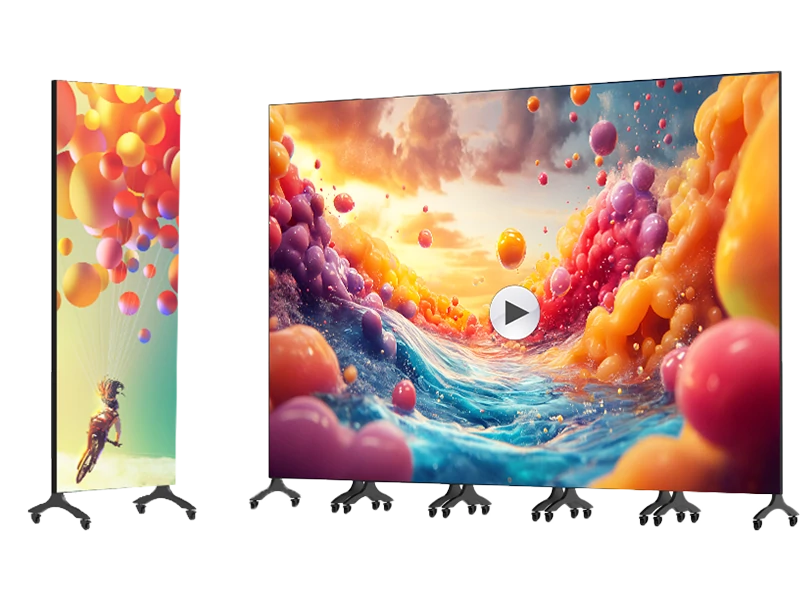
.jpg "How do you pick a China outdoor stage LED display manufacturer that won't let you down on show day?")
.jpg "Who sells wholesale LED displays?")
.jpg "LED matrix display manufacturers | how to pick one")