 English
To pick the right source among commercial led video wall panel manufacturers, you should evaluate four main hardware criteria: diode encapsulation quality (Nationstar Gold Wire vs. Kinglight vs. COB), driver IC refresh rates (at least 3840Hz to 7680Hz for camera-safe environments), power supply stability (such as Mean Well), and die-cast aluminum cabinet precision (tolerances within ±0.05mm). Sourcing directly from verified Tier-1 brands or tier-2 OEM factories ensures single-bin LED batch consistency, proper safety certifications (UL/ETL/CE), and 5% to 10% matching spare module buffers over a 5-to-10-year operational life.
Ever spent hours staring at glossy PDF brochures from led video wall panel manufacturers, wondering if the numbers on paper actually match what gets delivered in a wooden crate? You are definitely not alone! When you start searching for panel suppliers for a corporate lobby, house of worship, or commercial retail space, the amount of technical jargon thrown at you is completely wild. Everyone claims to have the brightest diodes, the seamless cabinet locks, and the best direct-factory prices.
Saying that, when we are putting together a commercial display setup, we've learned that what happens inside the panel casing matters ten times more than the brand logo glued on the back plate. A single bad batch of diode lamps or a cheap unbranded power supply can turn a multi-thousand-dollar display into an ongoing nightmare of discolored patches and dark scan lines.
So, how do you cut through the marketing noise, find reputable factory partners, and make sure you aren't paying a 50% brand markup for hardware you could source directly? Let's break down the whole supplier landscape together, step by step!
Before asking for quotes from every supplier on the first page of Google, it really helps to understand how the manufacturing supply chain actually works. Not every company calling themselves a manufacturer builds their panels from the ground up. In fact, most suppliers fall into three distinct buckets.
┌────────────────────────────────────────────────────────┐
│ TIER 1: Global Integrated Tech Giants                  │
│ (Samsung, LG, Sony)                                    │
├────────────────────────────────────────────────────────┤
│ TIER 2: Dedicated Pro-AV & Architectural Engineering   │
│ (Planar/Leyard, Daktronics, Barco, Vanguard)           │
├────────────────────────────────────────────────────────┤
│ TIER 3: High-Volume Direct OEM Factories               │
│ (Absen, Unilumin, ROE Visual, INFiLED)                 │
└────────────────────────────────────────────────────────┘
Companies like Samsung and LG lead this space. Their panels are polished, their smart signage software is built-in, and they offer turnkey all-in-one displays. If you buy something like a Samsung The Wall package, you get display processors, audio, and wall mounts in one box. But here is the thing: you pay a massive brand premium, and custom sizing or non-standard aspect ratios can get crazy expensive really fast.
These are display engineering specialists that AV integrators turn to for high-stakes projects:
Planar (a Leyard company): Known across North America for ultra-fine pitch indoor panels (P0.6 to P1.5) that fit tightly in corporate boardrooms, lobbies, and control rooms.
Daktronics: The uncontested benchmark for stadium scoreboards, outdoor billboards, and high-impact venue screens.
Vanguard LED Displays: American-based display maker known for TAA-compliant, fine-pitch COB and indoor video wall builds.
This is where the majority of global LED panel supply comes from. Factories like Absen, Unilumin, ROE Visual, and INFiLED manufacture millions of cabinet modules every single year. In fact, many local US and European brands buy raw cabinets directly from these assembly lines and rebrand them. Sourcing here gets you high-tier hardware at factory-direct pricing, provided you have a competent local AV installer handling setup.
Here is a quick snapshot table comparing how these manufacturer categories line up:
| Supplier Tier | Overall Build Control | Relative Hardware Cost | Customization Options | Best Suited Applications |
| Tier 1 (Global Brands) | Extremely High | Premium (+50% to +90% markup) | Low (Mostly fixed aspect sizes) | Executive suites, flagship retail, Fortune 500 boardrooms |
| Tier 2 (Pro-AV Brands) | High (Strict QA) | Mid-to-High | High (Custom shapes, curved, fine pitch) | Broadcast studios, military command centers, churches |
| Tier 3 (Direct OEM) | High (Industry Standard) | Competitive (Direct Factory) | Very High (Custom pitch & cabinet build) | Commercial integrators, venue staging, retail chains |
When you get a quote from a supplier, don't just look at the total project price or screen resolution. You need to ask what individual components are packed inside those cabinet frames. The overall lifetime of an LED panel comes down to four core hardware pieces.
  ┌─────────────────────────────────────────────────────────────┐
  │                 ANATOMY OF AN LED CABINET                   │
  └──────────────────────────────┬──────────────────────────────┘
                                 │
         ┌───────────────────────┼───────────────────────┐
         ▼                       ▼                       ▼
┌──────────────────┐    ┌──────────────────┐    ┌──────────────────┐
│  LED Diodes      │    │  Driver ICs      │    │  Power Supply    │
│  (SMD vs COB)    │    │  (Refresh Rate)  │    │  (Mean Well)     │
└──────────────────┘    └──────────────────┘    └──────────────────┘
The LED diode determines your color fidelity, contrast, and physical resistance:
SMD (Surface Mount Device): Red, green, and blue chips are encased inside small surface-mounted cups. It's cost-effective, proven, and simple to repair individual broken lamps.
COB (Chip-on-Board): Bare LED chips are mounted directly onto the circuit board and sealed with a smooth resin coating. This makes the panel surface impact-resistant, dustproof, and splash-resistant. For pixel pitches tighter than P1.2, COB is quickly becoming the standard.
Gold Wire vs. Copper Wire: Nationstar Gold Wire lamps offer superior heat conductivity and far lower failure rates over time compared to budget copper wire options.
If you point a phone camera at an LED wall and see rolling black scan lines, that display is running low-grade driver ICs.
1920Hz Refresh Rate: Acceptable for static outdoor signs viewed from a distance.
3840Hz to 7680Hz Refresh Rate: Mandatory for houses of worship, broadcast rooms, or corporate stages where cameras or phone photos will be used. Look for driver chips from established makers like Macroblock (MBI) or Icnopto (ICN).
Cheap power supplies are responsible for almost 70% of electrical display failures! Unbranded power units overheat quickly and send voltage spikes across the panel. Always specify brand-name power supplies like Mean Well or high-grade G-Energy modules.
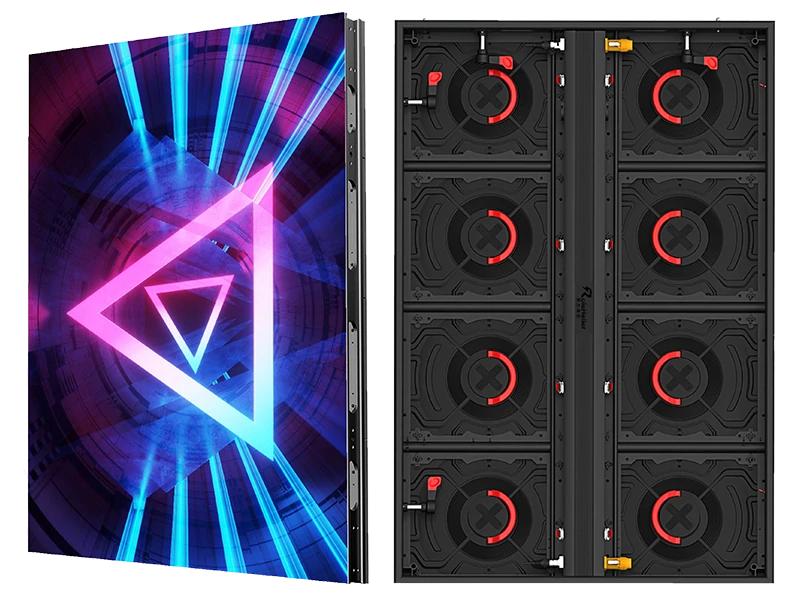
If a manufacturer uses cheap sheet metal or worn die-casting molds, the individual cabinet panels won't lock together tightly. A tolerance error of even 0.2mm leaves ugly dark or light vertical lines running down your video wall image. High-end panels use die-cast aluminum frames with structural tolerances under ±0.05mm.
So, how do you verify if a factory can actually build what they promise? Here is the 4-step audit process we use when evaluating new supply options before signing a purchase order.
[ Step 1: Order a Sample Cabinet ] ──► [ Step 2: Verify Safety Certifications ]
                                                    │
                                                    ▼
[ Step 4: Virtual Tour of SMT Lines ] ◄── [ Step 3: Require Single-Bin Batching ]
Never buy an entire wall based on 3D renders or catalog photos. Request a working sample cabinet. When it arrives:
Turn down the screen brightness to 10% and check for smooth gray color distribution.
Inspect the soldering work on the back PCB board—soldering joints should look clean, bright, and uniform.
Run a full white screen test at 100% brightness for two hours and feel if heat builds up evenly across the rear aluminum casing.
If you are installing panels in commercial spaces across North America or Europe, electrical building inspectors will check for valid compliance marks:
UL / ETL: Essential for electrical safety compliance in North American commercial buildings.
CE / FCC / RoHS: Standard safety and environmental marks for European and American deployments.
EMC Class A / Class B: Crucial for broadcast rooms or offices to keep the wall from interfering with local Wi-Fi and audio gear.
LED diodes produced in different factory runs always vary slightly in voltage and color tone.
Always require that your full order comes from a single bin batch of LEDs.
Require a 5% to 10% spare module buffer (matching receiving cards, modules, and driver ICs) from that exact same production run. That way, if a module gets damaged three years later, you can swap it out without creating an off-color square on your display.
If you can't fly out to inspect the factory in person, schedule a live video walk-through. Ask to see their high-speed SMT (Surface Mount Technology) lines and their Aging Test Room, where fully assembled panels undergo at least 72 hours of continuous burn-in testing before packing.
Let's address a few common questions that usually come up during panel sourcing discussions.
That's actually a very real concern that some buyers run into! To protect yourself, always make sure the specific component brands (for example: Nationstar Gold Wire LEDs, Mean Well power supply, MBI driver IC) are explicitly listed inside the signed sales contract. Also, state that final payment is contingent on a pre-shipment inspection report or third-party audit.
Not necessarily! While COB is amazing for fine-pitch displays (under P1.2) where people stand right next to the screen, standard SMD panels are still fantastic for medium-distance viewing. SMD panels are also cheaper and easier to repair at a component level if a diode gets damaged. So, if your screen is mounted high on a wall, sticking with quality SMD panels saves money without losing visual quality!
Different environments require completely different panel builds. You wouldn't put a delicate fine-pitch indoor panel on an outdoor patio, nor should you use a high-brightness billboard panel in an executive boardroom.
Here is how key specifications line up across common project scenarios:
| Installation Setting | Recommended Pixel Pitch | Brightness Level (Nits) | Recommended Panel Build | Key Feature to Require |
| Corporate Lobbies & Boardrooms | P0.9 to P1.5 | 600 – 800 Nits | Fine-Pitch COB or Mini-LED | 16:9 native aspect ratio matching, front-service access |
| Houses of Worship & Auditoriums | P1.8 to P2.5 | 1,000 – 1,200 Nits | High-Refresh SMD / Aluminum Frame | Camera-safe driver ICs (≥3840Hz), wide viewing angle |
| Retail Storefront Windows | P2.5 to P3.9 | 3,000 – 4,500 Nits | High-Brightness SMD | High heat tolerance, automatic ambient light sensor |
| Outdoor Venue / Billboards | P3.9 to P8.0 | 5,500 – 8,000 Nits | IP65/IP66 Waterproof Enclosure | UV protection, weatherproofing, remote cloud diagnostics |
When people start looking at video wall options, they often assume "the smaller the pixel pitch number, the better the display." But choosing a pixel pitch that is too tight is the fastest way to double your project cost without seeing any real visual benefit!
Here is the simple viewing distance math we use:
For instance:
If your viewers sit 2 meters (about 6.5 feet) away from the wall, a P1.8 to P2.0 panel looks seamless and crisp. Buying a P0.9 panel here costs almost double without adding noticeable sharpness to human eyes at that distance!
If the screen is installed in a sanctuary or hall where the front row sits 5 meters (16 feet) away, a P2.5 or P2.9 wall delivers a great visual experience while keeping equipment costs manageable.
                  [ EYE RESOLUTION VS PIXEL PITCH ]

   Close Viewing (2m / 6.5ft)  ──────►  P1.2 - P1.8 Pitch Needed
   Medium Distance (5m / 16ft) ──────►  P2.5 - P2.9 Pitch Needed
   Distant / Outdoor (10m+/33ft) ────►  P3.9 - P6.0 Pitch Needed
Quick tip: If your planned screen size is smaller than 110 inches diagonally, direct-view LED panels might not be the most practical choice. High-brightness commercial LCD video walls or single 98-inch 4K displays win on price, power draw, and sharpness every single time at that smaller scale!
Over the years, we've seen plenty of buyers fall into simple trapdoors that end up costing thousands down the road. You know how it goes—a quote comes in that looks 35% cheaper than everyone else's, and it feels too tempting to pass up! Here are the warning signs indicating a supplier might be cutting corners.
Cheap manufacturers sometimes overdrive their LED chips to claim higher brightness figures on paper. This generates severe heat behind the cabinet casing, causing rapid pixel fading, yellowing mask covers, and dead LED spots within 18 months.
The LED panel casing is only half of the system. You also need a hardware video processor (such as NovaStar, Colorlight, or Brompton) to scale your media sources to the screen's exact pixel layout. Cheap unbranded video processors introduce motion lag, color banding, and limited input switching.
An LED video wall isn't lightweight! A standard 150-inch commercial screen setup can easily weigh between 300 and 600 pounds. Make sure your building wall studs can handle the load, and ensure your electrician drops dedicated power circuits before installation day.
In our experience, the best manufacturing partner isn't necessarily the huge brand name, nor is it the cheapest vendor on an online directory. It's the supplier who gives you complete transparency about their internal parts, maintains tight QA control over their assembly lines, and offers solid long-term technical support.
If you are an AV integrator or tech director, we suggest building a solid relationship with two reliable OEM factories—one specializing in fine-pitch indoor builds (P0.9–P1.8) and another focused on rugged outdoor or venue displays (P2.9–P4.8). That way, you have proven hardware options ready for whatever project comes up, backed by engineers who actually help out when you need guidance during setup.
Hopefully, this breakdown gives you a solid game plan for evaluating display suppliers. Have you run into any weird component issues or color-matching headaches on your own display projects? Drop a comment below, let's chat about it~
For indoor corporate lobbies, Planar (Leyard), Samsung (The Wall), Vanguard LED, and Absen are widely considered top choices due to their fine pixel pitch options, clean aesthetics, and low-profile mounting hardware.
Standard panel orders typically take 15 to 25 business days for production, followed by a mandatory 48 to 72-hour continuous aging test. Shipping via ocean freight usually adds another 3 to 4 weeks, while air freight takes around 5 to 7 days.
You can verify certification authenticity by asking the manufacturer for their official UL File Number or ETL Control Number. Then, look up that exact number directly in the online public directory on the official UL Product iQ or Intertek Directory websites.
For most churches and auditoriums where the front row sits around 12 to 20 feet away, a pixel pitch of P1.8mm to P2.5mm provides a clear, seamless image for both live viewing and video broadcasts.
Commercial LED panels from reputable manufacturers are rated for 100,000 hours of operation (roughly 10 years of continuous use) before reaching half brightness, provided the screen is operated at reasonable brightness levels (around 70–80%).
SMD packages individual RGB diodes inside tiny plastic cups soldered onto the PCB board surface. COB attaches raw LED chips directly onto the board and coats the surface with protective resin, making it durable, dustproof, and impact-resistant.
Flicker and dark scan lines occur when the display's driver IC refresh rate is too low. Choosing panels with driver IC refresh rates of 3840Hz or higher eliminates camera interference during live broadcasts or video recording.
You should always request a 5% to 10% spare parts package, including matching LED modules, power supply units, receiving cards, and ribbon cables from the exact same production batch.
Standard indoor LED walls operate fine in normal air-conditioned rooms. However, for ultra-large displays or recessed wall cavities with minimal airflow, installing quiet exhaust fans behind the frame helps prevent heat buildup and extends component lifespan.
Because diode batches vary in voltage and color tint, you must use spare modules saved from your initial shipment batch. If no original spares are left, the full video wall will require optical calibration using professional calibration software (such as NovaStar NovaLCT) to align color values.
.jpg "Who Are the Top China LED Video Wall Rental Screen Manufacturers in 2026?")