English

If you need a direct, no-nonsense answer on how to select china p6 indoor led display manufacturers without ending up with flickering tiles, blotchy color patches, or blown power supplies, here is the professional benchmark: do not buy from trading brokers on generic B2B export portals who claim to own sprawling mega-factories. Instead, source directly from specialized indoor display assemblers located in Shenzhen’s Bao'an and Guangming districts or the Huizhou industrial belt that meet five strict hardware criteria. First, insist on genuine black-face surface-mount LEDs (Nationstar or Kinglight) built with 99.99% pure gold-wire bonding rather than cheap copper or alloy wire. Second, demand constant-current driver ICs with pulse-width modulation (PWM) that deliver at least a 3,840 Hz refresh rate and 16-bit grayscale (such as Macroblock MBI5153 or Chipone ICN2053) so your display doesn't show rolling scan bars on camera. Third, specify die-cast aluminum cabinets machined on five-axis CNC mills with sub-0.05 mm edge tolerance to eliminate visible seam lines. Fourth, verify that all power distribution runs through certified Mean Well or Great Wall low-noise power supplies with active power factor correction (PFC > 0.95). Fifth, contractually mandate a 5% batch-matched spare parts kit from the exact same diode wafer lot. If an overseas sales rep cannot provide an unedited video walkthrough of their automated surface-mount lines or stalls when asked for a continuous 72-hour full-white burn-in test report, walk away immediately.
Picture this realistic scenario: you are handling the audio-visual fit-out for a major commercial project—maybe an 800-seat church sanctuary in Dallas, an indoor convention hall in Birmingham, or a mega-retail shopping arcade in Frankfurt. The architectural drawings specify a massive 12-meter-wide by 5-meter-high video backdrop. You know fine-pitch screens like P1.5 or P1.8 are complete overkill because the closest spectator is sitting thirty feet away, and your client does not have a half-million-dollar budget to burn. So you decide to source P6 indoor panels (6 mm pixel pitch, roughly 27,777 pixels per square meter). You search for china p6 indoor led display manufacturers, and within two days your email inbox is buried under forty-five different quotes ranging wildly from $180 to $650 per square meter. Every factory representative swears on their mother's grave that their modules are Grade A, their LEDs are the highest tier, and their warranty covers you for five years. But what happens when the freight clears customs, your rigging crew bolts the panels onto the steel subframe, and the screen is powered on? You suddenly discover that the left side of the wall has a green tint, the right side has a magenta cast, the cooling fans in the sheet-metal cabinets roar like jet engines, and half of the power connectors become scorching hot within two hours. Replacing failed modules on a 20-foot-high wall requires scissor lifts, scaffolding permits, and endless midnight troubleshooting while an overseas supplier ignores your messages. To make sure you never find yourself in that nightmare, let's break down the technical trade-offs, internal component engineering, and factory inspection protocols you need to master.
In an era where tech marketing constantly pushes sub-millimeter micro-LED and narrow pixel pitch (NPP) walls, many inexperienced buyers mistakenly think P6 (6.0 mm diode spacing) is obsolete. That is a fundamental misunderstanding of optical physics and commercial return on investment.
When we are using visual displays in large-format spaces, pixel pitch must always be calculated against the minimum viewing distance (MVD) and human visual acuity (the 20/20 vision threshold).
[Viewing Distance vs. Perceived Pixelation Formula]
Minimum Viewing Distance (MVD in meters) ≈ Pixel Pitch (in mm) × 1.0 to 1.5
For P6 Indoor: 6.0 mm × 1.0 = 6.0 meters (approx. 20 feet)
At a viewing distance of 6 meters (20 feet) or greater, the human eye cannot distinguish individual diodes on a P6 screen. The red, green, and blue sub-pixels blend smoothly into continuous imagery.
Consider the mathematics on a 12m × 5m display canvas (60 square meters):
A P6 display delivers a total resolution of 2000 × 833 pixels, which effortlessly renders native 1080p Full HD video without awkward non-integer down-scaling artifacts.
Building that same 60-square-meter screen with P1.5 modules would yield a staggering 8K resolution requiring expensive fiber-optic distribution systems, multiple multi-port video processors, and a hardware bill exceeding $180,000.
A professional-grade P6 indoor wall will accomplish the exact same perceived visual impact for your audience at one-quarter of the cost, while drawing 60% less electrical power and generating vastly less ambient heat inside the building.
For worship sanctuaries, high-ceiling corporate exhibition auditoriums, sports arena concourses, hotel ballrooms, and airport terminals where viewers are standing at least twenty feet away, P6 remains the undefeated workhorse for large-format video delivery.
When procuring electronics from China, you have to understand the industrial geography of Guangdong Province. Over 85% of the world's commercial LED displays are assembled within a three-hour driving radius around the Pearl River Delta, but different industrial clusters specialize in completely different quality tiers.
[Pearl River Delta LED Manufacturing Ecosystem]
                      │
     ┌────────────────┼────────────────┐
     ▼                ▼                ▼
[Shenzhen]       [Huizhou &        [Jiangmen &
(Bao'an /         Dongguan]         Zhongshan]
Guangming)       Massive Automated Low-Cost Domestic
Engineering Hub,  SMT Capacity,    Signage, Mixed
High-End Custom   Commercial       Components,
Cabinets & SMT    Production       Budget-Focused
Shenzhen is the high-tech heart of the global display industry. This is where engineering design firms, advanced CNC tool-and-die shops, and top-tier surface-mount technology (SMT) cleanrooms are concentrated. Manufacturers here build for international commercial AV integrators, rental production houses, and broadcast networks. If you require strict adherence to international electrical safety standards (such as UL, CE, ETL, and FCC), precision die-cast aluminum frames, and customized NovaStar or Brompton processing, this is where your supplier should be located.
Located immediately adjacent to Shenzhen, these two industrial hubs host massive, high-throughput manufacturing plants. Land and labor costs are lower here, so companies operate sprawling facilities with dozens of high-speed Yamaha, Panasonic, or Fuji SMT placement lines running around the clock. Huizhou and Dongguan plants excel at high-volume, standardized commercial displays where production consistency and aggressive pricing per square meter are paramount.
Zhongshan and Jiangmen have historically been the manufacturing capitals of decorative consumer lighting and basic commercial illumination. While many factories here assemble LED display panels, their core focus has traditionally been low-cost domestic signage and budget commercial billboards. Unless you have an experienced on-site quality-assurance engineer inspecting every single batch on the factory floor, buying high-resolution indoor video panels from small assembly workshops in these areas carries substantial risk regarding mixed diode binning and uncertified power supplies.
When you look at a P6 indoor module, it appears deceptively simple: a black plastic front mask, an array of surface-mount diodes, a multi-layer printed circuit board (PCB), and some integrated circuits on the back. But beneath the surface, the difference between an enterprise-grade module and a cut-rate burnout comes down to microscopic component choices.
[P6 Module Cross-Section Anatomy]
┌────────────────────────────────────────────────────────┐
│ Anti-Glare Matte Mask with Micro-Louvers (PC Material) │
├────────────────────────────────────────────────────────┤
│ Black-Face SMD2121 / SMD3535 LEDs (99.99% Gold Wire)   │
├────────────────────────────────────────────────────────┤
│ 4-Layer High-Tg FR4 Circuit Board (2oz Copper Weight)  │
├────────────────────────────────────────────────────────┤
│ Constant-Current PWM Driver ICs (3,840 Hz Refresh)     │
├────────────────────────────────────────────────────────┤
│ Die-Cast Aluminum Frame / Precision Alignment Bushings │
└────────────────────────────────────────────────────────┘
Inside every SMD LED package (typically SMD2121 or SMD3535 for P6 indoor use), microscopic bonding wires connect the semiconductor die to the lead frame.
Gold-Wire Bonding: Top-tier manufacturers specify 99.99% pure gold bonding wire. Gold is chemically inert, meaning it never oxidizes. More importantly, its coefficient of thermal expansion matches the surrounding packaging resin smoothly, preventing stress fractures during hundreds of heat cycles. Diode brands like Nationstar (Gold Wire series), Kinglight (high-spec tier), and Nichia utilize gold bonding.
Copper or Alloy Wire: Budget assembly shops slash up to 25% off their diode procurement costs by substituting copper or composite alloy bonding wire. Copper oxidizes rapidly if microscopic atmospheric moisture penetrates the epoxy lens. Over months of thermal expansion and contraction, copper wire embrittles and snaps at the solder weld point, causing sudden dead pixels and flickering sub-pixels to spread across your wall.
For indoor installations, visual impact is dictated entirely by contrast ratio, not raw blinding brightness.
White-Face LEDs: Older or cheap outdoor-adapted modules use white plastic diode bodies to maximize lumen output (reaching 2,500 to 3,500 nits). However, when white-face diodes are installed indoors, ambient ceiling lights reflect off the pale resin bodies, turning the screen background into a milky, washed-out gray.
Full Black-Face SMD: Premium indoor P6 modules utilize deep-black epoxy resin and black lead frames, paired with a matte-black polycarbonate front mask. While overall brightness is calibrated between 800 and 1,500 nits (which is plenty for indoor viewing), the contrast ratio jumps from 1,000:1 to over 5,000:1. Dark film scenes and corporate graphics render with deep blacks and rich color saturation.
The driver IC controls how power is distributed to each diode.
High-Refresh PWM Drivers: Chips such as Macroblock MBI5153/MBI5359 or Chipone ICN2053 contain onboard SRAM and pulse-width modulation processing. They deliver refresh rates of 3,840 Hz or higher and 16-bit grayscale depth. When presenters speak in front of the wall and audience members take photos or record video with smartphones, there are zero dark rolling scan lines, no camera flicker, and smooth color gradients even when the display is dimmed down to 15% brightness in a dark room.
Basic Dual-Latch Drivers: Low-end modules use basic driver ICs (such as ICN2037 or generic dual-latch clones) running at 960 Hz to 1,920 Hz with only 13-bit or 14-bit grayscale. When these screens are dimmed down for ambient indoor environments, subtle color gradients break apart into jagged, posterized steps, and fast-moving video clips exhibit noticeable ghosting.
The circuit board is the thermal and electrical foundation of the tile.
4-Layer FR4 with 2oz Copper: High-grade modules use a 4-layer PCB with a minimum 2oz copper thickness and a high glass-transition temperature (Tg > 150°C). Dedicated internal ground and power planes distribute current uniformly and dissipate heat away from the driver chips across the entire board surface, keeping the front face cool to the touch.
2-Layer Thin PCB: Discount vendors cut costs by using thin 2-layer boards with 1oz or 0.5oz copper. High electrical resistance causes severe voltage drops across the module, meaning pixels at the far edge of the tile receive less power and run noticeably dimmer. Even worse, the intense localized heat from the driver ICs warps the thin PCB over time, causing individual tiles to bulge forward and ruin the planar flatness of your display wall.
To help you benchmark competing proposals from china p6 indoor led display manufacturers, the table below outlines the component selections and engineering specifications across three common market tiers:
| Engineering Specification | Low-Budget Economy Tier | Commercial Integrator Standard | Enterprise / Broadcast Tier |
|---|---|---|---|
| Average Wholesale Price (FOB) | $180 – $260 / m² | $320 – $450 / m² | $550 – $750+ / m² |
| LED Packaging Brand | Generic unbranded SMD | Kinglight / Nationstar Copper | Nationstar Gold Wire / Nichia |
| Bonding Wire Material | Copper or Alloy wire | Copper wire (Tested) | 99.99% Pure Gold wire |
| Diode Surface Type | White-face or semi-black | Matte Black-face SMD2121 | Ultra-Black SMD2121 / GOB Coated |
| Driver IC Model | Generic Dual-Latch (ICN2037) | Chipone ICN2053 / MBI5124 | Macroblock MBI5153 / MBI5359 |
| Refresh Rate (Hz) | 960 Hz – 1,920 Hz | 3,840 Hz | 3,840 Hz – 7,680 Hz |
| Grayscale Processing | 13-bit – 14-bit | 14-bit – 16-bit | 16-bit – 18-bit Low-Gray Clear |
| PCB Construction | 2-Layer, 1oz copper, Tg130 | 4-Layer, 1.5oz – 2oz copper | 4-to-6 Layer, 2oz high-Tg FR4 |
| Cabinet Enclosure | Cold-rolled sheet iron (Heavy) | Die-cast aluminum alloy | CNC-machined die-cast magnesium |
| Power Supply Unit | Unbranded 5V (No PFC, loud fans) | Chuanglian / Megmeet standard | Mean Well UHP fanless (Active PFC) |
| Cabinet Tolerance | ± 0.50 mm (Visible gaps) | ± 0.10 mm (Clean seams) | ± 0.03 mm (Sub-millimeter seamless) |
| Expected Year-1 Defect Rate | > 60 PPM (Frequent dead pixels) | < 15 PPM (Stable operation) | < 3 PPM (Near zero defects) |
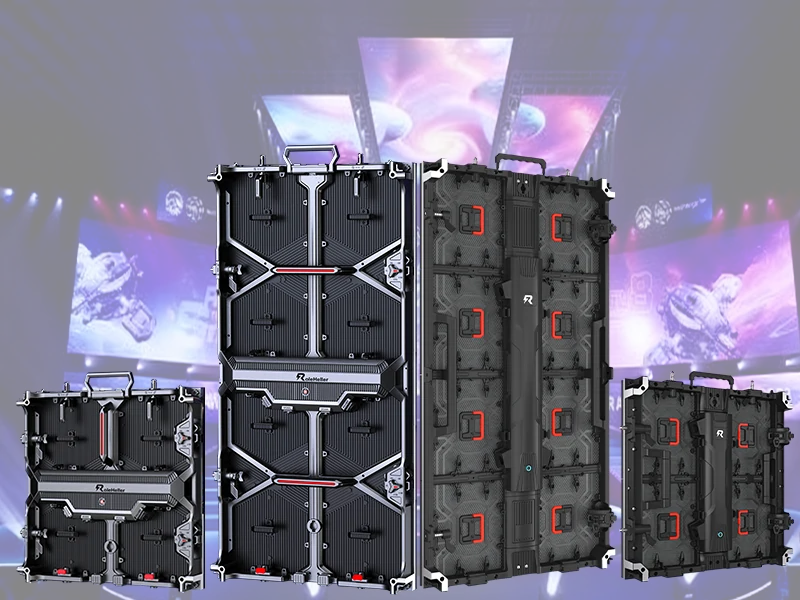
When sourcing P6 displays, you must choose the structural cabinet housing. P6 modules typically come in two standard form factors: 192 mm × 192 mm (32 × 32 pixels) or 384 mm × 192 mm (64 × 32 pixels). These modular tiles are mounted into larger structural cabinets, usually sized at 576 mm × 576 mm, 768 mm × 768 mm, or 960 mm × 960 mm.
[Standard 768mm × 768mm Cabinet Structure]
┌───────────────────┬───────────────────┐
│ Module (384×192)  │ Module (384×192)  │
├───────────────────┼───────────────────┤
│ Module (384×192)  │ Module (384×192)  │
├───────────────────┼───────────────────┤
│ Module (384×192)  │ Module (384×192)  │
├───────────────────┼───────────────────┤
│ Module (384×192)  │ Module (384×192)  │
└───────────────────┴───────────────────┘
Sheet metal cabinets are manually folded, welded, and spray-painted in general fabrication workshops.
The Good: They are cheap to produce and can be fabricated in custom dimensions to fit unusual architectural niches.
The Bad: Sheet metal is heavy (often exceeding 45 kg per square meter), placing immense dead-load strain on your building’s structural walls. Worse, manual bending and welding introduce tolerances of 0.5 mm to 1.0 mm. When you bolt twenty of these cabinets together, the mechanical variances stack up, resulting in noticeable dark or bright vertical seams across the screen. Furthermore, iron cabinets trap heat and require loud internal exhaust fans that produce distracting hums in quiet conference halls or churches.
Die-cast aluminum frames are molded under immense hydraulic pressure and then finished on multi-axis computer numerical control (CNC) milling machines.
The Good: Precision. CNC milling guarantees edge, corner, and locator-pin tolerances within ±0.03 mm to ±0.05 mm. When your rigging crew hangs adjacent cabinets, hardened steel locator pins pull the frames into perfect alignment, eliminating visible seams. Aluminum is also roughly 40% lighter (typically 24 kg to 30 kg per square meter), and the entire metal chassis acts as an efficient passive heatsink, allowing you to use completely fanless, dead-silent power supplies.
The Bad: Initial procurement costs are 15% to 25% higher than sheet metal, but this is offset immediately by faster installation times and zero customer complaints regarding seam alignment.
When you are committing tens of thousands of dollars to an overseas manufacturing order, relying on marketing photos and PDF brochures is a guaranteed path to failure. You must enforce an uncompromising quality-control and factory acceptance testing (FAT) workflow before releasing your final payment.
[Raw Component & SMT Cleanroom Verification]
                     │
                     ▼
[3D Solder Paste Inspection (SPI) & Automated Optical Check (AOI)]
                     │
                     ▼
[Cabinet CNC Indexing & Module Planar Alignment]
                     │
                     ▼
[Continuous 72-Hour Full-White & Dynamic Burn-in Marathon]
                     │
                     ▼
[Thermal Imaging Scan for Hot Driver ICs & Power Terminals]
                     │
                     ▼
[Single-Bin Chroma/Luma Camera Calibration]
                     │
                     ▼
[Anti-Static Vacuum Sealing & Plywood Export Crating]
Before transferring a single cent of your deposit, write every component specification directly into your formal purchase contract. Explicitly identify:
The exact diode packaging model: Nationstar Gold-Wire SMD2121 Black Face.
The constant-current driver IC: Macroblock MBI5153 with verified 3,840 Hz refresh rate.
The power supply manufacturer and series: Mean Well UHP-350-5 slimline fanless with active PFC > 0.95.
The receiving card model: NovaStar A5s Plus or A8s.
The cabinet specification: Die-cast aluminum 768 mm × 768 mm, front-and-rear magnetic serviceability.
Walk the factory’s surface-mount floor or hire an independent inspection agency to verify their equipment.
Ensure bare LED reels are stored inside climate-controlled dehumidification dry-cabinets. If surface-mount diodes absorb ambient atmospheric moisture prior to reflow soldering, that moisture vaporizes into high-pressure steam inside the reflow oven, creating microscopic internal delamination (the classic "popcorn effect") that causes premature diode failure in the field.
Verify that the factory runs automated 3D Solder Paste Inspection (SPI) before chip placement, followed by a multi-zone nitrogen reflow oven and 100% 3D Automated Optical Inspection (AOI) to catch solder bridging and cold solder joints.
Reliable china p6 indoor led display manufacturers will assemble your complete display array in their testing bay and run it continuously for at least 72 uninterrupted hours before packing.
Hours 0–24: Continuous full-raster white screen at 100% brightness. This stresses the power distribution traces, terminal blocks, and diode junctions to their maximum electrical and thermal limits.
Hours 24–48: Alternating solid red, solid green, and solid blue primary test patterns to expose dead sub-pixels, color drift, and weak solder connections.
Hours 48–72: Dynamic high-contrast video loops with rapid dark-to-light transitions.
During the full-white burn-in test, have an inspector walk the row of cabinets with a calibrated thermal imaging camera. If individual driver ICs or DC terminal blocks spike above 70°C in an ambient 25°C room, the PCB copper traces are undersized and those components will prematurely fail in field conditions.
Before dismantling the cabinets for crating, the manufacturer must run full-screen camera-based pixel-level calibration (chroma and luma calibration). A high-resolution CCD calibration camera captures the optical output of every single diode, calculates correcting coefficient matrices for red, green, and blue, and flashes those calibration values directly into the onboard EEPROM memory of each receiving card. This guarantees seamless edge blending and uniform color across the entire wall.
In indoor commercial spaces like churches, conference rooms, and executive ballrooms, acoustic noise is just as critical as visual quality. There is nothing worse than an executive or pastor speaking at a podium while a video wall behind them emits a loud, high-pitched electrical buzz and fan drone.
[Main AC Distribution (110V/230V)]
                 │
                 ▼ (Filtered Breakers & Surge Suppressors)
[Mean Well UHP Fanless Power Supplies (Active PFC > 0.95)]
                 │
                 ▼ (Heavy-Gauge Pure Copper DC Harness)
[5V / 4.2V Busbars Distributed Across Cabinets]
                 │
                 ▼
[Silent Conduction Cooling Through Die-Cast Aluminum Frame]
To achieve completely silent operation (under 25 decibels at one meter), insist on fanless, conduction-cooled power supplies such as the Mean Well UHP series. These power units transfer their thermal energy directly into the die-cast aluminum cabinet frame via thermal pads.
Never accept cheap silver-box power supplies equipped with tiny, high-RPM cooling fans. Those low-grade fans accumulate dust within six months, start rattling, and eventually seize, causing the power supply to overheat and shut down mid-presentation.
Large LED display walls draw substantial electrical current. If you power a 50-square-meter screen using low-cost power supplies that lack active Power Factor Correction (PFC < 0.80), the electrical load generates severe harmonic distortion back into the building’s power grid. This harmonic noise causes sensitive soundboard consoles, wireless microphone receivers, and video distribution switchers sharing the same electrical panel to hum, buzz, and drop signals. High-grade power supplies with active PFC (> 0.95) eliminate harmonic feedback and ensure full compliance with municipal building codes.
Question: Can I purchase replacement P6 modules from the same manufacturer three years from now and expect them to match my existing screen?
Answer: Physically, they will fit into the cabinet frames, but optically, they will almost certainly not match without extensive camera calibration. Semiconductor crystal growth is an organic chemical process; even the same manufacturer using the same packaging machines will produce diodes with slight variations in dominant wavelength and color temperature across different wafer batches. If you plug a new module into an older screen, it will stand out like an off-color patch. That is why you must contractually require the factory to supply a 5% batch-matched spare parts kit drawn from the exact same wafer lot as your primary shipment, and store those spares in a climate-controlled, static-safe space.
Question: Front-service vs. rear-service cabinets—which mechanical design should I specify?
Answer: For indoor commercial installations, you should specify 100% front-service cabinets in almost every scenario. In modern buildings, screens are typically mounted flush against drywall, recessed into custom wooden millwork, or hung directly against structural walls where constructing a two-foot rear maintenance corridor is physically impossible or wastes valuable commercial square footage. Front-service P6 modules are secured using high-strength neodymium floating magnets. Using an electric vacuum suction tool, a technician can pull a defective module straight forward from the front face in less than five seconds, swap the ribbon cable, and snap in a spare tile without touching the rest of the wall.
Question: What is the real-world difference between Novastar and Colorlight control systems for P6 indoor walls?
Answer: For standard commercial retail and corporate conference rooms, NovaStar (such as the Taurus series for cloud screens, or the COEX / MCTRL series paired with A5s Plus or A8s receiving cards) is the dominant global standard. It offers an ideal balance of cost, stability, and widespread technician familiarity. Colorlight is a capable, budget-friendly alternative frequently deployed in commercial retail signage networks. NovaStar remains preferable for mission-critical venues because virtually every professional AV technician in North America and Europe already understands how to configure and troubleshoot NovaLCT software, making local field support straightforward.
When you compare quotes from china p6 indoor led display manufacturers, knowing how production capital is allocated across the bill of materials (BOM) helps you distinguish genuine value from dangerous cost-cutting:
| Production Expense Component | Typical BOM Share | What Gets Cheated in Lowball Quotes |
|---|---|---|
| LED Diodes (R, G, B SMD Packages) | 35% – 42% | Swapped to copper/alloy wire, leftover mixed-bin lots |
| Constant-Current Driver ICs | 16% – 22% | Cheap dual-latch chips (960 Hz), severe ghosting and flicker |
| Multilayer PCB Board | 12% – 16% | Dropped from 4-layer 2oz copper to 2-layer 1oz, board warps |
| Cabinet Enclosure & CNC Machining | 14% – 18% | Rough sheet iron used instead of CNC die-cast aluminum |
| Power Distribution Units | 10% – 14% | Noisy unbranded clone PSUs with no active PFC |
| Receiving Cards & Cabling | 5% – 8% | Cloned controller cards, cheap aluminum-clad data cables |
| Factory Burn-In & Optical Calibration | 4% – 8% | Burn-in cut from 72 hours down to 12 hours or skipped entirely |
When a factory offers you a P6 indoor display at $200 per square meter while established engineering fabricators quote $380, they are not operating on razor-thin margins out of generosity. They are cutting corners in every major category: using copper-wire diodes, cheap driver ICs, thin 2-layer circuit boards, folded iron cabinets, and skipping the continuous burn-in marathon. You end up functioning as the factory's unpaid quality control tester on your job site.
When you are ready to issue purchase orders and negotiate commercial contracts with overseas suppliers, keep these field-tested procurement guidelines in mind:
First, never buy production quantities based on a glossy catalog or digital renderings. Always order a paid evaluation package containing at least one fully operational cabinet, spare modules, ribbon cables, and power connectors. Take that sample cabinet into your workshop. Inspect the solder fillets on the driver IC pins under a digital microscope, check for uniform solder paste distribution without bridging, measure surface heat dissipation under a full-white video signal with a power meter, and inspect the cabinet edges with digital calipers.
Second, lock down the bill of materials (BOM) in your legally binding commercial invoice. Do not accept vague descriptions like "High-Quality Indoor LED Display." The purchase contract must specify:
Exact diode package: Nationstar Gold-Wire SMD2121 Black Face, Single Binning Lot.
Exact driver IC model: Macroblock MBI5153 or Chipone ICN2053 with minimum 3,840 Hz refresh rate.
PCB architecture: 4-Layer FR4, minimum 1.6 mm thickness, 2oz copper weight, TG170 material.
Cabinet chassis: Precision die-cast aluminum alloy, magnetic front service, verified tolerance within ±0.05 mm.
Power hardware: Original Mean Well UHP series with active PFC > 0.95.
Packaging: Reinforced export plywood flight cases with high-density EPE foam cradles and moisture barriers.
Third, structure your payment terms around verified factory acceptance milestones. The standard international trade term is a 30% deposit upon order confirmation, and the remaining 70% balance paid before container loading. Never wire that final 70% based purely on factory-provided photos or prerecorded video clips. Hire an independent third-party inspection agency (such as QIMA, SGS, or an independent local engineer based in Shenzhen) to visit the factory floor, verify that the serial numbers match your specific batch, audit the live 72-hour burn-in line, and supervise the crating process. That small inspection fee is the cheapest insurance policy you will ever buy.