English
Short answer: when you search for china led video wall hire manufacturers, what you actually need is not the cheapest per-square-metre day rate but a supplier who can confirm panel model, cabinet count, spare modules, flight-case packing, on-site technician availability, lead time and a written failure-response plan before you sign anything. Expect rental-grade P2.9–P3.9 indoor cabinets to run roughly USD 80–250 per square metre per day if hired locally with crew, or USD 40–120 per square metre per day ex-factory if you are contracting a Chinese manufacturer directly and arranging freight and labour yourself; either way add shipping, carnets, insurance, rigging, power distribution, content and a contingency buffer. Read on for how to make that decision without learning it the hard way on show day.
You have seen this happen. The stage looks empty, the client wants "something big", someone promises a video wall, the quote arrives looking reasonable, and then three days before load-in nobody can tell you whether the cabinets will actually fit the truss, whether there are enough spares, or who shows up when a receiving card dies at 6 p.m. That is the moment people remember forever, usually while standing in front of a half-lit screen holding a phone that does not ring back.
Honestly, most of the pain in this business comes from one thing: the person signing the hire contract has never stood next to the actual kit. Let us fix that.
Buying a wall is about longevity. Hiring a wall is about reliability on a specific date, which is a much narrower and much less forgiving problem. When you buy, you care about five-year degradation curves. When you hire, you care about whether the case opens, whether the modules match, and whether the technician has done this exact build before.
That difference changes who you should talk to. A manufacturer who sells fine-pitch boards for fixed installs may have zero rental stock, zero flight cases and zero experience with a four-hour bump-in. Conversely, a rental house with beautiful photos may own nothing and subcontract everything at the last minute. Both exist. Neither is automatically wrong. But you do need to know which one you are dealing with before you hand over a deposit.
My rule of thumb: if the event is inside China or nearby in Asia and you have a local crew, hiring direct from a Chinese manufacturer with rental stock makes real financial sense. If the event is in Europe or North America and the timeline is tight, hire locally from a house that can show you their own warehouse — even if the panels inside the cases were made in Shenzhen. Freight and carnets eat the savings faster than most spreadsheets predict.
The search term pulls up three very different businesses, and they all look identical in a brochure.
Type A — Manufacturer with its own rental division. Owns the cabinets, runs the aging room, keeps spares, often supplies the processor and the cases. Best pricing, deepest technical knowledge. Downside: English communication varies, time-zone lag, and they will not send a technician to your city unless you pay for flights and hotel, which you should expect to do.
Type B — Trading company that hires in from factories. Good at packaging a full solution — wall, truss, processor, sometimes even content. Faster replies, more flexible. Downside: margin stacked twice, and when something fails you are dependent on whether their source still has the same batch of panels.
Type C — Rental house using Chinese-made gear. Owns the kit locally, provides crew, knows your venue, can react in hours. This is what most Western event buyers actually want, they just do not know to ask for it by name. Downside: higher day rate, and you should still ask where the panels came from and whether spares are in the building.
There is no villain here. But if you ask Type C for a factory price you will get confused, and if you ask Type A to be on site in eight hours you will get disappointed. Pick the type that matches your date, not the one with the best photos.
Leading with "how much per square metre per day" is how you end up with a number that means nothing. Two quotes at USD 100/m²/day can be completely different hardware — different pitch, different refresh rate, different cabinet system, different processor, different amount of spare kit. Write it down once, send it to everyone, then compare.
| Parameter | What to specify | Why it matters for hire |
|---|---|---|
| Pixel pitch | P2.9, P3.9, or P4.8 outdoor | Drives resolution and cost; cannot change on site |
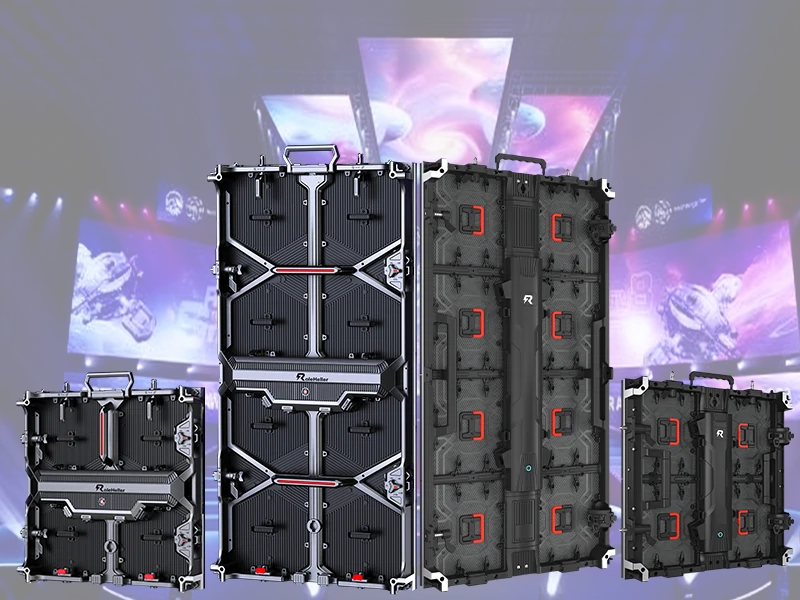
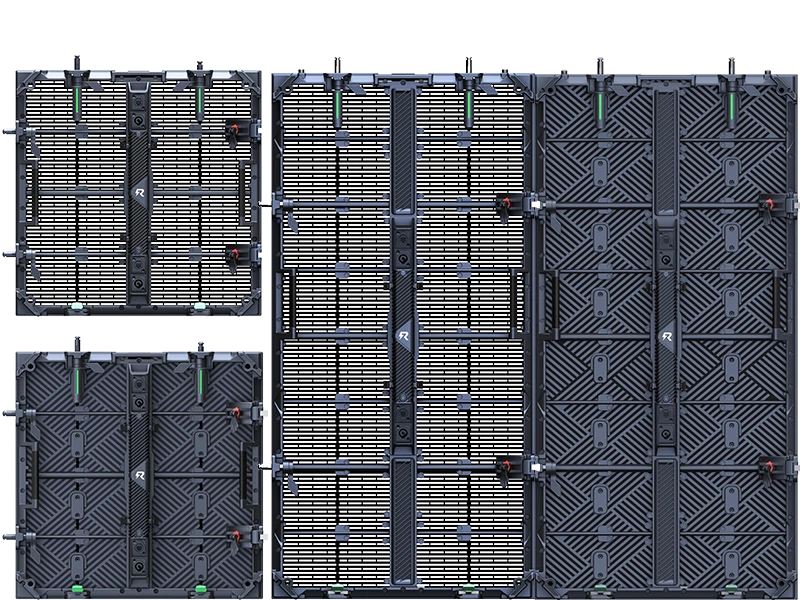
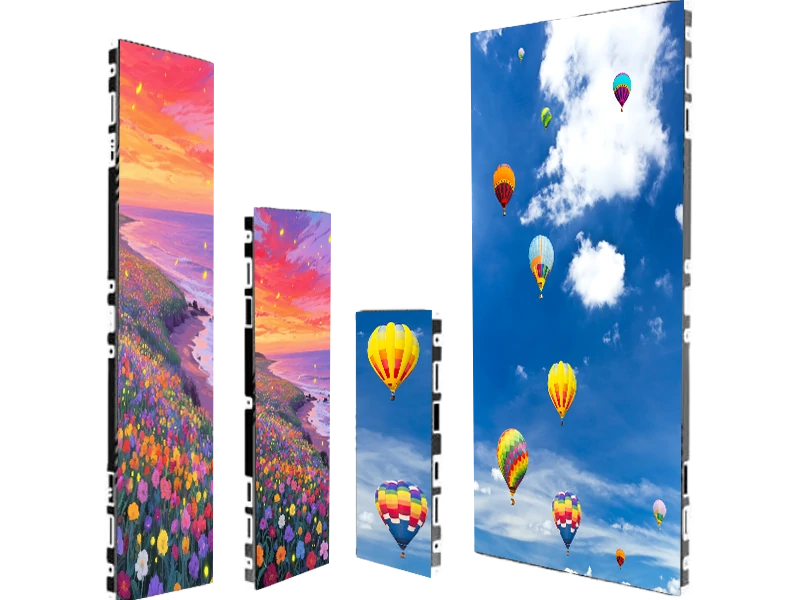
| Cabinet system | 500×500 and 500×1000 mixable, die-cast magnesium | Weight, speed of build, curve capability |
| Refresh rate | ≥3,840 Hz if filmed | Banding shows on camera instantly |
| Brightness | Indoor 800–1,200 nits; outdoor 4,500–6,000 nits | Daylight legibility |
| Aspect & size | Exact width × height in cabinets | Determines pixel-perfect fit and content resolution |
| Processor | Model, input capacity, backup unit | Single point of failure if ignored |
| Spares | Minimum 8–10% modules plus receiving cards and PSUs | Rental kit gets knocked around; plan for it |
| Flight cases | Road-ready, labelled, with packing list | Air freight and load-in depend on this |
| Rigging | Bars, chains, motors or ground stack defined | Often quoted separately or forgotten |
| Power | Total kW, distro, cables, phase balance | Venues notice, and generators cost extra |
| On-site tech | Number of technicians, hours included, overtime rate | The line item that saves shows |
| Insurance & carnet | Who holds it | Cross-border hires fail here most often |
Two things on that list deserve their own paragraph.
Spares percentage. For a fixed install I would say five to eight percent. For a hire job I say eight to ten percent, minimum. Rental cabinets travel. They get loaded by tired crews at 2 a.m., they get stacked in trucks, they get rained on during an outdoor bump-in. A failed module on a Tuesday morning is routine if you have spares and catastrophic if you do not. Make the spare count part of the quote, not a favour asked for later.
Processor redundancy. Everyone remembers to spec the panels. Half the people forget the processor is a single box that, when it dies, turns the entire wall black. Ask for a backup processor pre-configured and on site, or at minimum a hot-spare receiving card set and a laptop with the configuration file already saved. Ten minutes of preparation, zero drama on the night.
Numbers, because this is the section everybody scrolls for. These are typical ranges, not promises, and your actual quote will move depending on pitch, quantity, duration and location.
| Scenario | Typical rate | What is usually extra |
|---|---|---|
| Local hire, indoor P3.9, with crew and cases | USD 80–250 per m² per day | Content, rigging, generator, overtime |
| Local hire, outdoor P4.8 with waterproofing | USD 120–350 per m² per day | Structure, weather cover, power, permits |
| Direct from Chinese manufacturer, ex-factory | USD 40–120 per m² per day | Freight, carnets, insurance, local labour, tech travel |
| Technician day rate (Asian market) | USD 250–600 per day plus travel | Visa, flights, hotel, per diem |
| Backup processor rental | USD 150–400 per day | Often bundled, ask |
| Spare kit | Usually included at 8–10% | Confirm in writing |
A few things learned slightly painfully:
The wall itself is often only 40 to 55 percent of the total. Add rigging or ground support, power distribution, freight, insurance, carnets, labour, overtime, content creation and a contingency. Take the screen rate and multiply by roughly 1.8 to 2.2 for a realistic all-in figure. Projects panic less when the budget is honest early.
A quote that arrives within an hour at the bottom of the range is a placeholder, not a deal. A serious hire company needs dimensions, pixel map, venue access times, load-in window, ceiling height and whether there is filming. Someone quoting USD 30/m²/day without asking any of that is quoting air.
Duration discounts are real. A three-day show costs less per day than a one-day show. A week-long exhibition costs less per day again. Ask for tiered rates before the first quote lands, otherwise you negotiate against yourself after you have already shown your hand.
Rates held open for sixty days are suspicious. Panel availability shifts, freight shifts, and popular cabinet systems get double-booked in peak season. Seven to fifteen days is normal. Longer than that and the margin is hiding somewhere you will notice during load-in.
Deposit terms matter. Standard is 30 to 50 percent deposit with balance before dispatch or on delivery. Never transfer the full amount upfront on a first relationship, and always pay to the company name on the business license, not to an individual account.
Shenzhen and the surrounding region have thousands of LED businesses. A large share are traders with excellent photography. That is fine until a cabinet develops a fault at soundcheck and you need to know who answers the phone and whether they can reach the warehouse floor.
Ask for the business license. Check registered name, establishment date and business scope. A company formed fourteen months ago claiming fifteen years of rental experience has an arithmetic problem.
Ask for a live video call, not a video file. Say you want to see the warehouse at 3 PM their time. During the call ask them to walk to the rental storage area and show the actual cases, ideally with your enquiry reference written on paper next to them. Pre-recorded tours can be anybody's warehouse. People who cannot do live calls tend to develop sudden scheduling conflicts.
Check product focus. A genuine rental operator rents LED walls, processors, truss, cases and spares. If the same storefront lists solar lights, phone chargers and blenders, you are looking at a general trading account.
Verify certificates. Ask for certificate numbers and issuing bodies, then check on the issuer's own website. Expired certificates and certificates issued to a different company name are remarkably common. For venues with electrical inspection requirements, confirm compliance early, not the week before the show.
Request a recent job list. Names, dates, venues, wall sizes. Then pick one and ask a specific question about it — what went wrong, how it was fixed. Honest companies have stories. Dishonest ones have only highlights.
Ask for the aging and prep protocol. Decent operators run every hired batch through a full test and re-assembly check before it leaves the warehouse. Ask them to film your specific cases being tested. Hesitation is useful information.
Keep a second supplier warm. Not as leverage, as insurance. Supply chains shift and dates collide. Having a warmed-up backup quote saves shows.
Red flags: prices well below market with no explanation, refusal to put response times in writing, no independent test process, insistence on full payment upfront, payment to a personal account, "our warehouse is nearby, come visit" with no address given.
From confirmation to dispatch, a proper hire order needs the kit pulled, tested, re-assembled for checking, packed and documented. Allow seven to fourteen working days minimum for a standard job, longer if the cabinet system is specialised or the quantity is large. If someone promises three days on a 60-square-metre wall in peak season, they are pulling stock from another client's allocation. That other client will be very unhappy, and possibly it will be you.
Cross-border hire adds paperwork that does not forgive errors. ATA carnets or temporary import documentation, commercial invoices with accurate HS codes, packing lists with case-by-case weights and dimensions, and insurance covering transit plus on-site risk. Get the packing list early so your forwarder can quote properly, and confirm the duty treatment for temporary imports before finalising the budget — this is the line item that surprises people most often, usually on a Friday afternoon.
Work backwards from your load-in date and add two weeks. Every time. Factories book up, freight gets congested, customs officers have their own schedules, and none of them care about your curtain time. On top of that you have venue access windows, crane or motor bookings, rigging certification and local permitting. Any one of those can absorb three days without anyone doing anything wrong.
And one more, worth repeating: do the test build before it leaves the warehouse. Ask for photos or video of your exact wall built and lit in the warehouse, showing the full white, full black and a grey gradient. A wall that arrives on site already known to work is a completely different day than a wall that gets tested for the first time under stage lights.
Do we really need 3,840 Hz for a corporate event?
Only if someone is filming close. If there is a broadcast feed, a livestream or a lot of phone video from the front rows, yes, spec the high refresh. If it is a room full of people looking at a stage with no cameras closer than twenty metres, 1,920 Hz is functionally fine and the money is better spent on spares or a backup processor.
Can our own crew hang it?
Your crew can assemble ground stack, certainly. Flown walls need certified rigging, and people stand underneath them. A local rigger's fee is small compared with the alternative. Also confirm the venue's point-load limits and ceiling height before you commit to a design — discovering that on the morning of load-in is a special kind of bad.
What about power?
Indoor rental walls typically draw 400–700 W/m² peak depending on brightness and content. Outdoor runs higher. Confirm the venue's available supply, the phase balance and where the distro sits before the quote is finalised. Generator hire looks cheap until you add fuel and a quiet canopy.
Will the colour match if we add more wall later?
Reasonably well, if you keep the same cabinet model, insist on the same LED bin, and recalibrate on site. For a multi-day show with a possible extension, ask the supplier to hold matched stock rather than pulling from a different batch. Mixing batches from different suppliers is where colour matching goes to die.
Hire or buy for a recurring event?
If you run the same show format more than about twelve to fifteen times a year, buying starts to make sense — provided you have storage, a maintenance plan and someone who knows how to repair it. If it is a handful of events with changing sizes, hire is almost always the cleaner answer. Storage and depreciation kill more budgets than day rates do.
What happens when something breaks on the night?
This is where the contract matters more than the promise. A usable clause states: on-site technician present during show hours, response within 15 minutes during the event, spare modules and cards on site, and a clear statement of who pays for overtime and emergency replacements. Without an on-site tech, a warranty is a theory. With a tech, a failed module is a ten-minute job between sessions.
The conference that did it slowly and got it right. They started by asking for a warehouse test video of the exact build, confirmed 3,840 Hz because of the livestream, specified ten percent spares and a backup processor, and wrote the technician's hours into the contract including overtime rates. On day two a receiving card died during lunch. The tech swapped it in eight minutes and nobody in the audience knew anything had happened. That is what paying for spares buys — not a cheaper invoice, a quieter day.
The festival that bought on price. Roughly 50 square metres of outdoor wall, lowest quote available, no weather plan. It rained. The rear of the cabinets was not rated for the exposure they faced, two power supplies failed, spares were insufficient and the replacement parts were in another city. Lesson: for outdoor hire, confirm front and rear IP ratings, ask for the weather plan, and never let the spare percentage drop below ten percent on a touring job.
The retailer that over-specified. They asked for the finest pitch and highest refresh for a wall viewed mostly from six metres away by people walking past. It added about a third to the cost. After seeing a mock-up at actual viewing distance they dropped one pitch step and spent the difference on better graphics and a lighting pass. Honestly, good content beats marginal spec upgrades almost every time. A well-designed graphic on P3.9 outperforms a poorly designed one on P2.9, and the audience never asks what the pitch number was.
Comparing quotes by total instead of by line item. Two quotes at the same daily price can be completely different kit. Demand the cabinet model, pitch, refresh rate and processor brand on the quotation.
Forgetting the processor until load-in week. Input capacity, scaling, backup unit — discovering this late adds days.
Ignoring the content resolution. Design your artwork to the actual pixel map, not to a generic 1920×1080 assumption. Text rendered at the wrong resolution is the most common visual complaint, and it is entirely preventable.
Measuring the space optimistically. Confirm buildable width and height, sight lines from the side angles, ceiling height, door sizes for case access, and whether service access is possible with the final structure in place.
Skipping the rigging sign-off. Never let cost-saving happen here.
No lighting plan. A bright wall in a dark room works. A bright wall in a brightly lit room with no contrast planning looks washed out regardless of the nits rating.
Paying fully upfront. Standard terms exist for a reason. Always pay to the company name on the business license.
No post-show plan. Return packing, damage assessment, deposit refund timeline. Agree this before the wall ships, not after something gets scratched.
If I were hiring an LED video wall today I would shortlist three suppliers who can prove they physically hold the kit, ask for a warehouse test video of my exact build, insist on ten percent spares and a backup processor on site, and write the technician's hours and overtime rates into the contract before I signed anything. I would budget roughly eighty to one hundred and twenty percent on top of the per-square-metre day rate for rigging, power, freight, carnets, insurance, labour, content and contingency. And I would insist the first test happens in the warehouse under controlled conditions, not for the first time under stage lights with a room full of clients walking in.
It is not the fastest route. It is the route that does not end with you explaining to a room why the screen has a dark patch, forty minutes before the keynote starts.
Have you had a hire job where the kit looked great in the brochure and wrong on the day? The specific failures are the most useful part of this whole process, and hearing what actually happened on site helps everyone make better calls next time.
1. Where do I find china led video wall hire manufacturers?
Start with verified B2B platforms, industry trade shows such as Integrated Systems Europe and InfoComm, and referrals from regional integrators. Then apply the verification steps: business license check, live warehouse video call with your enquiry reference visible, certificate number checks on the issuer's website, a recent job list, and written response-time commitments.
2. How much does it cost to hire an LED video wall from a Chinese manufacturer?
Direct ex-factory hire typically runs USD 40–120 per square metre per day; local hire with crew and cases runs USD 80–250 per square metre per day indoor, USD 120–350 outdoor. Freight, carnets, insurance, rigging, power, labour, content and overtime are extra, and usually double the screen rate.
3. What pixel pitch should I hire for an indoor event?
P3.9 is the workhorse for general indoor events and stages. P2.9 suits closer viewing distances and broadcast environments. P4.8 is common for outdoor stages and facades. Base the choice on closest viewing distance and whether cameras will be filming close.
4. How do I know if a hire supplier actually owns the kit?
Check the business license scope and establishment date, request a live video walkthrough of the rental warehouse and flight cases with your enquiry reference visible, review their rental-only product range, ask for a recent job list with venues and dates, and request footage of your specific batch being tested.
5. What spare parts percentage should I require for a hire job?
Eight to ten percent minimum for indoor jobs, ten percent or more for outdoor and touring work. Include spare modules, receiving cards and power supplies, and confirm they travel in the same shipment as the wall.
6. What warranty or failure response should be in the contract?
On-site technician present during show hours, response within 15 minutes during the event, spare kit on site, replacement parts dispatched within 24 hours for longer jobs, clear statement of who pays freight and overtime, and a defined post-show damage assessment and deposit refund timeline.
7. What is a realistic lead time for hiring an LED wall?
Seven to fourteen working days minimum from confirmation to dispatch for testing and packing, plus freight and customs time for cross-border jobs. Work backwards from your load-in date and add two weeks.
8. Do I need an ATA carnet for cross-border hire?
For temporary imports into most countries, yes — or equivalent temporary admission documentation. Confirm the required paperwork, HS codes and duty treatment with your forwarder before finalising the budget, and ensure insurance covers both transit and on-site risk.
9. Should I hire or buy for repeated events?
If you run the same format roughly twelve to fifteen times a year or more, buying can make sense if you have storage, a maintenance plan and trained staff. For occasional or variable-sized events, hiring is nearly always cleaner and cheaper once storage and depreciation are counted.
10. What is the biggest mistake people make when hiring an LED video wall?
Choosing on day rate alone and forgetting the hidden costs: processor and backup, rigging, power distribution, spares, freight, carnets, insurance, labour, overtime, content and contingency. Compare line items not totals, demand a warehouse test video of the exact build, and keep a second supplier warm as insurance.
.jpg "Who Are the Best China Conference LED Video Wall Manufacturers?")