 English
Vetting legitimate wholesale 8k led display manufacturers comes down to three concrete benchmarks: first, the vendor must own an automated Flip-chip COB (Chip-on-Board) or MIP (Micro LED in Package) SMT line inside a certified Class 100 cleanroom; second, their processing pipeline must support native 8K@60Hz 4:4:4 uncompressed input with low latency through flagship systems like NovaStar COEX or Brompton; third, they must hold verifiable UL 62368-1, FCC Class B, and CE-LVD/EMC certifications issued directly to their manufacturing legal entity. If a vendor cannot provide proof of all three, move on.
When you are sourcing hardware for a flagship enterprise lobby in Manhattan, an executive boardroom in London, or an XR virtual production stage in Burbank, typing "wholesale 8k led display manufacturers" into a search bar hits you with hundreds of trading companies posing as mega-factories. Quotations swing wildly from $2,500 to $18,000 per square meter, datasheets throw around buzzwords like "DCI-P3" and "7680Hz refresh rate," and the moment you ask about sub-millimeter flatness tolerances or binning certificates, sales reps start dodging your calls. What should you do? Let's dive in!
Here is a question we should ask ourselves before sending out an RFP: does buying an 8K LED display simply mean getting a wall with 7680×4320 individual diodes?
Not even close. Assembling over 33 million micro-diodes onto a seamless indoor surface introduces brutal thermal buildup, massive signal bandwidth bottlenecks, and microscopic mechanical tolerances. When we use ultra-fine pitch displays in everyday commercial spaces, the real challenge is thermal expansion. If you are deploying a P0.9375mm screen measuring roughly 7.2 meters wide by 4.05 meters tall, an expansion offset of just 0.08mm between die-cast cabinets creates visible black lines or bright seams under direct downlights. Add in color shifts caused by uneven driver IC heat dissipation—where the center of your screen turns warm yellow while the corners stay cool white—and your multi-million-dollar boardroom investment turns into an eyesore. Commercial buyers in Western markets demand long-term structural and optical stability, not just paper specs.
Vendors love throwing acronyms at procurement teams. But some friends want to know which packaging architecture actually fits their physical venue and maintenance budget. Here is how the three dominant packaging methods compare on the production floor:
| Technical Spec | Flip-chip COB | MIP (Micro in Package) | Traditional SMD (1010/0808) |
|---|---|---|---|
| Typical Pixel Pitch | P0.4 – P1.25 mm | P0.6 – P1.5 mm | P1.25 – P2.5 mm |
| Surface Ingress Protection | IP65 (Impact, dust, & moisture proof) | IP54 (Conformal coating on face) | Non-rated (Exposed wire-bonded LEDs) |
| Defect Rate (Field PPM) | < 5 PPM / year | 10 – 20 PPM / year | 50 – 100+ PPM / year |
| Contrast Ratio | Up to 20,000:1 (Nano-black resin) | 10,000:1 (Matte black mask) | 3,000:1 – 5,000:1 |
| Horizontal / Vertical Angle | 170° / 170° (Minimal chromatic shift) | 160° / 160° | 140° / 140° (Noticeable color drop) |
| On-Site Reworkability | Module-level magnetic swap / vacuum | Single-pixel micro rework possible | Traditional soldering (Risks lifting pads) |
| Factory Wholesale Cost | Premium (High capital equipment) | Moderate to high | Low (Aging production lines) |
| 8K Deployment Rating | Recommended for permanent walls | Great for rental or modular builds | Not recommended for 8K resolution |
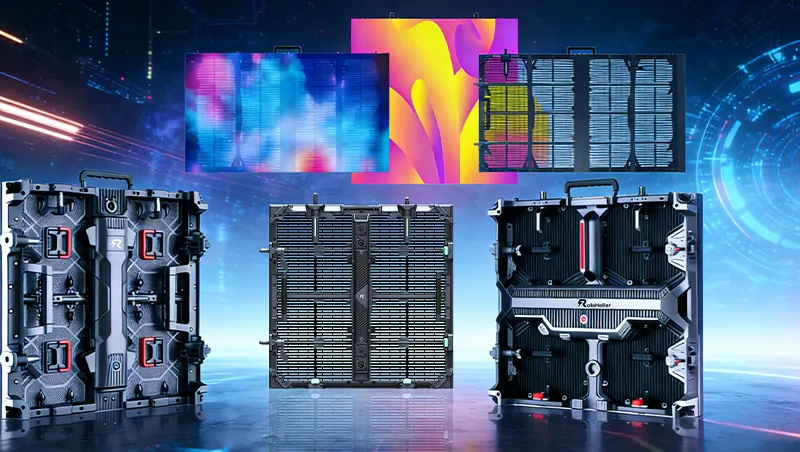
In overseas B2B trade, plenty of middleman operations set up sleek showroom videos and brand themselves as top-tier wholesale 8k led display manufacturers. What I always use to separate real manufacturers from brokers is a quick review of four internal hardware choices:
Factory Tip: Never accept marketing brochures at face value. Demand an unedited, real-time video call showing their high-speed pick-and-place lines (such as Yamaha or Panasonic SMT machines), vacuum reflow ovens, and darkroom optical calibration gantries. If they cannot show you this equipment running, they are outsourcing your boards.
Keep an eye out for these widespread corner-cutting tactics:
Batch Mixing (Binning Fraud): Quality factories bin wafers strictly by forward voltage (within 0.05V) and dominant wavelength (within 1.5nm). Shady suppliers purchase mixed remnant bins at discount prices; the display looks passable playing fast-moving demos, but switches to an uneven, mottled mess the second you pull up a clean white spreadsheet or corporate presentation.
Fake Refresh Rates via Cheap Driver ICs: Claiming "7680Hz" on a product sheet is easy when using basic dual-latch driver ICs driven past their limits. Point a broadcast camera or smartphone at the panel at 1/1000s shutter speed: scanlines and dark ghosting bands immediately appear. True broadcast compliance requires high-tier PWM constant-current driver ICs (Macroblock, Chipone, or equivalent).
Open-Frame Power Supplies: Power supplies fail long before the LEDs do. Premium factories use sealed, low-noise, common-cathode aluminum-casing power supplies that run 20% cooler with 90%+ power efficiency. Budget builders throw in unbranded open-frame power units that emit audible coil whine and pop capacitors after 18 months of daily use.
Software Interpolation Masquerading as Native 8K: Transmitting native 8K requires serious bandwidth. Some suppliers cut costs by shipping underpowered 4K processors and using internal hardware upscaling to stretch the canvas across 8K resolution, producing soft text and jagged vector graphics.
Detailed testing steps make all the difference, so let's look at the verification workflow. Before issuing a 30% deposit or signing off on pre-shipment inspections, run these practical tests on the sample cabinets:
72-Hour Thermal Burn-in Scan
Require the factory to run a 72-hour full-white burn-in test at 100% brightness. Scan the rear chassis with a handheld FLIR thermal camera. Temperature variance across the cabinet backplate should stay within 4°C to 5°C. Any hot spot exceeding 68°C indicates poor thermal pathways that will degrade the surrounding LEDs prematurely.
Low-Grayscale Purity Check
Lower the screen brightness down to 5%–10% and cycle through red, green, blue, and white solid colors. Low-grayscale performance exposes driver inconsistencies, micro-banding, and noisy pixel jitter that remain hidden under full brightness. Transitions must remain linear and smooth.
High-Speed Shutter Verification
Set a professional DSLR or mirrorless camera to manual exposure with a shutter speed of 1/1000s, then 1/2000s. Pan smoothly across the panel surface while playing a video with fine gradients. If rolling black bars or color breakup appear on your monitor, the PWM frequency is insufficient for broadcast or studio use.
Four-Corner Mechanical Interlock Test
Snap four cabinets together on a precision granite inspection table. Run a steel feeler gauge along the horizontal and vertical seams. Mechanical gaps must measure under 0.05mm. Run your bare fingers across the joints; you should feel zero tactile lip or stepping between panels.
Certifying Agency Audit
Take the UL or ETL listing number from the cabinet serial label and search it directly inside the official OSHA-recognized NRTL online directories. Confirm that the company name on the certificate matches the manufacturer's operational business license.
Wholesale builds need to adapt specifically to the deployment environment:
Executive Corporate Briefing Centers: Prioritize whisper-quiet operation and eye comfort. The display should utilize a completely fanless, passive-cooling chassis design to keep ambient noise floor below 20 dBA during board meetings. Look for factory-applied anti-glare (AG) surface treatments and low-blue-light certifications to minimize glare from overhead office lighting.
Broadcast Newsrooms & XR Virtual Production Stages: Demands lean heavily toward color space coverage and synchronization. Hardware must cover at least 98% of the DCI-P3 color gamut, feature dedicated Genlock frame synchronization to lock onto external master clocks, and guarantee ultra-low pipeline latency (sub-1 frame) to eliminate lip-sync and tracking mismatches.
When evaluating wholesale pricing, remember that the display panels represent only a portion of the total hardware deployment:
| Budget Item | Typical Share of Total Spend | Key Components & Engineering Requirements |
|---|---|---|
| LED Modules & CNC Die-Cast Cabinets | 55% – 63% | Flip-chip COB/MIP modules, CNC magnesium or aluminum cabinets, high-speed internal ribbon/floating connectors |
| Processing & Signal Distribution | 13% – 18% | 8K@60Hz master processors (NovaStar CX80 Pro / Brompton SX40), 10G/40G fiber transceivers, zero-latency pipeline |
| Power Distribution & Protection | 6% – 8% | Common-cathode power supplies, motorized PLC power distribution boxes with sequential boot and surge protection |
| Spare Parts Provisioning | 5% – 8% | 3%–5% spare modules from the exact same wafer batch, 10% spare PSUs and receiver cards, vacuum extraction tools |
| Heavy-Duty Export Packaging | 3% – 5% | Custom non-fumigation plywood crates with high-density EVA foam inserts, anti-static moisture barrier bags |
| Factory Calibration Data & Warranty | 4% – 6% | Stored Chroma/Luma calibration files per module, 3 to 5-year replacement SLA with advance component exchange |
When we deal with overseas hardware manufacturers, squeezing prices to the absolute floor usually backfires. Micro-pitch manufacturing carries fixed silicon and cleanroom overheads. When a supplier gets backed into an impossible margin corner, they quietly substitute lower-grade decoupling capacitors, drop from 6-layer to 4-layer PCBs, or use recycled aluminum alloys that warp under summer building temperatures.
What works far better is holding the line on contract performance guarantees. Tie milestone payments to zero dead pixels at factory acceptance testing, and make it mandatory that the factory archives the raw optical calibration coefficients for every spare module included in your shipment. This way you can swap a damaged module two years from now, push the calibration data via software, and avoid an awkward mismatched patch in the middle of your 8K wall. Hope this helps you navigate vendor conversations with confidence!
Most Tier-1 and Tier-2 factories do not set a strict square-meter minimum for standard pixel pitches like P0.9375mm or P1.25mm, typically fulfilling orders starting around 5 to 10 square meters (roughly 20 to 40 standard cabinets). For custom-engineered cabinet dimensions or curved structural frames, MOQs generally start at 25 to 30 square meters.
P0.9375mm is the benchmark for standard executive boardrooms because it achieves native 8K resolution (7680×4320) across a manageable 7.2m × 4.05m (approx. 330-inch) footprint. If your venue has a larger viewing distance, such as a 12-meter-wide auditorium wall, P1.25mm or P1.56mm becomes the more cost-effective choice.
Flip-chip COB eliminates microscopic gold bonding wires by bonding diode chips directly to the PCB board. This layout provides exceptional thermal dissipation, delivers wide viewing angles with zero edge tinting, and seals the front surface in tough resin, dropping field dead-pixel rates from 50+ PPM down to under 5 PPM.
For the United States and Canada, displays require UL 62368-1 (or equivalent ETL listing) for electrical safety alongside FCC Part 15 Class A or Class B for electromagnetic interference. For the European Union, products must carry CE marks covering both the Low Voltage Directive (LVD) and Electromagnetic Compatibility Directive (EMC), as well as RoHS compliance.
Always specify 3% to 5% spare LED modules manufactured from the exact same wafer batch and color-binning lot. In addition, include 10% spare power supply units, 5% to 10% spare receiving cards, extra data/ribbon cables, and at least two vacuum extraction service tools.
Uncompressed 8K@60Hz at 4:4:4 10-bit color requires high-bandwidth inputs via HDMI 2.1 (up to 48 Gbps) or DisplayPort 1.4 / 2.0 with DSC. From the primary controller out to the LED wall, transmission must run through 10G or 40G optical fiber links, as standard 1Gbps copper Ethernet cables lack the bandwidth to carry native 8K video streams without heavy compression.
Standard micro-pitch orders take between 25 and 35 business days for SMT mounting, assembly, and mandatory 72-hour burn-in calibration. Custom cabinets or large-volume production runs require 40 to 55 business days. Ocean transit to West Coast US ports takes approximately 18 to 22 days, while shipments to East Coast ports or Western Europe require 30 to 40 days.
Connect 4 to 6 sample cabinets on a flat floor and slide a credit card or a 0.05mm feeler gauge across the intersections; the card should pass without catching on cabinet edges. Next, fire up a pure gray field (20% to 30% brightness) on the screen: any cabinet misalignments will immediately show up as distinct dark or glowing seam lines.
Established factories offer a 2 to 3-year standard factory warranty on parts, with options to purchase extensions up to 5 years. Standard service terms operate under an advance parts exchange model, where the client uses on-site spare inventory while defective modules are returned to the factory or regional service hub for precision rework.
Specify reinforced, non-fumigation plywood crates built to international export standards, lined with high-density EVA shock-absorbing foam cut specifically to cabinet dimensions. Each cabinet must be vacuum-sealed in an anti-static barrier bag with silica gel desiccant packs to prevent saltwater condensation and oxidation during long ocean crossings.





.jpg "DIY LED Sign Display Manufacturers | Factory Kits & Parts")
.jpg "LED display manufacturers in USA?")