 English
The event is in six weeks. The client changed their mind about the stage layout twice, the venue will only allow load-in between seven and nine in the morning, and your boss has just asked whether the portable screen can be set up by two people in under twenty minutes because the labour quote came back higher than the screen itself. You open a new tab and type china portable led display screen manufacturers into the search bar, and within thirty seconds you are looking at forty-seven companies that all claim to be "the leading manufacturer" with "best quality and competitive price" and photos of the same trade-show booth.
Short answer, before the long version: the right portable LED supplier is the one who can prove three things — actual panel weight and setup time with real hands on a real floor, brightness and refresh performance at the conditions where your event actually happens, and spare parts plus a named contact who still works there when you need a replacement panel nine months later. Everything else on the page is decoration. For most buyers in the US or Europe, the practical route is either a mid-size Guangdong maker that does rental-grade stock and will ship sample panels, or a domestic rental-house or distributor who adds margin but handles freight, certification, and the midnight phone call when a panel dies during load-in.
Now the detail, which is where portable buys go wrong, because portable means more moving parts and more failure points than a fixed install, and whatever mistake you make you make it in front of an audience that paid for tickets.
This is where most confusion starts. A buyer asks for a portable screen and gets quoted for something that needs four people and a ladder. Or they get a lightweight foldable panel that looks brilliant in a showroom and turns invisible the moment someone opens the hall doors at noon.
| Type | What it is | Best use | Where it fails |
|---|---|---|---|
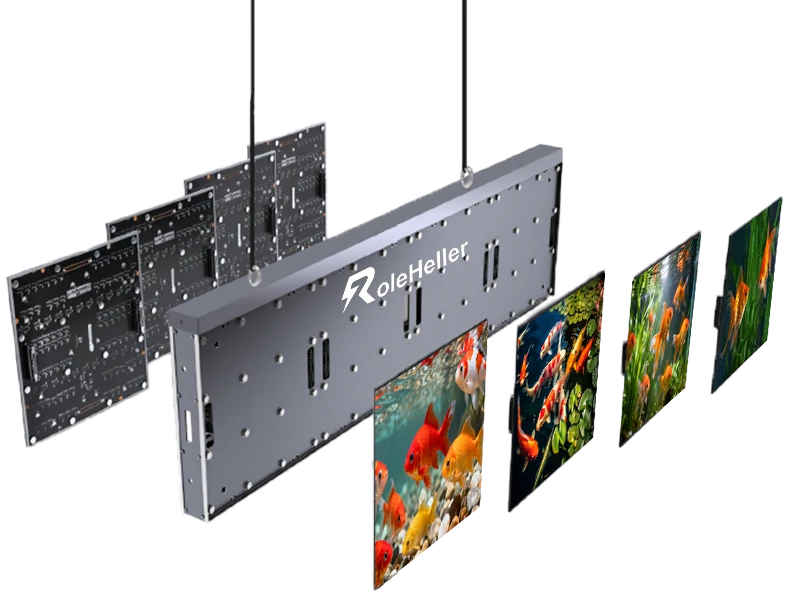
| Foldable / soft-module panel | Light fabric or thin PCB modules on a flexible frame | Small stages, churches, schools, pop-up retail, tight budgets | Low brightness, poor flatness, seams show on solid colours, slow to tension properly |
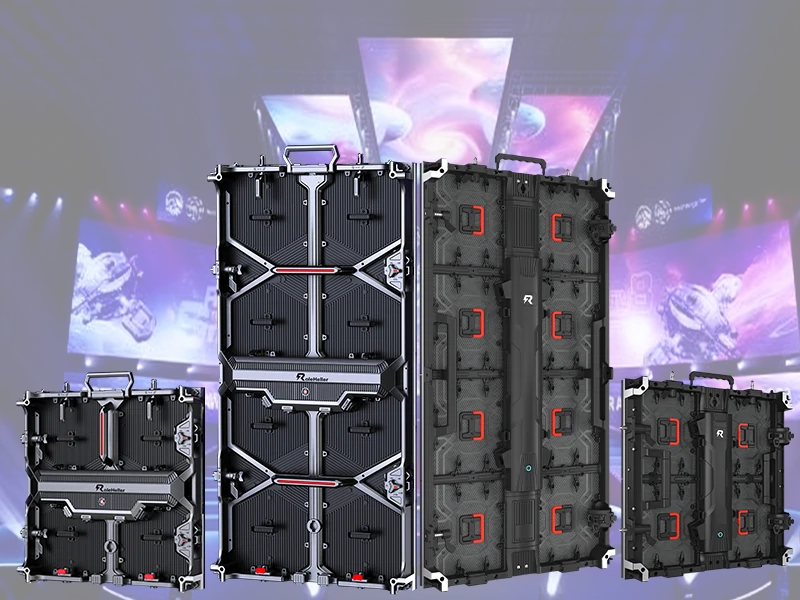
| Die-cast aluminium rental cabinet (500×500 / 500×1000) | Locking cabinets, front/rear service, quick-lock hardware | Concerts, conferences, touring, broadcast | Heavy per panel, needs cases, needs trained crew |
| Suitcase / all-in-one with wheels and stand | Cabinet + frame + controller in one case, pull-up like luggage | Roadshows, trade shows, single-operator demos | Small sizes only, limited brightness, fragile latches |
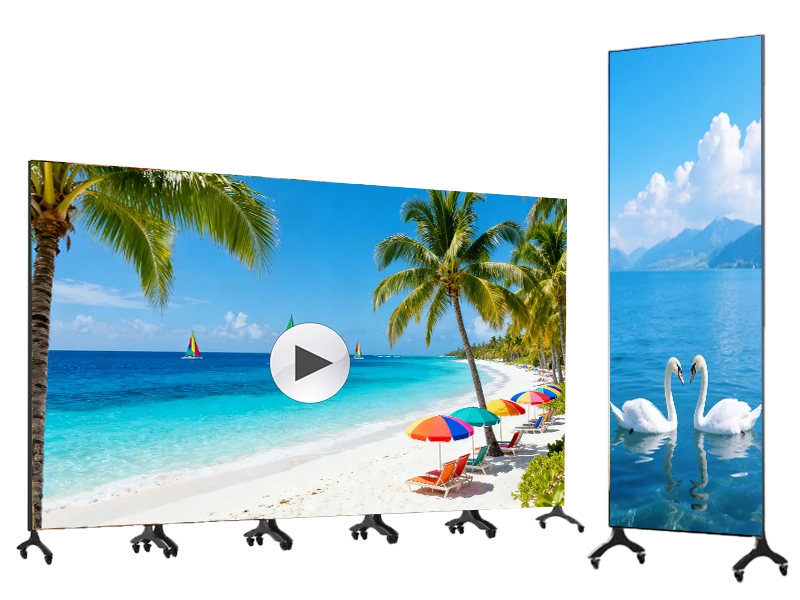
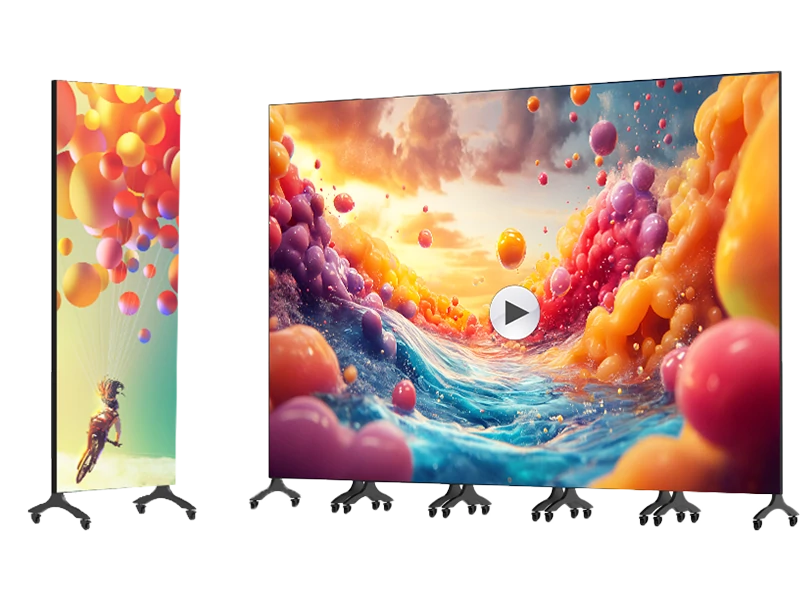
| Tripod / poster / banner LED | Narrow vertical format, standing on legs | Doorways, registration areas, wayfinding, photo walls | Wind kills it outdoors, low resolution, tipping hazard |
| Battery-powered / wireless unit | Built-in battery pack, sometimes Wi-Fi content | Outdoor festivals, parades, locations with no power | Runtime rarely matches the spec, batteries degrade, heavy |
One thing worth saying early: portable does not automatically mean lighter, and it definitely does not mean simpler. A foldable panel saves on freight and crew, but it trades away flatness and brightness. A rental cabinet gives you a proper image and proper rigging points, but it demands cases, a truck, and people who know how to lock the corners. Picking the wrong type is not a supplier problem, it is a failure to define how the thing actually gets moved and who moves it.
Measure the door. Seriously. I have seen a beautiful order arrive on time and then sit in a loading bay because nobody checked whether the assembled wall would fit through the venue's service lift. The largest dimension that matters is not the screen size, it is the size of the smallest doorway between the truck and the stage.
Weight per panel and total system weight. This is the number that decides everything else — crew size, flight case count, whether you need a lift gate, whether the venue charges extra for rigging. Ask for the weight of a single cabinet including the module, the receiving card, the power supply, and the locking hardware. Not the module weight. Not the "net weight" of a bare cabinet. Suppliers who quote module-only weight are hiding roughly forty percent of the real figure. Then multiply by your panel count and add twenty percent for cases and structure. That is the number you give the rigger.
Setup time, measured with a stopwatch. Ask them to film it: two people, uncase, build a 3×2 wall, power up, display an image, strike, and re-case. Time it. Anything under fifteen minutes for a modest wall is good. Anything over thirty means you are paying for labour you did not budget. And watch whether they need tools. Tool-free locks are the whole point of portable; if a hex key appears in the video, ask why.
Brightness and where it is measured. Indoor events need 800–1,500 nits. Daytime outdoor or bright atriums need 4,500–6,000. But datasheet brightness is measured on a fresh module at full white in a lab, and nobody runs a portable screen at full white. What you need is legibility at the actual ambient light level, with the content you actually run. Ask for a demo video shot in daylight, not in a darkened showroom. If they only have showroom footage, that tells you something.
Refresh rate and camera performance. Portable screens get filmed constantly — corporate videos, livestreams, social clips. A panel that looks smooth in person can throw bands across the feed if the refresh rate and scan design do not match your camera's shutter. Push for 3840 Hz if you record regularly, 1920 Hz minimum, and test with your own camera. Different cameras behave differently, which is exactly why factory reels cannot be treated as evidence.
Flatness and seam gap. For close-up work — and portable screens often sit much closer to the audience than a fixed install — you want gap under 0.1mm and flatness within 0.2mm. Otherwise a grid shows up on solid colours, and solid colours are what you have when someone puts a logo on the screen. Flatness is a tooling and lock-design issue. Cheap tooling shows up here first, and it shows up worst after the tenth load-in, when the locks have taken a beating.
Front service and module access. If a panel dies in the middle row, can you swap it from the front without taking the wall apart? If the answer is no, you are buying downtime. Front-access modules and front-access power supplies are worth paying for on anything that gets toured.
IP rating and dust. IP54 minimum for indoor rental, IP65 if it goes outside. But the real killer for portable gear is not rain, it is dust and the constant assemble-disassemble cycle that works seals loose over time. Ask how the cabinet seals, whether gaskets are replaceable, and whether there are spare gaskets in the case.
Power draw and whether it runs on standard circuits. A 3×2 wall of P2.9 cabinets might pull anywhere from 800W average to 2.5kW peak depending on drive design and content. Ask for average draw at fifty percent brightness with typical content, not peak white. Venues charge for power, circuits trip, and generators get sized wrong. Also ask whether common-cathode drive is available — it cuts consumption and heat noticeably, and heat is what kills panels sitting in cases between shows.
Cases and how they pack. Flight cases with custom foam, wheels, and a weight low enough that one person can move them. Cardboard is how panels arrive cracked. And check the case count against your van: a 3×2 wall split across eight heavy cases is a different logistics problem than the same wall in three cases.
Q: Should we buy foldable soft panels or proper rental cabinets?
A: Depends on viewing distance, ambient light, and how often it moves. Under about four metres with decent lighting control, a good foldable panel is genuinely useful and the freight savings are real. Beyond that, or anywhere with strong ambient light, rental cabinets win on brightness, flatness, and repairability. Do not pay for foldable convenience and then complain the image looks soft. You bought soft, you got soft.
Q: Do we need a video processor?
A: If you switch sources — laptop, camera, playback, conferencing codec — yes. The controller handles the panel; the processor handles the switching, scaling, and picture adjustment. Novastar, Colorlight, Linsn dominate the controller space. Confirm input count, confirm licensing, and confirm someone on your team knows how to operate it. A screen nobody can switch becomes a very expensive poster, and at an event that means it stays blank for the first twenty minutes while someone finds the password.
Q: What about battery-powered units?
A: Useful in specific situations — parades, outdoor ceremonies, places where running cable is impossible. Treat the runtime spec as optimistic by about thirty percent, and remember that batteries lose capacity every year. Ask what the rated capacity is in watt-hours, not "up to 6 hours," and ask how many charge cycles the pack is rated for. Also, batteries add weight and they complicate air freight considerably. Shipping lithium packs internationally is a paperwork exercise you do not want to discover the week before the show.
Q: Does the manufacturer handle installation?
A: Sometimes through a local partner, often not. Honest answer: the manufacturer makes panels and the crew makes the install work, and blaming the wrong party later is a very common outcome. Decide early whether you want one responsible party — an integrator or rental house, at a markup — or whether you will run your own crew and save money. Both are valid. Mixing them halfway through causes problems.
Q: How long will portable gear last?
A: Realistic life for well-handled rental cabinets is five to eight years, with power supplies, locks, and possibly fans replaced along the way. Brightness declines gradually. Panels that get loaded in and out every week age faster than panels that sit in a church hall twice a year. Plan a replacement budget instead of assuming permanent service, and plan for the control software to become obsolete before the panels do.
Q: Do we need to visit the factory?
A: Not required. One visit does more than six weeks of email, though. If travel is not possible, hire a third-party inspector in Guangdong for a day — a few hundred dollars, pays for itself immediately — and insist on a live video walkthrough of the aging room. Better still, try to see a unit they shipped two or more years ago. A showroom panel lies. An aged panel tells the truth.
Which LED lamp brand and bin, and will you retain my batch records? Bin is the colour and brightness grouping. Mix bins and you get patches. When you need five replacement panels in year three, matching is everything. Most suppliers will not volunteer to keep batch records; you have to ask, and you have to get it in writing.
Can I see a per-panel calibration report? Legitimate makers calibrate panel by panel and store the data. No report means no calibration, which means living with uneven patches forever. Also ask whether calibration data survives a panel swap — some systems keep it on the receiving card, some in software. The answer determines how painful maintenance becomes.
What driver IC and scan mode? Constant current is baseline. Names worth recognising: Macroblock MBI5124/MBI5153, ICN2038S, SM series. Two panels can look identical and contain completely different internals. Ask for the bill of materials by brand and model number.
What is the exact weight per cabinet including hardware, and what is the weight of a fully packed case? These are two different numbers and both matter.
Can you send a timed setup video with two people, unedited, from uncase to image on screen? If they send a polished marketing film instead, ask again.
Is it front-service, and how do I reach the power supplies? Power supplies fail before anything else. Plan access now, while nobody is emotionally invested in the stage design.
What is the measured noise level? Fans in a quiet conference room are genuinely disruptive, and it is the complaint that arrives in month six rather than on day one. Ask for dB at one metre.
Who do I call after year two, and do you hold spares from my batch? Sales reps change companies constantly in this industry. I usually ask for three to five percent of the panel count up front, same batch, shipped with the order. It is the cheapest insurance you will buy.
One thing I tell people: if a supplier cannot name the parts inside their own cabinet, they did not build the cabinet.
I am not going to claim trading companies are bad. Some of the smoothest transactions I have been part of were with traders who understood the spec, held stock, and shipped in ten days when the factory was booked solid. What matters is knowing which one you are dealing with, because warranty claims, batch matching, and technical support all flow through that relationship.
| Signal | Actual factory | Trading company / assembler |
|---|---|---|
| Product photos | Same machines, same floor angles across years; close-ups of SMT placement, aging racks, lock testing | Stock renderings, showroom shots, images lifted from other brands' brochures |
| Datasheet | Owns the numbers: cabinet dimensions, module size, scan mode, IC model, brightness curve, power draw | Rebranded PDF, sometimes with another company's logo still in the footer |
| BOM detail | Gives lamp brand, driver IC, power supply brand by model | "High-quality imported LEDs" / "premium components" |
| MOQ | Higher, but will do custom cabinet sizes and pitches | Very low, fast, mostly standard SKUs |
| Lead time | Honest and longer, three to six weeks made-to-order | Suspiciously short unless pulling from stock |
| Video call | Walks you past the aging room on the spot | Camera broken, person on holiday, factory under renovation — always something |
One thing worth saying: plenty of genuine factories also run a trading desk for smaller orders. So the test is not "factory good, trader bad." The test is whether they can show you the line and name the parts.
Also worth noting plainly: "made in China" is not the risk here. Most of the world's LED panels come out of Guangdong regardless of whose logo is on the case. The exposure is in calibration discipline, bin control, batch record retention, and whether the person answering your message at two in the morning Beijing time knows a receiving card from a sending card. That last one is not a joke. I have had that conversation twice.
Numbers move with LED package markets and exchange rates, so treat these as ballpark. What matters is confirming what sits inside the number.
Indoor rental-grade portable, per square metre, FOB:
P2.6–P2.9 die-cast rental cabinet systems: roughly $1,600–$3,500 depending on whether cases, controllers, processors and spares are included
P3.9–P4.8 outdoor rental: roughly $1,100–$2,400
Foldable / soft-module panels: roughly $900–$2,200
All-in-one suitcase units (per unit, small sizes): roughly $1,500–$5,000
Panels alone — meaning no cases, no controllers, no structure — run materially lower. Which is exactly why comparing "per square metre" quotes across suppliers is meaningless unless you confirm what is included.
Always confirm in writing: panels only, or panels plus cabinets plus receiving cards plus power supplies plus controller plus video processor plus cables plus flight cases plus structure or stands plus crating plus shipping terms plus spare parts plus on-site commissioning. A quote that comes in thirty-five percent cheaper than the others almost always excludes cases, controllers, and commissioning. It is not a discount. It is a different product.
Costs that get forgotten routinely: flight cases (real ones, not cardboard), spare panels and power supplies, freight and duties, inland trucking and lift-gate service, rigging hardware and labour, electrical work and venue power fees, operator training, replacement lead time after warranty since air freighting panels can cost more than the panels themselves, and battery replacement down the line if you went battery-powered.
And electricity, which nobody thinks about until the invoice arrives. A large wall running through rehearsals, doors-open time, and the event itself carries real demand charges. Common-cathode drive and auto-dimming cut consumption noticeably. Ask for an annual kWh estimate based on your actual usage pattern, not just peak wattage. Over five years that figure is real money, and in some organisations it is the number that gets a capital request approved.
Step 1 — Write your own spec. Do not accept the supplier's template. Pixel pitch, cabinet dimensions and material, panel weight including hardware, brightness target, refresh rate, lamp brand and bin, driver IC, power supply brand, receiving card, scan mode, operating temperature range, noise limit, IP rating, service direction, case specification, voltage and plug type, required certifications, spare parts commitment. Have them sign it back as the basis of the quote. When the goods arrive you check against this document. Without it you have nothing to check against.
Step 2 — Get a physical sample panel. Two or three actual panels, not photos. Check uniformity at low brightness, hunt for dead pixels, check connector fit, lay a straightedge across the surface, and run it for forty-eight hours straight. A panel that develops a warm corner after six hours has a thermal problem no spec sheet mentions. Better still, borrow or rent a small section and put it through an actual event. Let the crew handle it. Let the person who loads the truck lift a case. Three days of real use teaches more than three weeks of PDFs.
Step 3 — Audit if you cannot travel. Third-party inspection for a day, verifying SMT line count, aging room capacity, calibration equipment, lock and drop testing, and whether the company name on the business license matches the name on the quote. Name mismatches happen more often than expected.
Step 4 — Payment terms that protect you. Standard is thirty percent deposit, seventy percent before shipment or against copy of bill of lading. Never pay everything upfront. On larger orders use a letter of credit. Tie final payment to passing a pre-shipment inspection you arrange, not one they arrange.
Step 5 — Pre-shipment inspection. Panel count, batch numbers, burn-in records, random photometric spot checks, cabinet fit and lock function, case fit and foam. Anything that moves should travel in custom-fit foam flight cases. Cardboard boxes for ocean freight is how panels arrive cracked.
Step 6 — Test everything on arrival, before the first event. Power up every panel in the warehouse. Build a small wall. Find a dead panel on the ground and it is a five-minute swap. Find it after the wall is built and the talent is walking on stage in twelve minutes, and it is a whole different day.
Step 7 — Commission and document. Calibrate at actual operating brightness. Photograph serial numbers. Keep a spreadsheet with serial, purchase batch, event count, and the name of the person who handled your order. A direct line to someone who remembers your project two years later is worth more than a slightly better price.
Step 8 — Train the crew, not just the manager. Write a one-page load-in sheet: which case holds what, which cable goes where, what to do when a panel goes dark. Laminate it and put it in the case. The person who actually sets this up at seven in the morning is not the person who signed the purchase order, and they will not have read the manual.
Ordering by pitch alone. Two P2.9 panels can differ enormously in lamp brand, scan design, lock quality, and calibration. Pitch is a starting point, not a specification.
Buying for the showroom. Suppliers keep their best-calibrated, newest-batch panels in the showroom. The production order comes from whatever batch is running that week.
Skipping spares. Panels fail, always. Skipping spares to save two percent is false economy, and when a screen is dark during load-in nobody cares about the savings.
Underestimating case count and weight. A wall that fits in three cases is a two-person job. The same wall in eight cases is a four-person job plus a bigger van. Freight gets priced on volume and weight, and the difference shows up immediately.
Assuming any surface can take the load. Get the load calc, get it signed, and make sure whoever rigs it signs off too. Portable does not mean light enough to ignore structure.
Forgetting wind. Outdoor portable setups — tripods, banners, free-standing walls — are sail-shaped. Ask for the wind rating and use ballast or truss bracing accordingly. I have seen a perfectly good screen spend an afternoon on the grass because nobody brought sandbags.
Ignoring the content workflow. Great hardware, mediocre workflow, and by the third event the screen shows the same static slide because updating it requires three people and a password nobody remembers. Assign an owner. Build templates. Manual processes decay.
Not checking the venue's rules. Some venues restrict rigging points, power drop locations, and maximum brightness. Check before you design the stage.
Treat the panel as a commodity and treat the relationship as the actual purchase. Any competent factory in Guangdong can make a P2.9 cabinet that looks fine on day one. What separates them is whether they keep your batch records, whether they answer the phone on a Saturday morning when a panel goes dark before load-in, and whether they still exist in year four when five matching panels are needed.
Write the spec and make them sign it. The industry runs on vague PDFs, and vagueness always resolves against the buyer. A one-page spec sheet with panel weight including hardware, lamp brand and bin, driver IC, power supply, refresh rate, case specification, and spare parts commitment removes most of the unpleasant surprises.
Do not chase the lowest price per square metre. Chase the lowest total cost over the life of the gear, including freight, cases, electricity, spares, crew time, downtime, and the person to call when something breaks. Price it that way and the cheapest quote rarely wins.
Pilot before committing to the full order. Buy or rent a small section, run it through a season of events, learn what the crew can and cannot manage, then expand. Things get discovered in three months of real use that no factory tour reveals, mostly about who actually builds the wall at seven in the morning and what happens when that person leaves.
And one thing harder to quantify: buy enough brightness, but not too much resolution. The most common regret I hear is not "we overspent," it is "we saved money on brightness and now it washes out as soon as the house lights come up." Saving fifteen percent to lose half the room is not a saving.
Have you been through this already, either the version that went well or the version that did not? The details of what surprised you help other buyers more than any list of brand names.
What pixel pitch is best for a portable LED screen? For indoor events with viewers under four metres, P2.6–P2.9. For larger halls and greater viewing distances, P3.9–P4.8. Outdoor roadshows and concerts typically use P3.9–P4.8 for brightness and cost efficiency.
How bright does a portable screen need to be? Indoor 800–1,500 nits; daytime outdoor or bright atriums 4,500–6,000 nits. Always ask for auto-dimming and test legibility at actual ambient light levels.
How heavy are portable LED panels? Typical die-cast rental cabinets run roughly 7–12 kg per 500×500 panel including hardware; fully packed flight cases weigh considerably more. Always ask for both figures separately.
How fast can a portable LED screen be set up? A competent two-person crew should build a modest 3×2 wall, power up, and show an image in under fifteen to twenty minutes with tool-free locks. Ask for an unedited timed video.
Do I need a video processor with a portable LED display? Yes if you switch between sources such as laptop, camera, playback, or codec. Confirm input count, licensing, and that someone on your team knows the software.
Are battery-powered portable LED screens practical? Yes for specific uses like parades and outdoor ceremonies, but treat runtime specs as optimistic by about thirty percent, plan for battery degradation, and account for lithium shipping restrictions.
What certifications are needed? CE/RoHS for Europe, UL/ETL and FCC for North America, plus venue and local electrical approvals. Confirm the listing covers your exact model and voltage before paying the deposit.
What is a realistic lead time? Stock items one to two weeks. Made-to-order three to six weeks. Custom specs or special certifications six to ten weeks, plus freight and customs clearance.
How many spare panels should I order? Plan three to five percent of the panel count from the same production batch, plus spare power supplies and gaskets, shipped with the order and kept with batch records.
Are Chinese portable LED display screen manufacturers reliable? Yes at the production level — most of the world's LED panels come from Guangdong regardless of brand. The risk lies in verification, calibration discipline, bin matching, batch records, and after-sales support, not in geography.
.jpg "Wholesale 8K LED Video Wall Manufacturers")
.jpg "China LED Video Wall Outdoor Rental Manufacturers | IP65, Price & Factory Check")