 English
If you are searching for china church led video wall manufacturers, you probably already have a worship team asking why the projector looks washed out every Sunday morning, and a pastor who wants lyrics big enough for the back row. That is usually how this conversation starts. Not with spec sheets, but with someone squinting at the screen during hymns. The good news is that China makes most of the world's indoor LED walls, and churches buy them in volume every week. The less good news is that the same market also sells a lot of panels that look great in a showroom and start showing dead pixels right after the warranty paperwork gets lost. This guide walks through what actually matters when you are buying one, including price ranges, what specs to lock down, how to tell a real factory from a middleman, and the mistakes we see repeat over and over.
Honestly, not always. We get asked this a lot and sometimes the honest answer is no.
A projector still works fine if the room is dark, the screen is under about 4 metres wide, and nobody is filming the service for social media. LED wins when you have house lights on, windows, or when the service gets recorded and streamed. Projectors fade in daylight. LED does not care. That single difference is why most churches that switch do not go back.
But if your sanctuary is small, say under 150 seats, and the budget is tight, putting money into better audio and a decent camera often gives more noticeable improvement than a cheap LED wall. Just saying.
Church installs are different from concert rentals. The screen usually stays in one place for years, hangs above or beside the stage, and gets used for lyrics, sermon slides, sermon notes, baptism and Christmas videos, and occasionally live camera feed. That changes what you should prioritise.
| What to check | What we'd pick for a church | Why |
|---|---|---|
| Pixel pitch | P2.6 to P3.9 for most sanctuaries; P4.8 only if the room is deep and people sit far back | Closer seating needs finer pitch. If the front row is within 4 metres, lean toward P2.6 or P2.9 |
| Brightness | 800–1,500 nits, dimmable | Churches are not outdoor stages. Too bright hurts eyes during prayer moments and makes skin tones look awful on camera |
| Refresh rate | 3,840 Hz minimum if you stream or record | Lower refresh shows scan lines on phone video. You will notice it immediately in livestream playback |
| Noise | Fanless or low-noise cabinets | A noisy wall behind the worship team ruins microphone pickup. This gets forgotten constantly |
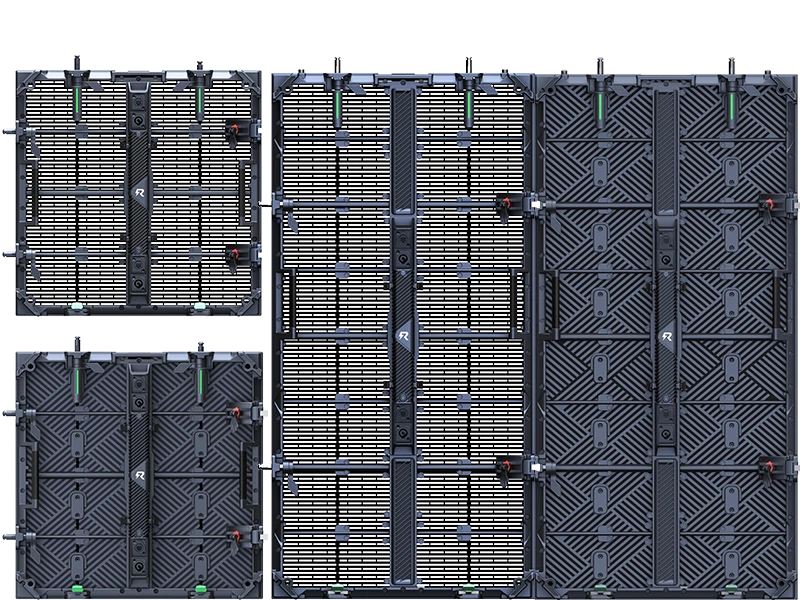
| Maintenance | Front service if the wall is flush against a wall or hung high | No access behind = no maintenance possible |
| Colour calibration | Same batch LEDs, same bin, factory calibrated | Prevents the patchy look where one section looks greener than the next |
| Control system | Novastar or equivalent, with spare sending card | One failed card on Easter Sunday is not a fun surprise |
One thing worth repeating: brightness is not a virtue in a church. Suppliers love quoting 5,000 nits because bigger numbers look impressive. For an indoor sanctuary that is simply too much, and it shortens the life of the LEDs. You want something that dims smoothly down to very low levels without colour shift, because there will be moments — candlelight services, communion, that kind of thing — where the screen needs to go almost dark and still show text cleanly.
This is the question everyone lands here for. Ranges below are typical FOB Shenzhen for indoor fixed-installation church-grade walls, standard configuration. Not including controllers, structure, shipping, duties, or local installation labour.
| Order size | Rough price per m² | What you're likely getting |
|---|---|---|
| Small wall, under 10 m² | USD 500–900/m² | Small orders carry higher unit cost; factory attention same either way |
| Mid size, 15–30 m² | USD 380–700/m² | The sweet spot for most churches |
| Large install, 40 m²+ | USD 320–550/m² | Volume discount is real, ask for tiered pricing upfront |
| Spare modules & power supplies (5–8%) | USD 40–120 each | Non-negotiable, keep them on site |
| Video processor / controller | USD 300–2,500 per set | Often quoted separately. Always ask |
| Steel structure & mounting | Local cost, varies widely | Do not let the factory guess your building's structure |
A few things we learned the slightly painful way:
The per-square-metre figure is maybe two-thirds of your real total. Add the controller, crating, freight, duty, rigging, electrician time, content setup, and the steel structure. We usually tell churches to take the screen quote and multiply by about 1.5 to get the installed reality.
A quote that arrives in twenty minutes at the bottom of the range is not a bargain. It is a quote for a product that does not exist yet. A serious supplier needs your width, height, viewing distance, whether there is rear access, and what you plan to display before they can price properly.
Ask for the tiered price list in the first email. Most factories will move 3–8% between 15 m² and 50 m². If you negotiate after the fact you are haggling against yourself.
Voltage matters. Hong Kong and mainland China use 220V, so no issue there. But if your church has branches overseas, or if you are sourcing for a mission partner in North America, confirm 110V-compatible power supplies. It is a small line item that causes big headaches later.
Shenzhen has thousands of LED businesses. A good number of them are traders who photograph other people's factories. Traders are not automatically bad — some are genuinely helpful and speak better English — but when a module fails in year two, you need to know who is going to answer the email.
Here is the sequence we use, and it takes about a week:
Ask for the business license. Look at the registered name, establishment date, and registered capital. A company formed last year that claims twelve years of manufacturing experience has a math problem.
Request a live video call, not a video file. Say you want to see the production floor at 3 PM their time. Then ask them to walk to the aging room and show you the cabinets currently running. Traders develop sudden scheduling conflicts. Pre-recorded tours can be anyone's factory.
Check product focus. A genuine display maker sells LED screens, controllers, maybe rental cases. If the same storefront lists LED walls alongside phone chargers, garden lights, and Bluetooth speakers, that is a general trading account.
Verify certificates yourself. Ask for certificate numbers and the issuing body, then look them up on the issuer's site. Expired certificates and certificates registered to a different company name are surprisingly common. For church installs you want CE and RoHS at minimum, plus ISO 9001. If the wall goes into a public assembly space, your local fire and building codes may require more — check with your venue manager, not the factory.
Buy one sample cabinet. Yes, it costs more per square metre. Yes, do it anyway. Run it for a week in the actual room if possible. Leave it on full white for a few hours, then full black, then a grey gradient. Look for uneven patches, dead pixels, and listen for fan noise. That one cabinet teaches you more than twenty brochures.
Keep a second supplier warm. Not as a threat, just as insurance. Supply chains move, and having a backup quote that is already warmed up saves weeks when timelines slip.
Red flags we will not ignore: prices well below market with no explanation, refusal to put warranty response times in writing, insistence on 100% payment upfront, payment to a personal account instead of the company name on the license, and "our factory is nearby, come visit" with no address provided.
Q: Can we mount the wall ourselves?
A: Physically, yes. Should you? Only if you have someone who understands structural loading and electrical capacity. An indoor P3 wall can draw 500–800 W per square metre at peak. That is a real electrical load and venues notice. The steel structure needs to be rated properly, especially for a hanging install above a stage where people sit underneath. We have seen churches save money on the screen and then spend more on an engineer's sign-off. Do the sign-off first.
Q: How long does the whole process take?
A: From deposit to shipment, typically 20–30 working days including the aging test. Rush orders can sometimes be done in 12–15 days with a surcharge. Then sea freight to Hong Kong is relatively quick — a matter of days — but customs clearance, local delivery, and installation add their own time. If your deadline is Christmas or Easter, work backwards from that date and then add three weeks. Every single time.
Q: What about warranty when the supplier is overseas?
A: This is where the contract matters more than the promise. A usable warranty clause states: the response time (reply within 24 hours), when replacement parts ship (within 5–7 working days), who pays freight on replacements, and how long the coverage lasts — 2 to 3 years is standard. And crucially, it includes a spare-parts kit shipped with the original order: 5–8% extra modules and a couple of extra power supplies and receiving cards. Without spares on site, a warranty is a theory. With spares, a failed module is a twenty-minute job.
Q: Do we need a video processor?
A: If you are switching between a laptop, a camera feed, and a media player, yes. A processor lets you scale inputs, store presets, and switch sources cleanly. Some churches skip it to save money and then struggle with resolution mismatches for months. Not worth the saving.
Q: Will the colours match our branding?
A: Reasonably well, if you ask for calibration and then actually calibrate on site with your own content. Factories calibrate at the module level, which gets you close. But the final look depends on your lighting, your camera settings, and your graphics. Bring the actual content you plan to use during commissioning and tune it then. Generic test patterns lie.
A mid-size church in Kowloon went with the cheapest P3.9 quote they could find, roughly 18 square metres. For the first six months it was fine. Then they noticed one quadrant looked slightly warmer than the rest — the LEDs came from different production batches and nobody had asked for bin matching in writing. By month nine two power supplies had failed and the spare parts took three weeks to arrive because the supplier had never been asked to commit to a timeline. They ended up buying a second batch from somewhere else and the colour never quite matched. Lesson: keep everything from the same production batch, and get the bin-matching and spare-parts timeline written into the contract before payment.
Another congregation did it the slower way and it worked out better. They started with a sample cabinet, tested it in their hall for ten days, checked seam flatness with their own eyes, then placed a 25 m² order with 8% spares, front-service cabinets, 3,840 Hz refresh, and a named response time in the warranty. Three years later they added another section for the youth hall using the same model and everything matched. Lesson: standardise your cabinet model and stick with it. Future-you will be grateful.
Then there is the church that over-specified. They insisted on the highest refresh rate and finest pitch available for a wall where the closest seat was seven metres away and nobody filmed close-ups. It added around a third to the cost. After seeing a mock-up, they dropped back to a standard spec and spent the difference on better graphics and a decent camera. Honestly, good content and decent lighting beat marginal spec upgrades almost every time. A beautifully designed lyric slide on a mid-range wall looks better than a poorly designed one on the most expensive wall in the catalogue.
Comparing quotes by total price instead of by line item. Two quotes at USD 600/m² can be completely different products. One uses known-brand LEDs and a proper driver IC, the other does not. Ask for the brand and model of the LED, the driver IC, the power supply, and the control system on the quotation itself.
Forgetting the controller until installation week. Sending card capacity, receiving cards, and whether a processor is included — discovering this late adds weeks.
Ignoring the noise issue. Mentioned already, but worth repeating because nobody remembers until the sound check.
Measuring the space optimistically. Confirm the exact buildable area, ceiling height, rigging points, sight lines from the side aisles, and whether rear access exists. A wall designed for rear maintenance in a room with no back access is a very expensive problem.
Assuming the wall will be perfectly seamless. Good installations are very close. But cheap cabinets with poor flatness tolerance show gaps, especially on solid-colour backgrounds. Ask about flatness tolerance and ask to see photos of a built wall, not just a single cabinet.
No content plan. Pixel pitch determines how close people can stand and how small text can be. Design your graphics around that. Big type, high contrast, and not too much of it.
Paying 100% upfront. Standard terms are T/T 30% deposit, balance before shipment or against copy of bill of lading. For larger orders, LC at sight is common. Always pay to the company name on the business license.
I would shortlist three suppliers who can actually demonstrate they manufacture, pay for a sample cabinet from at least one of them, and run it in the actual room for a week with the actual lights on and the actual content playing. I would place a modest first order with the winner while keeping the second choice warm, write the warranty response times and spare-parts percentage into the contract, and budget about fifty percent on top of the per-square-metre price for everything else the project needs — structure, electrics, rigging, processor, freight, installation, and content setup. Then I would spend whatever was left on making the graphics look good, because that is what the congregation actually sees.
It is not the fastest route. It is the route that does not end with you explaining to a board why the screen looks patchy three months after everyone voted yes.
1. What pixel pitch should a church use?
For most sanctuaries, P2.6 to P3.9. Choose based on the distance from the front row to the screen: closer seating needs a finer pitch. If the closest viewers are within 4 metres, lean toward P2.6 or P2.9.
2. How much does a church LED video wall from China cost?
Roughly USD 380–700 per square metre for typical indoor fixed-install orders of 15–30 m², FOB Shenzhen. Smaller orders cost more per square metre; larger orders less. Controllers, structure, freight, duty, and installation are extra.
3. How do I know if a Chinese LED supplier is a real factory?
Check the business license and establishment date, request a live video walkthrough of the production and aging floor, verify certificate numbers with the issuing body, review their product range for focus, and order a sample cabinet before committing to volume.
4. What brightness is right for a church?
800–1,500 nits, and it must dim smoothly. Higher brightness is unnecessary indoors, uncomfortable for the congregation, and harder on camera.
5. Do I need a high refresh rate?
Yes, 3,840 Hz or higher if you record or stream services. Lower refresh rates produce visible scan lines in video footage.
6. How long does production and delivery take?
Production is typically 20–30 working days including aging tests. Sea freight to Hong Kong is fast, but allow additional time for customs clearance, delivery, and installation. Plan backwards from your event date and add a buffer.
7. What warranty terms should I insist on?
2–3 years, with a written response time, clear statement of who pays freight on replacements, and a spare-parts kit (5–8% extra modules plus power supplies and receiving cards) shipped with the original order.
8. Can the wall be serviced from the front?
Yes, if you specify front-service cabinets. This is essential when the wall is mounted flush against a wall or hung where there is no rear access.
9. What voltage and certifications do I need?
Hong Kong uses 220V. Require CE and RoHS at minimum, plus ISO 9001. For public assembly spaces, confirm any additional local fire or building code requirements with your venue or a local engineer.
10. What is the biggest mistake churches make buying these?
Choosing on price alone and forgetting the hidden costs: controller, structure, rigging, electrical work, spares, freight, and installation. Compare line items, not totals, and budget for the whole installed project, not just the panels.
.jpg "Where Can You Find Reliable China LED Video Wall Billboard Manufacturers?")