English

Have you ever walked past a luxury boutique in Central or a flagship store on Regent Street, stopped dead in your tracks, and wondered how that vibrant video is floating right across a storefront window while you can still see the handbags inside? It looks like science fiction, but the reality behind the glass comes down to hardware engineering coming out of South China. If you are currently hunting for dependable china transparent led display manufacturers, you probably already know that finding a legitimate factory—one that does not cut corners on IC drivers or slap low-grade glue onto delicate PCB bars—can feel like walking through a minefield.
When we source visual hardware across Shenzhen, Huizhou, and Dongguan, the sheer volume of catalog claims is dizzying. Over 80% of the companies pitching you slick brochures online are actually trading intermediaries or third-party cabinet assemblers renting a two-room office in Bao'an. They show you gorgeous rendered photos, promise 80% transparency with 5,000 nits of daytime brightness, and quote you half the market price. Then the cargo lands in your warehouse, and three months into installation, the lamp beads start dropping like flies because of thermal expansion. Let's dig right into what is actually happening on the factory floors, what technical specs genuinely matter, and how to tell the real innovators apart from the box-pushers.
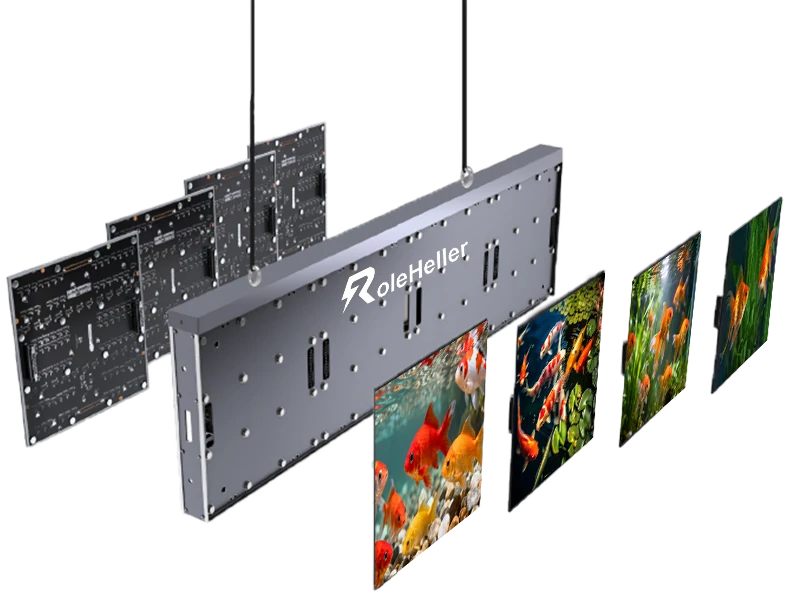
Before evaluating supplier quotes, we need to strip down the technology. Transparent LED displays are essentially conventional surface-mount diode (SMD) arrays engineered onto ultra-narrow aluminum or composite strips, spaced out to let light pass through the gaps. However, how those LEDs are soldered and housed determines whether your screen survives three years of summer heat or fails within six months.
This is usually the first fork in the road when talking to factory engineers:
Side-Emitting (Side-Lit) Technology: The LED chips are soldered directly onto the side edge of the PCB strip. Because the front face of the PCB strip is exceptionally thin (often under 1.5mm), light passing through the glass encounters almost zero physical obstruction. This configuration yields superior transparency—frequently reaching 75% to 88%. The trade-off? Side-mounted solder joints have a smaller mechanical footprint, making them slightly more vulnerable to physical impact during maintenance.
Positive-Emitting (Front-Lit / Direct-Lit) Technology: Standard SMD diodes sit flat on the front surface of the PCB strip, identical to traditional indoor video walls. This approach delivers significantly higher maximum brightness—easily pushing past 5,500 to 6,500 nits for punishing direct sunlight—and greater structural stability. But your transparency drops down to roughly 55% to 70% because the wider PCB face blocks more ambient light.
Rigid Glass-Curtain Displays (Strip Bar Structure): Built with rigid aircraft-grade aluminum alloy profiles (typically 6063-T5). They mount directly behind architectural glass curtain walls via tensioned steel cables or fixed structural brackets. Highly durable, easy to service, and the gold standard for shopping malls and auto dealerships.
Flexible Adhesive LED Film: Ultra-thin, flexible polyester or polyimide films with embedded micro-circuitry, stuck directly onto the interior glass surface like a window tint. Transparency can exceed 85%, but thermal dissipation is entirely dependent on the glass itself, limiting operational brightness to indoor-facing scenarios under 3,000 nits.
Laminated Architectural LED Glass: The diodes are embedded inside PVB or EVA interlayer resin sandwiched between two tempered architectural glass panes. Highly weather-sealed, but if a single diode fails inside the laminate, you cannot replace a single module—the entire glass pane has to be swapped out.
Outdoor Mesh / Grille Displays: Heavy-duty, IP67-rated modular bars designed for massive building facade takeovers. They feature larger pixel pitches (P10 to P25) and extreme brightness outputs up to 8,000 nits to overpower midday solar glare.
| Display Architecture | Transparency Rate | Peak Brightness (Nits) | Typical Pixel Pitch | Primary Advantage | Typical Structural Weakness |
|---|---|---|---|---|---|
| Side-Lit Rigid Bar | 75% – 88% | 3,000 – 4,500 | P3.91×7.81, P7.82 | Highest optical clarity; slim frame | Sensitive side solder joints |
| Front-Lit Rigid Bar | 55% – 70% | 5,000 – 6,500 | P3.91, P5.2, P10.4 | Superior sunlight cut-through | Lower see-through effect |
| Adhesive Optical Film | 80% – 90% | 1,500 – 3,000 | P6 to P16 | Ultra-lightweight; zero framework | Thermal entrapment against glass |
| Laminated LED Glass | 70% – 82% | 2,500 – 4,000 | P8 to P20 | Structural building element | Permanent un-repairable failure |
| Outdoor Facade Mesh | 45% – 60% | 6,500 – 8,500 | P10 to P31.25 | Extreme weather resilience | Too coarse for close viewing |
Almost all global supply originates from Guangdong Province. If a vendor claims their factory is located elsewhere, they are almost certainly sourcing white-label cabinets from the Pearl River Delta and relabeling them.
The manufacturing ecosystem divides geographically into two major centers:
Shenzhen (Bao'an, Guangming, and Longhua Districts): The world center for LED packaging, driver firmware, and high-precision assembly. R&D-heavy transparent specialists operate here, alongside the major public display enterprises.
Huizhou and Dongguan: Larger industrial facilities where heavy mechanical tooling, metal die-casting, extrusion milling, and high-volume automated SMT (Surface Mount Technology) runs take place at lower real estate overheads.
When evaluating suppliers, it helps to understand how the market segments into distinct tiers:
[Tier 1: Comprehensive Public Giants]
  ├── Mass output, rigid catalog, premium brand tax
  └── Examples: Leyard, Unilumin, Absen

[Tier 2: Specialized Transparent Engineering Houses]
  ├── Core R&D in glass displays, flexible customization, competitive pricing
  └── Examples: Dedicated transparent patent holders, Nexnovo, Muxwave-style film makers

[Tier 3: White-Label Component Assemblers]
  ├── Low upfront cost, outsourced PCBs, unpredictable diode binning
  └── Sourced from multi-brand parts markets
Companies like Unilumin, Leyard, and Absen dominate global tenders. Their strengths are undeniable: deep balance sheets, international service hubs in Europe and North America, and rigorous ISO-certified production lines. However, transparent screens represent only a minor fraction of their total revenues. Their pricing carries a 30% to 50% brand premium, and when you request custom bracket engineering or non-standard cabinet radiuses for curved architecture, their engineering departments can be painfully slow to iterate.
This is where experienced commercial procurement teams spend most of their time. These manufacturers focus exclusively on transparent bars, film screens, and glass integration. Because transparent displays represent their entire balance sheet, their R&D goes straight into solving specific physical challenges: reducing PCB bar widths, designing tool-less quick-locking mechanisms, and custom-molding silicone weather seals. You get direct access to their structural engineers, faster turnaround on custom cabinet sizes, and pricing that skips the public-company administrative overhead.
Scattered across the industrial parks of Shiyan and Fuyong, these workshops buy bare circuit boards from third-party PCB houses, purchase unbinned lamp beads from budget packagers, and manually solder cabinets using basic jigs. They can quote tantalizingly low figures—sometimes $500 to $700 per square meter for specs that look impressive on paper. But when we inspect these cabinets under thermal imaging, the current distribution is erratic, power supplies run scorching hot, and color calibration drifts visibly across adjacent modules.
| Evaluation Metric | Tier 1: Global Giants | Tier 2: Dedicated Innovators | Tier 3: Budget Assemblers |
|---|---|---|---|
| Typical Target Application | Airports, public stadiums, corporate HQs | Luxury storefronts, auto showrooms, atriums | Pop-up shops, budget short-term stages |
| Pixel Pitch Precision | Down to P1.9 / P2.8 | Down to P2.5 / P3.91 | Usually limited to P3.91 & coarser |
| Lamp Bead Sourcing | Tier-1 Nationstar (Gold wire), Nichia, Cree | Nationstar, Kinglight (High-bin copper/gold) | Mixed-bin unbranded or San'an low-tier |
| Driver IC Selection | Macroblock (MBI), Chipone high-refresh | Macroblock, Chipone, ICN high-spec | Generic ICN or unbranded PWM chips |
| Cabinet Tolerance | < 0.1mm CNC machined aluminum | < 0.2mm high-precision extrusion | 0.5mm – 1.2mm stamped sheet metal |
| Factory Aging Protocol | 72 hours full white + video loop | 48 – 72 hours continuous thermal cycle | 12 – 24 hours static test (often skipped) |
| Custom Engineering | Rigid, requires huge MOQs | Agile, welcomes architectural drawings | Very limited structural capability |
When reviewing specification sheets from Chinese suppliers, looking only at pixel pitch and headline price is an expensive mistake. The devil lives entirely in the sub-component tolerances.
In conventional LED displays, a P3.91 panel means the diodes are spaced 3.91mm apart both horizontally and vertically (3.91 × 3.91 mm). In transparent displays, however, factories often utilize an asymmetric layout to increase light pass-through:
A panel sold as P3.91-7.81 features diodes placed 3.91mm apart horizontally along the strip, but the vertical distance between strips is 7.81mm.
This delivers crisp horizontal clarity while keeping transparency above 70%.
If a supplier quotes a "P3.9 screen" at an unusually cheap price, verify the vertical pitch immediately. If it is actually 3.91 × 7.81 mm, your vertical resolution is halved compared to a true symmetrical grid.
A transparent screen placed behind south-facing storefront glass must compete directly with ambient outdoor sunlight.
North-facing or shaded interior windows: 2,500 to 3,500 nits is perfectly adequate.
Direct solar exposure through clear double-glazed glass: You need a minimum of 5,000 to 6,000 nits calibrated brightness.
Here is the engineering catch: driving small SMD1921 or SMD1515 diodes to 6,000 nits produces immense heat. If the supplier is using cheap double-sided fiberglass PCBs rather than thick aluminum substrates, that heat cannot escape. Trapped behind insulated glass curtain walls, the ambient chamber temperature can hit 65°C. At that point, cheap epoxy resin discolors, turning yellowish, and your color uniformity across the screen is ruined.
If your display is going into high-end retail, hospitality, or corporate atriums, it will be photographed and filmed continuously on smartphones.
Standard Driver ICs (Double Latch / Basic PWM): Provide refresh rates around 1,920Hz. To the naked human eye, the image looks fine. But point an iPhone camera at it, and severe dark scanning lines roll across the video.
High-End PWM Drivers (e.g., Macroblock MBI5153, MBI5359, or Chipone ICN2153): Deliver refresh rates of 3,840Hz to 7,680Hz alongside 14-bit to 16-bit grayscale. This eliminates camera moiré and banding even under low-brightness dimming at night.
Incoming Signal ──> [Receiving Card: NovaStar A5s Plus / Colorlight]
                          │
                          ▼
           [High-PWM Driver IC: MBI5153] ──> Stable 3840Hz Output (Zero Camera Flicker)
                          │
                          ▼
             [Gold-Wire Encapsulated SMD] ──> Consistent Color Temperature Over Time
Transparent screens are lightweight, meaning their power boxes must be compact. Reputable manufacturers use custom slimline switching power supplies from brands like Mean Well, G-Energy, or Great Wall.
Always check the load factor. If a cabinet's peak power consumption is calculated at 600W per square meter, the power supplies installed inside the side spine must be rated for at least 800W (a 25% to 30% safety headroom).
Budget builders run power supplies at 95% capacity to save $15 per box. When displaying high-brightness white video loops, those supplies overheat, trigger thermal shutdown, and send entire vertical sections dark.
How your glass wall is constructed dictates how your LED screen must be serviced. Once the screen is mounted 15 floors up inside an atrium or flush against an existing storefront mullion, physical access becomes challenging.
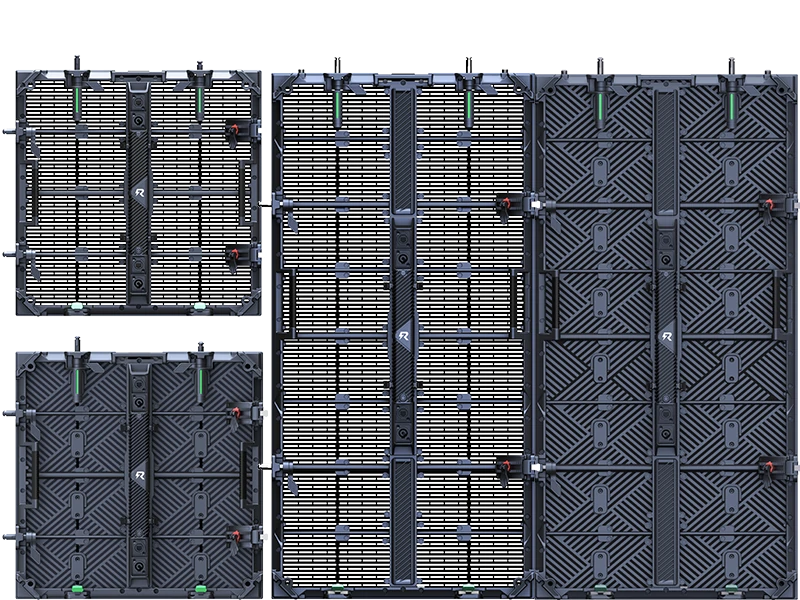
In this setup, each individual LED strip or module can be unlocked from the display face using an insulated magnetic extraction tool or quick-release front pins.
When you need it: Crucial when the screen is mounted within 10 to 15 centimeters of permanent architectural glass where human hands cannot physically reach the rear side.
The mechanical cost: Front-service mechanisms add mechanical complexity. If the locking tolerance is poorly engineered, the strips will not sit perfectly flush, resulting in jagged visible seam lines when viewed from an angle.
The power supply box, receiving cards, and ribbon connectors unlatch from the backside of the support frame.
When you need it: Ideal for large atrium hanging displays or venues where a clear walkway or catwalk exists behind the installation.
The benefit: Significantly lower hardware cost and cleaner structural profiles, but it requires at least 60 to 80 centimeters of clear working space behind the screen for technician access.
When communicating with overseas sales managers on WeChat or email, you will receive polished brochures and reassurances. Let's walk through the exact technical questions you need to fire back, and what the real answers look like.
The word "P3.91" only defines center-to-center diode spacing—it says nothing about what components are mounted to the board. When a quote is suspiciously low, the manufacturer is almost certainly shaving cost across four hidden areas:
Copper Wire vs. Gold Wire LEDs: Gold wire bonding inside the diode package handles thermal expansion cycles without fracturing. Copper wire saves 25% in packaging costs but oxidizes faster in humid coastal environments, causing dead pixels.
PCB Thickness: Top-tier transparent bars use 4-layer or 6-layer high-TG (glass transition temperature) boards (1.6mm to 2.0mm thick). Cheap shops use 2-layer boards (1.0mm) that warp under heat, causing the strips to bend outward.
Low-Bin Diode Sorting: LED wafer foundries sort diodes into bins based on wavelength and lumen output. Tier 1 factories buy narrow, uniform bins. Low-tier shops purchase wide-bin leftovers, resulting in noticeable blotchy pink or green color patches when showing a pure white background.
Under no circumstances can rigid transparent LED cabinets be cut or resized on an installation site. Architectural glass drawings frequently differ from as-built site conditions by 15mm to 30mm. If your factory builds standard 1,000mm × 500mm cabinets and your structural mullion opening is 980mm, those cabinets will not drop into place.
What you must do: Experienced sourcing teams always request custom edge-filler modules. The manufacturer designs standard modular cabinets for the center span, accompanied by custom-width passive border modules engineered specifically from 3D laser site scans.
Adhesive LED film depends on an optical clear adhesive (OCA) layer bonded directly to the window glass.
If the manufacturer uses standard industrial double-sided adhesive instead of dedicated UV-stabilized optical glue, the combination of ultraviolet solar radiation and heat will cause the glue to dry, bubble, and turn milky within 12 to 18 months.
Always require the supplier to certify their adhesive's UV resistance index (typically delta E < 2 over 5,000 hours of UV aging test) and review past case studies installed in high-sunlight regions like Dubai, Florida, or Southeast Asia.
[Sunlight Exposure (UV + IR Heat)]
                 │
                 ▼
    [Glass Pane Outer Surface]
                 │
                 ▼
   [Optical Clear Adhesive (OCA)] ──> Must have UV inhibitors (or yellowing occurs)
                 │
                 ▼
    [Flexible Polyimide Base]    ──> Poor thermal conduction creates hot spots
                 │
                 ▼
       [Micro-SMD Diodes]        ──> Requires under-driving (Max 2500 nits) for longevity
LED diodes change slightly with every manufacturing batch. If a module fails two years from now and you replace it with a module from a newer batch, that new module will look like an obvious bright patch on your wall.
The procurement rule: Insist on an integrated 5% to 8% spare parts package from the exact same production lot and bin. This includes spare PCB strips, power supply modules, receiving cards, and IC driver reels.
Verify that the factory stores your batch calibration data (chroma and brightness correction files) on their cloud servers linked to your project serial number.
To protect your capital when dealing with manufacturers abroad, avoid signing purchase contracts based purely on sample boxes sent via air courier. Follow this structured verification path:
[Phase 1: Component Audit] ──> Specify exact diode, IC, and PSU brands in contract
             │
             ▼
[Phase 2: Live Video Inspection] ──> Real-time factory walk, SMT line & aging room
             │
             ▼
[Phase 3: 72-Hour White Screen Test] ──> Push 100% full white to reveal color shifts
             │
             ▼
[Phase 4: Third-Party Pre-Shipment QC] ──> Measure lux, check flatness & pack seals
             │
             ▼
[Phase 5: Release Final Balance] ──> Cargo clears factory gate only after QC sign-off
Lock Component Brands in the Proforma Invoice: Never accept vague terms like "Nationstar or equivalent" or "High-refresh driver." The contract must read: "Nationstar Gold-Wire SMD1921, Macroblock MBI5153 Driver IC, Mean Well UHP-Series Power Supply, NovaStar A5s Plus Receiving Card." If they substitute without written approval, it constitutes a material breach.
Conduct a Live Video Audit of the Production Line: Ask the sales rep to walk their smartphone through the SMT placement workshop, the automatic optical inspection (AOI) stations, and the thermal aging room. If they hesitate or claim photography is forbidden due to "confidentiality," you are dealing with a trading office that has to arrange a visit to someone else's facility.
Mandate the 72-Hour Full White Aging Test: Most component failures happen within the first 48 hours of thermal cycling. Demand that your entire assembled screen run continuously for 72 hours—not with a colorful video loop that masks dead pixels, but with a static, 100% brightness pure white screen. Request time-stamped video evidence panning across all cabinet seams.
Check Mechanical Cabinet Flatness: The aluminum spine profiles must have a tolerance under 0.2mm. Lay three assembled cabinets flat on a granite inspection table. If you can slide a 0.5mm feeler gauge between the cabinet joints, the display will look irregular once hung against flat architectural glass.
If you take only one piece of advice away from years of managing commercial hardware rollouts across Chinese factories: stop negotiating exclusively on bottom-line cabinet price, and start negotiating on structural transparency, thermal design, and component provenance.
When you squeeze a factory in Shenzhen for an extra $100 off per square meter, the sales director does not take a salary cut to accommodate your budget. Instead, their purchasing manager quietly swaps out gold-wire Nationstar LEDs for budget copper packages, drops the driver chip from an energy-saving PWM controller down to a generic shift register, and replaces Mean Well power units with generic local brands. On the day your screen clears customs and turns on, it will look brilliant. But eighteen months later, when the screen has baked under the afternoon sun, the diodes start dropping, the glue yellows, and your client demands a warranty replacement, that saved $100 per meter turns into thousands of dollars in scaffolding, uninstalled panels, and legal headaches.
Focus your energy on finding a dedicated, responsive Tier-2 specialist whose core engineering is transparent hardware. Insist on inspecting their SMT placement floor via live video, specify exact component brands down to the part number in your sales contract, demand a verified 72-hour continuous white-screen burn-in, and maintain a mandatory 5% batch-matched spare parts buffer in your warehouse. Do that, and you will walk away with an architectural display that looks like floating magic and runs reliably for years to come.
Standard modular cabinets (such as 1,000mm × 500mm or 1,000mm × 1,000mm frames) usually carry a production lead time of 20 to 28 calendar days for orders between 20 and 100 square meters. If your project demands custom curved cabinets, bespoke frame colors, or custom-length edge-filler bars, lead times extend to 35 to 45 days because of the tooling, CNC machining, and specialized PCB layouts involved. Always build in an extra 7 days for factory aging tests and another 25 to 35 days if shipping via sea freight.
For dependable commercial-grade hardware using Tier-1 packaging (Nationstar diodes, high-refresh PWM ICs, Mean Well power supplies), current FOB Shenzhen pricing generally sits in these brackets:
P3.91×7.81mm Indoor High-Transparency: $850 – $1,300 per sqm.
P3.91mm True Symmetrical High-Res: $1,400 – $1,900 per sqm.
P7.81mm / P10.4mm High-Brightness Outdoor/Window: $700 – $1,050 per sqm.
Flexible Adhesive Film Screens (P6 to P10): $1,200 – $2,200 per sqm depending on optical layer grade.
Any quotation significantly below these bands typically indicates compromised copper-wire LEDs, generic driver chips, or unbranded power units.
The rule of thumb for transparent displays balances viewing distance against required transparency:
Viewing distance under 4 meters: Choose P2.8 or P3.91. This maintains sharp image clarity for pedestrians walking past a boutique window, though transparency will hover around 65% to 75%.
Viewing distance between 5 and 15 meters: Choose P3.91×7.81mm or P5.2. This hits the sweet spot for shopping mall atriums, balancing 75% to 80% transparency with solid text readability.
Viewing distance beyond 20 meters: Choose P7.82, P10.4, or P15. Used for large multi-story glass facades where transparency must exceed 85% and resolution requirements are modest.
Yes, but only if the display is engineered with the correct optical brightness rating. Standard indoor screens operate between 800 and 1,500 nits, which washes out completely behind sunlit glass. For windows facing direct midday sun, you must specify a minimum of 5,000 to 6,500 nits. For indirect sunlight or shaded street frontage, 3,500 to 4,500 nits is sufficient. Make sure the factory includes an automatic light sensor probe with the controller system to dim the screen at night down to 500 nits, preventing driver distraction and community light-pollution complaints.
Transparent screens are never hung directly from the glass panes. Instead, they are supported by the structural building architecture behind the glass:
Hanging Beam System: High-tensile steel brackets or aviation cables attach to the overhead concrete slab or structural steel I-beams. The cabinets hang downward in linked vertical columns.
Floor Stacking System: A rigid steel or aluminum base structure anchors to the finished floor slab, with cabinets stacking upward, stabilized by rear tie-backs anchored to structural window mullions.
Direct Mullion Mounting: For small installations, custom side brackets clamp directly around vertical structural aluminum mullions, avoiding any drilling into building glass.
Over 90% of Chinese transparent manufacturers standardize on NovaStar (e.g., Taurus Series multimedia players like TB50/TB60, or independent master controllers like the VX-series) or Colorlight. These systems support both synchronous playback (HDMI/DisplayPort direct from a media server) and asynchronous playback (uploading video loops via Wi-Fi, 4G, or local network to onboard storage). Cloud-based CMS platforms allow technical teams to schedule content, monitor operating temperatures, and detect power supply faults remotely across multiple global store locations.
Transparent displays are thin and feature exposed edges, making proper packaging non-negotiable:
Flight Cases (Road Cases): Required if the screen will be moved, rented, or dismantled periodically. High-density EVA foam cutouts cradle each cabinet securely.
Plywood Crates with Shock Buffers: Standard for fixed architectural installations. Ensure the supplier uses export-grade, fumigated plywood with 20mm high-density polyethylene internal foam linings.
Air Freight vs. Sea Freight: Air freight takes 5 to 8 days but costs significantly more due to dimensional volume. Sea freight (LCL or FCL) takes 20 to 35 days depending on the destination port. Always insist on CIF or DDP terms only if your forwarder cannot handle domestic China customs clearance directly.
For entry into North American and European markets, customs and local electrical inspectors require valid test reports:
European Union: CE-EMC, CE-LVD, and RoHS compliance are mandatory. High-end architectural jobs often require EN 13501-1 flame-spread certification for materials installed in public escape routes.
North America: FCC Class A or Class B for electromagnetic interference is mandatory. For permanent architectural installation inside commercial buildings, look for ETL listed (UL 48 or UL 8750 standards). Many budget Chinese suppliers do not hold genuine UL/ETL certifications; they hold CE and claim it is universally valid. Verify the ETL control number directly on the Intertek directory before ordering.
Because of the modular strip design, field maintenance is straightforward:
Power down the cabinet sector.
Using an extraction tool or miniature screwdriver, unfasten the single defective PCB strip from the cabinet spine.
Disconnect the tiny ribbon connector linking the strip to the distribution bus.
Plug in a replacement spare strip from your original batch stock and lock it in.
The defective strip is then sent back to your local AV repair partner or returned to China in batches for component-level hot-air desoldering and diode replacement.
Yes. Top-tier manufacturers engineer custom angled cabinet edge frames (often offering 45-degree mitered edges) that align flush to form seamless 90-degree convex or concave corners with minimal seam gap. For circular or serpentine glass curtain walls, factories build faceted curved frames with angle-adjustment locks between cabinets (typically allowing 0 to 10 degrees of inter-cabinet adjustment). For continuous smooth curves without faceting, ultra-flexible adhesive film displays are the preferred solution, as they bend naturally to match the curvature radius of the glass substrate.