English

If you are looking for the short answer before diving into dozens of supplier catalogs: yes, buying directly from china p3 led display manufacturers can easily save you 40% to 65% compared to purchasing from local Western distributors, but only if you know how to bypass trading companies and lock down exact component specifications in your contract. For indoor corporate boardrooms, house of worship sanctuaries, hotel ballrooms, and retail stores with viewing distances around 10 to 30 feet, P3 (3.0mm pixel pitch) remains the commercial sweet spot where visual sharpness, mechanical durability, and price per square meter strike a near-perfect balance.
When sourcing LED video walls out of the Pearl River Delta, the hardest part is not finding a supplier. Type a search query into any directory and you will receive fifty quotes within twelve hours. The real challenge is that nearly 70% of the companies presenting themselves as original equipment manufacturers are actually third-party packagers, assemblers, or pure trading firms operating out of shared commercial offices in Shenzhen’s Bao'an or Longhua districts. They send rendered product photos, quote rock-bottom rates like $350 per square meter, and omit critical hardware details. Six months later, your client is dealing with burnt-out power supplies, dead pixels, and obvious color patches across adjacent panels. Let's pull back the curtain on how these displays are engineered, who is actually making them, and how you can run a smooth procurement process from 7,000 miles away.
A P3 LED screen is defined by its center-to-center diode spacing of 3.0mm (or 3.076mm depending on whether the manufacturer uses a standard 192×192mm module or a 320×160mm universal module). That translates to roughly 111,111 pixels per square meter. At that pixel density, the individual diodes blur into a cohesive, high-definition image once the viewer stands roughly 3 meters (10 feet) away.
However, two displays with identical P3 pixel pitch can perform completely differently over time. The difference between an installation that runs problem-free for six years and one that develops flickering modules after six months comes down to four fundamental sub-components:
The diode package is the single largest component cost on the bill of materials.
Gold Wire Bonding (Nationstar REESTAR or High-Tier Copper): Inside the miniature SMD package (typically SMD2121 for indoor P3), microscopic wires connect the silicon die to the lead frame. Pure gold wire handles continuous thermal expansion and contraction cycles without snapping.
Budget Copper or Alloy Wire: Cheaper packaging shops use copper or alloy bonding wires. Copper saves 20% to 30% in manufacturing costs, but in humid environments or installations with poor ventilation, the bond wire oxidizes, develops micro-fractures, and leads to dead pixels (black spots) or single-color failures (a stuck red, green, or blue diode).
Epoxy Face Finish: Indoor P3 displays prioritize high contrast. Premium modules use a true black-body SMD package with matte black epoxy encapsulation to prevent ambient light reflection, while cheap units use dark-gray faces that wash out under overhead lighting.
The driver IC determines how cleanly and smoothly current is routed to the diodes.
High-End PWM Drivers (Macroblock MBI5153 / MBI5359, Chipone ICN2153): These provide true pulse-width modulation driving, delivering 3,840Hz to 7,680Hz refresh rates alongside 14-bit to 16-bit grayscale. When someone films your screen with a smartphone or broadcasts a keynote with high-definition cameras, there are zero rolling black scan lines or moiré artifacts.
Basic Shift-Register Drivers (e.g., standard double-latch ICs): These peak at 1,920Hz and 12-bit grayscale. To the human eye in person, it looks passable. On camera, it creates horizontal banding, and when you dim the screen to 20% brightness for evening events, dark areas break up into ugly pixelated blotches.
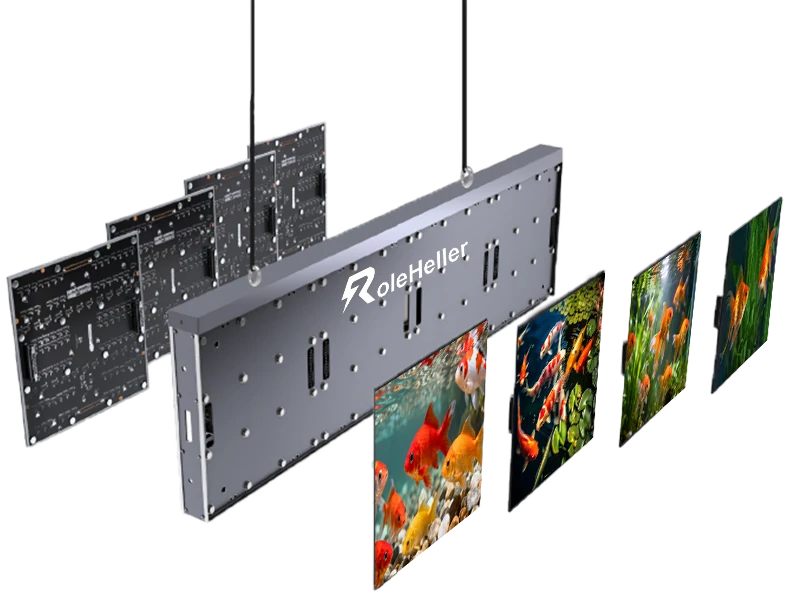
4-Layer to 6-Layer High-TG FR4 Boards: Quality manufacturers use multi-layer fiberglass boards with high glass transition temperatures (TG150 or TG170) and 1.6mm thickness. Multi-layer routing separates signal lines from high-current power traces, reducing electromagnetic interference and ensuring uniform heat dissipation across the entire module face.
2-Layer Thin Boards (1.0mm to 1.2mm): Cheap assemblers use 2-layer boards to cut costs. Under continuous heat, these thin boards warp slightly, pushing individual modules outward and turning flush cabinet joints into visible, distracting seam lines.
Commercial installations run long hours. A standard P3 cabinet pulls roughly 500W to 650W per square meter at peak full-white brightness and about 200W to 250W under typical video playback.
Reliable builders install ultra-slim, fanless switching power supplies from proven brands such as Mean Well, G-Energy, or Great Wall, engineered with at least 30% operational headroom. If your display pulls 400W peak per cabinet, the power unit inside must be rated for at least 550W to 600W so it never runs at thermal capacity.
Practically all global P3 LED video wall manufacturing is concentrated in China's southern industrial belt within Guangdong Province. Understanding how these manufacturers are stratified saves you weeks of misdirected communication.
[Tier 1: Public Market Leaders]
  ├── Leyard, Unilumin, Absen, Liantronics
  └── Strengths: Turnkey warranties, Western offices, enterprise compliance
  └── Trade-off: 40% to 60% brand premium, strict MOQ, inflexible customization

[Tier 2: Specialized Export Manufacturers]
  ├── Gloshine, Dicolor, Chipshow, CreateLED, INFiLED
  └── Strengths: Agile engineering, custom cabinet sizes, transparent BOM pricing
  └── Trade-off: Requires independent QC verification, FOB/CIF logistics handling

[Tier 3: White-Label Component Assemblers]
  ├── Shiyan, Fuyong, and Dalingshan Industrial Workshops
  └── Strengths: Extremely low initial quotation ($300-$450/sqm)
  └── Trade-off: Unbinned LEDs, generic power units, high failure rates
Shenzhen (Bao'an, Guangming, Longhua): The innovation epicenter. This is where SMT machinery lines run 24 hours a day, firmware engineers write controller patches, and the most advanced die-cast aluminum tooling is fabricated.
Huizhou and Dongguan: Massive production campuses dedicated to metal stamping, extrusion milling, automated wave soldering, and large-scale bulk module production. Many Shenzhen-headquartered brands maintain their primary assembly lines in Huizhou to reduce overhead.
| Evaluation Factor | Tier 1: Public Brand Giants | Tier 2: Specialized Export Houses | Tier 3: Budget Assemblers |
|---|---|---|---|
| Typical Target Projects | International arenas, broadcast studios, airports | Corporate HQs, churches, rental staging, retail | Short-term promotional booths, temporary events |
| Lamp Bead Selection | Custom Nationstar Gold, Cree, Nichia | Nationstar Gold/Copper, Kinglight High-Bin | Unbranded, San'an low-tier, mixed bins |
| Driver IC Standard | Macroblock MBI5359 / Chipone 2153 (3840Hz+) | Macroblock MBI5153 / Chipone 2153 (3840Hz) | Generic ICN / Summwinner (1920Hz) |
| Cabinet Construction | CNC-milled die-cast magnesium/aluminum (<0.1mm gap) | Precision die-cast aluminum (<0.2mm gap) | Stamped iron sheet metal (0.5mm–1.0mm gaps) |
| Burn-In Aging Protocol | 72 hours full white + video thermal cycle | 48 to 72 hours continuous thermal test | 12 to 24 hours basic video loop (often skipped) |
| Pricing Baseline (P3 Indoor) | $1,200 – $1,800 / m² | $650 – $950 / m² | $350 – $500 / m² |
| Field Customization | Slow turnaround, high MOQ required | Rapid engineering drawings, flexible frame design | No internal engineering department |
Many buyers assume that an outdoor P3 screen is simply an indoor P3 display placed in a weatherproof box. Truth be told, treating them interchangeably is one of the most expensive mistakes an AV installer can make.
Indoor P3: Designed to output 600 to 1,200 nits. Pushing an indoor screen past 1,200 nits in an enclosed conference room will cause eye fatigue for viewers, generate unnecessary heat, and degrade diode lifespans.
Outdoor P3: Must overpower ambient daylight and direct solar rays. It requires a minimum calibrated output of 4,500 to 6,000 nits. Achieving this brightness demands larger LED dies (such as SMD1921 or SMD1415), higher drive currents, and robust power delivery.
Indoor Modules: Usually leave the rear circuit board exposed or lightly covered with a dust-shield plastic casing. Heat radiates passively into the air conditioned room.
Outdoor Modules: Require full IP65 or IP66 ingress protection. The front face features a sealed louver mask with ultraviolet (UV) inhibitors, while the rear PCB is completely potted with two-component silicone rubber to lock out rain, ocean salt air, and airborne dust. Because that thick silicone traps heat inside the module, outdoor cabinets must use hollow airflow channels or waterproof high-velocity exhaust fans to prevent thermal runaway.
[Outdoor Solar Radiation: Direct UV + Ambient Heat]
                   │
                   ▼
  [UV-Stabilized Anti-Glare Polycarbonate Mask]
                   │
                   ▼
 [High-Power SMD1921 Diodes (5500+ Nits Brightness)]
                   │
                   ▼
  [Two-Component Silicone Potting Layer (IP65)]
                   │
                   ▼
  [Aluminum Core Heat Sink / Forced Airflow Fan] ──> Dissipates Internal Cabinet Heat
To build an accurate budget, you need to understand where your money goes. A turnkey video wall quote includes the display modules, cabinets, receiving cards, master video processor, spare parts buffer, and freight packaging.
Here is a realistic factory-direct pricing framework (FOB Shenzhen/Hong Kong) for commercial-grade P3 installations:
| Component / Configuration Tier | Entry Commercial Spec | Professional Enterprise Spec | Broadcast & XR Studio Spec |
|---|---|---|---|
| Target Application | Retail shop, bar, small church | Corporate lobby, auditorium, event rental | TV studio, virtual production, luxury boardroom |
| LED Package & Solder | Kinglight Copper Wire SMD2121 | Nationstar Copper/Gold Wire SMD2121 | Nationstar Gold Wire / REESTAR Black Face |
| Driver IC & Refresh | ICN2053 (1,920Hz / 13-bit) | MBI5153 (3,840Hz / 14-bit) | MBI5359 (7,680Hz / 16-bit HDR) |
| Cabinet Profile (500×500mm) | Cast Aluminum ($450 – $600/m²) | Precision CNC Aluminum ($650 – $850/m²) | Ultra-Light Magnesium Alloy ($1,000 – $1,400/m²) |
| Power Supply Brand | G-Energy or Chuanglian Slim | Mean Well LRS / UHP Series | Mean Well UHP Low-Leakage Redundant |
| Control Hardware | NovaStar MRV328 Receiving Cards | NovaStar A5s Plus / Armor Series | NovaStar A8s / A10s Plus (Full Color Calibration) |
| Estimated Hardware Cost (per m²) | $550 – $750 | $750 – $1,050 | $1,200 – $1,850 |
| Recommended Spare Buffer | 3% modules, 1 power supply | 5% modules, 2 power supplies, spare ICs | 8% to 10% modules, full matching batch buffer |
Master Video Controller / Splicer: A basic NovaStar VX400 or VX1000 all-in-one controller adds $600 to $1,400. For high-end 4K processing with low-latency fiber outputs, a NovaStar NovaPro UHD Jr or Brompton Tessera processor will range from $3,500 to $8,000+.
Packaging: Plywood crates for fixed installations run roughly $50 to $80 per cubic meter. Heavy-duty road flight cases with wheels (for rental staging) cost approximately $180 to $260 per case (typically housing six to eight 500×500mm cabinets).
Shipping & Tariffs: Air cargo from Shenzhen/Hong Kong to European or North American hubs runs around $4.50 to $7.00 per kilogram (taking 5 to 8 days). Sea freight costs significantly less on a per-unit basis, but requires 25 to 40 days port-to-port plus domestic customs clearance fees and local import tariffs.
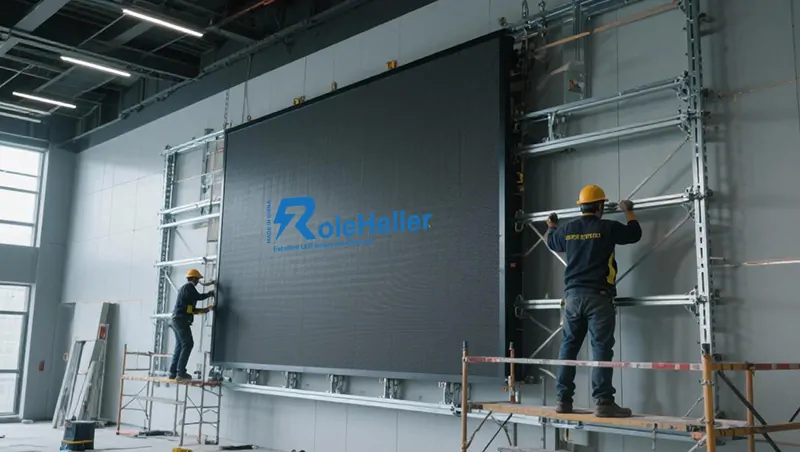
Before ordering cabinets, your site survey must confirm how your technicians will service the screen once it is bolted to the wall.
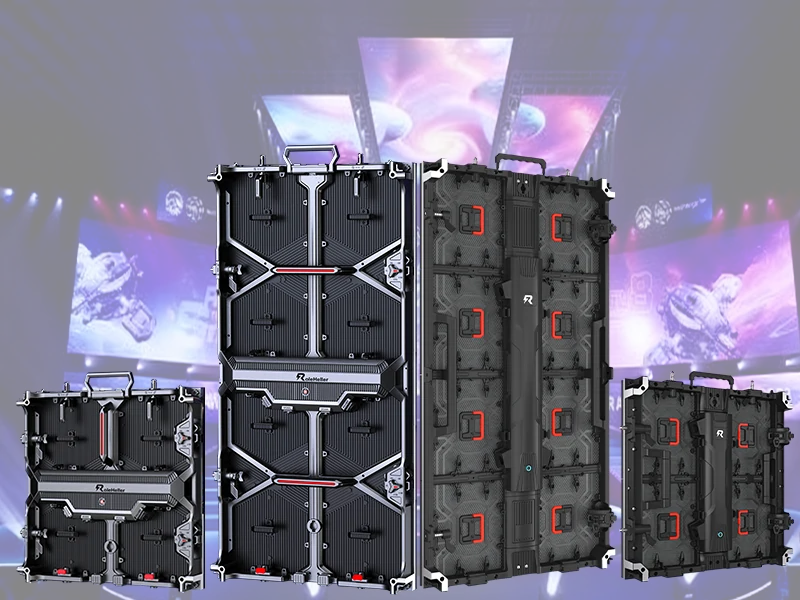
The Mechanism: Each 320×160mm or 192×192mm module is secured to the cabinet chassis using four to six strong neodymium magnetic pillars. A technician uses a motorized vacuum extraction tool or an insulated magnetic handle placed on the module face, pulls firmly, and the module pops straight out toward the room.
When to Use: Essential for conference rooms, shopping malls, and hotel lobbies where the display mounts flush against a drywall or concrete wall with zero space behind the screen.
Watch Out For: If the factory's structural frame lacks rigid CNC tolerances, magnetic modules can shift slightly under building vibrations, creating uneven, jagged edges between panels.
The Mechanism: Modules are fastened securely from the backside using stainless steel hex bolts, and the power box opens via rear hinge doors or thumb screws.
When to Use: Standard for hanging concert trusses, sports arena scoreboards, and large venues equipped with an accessible service catwalk behind the video wall.
The Benefit: Lower mechanical cost per cabinet, tighter mechanical locking strength, and simpler structural framing.
To protect your business when sourcing from China, avoid paying a deposit until you have verified the factory's actual manufacturing capabilities.
[Step 1: Technical Spec Lock] ──> Write exact diode, driver IC, and PSU brands into the PI
             │
             ▼
[Step 2: Live Video Facility Audit] ──> Inspect SMT placement lines, AOI machines & aging floor
             │
             ▼
[Step 3: 72-Hour Burn-In Inspection] ──> Run 100% full-white test to spot color bin variations
             │
             ▼
[Step 4: Pre-Shipment Video & Photos] ──> Confirm cabinet alignment, serials & spare parts package
             │
             ▼
[Step 5: Release Final Balance] ──> Hand over final 70% payment only after QC documentation clears
Never accept vague descriptions like "high-quality Nationstar lamp" or "Taiwan-brand power supply." Your Proforma Invoice (PI) must explicitly read:
"LED Package: Nationstar SMD2121 Gold Wire. Driver IC: Macroblock MBI5153 (Minimum 3,840Hz refresh rate). Power Supply: Mean Well UHP-200-5. Receiving Card: NovaStar A5s Plus. Module PCB: 4-Layer FR4 TG150 1.6mm thickness."
If an overseas supplier attempts to substitute a generic component during production, having exact part numbers in your written agreement provides clear legal grounds to halt shipment or reject the cargo.
Trading agents will happily send you high-resolution photos of gleaming robotic production floors that belong to other companies.
Ask the sales representative to do a live WeChat or WhatsApp video call during normal China business hours (GMT+8).
Ask them to walk through the SMT (Surface Mount Technology) clean room, show you the high-speed Panasonic or Yamaha pick-and-place machines in operation, and take you into the thermal aging room.
If they claim that video calls are strictly forbidden due to "client privacy concerns," you are almost certainly speaking with a sales agent who does not own the manufacturing plant.
Most component failures occur during the first 48 hours of continuous operation due to thermal stress.
Instruct the factory to run your completed screen continuously for at least 72 hours before crating.
Crucially, instruct them not to simply loop colorful promotional videos. Motion footage easily hides flickering diodes and color shifts.
Require them to display a static, 100% full-white screen at maximum brightness, followed by pure red, pure green, and pure blue fields.
Ask for high-resolution video clips panning across all cabinet joints to confirm that color temperature is consistent and that no modules show blotchy pink, green, or yellow tints.
In my experience managing commercial video wall installations, here is the golden rule: the cheapest quote on your desk is almost always the most expensive display you will ever buy.
When an overseas buyer pushes a Shenzhen sales manager to shave an extra $80 per square meter off a quote, the factory does not accept a financial loss. Instead, their procurement team quietly downgrades the internal hardware. They swap out gold-wire Nationstar diodes for unbranded copper packages. They replace a high-PWM Macroblock driver with an entry-level shift register. They install generic power supplies operating at 95% thermal load, and they cut down the factory aging test from 72 hours to 12 hours.
On the morning your installation team uncrates the display and fires up a 4K motion graphic, it will look stunning. But nine months later, when the display has accumulated 3,000 operational hours in a warm building, the issues begin. Solder joints crack, diodes stop displaying green, power supplies shut down under heat spikes, and color uniformity drifts visibly between cabinets.
What I always recommend to clients is straightforward:
Partner with a dedicated Tier-2 specialist who specializes in high-density commercial displays.
Insist on proven component specifications and lock them in writing.
Always purchase a mandatory 5% to 8% spare parts buffer (spare modules, power units, receiving cards, and ribbon cables) created from the exact same production lot and color bin.
Ensure the factory uploads your batch chroma and brightness calibration files to a secure cloud server linked to your project serial number.
Taking these precautions gives you the best of both worlds: genuine factory-direct Chinese pricing paired with the rock-solid reliability your clients expect.
For standard indoor P3 video walls using modular 500×500mm or 500×1000mm die-cast aluminum cabinets, typical factory production time runs 15 to 22 business days for orders between 10 and 80 square meters. Custom curved frames, bespoke cabinet dimensions, or non-standard architectural bracketry usually extend production to 28 to 35 business days to account for CNC re-tooling. Always add 3 to 4 days for continuous full-white aging tests, plus 5 to 7 days for air freight or 25 to 35 days for ocean freight.
Generally, no. Even under a protective roof canopy, ambient outdoor humidity, seasonal condensation, temperature swings, and airborne pollutants will rapidly degrade an indoor P3 display's unsealed PCB. Furthermore, standard indoor P3 displays max out around 1,000 to 1,200 nits, which will appear dim, washed out, and difficult to read against daylight reflection. Semi-outdoor or outdoor canopy installations require true outdoor-grade modules featuring conformal silicone potting and a minimum brightness rating of 4,000 nits.
The prevailing industry standard for overseas B2B orders is 30% T/T deposit upon contract signing, and the remaining 70% balance paid prior to shipment after the customer reviews and approves pre-shipment quality control videos and aging test documentation. For large commercial projects exceeding $100,000, many established manufacturers accept an Irrevocable Letter of Credit (L/C at sight) issued by a reputable international bank. Avoid suppliers that demand 100% upfront payment before manufacturing begins.
Every production run of LED diodes has minute variations in color wavelength and lumen output. If you install a replacement module manufactured from a different production batch two years down the road, it will look like a noticeably brighter or discolored patch on your screen. This is why you must order a 5% to 8% spare module buffer from the original production batch. If you eventually run out of matching batch spares, a technician must use a NovaStar or Colorlight optical calibration camera system to re-calibrate the brightness and chroma values of the new module to match the existing wall.
For importation into the European Union, the manufacturer must provide authentic CE-EMC, CE-LVD, and RoHS test reports issued by recognized testing laboratories (such as SGS, TUV, or Intertek). For permanent architectural installations in North America, displays must comply with FCC Part 15 Class A or B for electromagnetic emissions, and commercial building inspectors will require electrical safety certification under UL 48 or UL 8750 (often listed via ETL). Always ask for the factory's active ETL/UL listing number and verify it directly in the testing agency's online directory before placing your deposit.
Over 85% of Chinese commercial display manufacturers standardize on NovaStar control hardware. For standard fixed commercial installations, specify NovaStar A5s Plus or A8s receiving cards inside the cabinets paired with an all-in-one controller/processor like the NovaStar VX400, VX600, or VX1000. Specifying NovaStar makes ongoing field support straightforward, as AV technicians worldwide are already trained on NovaLCT configuration software and replacement parts are readily available from domestic distributors in North America and Europe.
For fixed architectural installations, quality suppliers pack cabinets inside heavy-duty, fumigated export plywood crates lined with 20mm high-density polyethylene shock-absorbing foam. Each module face is protected with an anti-static bubble wrap sleeve. For touring, rental, or staging applications, cabinets must be shipped in custom wheeled flight cases (road cases) built with durable aluminum extrusion edges and form-fitted high-density foam slots. Avoid cardboard carton packaging for overseas transport, as module corners are vulnerable to drop damage.
Quality P3 LED displays engineered with Tier-1 gold-wire diodes and premium switching power supplies carry a theoretical operational lifespan of 100,000 hours (roughly 11 years running 24/7). In practical commercial installations operating 12 to 16 hours daily at calibrated 60% to 70% operational brightness, you can reliably expect 6 to 8 years of consistent visual performance before diode degradation and phosphor decay begin to noticeably shift the display's color temperature.
Yes, but screen dimensions dictate resolution. Because a P3 display has roughly 333 pixels per linear meter, displaying a native 4K UHD signal (3,840 × 2,160 pixels) without downscaling requires a physically large video wall: approximately 11.5 meters wide by 6.5 meters high (37.7 feet × 21.3 feet). If your physical wall space is limited to a smaller footprint (such as 4 meters wide by 2.25 meters high), your screen resolution will be 1,333 × 750 pixels. In that scenario, your 4K video processor will cleanly downscale your incoming 4K content to fit the physical pixel grid of the display.
Fixing an individual dead diode on-site requires a steady hand and specialized surface-mount tools. A technician unplugs the module, takes it to a clean workbench, and uses a hot-air rework station set to approximately 280°C with tweezers to remove the damaged diode. Solder paste is applied to the bare pads, a matching spare diode from the original factory component reel is positioned, and hot air is applied until the solder reflows. For busy on-site AV crews, it is far faster to simply replace the entire damaged module with a fresh spare in under two minutes, saving the delicate micro-soldering work for bench maintenance later.