English

Have you ever stopped to wonder why two outdoor LED video screens with the exact same 4mm pixel pitch can look completely night and day after only twelve months on a commercial wall? One display maintains vibrant, punchy colors and deep blacks even against scorching midday sunlight, while the right-hand panel down the street looks like an uneven checkerboard of faded modules, discolored patches, and dead pixels. When commercial buyers, venue operators, and media contractors start searching for reliable p4 outdoor led display manufacturers, they are usually bombarded with glossy spec sheets claiming identical numbers: 6,500 nits brightness, IP65 waterproof rating, high refresh rates, and a mysterious 100,000-hour operational lifespan. Yet in the real world, the actual build quality, component sourcing, thermal design, and factory quality control vary wildly across the market.
Selecting the right factory partner is not just about comparing base unit prices per square meter. An outdoor screen is an industrial electronic installation exposed to continuous UV radiation, driving rainstorms, high humidity, seasonal thermal shocks, and saline coastal air. If you choose an unqualified assembler who cuts corners on gold wire bonding or silicone waterproofing, your initial equipment savings will get devoured by scissor-lift rentals and technician call-outs within the first two seasons. Let us cut through the marketing noise and look at how tier-one manufacturing really works, what technical indicators actually matter, and how you can source a dependable P4 display that performs flawlessly year after year.
A P4 outdoor screen features an exact 4.0mm center-to-center distance between neighboring pixels, translating into a pixel density of 62,500 dots per square meter. In modern digital out-of-home (DOOH) advertising, commercial plazas, sports perimeters, transit hubs, and retail building facades, P4 has become the definitive gold standard for mid-to-close viewing distances.
At a viewing distance of four meters (around 13 feet), the human eye can no longer discern individual pixel dots; the image resolves into a crisp, unified visual plane. However, packaging 62,500 SMD (Surface Mount Device) diodes into a single square meter of outdoor-rated hardware presents substantial physical and thermodynamic hurdles.
When we were testing outdoor displays in humid coastal conditions, the failure points almost never originated from software or receiving cards. The breakdown almost always traced back to heat accumulation inside tightly packed cabinets, moisture penetration across micro-fractured silicone seals, or cheap copper-wire diodes failing under heavy electrical loads. An outdoor P4 cabinet must dissipate high thermal wattage while remaining impervious to heavy monsoon downpours and fine dust particles. If an overseas supplier attempts to achieve high brightness simply by over-driving current through lower-grade LED chips without proper thermal copper substrates, the diode brightness will degrade by 25% within the first eight months alone.
To evaluate p4 outdoor led display manufacturers like a seasoned field engineer, you need to look past the painted metal casing and examine the internal Bill of Materials (BOM). A finished LED cabinet is an assembly of five critical subsystems: the LED packaging, the driver IC, the power supply units, the PCB design, and the structural chassis.
The diode itself is the single most important component on the module face. Top-tier manufacturers typically source from established packaging giants such as Nationstar (particularly their high-end outdoor lines like RS or Gold-wire series), Kinglight, or premium tiers of Hongsheng.
Gold Wire Bonding: Industrial-grade outdoor modules utilize 99.99% pure gold wire to bond the semiconductor chip to the lead frame. Gold does not oxidize, withstands continuous thermal expansion cycles, and provides stable conductivity over years of operation.
Copper Wire Bonding: Lower-cost assemblers frequently quote attractive prices by quietly swapping in copper-wire or alloy-wire diodes. In hot and humid environments, moisture molecules inevitably penetrate the epoxy resin casing. Copper oxidizes rapidly when exposed to trace moisture and thermal stress, resulting in open-circuit failures and the dreaded dead-pixel clusters.
The driver IC determines how cleanly the visual signal translates into light output, grayscale gradients, and camera capture stability.
PWM High-Refresh ICs: Chips from manufacturers such as Macroblock (e.g., MBI5153, MBI5252, MBI5359) or Chipone (ICND2153, ICND2065) feature integrated pulse-width modulation. They comfortably achieve refresh rates between 3,840Hz and 7,680Hz with 16-bit true grayscale processing. When pedestrians photograph your screen or media teams shoot video in front of your storefront, there are zero rolling scan lines or flickering artifacts.
Standard Entry-Level ICs: Budget suppliers often configure screens at 1,920Hz using older dual-latch driver chips. While this looks acceptable to the naked eye under static test patterns, low-brightness color banding appears at night, and smartphone cameras capture harsh black refresh bars.
One of the most consequential advancements in outdoor LED engineering over the past few years is the shift toward Common Cathode energy-saving architecture.
Traditional Common Anode: Both Red, Green, and Blue dice share a single 5.0V power rail. However, Red diodes only require approximately 2.8V to operate efficiently, while Blue and Green require roughly 3.8V. The excess voltage supplied to the Red diode is converted directly into wasted thermal energy, heating up the front surface of the display.
Common Cathode Design: Independent power lines feed the diodes with separate voltages (2.8V for Red, 3.8V for Green and Blue). This targeted power delivery reduces overall power consumption by 25% to 40%, lowers the working surface temperature of the cabinet by 10°C to 15°C, and substantially slows down the chromatic shift of the diodes over time.
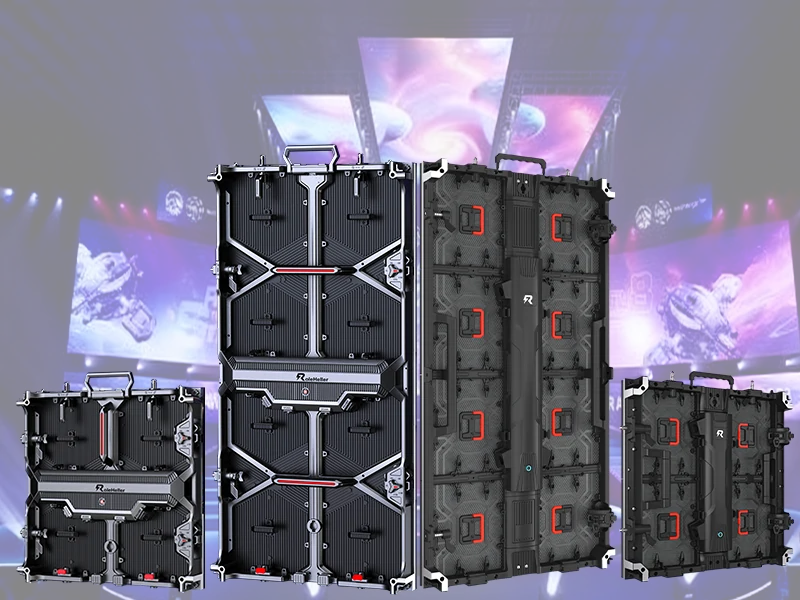
Die-Cast Aluminum / Magnesium Alloy: Premium manufacturers utilize high-precision CNC-machined die-cast aluminum cabinets. These provide dimensional tolerance within 0.1mm, ensuring razor-flat cabinet-to-cabinet seams without visible vertical lines. Aluminum also acts as a massive passive heat sink, allowing completely fanless, silent designs that do not suck moist outside air into the enclosure.
Traditional Sheet Metal (Iron/Steel): Budget mass-market screens still rely on folded iron boxes. They are heavy, prone to joint rust along screw threads in marine or humid climates, and inevitably warp under direct solar heating, creating irregular cabinet seams.
When reviewing factory quotations, keep this component matrix handy to determine whether a quotation represents an authentic commercial-grade build or a compromised value product:
| Technical Parameter | Tier-1 Enterprise Standard | Commercial Grade (Mid-Tier) | Economy / Budget Assembly |
|---|---|---|---|
| LED Packaging | Nationstar Gold Wire / Cree / Nichia | Nationstar Copper Wire / Kinglight | Generic Brand / Alloy Wire |
| Drive IC Architecture | Macroblock MBI5359 / Chipone ICND2065 | Chipone ICND2153 / MBI5124 | Low-end unbranded IC |
| Refresh Rate | 3,840Hz – 7,680Hz | 1,920Hz – 3,840Hz | ≤ 1,920Hz |
| Peak Brightness | 6,500 – 8,000 nits (calibrated) | 5,500 – 6,500 nits | 4,500 – 5,200 nits (uncalibrated) |
| Power Distribution | Common Cathode Dual-Rail (2.8V / 3.8V) | Hybrid High-Efficiency 4.2V/4.5V | Traditional Common Anode 5.0V |
| Average Power Draw | 180W – 240W per sqm | 260W – 340W per sqm | 400W – 550W per sqm |
| Ingress Protection | IP66 / IP68 (Fully sealed module) | IP65 Front / IP54 Rear | IP65 Front / Open Rear Grille |
| Cabinet Construction | CNC Die-Cast Aluminum or Magnesium | Die-Cast Aluminum | Cold-Rolled Sheet Metal / Iron |
| Power Supply Unit | Mean Well UHP / G-Energy Fanless | Mean Well LRS / Chuanglian | Unbranded generic switching PSU |
| Control System | NovaStar Armor / Colorlight i9+ | NovaStar A5s Plus / DH7512 | Low-tier synchronous card |
| Lifespan to 50% Luma | 100,000 Hours (Stable decay) | 70,000 Hours | 30,000 – 50,000 Hours |
The global manufacturing landscape for outdoor LED video walls is heavily centered in specialized industrial clusters, primarily around Shenzhen, Huizhou, and Dongguan in the Pearl River Delta. However, not every factory serves the same customer profile.
Brands like Absen, Unilumin, Leyard, and INFiLED dominate high-profile international airport projects, flagship retail facades, and massive DOOH billboard networks.
The Advantage: These manufacturers operate fully automated SMT cleanroom facilities, run exhaustive environmental stress testing (salt spray chambers, high-low temperature shock cycles, vibration testing), and hold comprehensive international certifications (CE, UL, ETL, FCC, RoHS). Their optical calibration algorithms ensure exceptional color uniformity across vast video surfaces.
The Trade-Off: You will pay a considerable brand premium, often 30% to 60% higher than smaller OEM specialists. Furthermore, customization requests for non-standard cabinet dimensions or unique structural geometries can involve long lead times and high minimum order quantities.
A second category consists of dedicated export-focused engineering manufacturers such as Dicolor, Gloshine, CreateLED, Uniview LED, and Lamp.
The Advantage: These suppliers focus intensely on rental and fixed-installation display hardware. They are frequently far more nimble than top-tier conglomerates, offering rapid engineering support for custom curved cabinets, front-service magnetic hardware, and specialized architectural mountings. When specified with premium components (such as Nationstar gold-wire LEDs and Mean Well fanless supplies), their build quality rivals the top brands at a significantly more competitive capital cost.
The Trade-Off: The buyer must possess a clear understanding of technical specifications. Because OEM plants offer multiple tiers of internal BOM options, an unguided buyer who simply requests the lowest possible price may end up receiving their entry-level budget build rather than their enterprise-grade hardware.
Companies like Qiangli Jucai and various local regional assemblers produce staggering quantities of standardized outdoor modules.
The Advantage: Rock-bottom upfront hardware pricing and massive distributor stock availability. If you break a single module, finding a replacement off the shelf is relatively straightforward.
The Trade-Off: These modules are primarily engineered for domestic cost-sensitive applications. Module flatnesses, color binning tolerances, and long-term UV resistance on the plastic louvers are rarely suited for demanding commercial architectural facades or high-end branding environments.
One common mistake commercial buyers make when liaising with p4 outdoor led display manufacturers is neglecting physical maintenance access until the structural frame is already built on site.
Outdoor video walls are generally serviced in one of two configurations:
[Rear Maintenance Setup]
+------------------------------------------------------+
| Display Face  | Modules | Cabinets | Catwalk / Doors |
+------------------------------------------------------+
  Requires: Minimum 600mm to 800mm space behind the wall
  Pros: Cheaper standard cabinet hardware
  Cons: Huge architectural footprint, costly secondary steel structure

[Front Maintenance Setup]
+------------------------------------------------------+
| Display Face  | Modules (Vacuum Tool / Front Bolts)   |
+------------------------------------------------------+
  Requires: Zero rear space (direct wall-mount or slim frame)
  Pros: Saves real estate, lower structural construction costs
  Cons: Requires high-precision magnetic or hydraulic latching mechanisms
If your screen is being mounted directly onto a building facade, a shopping center canopy, or an existing stone wall, you must specify front-service modules. In a quality front-service P4 display, modules are detached from the structural frame either via an electric vacuum suction tool or through specialized front-access Allen-key release mechanisms. This eliminates the need for expensive rear maintenance catwalks, which can save thousands of dollars in structural steel fabrication and municipal permit approvals.
When presenting an investment proposal to corporate stakeholders or property managers, looking solely at the purchase invoice is a recipe for budget surprises. An outdoor screen runs between 12 and 18 hours per day, 365 days a year. Electricity and thermal degradation represent a massive fraction of your five-year operating expenditure.
Let us run a real-world calculation comparing a standard Common Anode P4 display against a modern Common Cathode P4 display across a standard 30-square-meter commercial video facade:
Daily Operating Hours: 14 hours/day
Screen Surface Area: 30 m²
Electricity Tariff: Assumed at an average commercial rate of $0.20 per kWh
[Traditional Common Anode Screen]
Average Power Consumption: ~350W per m²
Hourly Consumption (30m²): 10.5 kW
Daily Consumption (14 hours): 147 kWh
Annual Energy Cost: 147 kWh * 365 days * $0.20 = $10,731 USD
Five-Year Energy Expenditure: ~$53,655 USD

[Modern Common Cathode Screen]
Average Power Consumption: ~220W per m²
Hourly Consumption (30m²): 6.6 kW
Daily Consumption (14 hours): 92.4 kWh
Annual Energy Cost: 92.4 kWh * 365 days * $0.20 = $6,745 USD
Five-Year Energy Expenditure: ~$33,725 USD
By specifying Common Cathode technology from your manufacturer, you save nearly $20,000 in electricity alone over a five-year lifecycle on a modest 30-square-meter installation. Furthermore, because the screen operates substantially cooler, the silicone potting compound does not dry out and crack, the internal electrolytic capacitors inside the power supplies do not degrade prematurely, and color calibration remains remarkably consistent across all display cabinets.
Never wire a 30% initial deposit based solely on a PDF presentation and a polished website. If you are ordering a sizable commercial project, you or a trusted third-party technical inspector should verify the factory’s quality assurance pipeline. Here is the exact field checklist that seasoned procurement specialists follow:
A reliable manufacturer will never pack modules straight off the SMT line into wooden shipping crates. Every batch of P4 outdoor modules must undergo:
At least 24 hours of continuous module-level burn-in (alternating between full white, full red, green, blue, and gradient video patterns).
An additional 48 hours of fully assembled cabinet burn-in with all power supplies, receiving cards, and ribbon cables linked together.
Ask the supplier for live video streams showing the actual production batch undergoing testing in their burn-in hall, clearly displaying the running timecode and project serial numbers.
A true IP65 or IP66 outdoor rating requires real physical verification. The factory should possess a dedicated water-ingress test chamber where assembled cabinets are subjected to continuous high-pressure water jets from all angles for a minimum of 30 minutes. Following the test, engineers must open the rear access hatches and inspect the interior perimeter for any trace of water misting, condensation, or gasket failure.
Examine the physical module up close:
The black plastic louvers (the contrast masks protecting the LEDs) must be molded from high-grade polycarbonate with anti-UV additives. Inferior plastics turn chalky and gray after six months of direct sun exposure, completely ruining screen contrast.
The silicone potting on the rear of the PCB must be applied by automated two-component dispensing machines, creating a completely bubble-free, uniform protective rubber layer that covers every single SMD resistor, capacitor, and IC pin.
Look at the solder joints on the connector pins: they should be smooth, shiny, and concave, indicating proper reflow oven temperature curves rather than brittle cold-soldering.
A common supplier trick in the display export industry is "BOM drifting." The initial evaluation sample arrives equipped with top-spec Nationstar Gold-wire LEDs and Mean Well power supplies. However, once the contract is signed and the deposit cleared, the production manager quietly substitutes lower-cost components to widen factory margins.
Always insist on an explicit, itemized Bill of Materials attached directly as an enforceable annex to your commercial contract. The contract should explicitly stipulate:
The exact LED packaging model and wire-bonding type.
The specific driver IC model number.
The brand, model, and wattage of the power supplies.
The specific receiving card firmware and hardware version.
A requirement for factory-calibrated chromatic and luminance data files to be delivered on a flash drive with the shipment.
When managing an outdoor display deployment, practical questions inevitably arise on site. Let us tackle the core questions that field engineers and project managers confront most often:
Yes, but only if the display provides a calibrated brightness of at least 6,000 to 6,500 nits (cd/m²) combined with high-contrast matte-black optical masks. If a screen faces due south or due west—catching direct, unshaded afternoon solar glare—a 5,000-nit screen will look washed out, with dark video content appearing faded and murky. In these high-exposure environments, you must specify ultra-high-brightness LEDs capable of reaching 7,000 to 7,500 nits, paired with an automated ambient light sensor that dims the display down to 1,200–1,800 nits after dusk to prevent blinding drivers and violating local light pollution bylaws.
Never purchase an outdoor LED wall without a comprehensive spare parts package originating from the exact same production batch. LED manufacturing involves subtle binning variations; diodes produced six months later will exhibit slight color temperature and wavelength shifts that are visibly glaring if patched into an older screen. Always insist on:
3% to 5% spare LED modules (pre-calibrated to the master batch).
3% to 5% spare power supply units.
2% to 3% spare receiving cards.
A complete set of replacement data flat cables, power interconnect cables, silicone waterproof rubber rings, and proprietary cabinet screws.
Without question. While sheet metal iron cabinets may shave 10% to 15% off the initial hardware quotation, they create massive headaches over time. Iron expands and contracts significantly under heat, causing individual cabinets to shift and creating visible black seam lines between panels. Moreover, once the paint layer is scratched during installation, iron rusts rapidly in rainy or coastal environments. Die-cast aluminum provides extreme rigidity, zero rust, superior passive heat dissipation, and reduces structural loading weight on the host building by up to 40%.
When sourcing commercial display hardware, remember that the cheapest quotation is almost always the most expensive display you will ever buy. If an overseas sales rep offers you a P4 outdoor display at a price that seems dramatically lower than the rest of the market, they did not discover some magical engineering shortcut. They simply downgraded the copper content in the PCB, selected copper-wire or scrap-wafer diodes, installed undersized power supplies operating at 95% continuous load capacity, and skipped the mandatory 72-hour burn-in cycle.
Focus on total system stability. Partner with a manufacturer that communicates transparently about their internal bill of materials, provides detailed CAD structural drawings for your installation team, and maintains an accessible technical support desk. An outdoor P4 video wall should be an asset that runs smoothly in the background, driving brand awareness and advertising revenue without demanding constant emergency repairs.
The recommended minimum viewing distance for a P4 display is approximately 4 meters (13 feet). At this distance, the human eye with normal 20/20 vision perceives individual pixels as a smooth, continuous image. The optimal viewing range extends from 4 meters up to roughly 50 meters, making it ideal for street-level retail, drive-thru digital menus, shopping center facades, and gas station pylons.
An IP65 rating signifies complete protection against dust ingress and resistance to water jets projected from any direction. IP66 offers a higher seal integrity, protecting against powerful, heavy seas or torrential storm surges. IP68 represents hermetically sealed hardware capable of continuous water submersion. For most commercial outdoor installations, an IP66 front and IP65 rear configuration provides exceptional durability against extreme weather.
Common Cathode technology supplies independent, optimized voltage rails to the Red (2.8V) and Blue/Green (3.8V) diode chips instead of supplying a uniform 5.0V. By eliminating the need to burn off excess voltage as heat, the screen operates between 10°C and 15°C cooler. Lower internal temperatures dramatically reduce thermal stress on the electronic solder joints, prevent the silicone potting compound from hardening or cracking, and extend overall diode half-life past 100,000 operational hours.
While a 1,920Hz refresh rate looks acceptable to the naked eye, smartphone cameras and broadcast cameras capture visual artifacts when recording lower-frequency screens. A refresh rate of 3,840Hz or higher ensures that video recordings, social media photos taken by passing pedestrians, and TV broadcasts remain entirely free of black rolling scan bars, flickering, and color tearing.
For displays facing direct, unshaded sunlight (especially South- or West-facing facades), a minimum brightness of 6,000 to 7,000 nits is essential to prevent the image from appearing washed out. For displays permanently shaded or facing North, 5,000 to 5,500 nits is generally sufficient. All commercial outdoor screens should incorporate an automatic ambient light sensor to throttle brightness down during nighttime hours.
Yes. Modern P4 outdoor screens can be engineered with front-service modules utilizing high-strength magnetic mountings or mechanical front-lock screws. Front-maintenance displays can be installed completely flush against structural building walls, eliminating the need for expensive rear access corridors, catwalks, and heavy secondary framing.
A high-quality P4 outdoor display built with gold-wire LEDs, brand-name driver ICs, and high-efficiency power supplies has an expected operational lifespan of 80,000 to 100,000 hours before brightness drops to 50% of its original output. Lower-grade displays built with copper-wire LEDs and generic components frequently experience noticeable color shift and heavy pixel degradation within 20,000 to 30,000 hours.
Standard SMD (Surface Mount Device) solders the diode directly onto the PCB surface with an individual plastic louver mask for protection. GOB (Glue-on-Board) applies an optically clear, high-durability epoxy resin shield directly over the entire module face. GOB provides superior impact resistance, dust-proofing, and moisture protection, making it particularly advantageous for street-level installations vulnerable to pedestrian contact, accidental impacts, or vandalism.
High humidity combined with saline coastal air accelerates electrolytic corrosion across exposed copper traces, connector pins, and solder joints. In coastal or tropical climates, buyers should explicitly specify conformal coating on all PCBs, anti-corrosion gold-plated connector pins, marine-grade aluminum cabinet alloys, and stainless steel (SUS304 or SUS316) exterior hardware.
The industry standard control systems are dominated by NovaStar (such as the Taurus multimedia player series, A5s Plus, or Armor series receiving cards) and Colorlight. These systems provide robust cloud-based content scheduling, automated thermal and hardware diagnostic telemetry, redundant signal loop backup, and precise pixel-by-pixel luminance and chromatic calibration.