English
Picture this — you've just landed a gig to supply a 200-square-meter LED video wall for a three-day outdoor music festival in Austin, Texas. The stage is massive, the client wants P3.91 panels, and you need them delivered in six weeks. Your first instinct is to go online, type "China outdoor rental LED video wall manufacturers" into a search engine, and start scrolling through results. But within ten minutes you're drowning in a sea of Alibaba listings, factory websites that all look identical, and price quotes that range from absurdly cheap to suspiciously high. How do you figure out who's a real manufacturer, who's just a middleman marking up prices, and who will actually deliver panels that survive rain, wind, and 40°C heat without falling apart on day two of the event?
I've been sourcing outdoor rental LED displays from Chinese factories for nearly a decade now — buying for my own rental inventory, consulting for event production companies across North America and Europe, and helping AV integrators navigate the sourcing process. Here's the honest truth: the best China outdoor rental LED video wall manufacturers are concentrated in Shenzhen's Bao'an and Longhua districts, factory-direct pricing for standard P3.91 outdoor rental cabinets sits between $280 and $650 per panel depending on LED chip brand and cabinet construction, and the difference between a panel that survives three seasons of touring and one that develops dead pixels after a single rainy festival comes down to component choices and build quality that most buyers never think to investigate.
Let's dig into what actually matters when you're sourcing outdoor rental LED video walls from China.
Indoor fixed installations and outdoor rental panels might look similar on a spec sheet, but they live in entirely different worlds. Outdoor rental panels get thrown into flight cases, loaded onto trucks, dragged through mud, set up in the rain, baked by the sun, and torn down at 2 AM by exhausted crew members. Every single time.
That means the manufacturing requirements are fundamentally different:
IP65 front protection is non-negotiable — rain, dust, and humidity will destroy panels that aren't properly sealed. I've seen "outdoor-rated" panels from budget manufacturers fail after a single afternoon of light rain because the silicone gaskets were poorly fitted
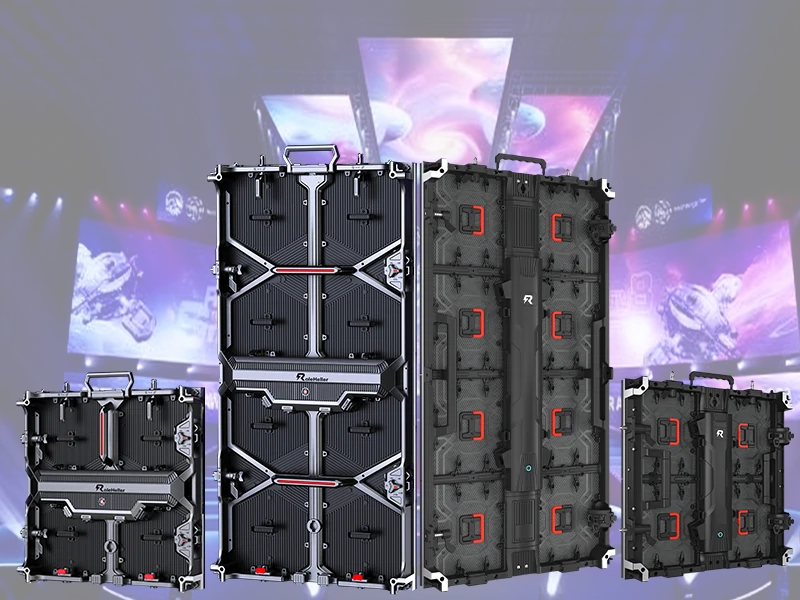
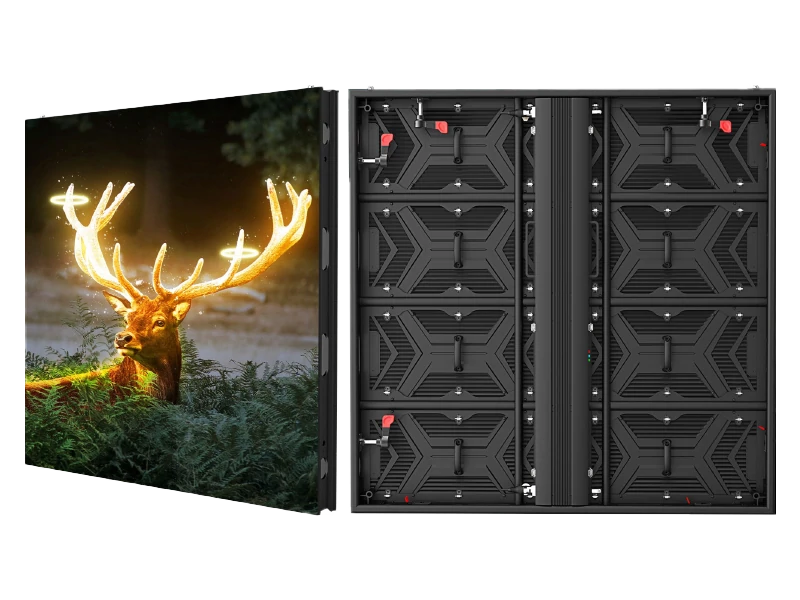
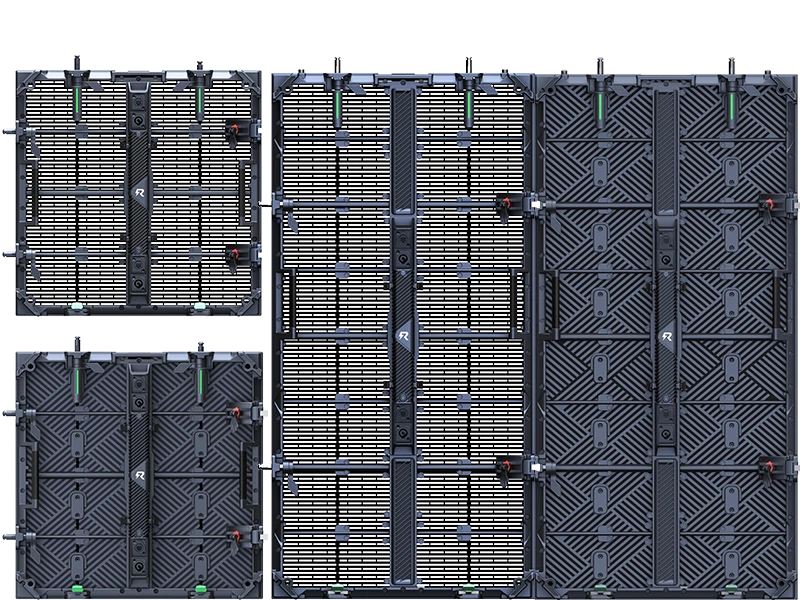
Die-cast aluminum cabinets are mandatory — sheet steel cabinets warp under repeated temperature cycling and physical handling. Die-cast aluminum holds its shape through hundreds of setup cycles and provides better heat dissipation
Quick-lock mechanisms must be metal, not plastic — plastic locking systems crack after 50-80 setup cycles. Metal cam locks with stainless steel pins are what you need for rental panels that will be assembled and disassembled hundreds of times
High brightness is essential — outdoor panels need 5,000-7,500 nits minimum to be visible in direct sunlight. Indoor panels at 800-1,500 nits are completely useless outdoors
Rear cable access must be tool-free — when you're doing field repairs at an event, you don't have time to hunt for screwdrivers. Tool-free rear access panels save real time on-site
This is where things get murky. Let me break down the different types of companies you'll encounter when searching for China outdoor rental LED video wall manufacturers.
Tier 1: Vertically integrated manufacturers with dedicated rental product lines
These are the big players — companies like Absen, Unilumin, Leyard, and LianTronics — that design, manufacture, and test every component in-house. They have dedicated rental product lines with purpose-built cabinets, proprietary quick-lock systems, and in-house calibration facilities. Their outdoor rental panels are engineered from the ground up for the abuse that rental environments inflict.
The advantage? Consistent quality, reliable supply chains, and comprehensive warranty support. The disadvantage? Higher prices — typically $450-$650 per P3.91 outdoor rental panel at wholesale quantities.
Tier 2: Mid-size manufacturers specializing in rental products
These factories might not have the brand recognition of Tier 1, but they focus specifically on rental and event display products. They understand the unique demands of the rental market — fast setup, durability, field-serviceability — and they engineer their products accordingly. Companies like PRG-affiliated operations, some Colorlight ecosystem manufacturers, and several mid-tier Shenzhen factories fall into this category.
Their pricing is often 20-35% below Tier 1, and the quality can be genuinely excellent if you know what to look for. This is where I've found some of the best value in outdoor rental panels.
Tier 3: General LED display factories that also make rental panels
These companies primarily manufacture fixed-installation indoor and outdoor displays, and they've added rental products to their catalog because the market is lucrative. Their rental panels are often adapted from fixed-installation designs — same cabinets, same modules, just with some locking hardware bolted on. The problem? Fixed-installation panels aren't designed for repeated assembly and disassembly, and they show it. Connector pins bend, cabinet corners dent, and locking mechanisms wear out quickly.
Tier 4: Assembly-only operations and trading companies
These entities buy modules and cabinets from upstream suppliers, assemble them, and sell under their own brand. They have no control over component quality, no in-house testing capability, and no engineering expertise. Some produce acceptable products by luck — by sourcing from good upstream suppliers — but you have zero visibility into what's inside the panels you're buying.
| Component | Budget Tier ($280-$380) | Mid-Range ($380-$500) | Premium Tier ($500-$650) |
|---|---|---|---|
| LED Chip Brand | Unbranded / Nationstar regular | Nationstar Gold, Kinglight Pro | Nationstar Gold SMD3535, Epistar |
| Driver IC | FM6124 basic | Macroblock MBI5124 | Macroblock MBI5359 / ICN2038 |
| Refresh Rate | 1920Hz | 3840Hz | 3840Hz+ high PWM |
| Cabinet Material | Die-cast aluminum (basic) | Die-cast aluminum (reinforced) | Die-cast aluminum, CNC-finished |
| IP Rating | IP65 (front only) | IP65 front + IP54 rear | IP65 front + IP65 rear |
| Brightness | 5,000 nits | 5,500-6,500 nits | 6,500-7,500 nits |
| Locking System | Basic cam locks | Reinforced cam locks | Precision quick-lock with stainless pins |
| Weight per Panel (500×500) | 8-10 kg | 7-9 kg | 7-8.5 kg |
| Setup Cycle Rating | 200-300 cycles | 400-600 cycles | 800+ cycles |
The LED chip is where the biggest visible difference emerges. At P3.91 outdoor, Nationstar Gold SMD3535 chips deliver consistent brightness and color across the panel surface even after thousands of hours of outdoor exposure. Budget chips — often unbranded or from lesser-known suppliers — start showing color shift and brightness degradation within 6-12 months of outdoor use, especially in high-UV environments.
Driver ICs determine how smoothly the panel renders motion and how well it performs on camera. The Macroblock MBI5359 provides precise current control with less than ±1% channel deviation, which means uniform brightness across every pixel even at low grayscale levels. Budget driver ICs at 3-5% deviation create visible brightness banding that becomes obvious when you're displaying gradient content or when cameras capture the panel.
Cabinet construction is where rental panels earn their price premium. A premium die-cast aluminum cabinet maintains flatness within ±0.05mm through hundreds of thermal cycles — going from 10°C at night to 45°C in direct sunlight and back again, over and over. Budget cabinets at ±0.15mm or worse develop visible seams between panels as the metal flexes and doesn't fully return to its original shape.
Let me give you concrete numbers based on current market conditions. These are factory-direct wholesale prices for outdoor P3.91 rental cabinets (500×500mm, die-cast aluminum) — processors, flight cases, cabling, and shipping are extra:
Sample order (1-10 panels): $450-$650 per panel
Small wholesale (20-50 panels): $380-$520 per panel
Medium wholesale (50-150 panels): $320-$440 per panel
Large wholesale (150+ panels): $280-$380 per panel
A few things to keep in mind about these numbers:
Flight cases add $35-$60 per panel depending on construction — roto-molded cases with EVA foam inserts are the standard for professional rental operations
For P2.97 outdoor rental panels (a finer pitch gaining popularity for closer-viewing-distance events), add roughly 25-40% to the prices above
Payment terms are typically 30% deposit via T/T, 70% balance before shipment. Established relationships sometimes get 40/60 terms
Shipping a 20-foot container of outdoor rental panels (roughly 180-220 panels depending on packaging) from Shenzhen to the US West Coast costs approximately $3,000-$5,000 at current ocean freight rates
This is the part most buyers skip, and it's the part that costs them the most money down the line. Here's my vetting checklist:
Request a factory video tour or visit in person
Real manufacturers are proud of their production lines and will happily show you their SMT equipment, aging rooms, and calibration setups on a live video call. If a company keeps deflecting — "our factory is very busy right now," "we'll arrange a visit next quarter" — that's a significant red flag. I always ask to see the SMT line first. If they can't show you active SMT machines placing components onto PCBs in real time, they're not manufacturing modules.
Ask about their aging test protocol
Outdoor rental panels need a minimum of 72 hours of continuous aging at full brightness before shipping. This catches early LED failures, power supply issues, and color inconsistency that would otherwise show up on-site at an event. Some manufacturers age for only 48 hours or skip aging entirely for rush orders. Ask specifically how long they age their outdoor rental panels and whether they monitor for dead pixels and brightness drift during the aging process.
Request per-module calibration data
At P3.91 outdoor, per-module calibration ensures that every panel in your order matches its neighbors in brightness and color. Ask the manufacturer to show you a sample calibration report — it should include individual brightness and chromaticity measurements for each module. If they only do batch-level calibration (setting all modules to the same average), expect visible color patches across large video walls.
Test their technical support responsiveness
Before placing an order, send them a few specific technical questions — about pixel mapping for a curved configuration, or power load calculations for your venue, or refresh rate settings for camera capture. If the responses are vague, generic, or take several days to come back, that tells you what after-sales support will be like when you have an urgent problem at 11 PM during an event.
Outdoor rental LED panels need to meet specific certification requirements depending on where they'll be deployed:
United States: ETL listing (Intertek) or UL listing is what electrical inspectors look for at event venues. FCC Part 15 for electromagnetic emissions. Some venues also require the panels to meet specific fire safety ratings for the cabinet materials
European Union: CE marking covering LVD, EMC, and RoHS. For outdoor events, some countries also require compliance with EN 60598 for luminaires and EN 62471 for photobiological safety
United Kingdom: UKCA marking post-Brexit, with essentially the same requirements as CE
Australia: RCM marking for electrical safety and EMC
Middle East: SASO/SABER for Saudi Arabia, ESMA for UAE
I always recommend asking for the actual test report — not just the certificate — and verifying the report number on the testing laboratory's website. Counterfeit certificates exist, and at the price points we're talking about for outdoor rental panels, a fake certificate could result in your equipment being shut down by venue inspectors mid-event.
I've watched these play out so many times it almost hurts.
Buying indoor panels for outdoor use
Some budget suppliers will tell you their "outdoor" panels are just indoor panels with a higher brightness setting. This is dangerously wrong. Indoor panels lack IP65 sealing, use different PCB coatings, and have cabinets that aren't designed for temperature cycling. An indoor panel used outdoors will fail — often catastrophically — within weeks.
Ignoring the flight case quality
Your panels are only as protected as their flight cases. Cheap cases with thin walls, inadequate foam, and weak latches will allow panels to shift during transit, damaging connector pins, cracking PCBs, and denting cabinet edges. A good roto-molded case with custom-cut EVA foam costs $35-$60 per panel. A cheap plywood case costs $15-$25. The $20 savings per panel isn't worth the damage it causes.
Not ordering spare parts upfront
Outdoor rental panels take abuse. Connector pins bend, LED modules get cracked during setup, power supplies fail, and receiving cards develop faults. When you place your wholesale order, negotiate a spare parts package — typically 5-8% extra panels plus additional power supplies, receiving cards, and connector cables. The cost is minimal compared to the panic of needing a single replacement panel shipped internationally two days before a major event.
Overlooking the video processor
Your outdoor rental LED video wall is only as good as the signal feeding it. A quality video processor from Novastar, Colorlight, or Brompton handles content scaling, brightness adjustment, and input switching. For outdoor rental, you need a processor that can handle multiple input sources, do real-time brightness adjustment as ambient light changes throughout the day, and support curved or irregular screen configurations. Budget at least $1,500-$5,000 for a processor depending on your resolution and input requirements.
This depends heavily on how they're treated and what components they're built with.
A premium outdoor rental panel built with Nationstar Gold LEDs, Macroblock driver ICs, and Mean Well power supplies — properly maintained, stored in good flight cases, and operated within its temperature specifications — will last 8-12 years in a professional rental environment. That's roughly 800-1,200 setup cycles before significant component degradation begins.
A mid-range panel with decent components but not premium-tier build quality will last 4-7 years and 400-600 setup cycles before you start seeing increased failure rates.
A budget panel with generic components might last 1-3 years and 150-300 setup cycles before the cost of repairs and replacements exceeds the value of the panels themselves.
Operating environment plays a huge role. Panels used primarily in temperate climates with moderate sun exposure will outlast panels used in desert festivals (extreme UV and heat) or tropical events (high humidity and salt air). I've seen premium panels from a rental company in Arizona that needed major refurbishment after four years of desert festival use, while the same model panels from a company in Portland, Oregon looked nearly new after six years.
After nearly a decade of doing this, here's what I've learned — the China outdoor rental LED video wall manufacturers who produce genuinely durable, high-performance panels aren't the cheapest, and they're not always the ones with the most polished marketing. They're the ones who can show you their aging rooms running panels at full brightness, explain their LED chip sourcing and binning process, demonstrate their per-module calibration setup, and back it all up with test reports from accredited third-party laboratories.
My advice to anyone entering the outdoor rental market: start with a sample order of 6-10 panels. Take them to an actual event. Set them up in the rain if you can. Leave them in direct sunlight for a full day. See how the locking mechanisms feel after 20 assembly cycles. Check the color uniformity across the wall at night and during the day. This sample investment — maybe $3,000-$5,000 — will tell you more about a manufacturer's quality than any spec sheet or sales pitch ever could.
Once you find a manufacturer you trust, the relationship becomes your biggest asset. They know your specs, they know your quality standards, they'll flag potential issues before they become problems, and they'll prioritize your orders when supply chains get tight. That kind of partnership is worth far more than saving $40 per panel from an unknown supplier.
Don't chase the absolute lowest price. The difference between a $300 panel and a $500 panel seems significant when you're buying 100 units, but over three years of touring, that $200 per panel difference buys you zero on-site failures during live events, consistent color uniformity across your entire inventory, locking mechanisms that don't strip after a season of use, and no emergency replacement orders flying in from Shenzhen the day before your biggest gig. For a rental business, reliability is revenue. Every minute your panels spend sitting in a repair queue is money you're not making.
1. What pixel pitch is best for outdoor rental LED video walls?
P3.91 remains the most popular pixel pitch for outdoor rental applications because it balances resolution, brightness, and cost effectively. P2.97 is gaining traction for events where audiences are closer to the stage (under 5 meters), offering noticeably sharper images at a 25-40% price premium. For large-scale festivals and concerts where viewing distances exceed 10 meters, P4.81 is still widely used and offers the best cost per square meter.
2. What is the minimum order quantity for outdoor rental LED panels from Chinese manufacturers?
Most manufacturers set their minimum order quantity at 10-20 panels for first-time buyers. Some mid-size manufacturers will accept orders as small as 5 panels for sample evaluation. The best wholesale pricing typically kicks in at 50+ panels, and significant volume discounts of 15-25% are available at 150+ panel orders.
3. How long does production take for outdoor rental LED video wall orders?
Standard production takes 18-25 working days for orders up to 100 panels, and 25-35 working days for orders of 100-300 panels. This includes SMT production, module assembly, cabinet integration, aging testing (72+ hours for outdoor panels), per-module calibration, IP sealing verification, and final QC inspection. Rush production is sometimes available at a 15-25% surcharge.
4. What IP rating do outdoor rental LED panels need?
IP65 on the front face is the minimum requirement for outdoor rental panels — this protects against dust ingress and water jets from any direction. The rear of the panel should be at least IP54, though premium panels offer IP65 rear protection as well. IP65 rating means the panel can withstand rain, splashing, and temporary water exposure, but it should not be submerged.
5. How do outdoor rental LED panels handle extreme temperatures?
Quality outdoor rental panels are rated for operating temperatures from -20°C to +50°C. In extreme heat, the panels' internal temperature management — including aluminum cabinet heat dissipation and intelligent brightness reduction — prevents thermal shutdown. In extreme cold, LED response times slow slightly but the panels remain functional. Premium panels use industrial-grade components rated for wider temperature ranges.
6. What video processor works best with outdoor rental LED panels?
Novastar controllers (A10s Pro, VX1000, or MCTRL4K series) are the most widely compatible with Chinese-manufactured outdoor rental panels. Colorlight Z-series and Nova's own premium controllers offer excellent value. For high-end broadcast and premium events, Brompton Tessera processors provide superior color accuracy, HDR processing, and real-time brightness adjustment that responds to changing ambient light conditions.
7. How do I maintain outdoor rental LED panels to maximize lifespan?
After each event, inspect panels for physical damage, clean the front face with a soft microfiber cloth (never use abrasive materials or solvents), check connector pins for bending or corrosion, and store panels in their flight cases in a dry, temperature-controlled environment. Every 6 months, run a full calibration check and inspect silicone gaskets for deterioration. Replace any gaskets showing cracks or compression set.
8. Can outdoor rental LED panels be used in rainy conditions?
Yes — properly rated IP65 outdoor rental panels are designed to operate in rain. However, you should avoid setting up or tearing down panels during heavy rain, as water can enter through open connector ports during assembly. Once fully assembled with all connections made and sealed, the panels can withstand sustained rainfall. Always ensure rear access panels are properly closed and latched before exposing panels to moisture.
9. What warranty do Chinese outdoor rental LED panel manufacturers typically offer?
Most reputable manufacturers offer 2-3 years of warranty coverage for outdoor rental panels. This typically covers manufacturing defects including LED chip failure, driver IC failure, power supply failure, and dead pixels exceeding the manufacturer's threshold (usually 5-10 dead pixels per module for outdoor P3.91). Physical damage from improper handling, accidents, or force majeure events is not covered. Some manufacturers offer extended warranty options up to 5 years for an additional fee.
10. How do I ship outdoor rental LED panels from China to the US or Europe?
Outdoor rental panels should be packed in roto-molded flight cases with custom EVA foam inserts, then palletized for ocean freight. A 20-foot container holds approximately 180-220 panels depending on case size. Ocean shipping takes 18-25 days to the US West Coast, 28-35 days to the US East Coast, and 30-38 days to Northern Europe. Air freight is available at 5-7 days but costs 4-5 times more. Always insure shipments for full replacement value and request pre-shipment inspection photos before the container is sealed.
.jpg "Which China Portable LED Video Wall Manufacturers Should You Trust in 2026?")