 English
You need a small screen. Not a billboard, not a stadium wall — something that fits above a counter, or on a pillar in a shop, or mounted outside a café door showing today's specials, or a little scoreboard for a training hall. You search for small led display manufacturers and within twenty minutes you are looking at roughly four hundred companies, all claiming factory-direct pricing, all offering free samples, and quotes running from about $300 to $2,800 per square metre for what is apparently the same P2.5 cabinet. Nobody explains the gap. Nobody tells you that "small" means very different things in this trade — a 320×160mm module is not the same supply chain as a one-square-metre fixed cabinet, and if you ask for a quote without saying which kind of small you mean, you will get a price for something you cannot mount where you need it. And almost nobody warns you that with small displays the failure point is rarely the LEDs; it is the power supply crammed into a tiny space, the receiving card tucked behind a panel nobody can reach, and the content designed for a phone that looks like pixel soup at two metres.
Here is the direct answer.
If you want documented specs and a supplier still around in five years, the names that keep coming up are Leyard (which owns Planar), Unilumin, Absen, Ledman, LianTronics, AOTO, plus a wide second layer of Shenzhen, Dongguan and Huizhou factories specialising in small-pitch indoor cabinets and signage, and Zhongshan for acrylic and light-box style work. For very small formats — counter displays, single-sided message boards, modular panels under a square metre — there is a separate cluster around Guangzhou and Shenzhen that lives on the B2B directories and exhibits at ISLE and InfoComm. If you need fine pitch below P1.5 or something that will be filmed, lean toward the bigger players or a verified mid-tier factory willing to lock its component list in writing. If you need a handful of small units fast and maybe odd sizes, the mid-tier specialists usually win on speed. That is the short version. The rest is how you stop guessing.
In this trade, "small" is not a size, it is a category label covering at least five different products. They look similar in a JPEG and behave completely differently once hung on a wall.
Small-pitch indoor cabinets (P1.2–P2.5). Standard 600×336 or 600×400 cabinets, front service, used for retail walls, lobbies, control rooms. This is the mainstream choice and the one with the most spare parts available.
Modular panels / poster-size screens. Often built from 320×160mm modules into a custom rectangle, framed in aluminium, hung like a picture. Cheap per square metre, good for odd aspect ratios. Weakness: seams show, the frame sags over time if the backing is thin, and calibration drifts between batches.
Single/dual colour small message boards. Red or red-green, P4–P10, used for prices, queues, church notices. Very cheap, very robust, cannot show video.
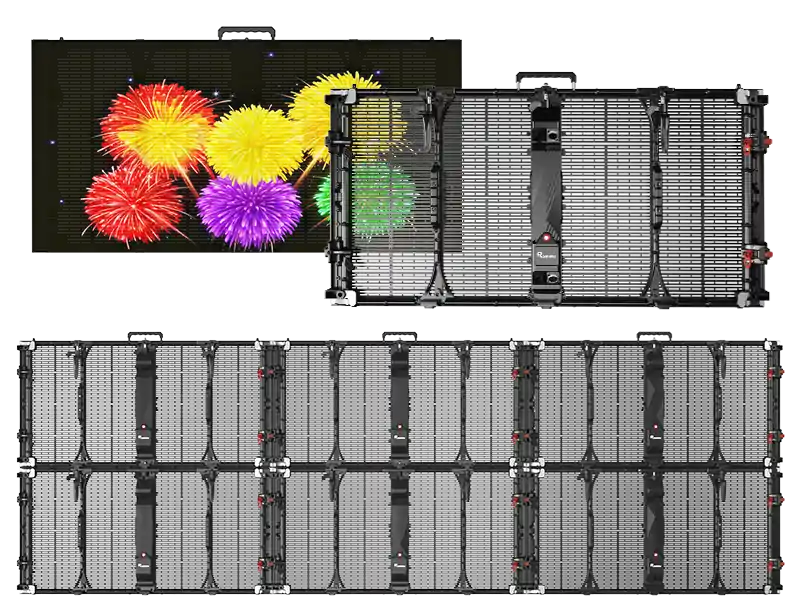
Transparent / acrylic sandwich and crystal-style small displays. Look premium on a counter or in a window. Weakness: brightness is low, uniformity suffers, and the programming chain is often proprietary.
LCD-hybrid small digital signage. Sometimes what people actually need is not LED at all but a commercial-grade LCD with a media player. Honest suppliers will say this. If your viewing distance is under a metre and the screen is below 55 inches, LED is often the wrong answer and you are paying for pixels nobody can resolve.
Ask yourself before requesting any quote: viewing distance, whether it will be filmed, how often the content changes, who changes it, and whether the screen lives in direct sun or under air conditioning. Because if the answer is "in the window, facing west, all day", a small indoor LED will be invisible by 2pm and no amount of brightness will fix it cleanly.
| Type | Best for | Typical pitch | Where it fails |
|---|---|---|---|
| Small-pitch indoor cabinet | Retail walls, lobbies, control rooms | P1.2–P2.5 | Cost, heat in recessed installs, needs front service |
| Modular panel / poster screen | Odd sizes, pillars, hanging displays | P2.5–P4 | Seams visible, frame sag, batch-to-batch colour drift |
| Small single/dual colour board | Prices, queues, notices | P4–P10 | No video, low resolution, third-party apps poorly documented |
| Transparent / acrylic sandwich | Windows, counters, feature pieces | P3.9–P10 | Low brightness, weak uniformity, proprietary software |
| Commercial LCD alternative | Under 55", close viewing, static content | N/A | Not LED; wrong call if you need daylight brightness or custom shapes |
Two PDFs can read identically and describe meaningfully different hardware. Once you learn where the gaps hide, the price spread stops looking like corruption and starts looking like arithmetic.
| What looks identical | What actually differs | Why it moves the price |
|---|---|---|
| Same pixel pitch | LED package 1921/2727/3535 or newer alternatives | Bigger packages handle heat better; smaller ones pack tighter but run hotter |
| Same brightness claim | Common-cathode vs common-anode; measured vs theoretical | Common-cathode costs more but cuts power and heat substantially |
| Same "indoor" rating | Black-body SMD vs normal SMD, contrast ratio | Black SMD gives real contrast indoors; cheap ones look washed out |
| Same cabinet size | Die-cast aluminium vs sheet metal; metal thickness | Thin metal warps, seams catch the light, flatness dies in a year |
| Same warranty length | Who pays parts, labour, freight, response time | A "five-year warranty" with no freight clause is worth much less |
| Same square metres | What is excluded | Mounting kit, processor, content, commissioning, shipping arrive as surprise invoices |
The biggest movers in practice, and the ones people forget to check on small displays:
LED die brand and bin grade. Top-bin Nationstar or Kinglight versus a lower bin changes colour consistency noticeably. On a small display this matters more than people think, because a small display is often viewed up close and next to other surfaces — paint, wood, product packaging — and any green or magenta shift reads immediately. Put two P2.5 cabinets side by side under grey content and you will see a patchwork. This is the single most common reason a wall looks wrong six months after install.
Driver IC. MBI5124, ICND2055, SM1620B — different chips, different grey scale at low brightness, different refresh behaviour on camera. If the screen sits behind glass or will be filmed, the driver IC matters more than the pixel pitch.
PCB thickness and copper weight. Thinner boards save money and move heat worse. In a small, tightly packed cabinet the heat has nowhere to go. Heat is what kills LED output over time. A cheap module is often just a hot module wearing a disguise.
Power supply brand and placement. Mean Well, Great Power, or unbranded. On small displays the PSU is often shoehorned behind the panel with zero airflow. The unbranded one works fine until it does not, and it has a habit of failing on a Friday evening. Ask where the PSU lives and whether it can be reached without taking the whole thing down.
Mask finish and flatness. On fine pitch, flatness is everything. Half a millimetre of warp and the seams catch the light. Glossy black shows every joint. Matte black forgives more.
The controller. NovaStar, Colorlight, Linsn — confirm the exact card models and verify them in the configuration software, which will tell you what is actually installed, more honest than the spec sheet. Also ask whether the software license is included and perpetual or annual, and whether you get the configuration file for your specific cabinet. That file is the key to the whole thing; without it you cannot add modules later, cannot replace a receiving card, and are locked to one vendor forever. Ask for a copy before payment.
Two traps worth naming. Bare-screen pricing that grows later — mounting brackets, processor, calibration, commissioning, shipping terms nobody clarified. And the sample-versus-production gap: the sample was hand-picked, the production run was whatever came off the line that week. Lock the component list into the purchase order: LED source and bin range, driver IC model, controller brand and card models, power supply brand, PCB spec, mask type and finish, cabinet material and thickness, plus a clause that any substitution requires written approval, and insist production matches the approved sample. Get it signed, not agreed over dinner.
Also ask for the dead-pixel acceptance standard in writing. Different suppliers use different thresholds per square metre at delivery. If nobody states a number, you will discover their standard after the install crew has gone home.
This filter does more work than anything else here. Most buyers skip it because asking feels mildly awkward, especially across language and time zone. Ask anyway.
Business licence with manufacturing in scope. Sales-only registration means reselling. Simple as that.
ISO 9001 certificate number, verified on the registrar's own site. Not the PDF they emailed. The actual lookup result.
A live video walk-through, today. Ask to see the SMT line, the aging racks, the calibration room, and a cabinet being assembled. Ask them to hold up a handwritten note with your name and today's date. Trading companies stumble here — not always from dishonesty, sometimes just because there is no floor to show.
A component list by brand. Factories recite this instantly. Traders go vague and promise to "confirm."
Test reports issued in their own company name. If the FCC, CE, or photometric report lists a different entity, ask why. Rebranding is a legitimate reason. You want the reason in writing, not discovered at customs.
Exhibition history. ISLE Shenzhen, InfoComm, ISE Barcelona, Guangzhou fairs. Real manufacturers exhibit the same shows year after year. Booth records are harder to fake than a PDF.
Two reference installs you can visit, one of them at least two years old. Photos do not.
One sample cabinet or module. One square metre teaches you colour consistency, dead pixel rate, connector fit, seam flatness, and — most telling of all — how fast they actually ship.
If the order is big enough, go in person. Shenzhen, Dongguan and Huizhou are all within reach for a day trip if you are based in Asia, and for Western buyers a two-day visit pays for itself. Bring a torch. Look at solder joints. Look at the encapsulation for bubbles. Check the magnet alignment. Ask to see a cabinet sitting on the aging rack for seventy-two hours. You learn quickly what paperwork conceals.
Pixel pitch. Minimum comfortable viewing distance in metres ≈ pitch × 1 to 1.5. P1.5–P2.5 for close-up retail and lobbies, P2.5–P4 for counters and hanging displays, P4+ for anything viewed beyond five metres. Going finer than your viewing distance burns money and generates extra heat for no gain.
Brightness. Indoor 600–1,500 nits typically. Window-facing needs more and may still lose against direct sun; sometimes the honest answer is LCD or a different location entirely. Always with auto-dimming tied to a light sensor, and always checked against local rules and landlord house rules. More brightness than you need fatigues the audience and cooks the cabinet.
Common-cathode drive. Worth paying for on anything permanently on, especially fine pitch where heat is the enemy. Cuts power draw and heat substantially, meaning lower running costs and longer PSU life. Only accept it if the supplier gives measured consumption at a defined brightness and test pattern, not the theoretical maximum. Maximum wattage is a marketing number. Average wattage is the number you pay.
Service direction. Flush against a wall with no access behind means front service. Costs more and limits cabinet size. Decide before finalising the mounting, because changing it later means rebuilding the frame.
Derating. At what ambient temperature does the screen automatically reduce brightness, and by how much. If the answer is "it does not derate," either they are overstating things or the cabinet is massively over-engineered. Neither is likely at the bottom price. Inside a recessed soffit or a sealed window reveal with no airflow, internal temperature can run well above ambient. This is where small screens fail, quietly, over a year.
Refresh rate and camera performance. If the screen will be filmed, ask for measured performance at your actual shutter speeds with your actual content. Fine pitch photographed badly looks worse than coarse pitch photographed well.
Mounting and access. How does the content get changed, and does that require tools or a ladder. If the answer involves two people and a screwdriver, your update schedule will drop to zero within six months. Also confirm weight per square metre and whether your wall can take it; small displays are often hung on drywall partitions that were never designed for the load.
Spare parts strategy. Will this cabinet still be in production in three years? Will they ship five modules or insist on a minimum order? Will the replacement bin match the aged ones already on your wall, and who does the matching calibration? Order spares with the main order, including at least one pre-configured receiving card.
Electrical and local compliance. Plugs and wiring to local standards, each unit or group on its own fused feed. Daisy-chaining too many units on one circuit is a common cause of early power-supply failure. Use a qualified electrician for the final connection and keep the test certificate. For external signs, check local planning rules and any landlord rules; many buildings restrict sign projection, illumination hours and fixings into the facade.
Certifications. United States: FCC Part 15 mandatory; UL or ETL often required in practice by landlords, insurers and government tenders. EU/UK: CE covering LVD (EN 62368-1), EMC (EN 55032/55035), RoHS, technical file kept at least ten years; UKCA for Great Britain. Always ask for ISO 9001, ISO 14001, and a flicker statement if the screen will be filmed. Practical bit: ask for the report number and issuing body, then look it up yourself. A scanned certificate with a fuzzy logo proves nothing except that someone owns a scanner.
They will not do a live video call, or they keep rescheduling it.
The certification report names a different company and nobody can explain why.
"Any pitch, any brightness, any price." Real factories have limits and they state them.
Price well below the market band while cabinet thickness and LED specs stay vague.
No stated dead-pixel acceptance standard at delivery.
Warranty says "five years" and says nothing about return freight, response time, or who sends the technician.
Payment demanded fully upfront, or into a personal account.
Zero reference projects in your application category, or references that do not answer the phone.
No discussion of mounting load, access, or local brightness regulations.
They cannot tell you the controller brand without "checking."
They will not provide the cabinet configuration file.
The sample took eight weeks and arrived with uneven alignment and poorly fitted magnets.
Is the cheapest option always wrong? Not always. But cheap with vague specs is a different product from cheap with locked specs. Unit price alone tells you nothing; the itemised quote tells you nearly everything.
Do I need a big-name manufacturer? If the screen is permanent, highly visible, and someone important looks at it daily, probably yes. If it is a secondary display or a temporary activation, a verified mid-tier factory usually delivers the same result for less.
Can I trust a supplier I have never visited? Yes, provided you run the checks above and order a sample. Physical visits help considerably, but a dated live walk-through plus certificate lookups catch most of the same problems.
Should I just pick the finest pitch available? No. Finer pitch costs more, draws more power, makes heat worse, and gains you nothing if people view from five metres away. Spend that budget on calibration, spares, and a proper processor instead.
Is LED even right for my size? If the display is under about 55 inches and viewed from under a metre, a commercial-grade LCD is often sharper, cheaper and easier to service. Be honest about this before committing. LED wins on custom shapes, seamless tiling, high brightness and long life at large sizes.
Do I really need to worry about the controller? Yes. This is the part that determines whether you can actually change the content yourself, and whether you are locked to one supplier forever. The panel is replaceable; a discontinued controller with no configuration file is a brick.
What software should I expect? For NovaStar chains, NovaLCT for configuration and ViPlex/VNNOX for content and cloud; Colorlight has Vision and their cloud platform; Linsn has LEDVISION. Ask which one your quote includes, whether it is Windows-only, and whether cloud scheduling costs extra per year.
How many spares should I order? Five percent of modules is a common starting point, plus a couple of power supplies and at least one pre-configured receiving card. For a hard-to-access install, push it higher.
Who handles installation and commissioning? Your local integrator should, and they should sign off on structure and electrical. Confirm in writing before signing, because the overseas supplier will assume you did, and you will assume they did, and meanwhile the crates sit in a warehouse.
I have watched buyers chase the bottom quote on a counter display and spend the next year living with a screen that reads slightly green compared to the wall beside it, because nobody locked the bin grade in writing and the second batch came from a different lot. I have also watched buyers overpay for a famous logo on a small indoor panel where a competent mid-tier factory would have done exactly the same job. The gap between those two outcomes was rarely about the brand. It was about whether someone wrote the component list into the contract, looked at the first batch with actual eyes, and asked what happens in year four before anyone signed anything.
With small displays specifically, I have seen more projects fail on three boring things than on anything exciting: the mounting bracket somebody value-engineered out, the power supply buried behind a panel nobody can reach, and the content designed on a laptop that looks like noise at actual viewing distance. Those failures do not show up in any quote comparison. They show up eighteen months later on a Tuesday morning when the screen goes grey or nobody bothers updating it because changing it takes forty minutes and a ladder.
What lasts comes down to three things: a thermal story you can verify with measured numbers, component transparency you can check yourself, and a warranty backed by an address that answers and will actually send a technician — plus, for programmable work, a copy of the configuration file and a clear answer on who owns the software license. Get those right and the rest is detail.
If I had to start over with zero contacts and a real deadline, I would define the site properly — viewing distance, ambient light, mounting surface, access, local rules, who updates the content — shortlist three suppliers using the checklist above, demand itemised quotes with locked components and a separate line for mounting and software, verify one certificate each myself, order one sample, hang it in the actual location for a week and try to program it myself, and only then negotiate. Three to four weeks, roughly. It removes most of the risk and costs almost nothing except patience.
Last thing, and I say it because I wish someone had said it to me: do not skimp on the mounting, the electrics, and the content. The finest small screen in the world looks wrong on a bracket nobody calculated, flickers on a circuit that was undersized, and wastes all its brightness on content designed for a phone. Get the steel right, get the electrics right, get the content designed for the actual viewing distance and the actual light conditions. The panel itself is the easy part.
1. Who are the main small LED display manufacturers? By scale and export volume: Leyard (incl. Planar), Unilumin, Absen, Ledman, LianTronics, AOTO, plus a broad layer of Shenzhen, Dongguan and Huizhou specialists in small-pitch indoor cabinets and signage. Largest is not automatically best for your specific format.
2. What counts as a "small" LED display? Typically anything under roughly two square metres — counter displays, poster-size screens, small indoor walls, single-colour message boards — built from fine-pitch modules or small cabinets.
3. What pixel pitch do I need for a small display? Minimum viewing distance in metres ≈ pitch × 1 to 1.5. P1.5–P2.5 for close-up retail and lobbies, P2.5–P4 for counters and hanging displays, P4+ beyond five metres.
4. How bright should a small indoor display be? 600–1,500 nits typically; window-facing needs more and may still lose against direct sun. Always use auto-dimming via a light sensor and check local brightness rules.
5. How do I tell a factory from a trader? Check the business licence scope, verify the ISO certificate on the registrar's site, run a dated live video walk-through including aging racks, confirm report numbers with the issuing body, and order a sample.
6. What specs should I lock in the purchase order? LED source and bin range, driver IC model, controller brand and card models, power supply brand, PCB thickness, mask finish, cabinet material and thickness, plus a clause requiring written approval for any substitution.
7. What certifications should I ask for? FCC Part 15 (US), UL/ETL as often required, CE covering LVD/EMC/RoHS with a technical file (EU), UKCA (Great Britain), ISO 9001/14001, and lab reports rather than self-declarations.
8. Should I choose common-cathode modules? Mostly yes for permanently-on fine-pitch displays. They cost more upfront but cut power draw and heat substantially. Only accept it if the supplier gives measured consumption, not a theoretical figure.
9. What warranty should I expect? Two to five years depending on tier. What matters is who covers parts, labour, freight and site visits, what the response window is, and whether matching modules will still be available after year three. Get it in writing.
10. How long does delivery take? Standard small cabinets often run four to eight weeks from order confirmation; custom sizes and odd aspect ratios take longer. Always build in time for a sample, mounting fabrication, shipping and commissioning.
.jpg "China Stage LED Video Wall Manufacturers | Rental Price Guide")
.jpg "How to Find Trusted Wholesale LED Video Wall Manufacturers?")