English
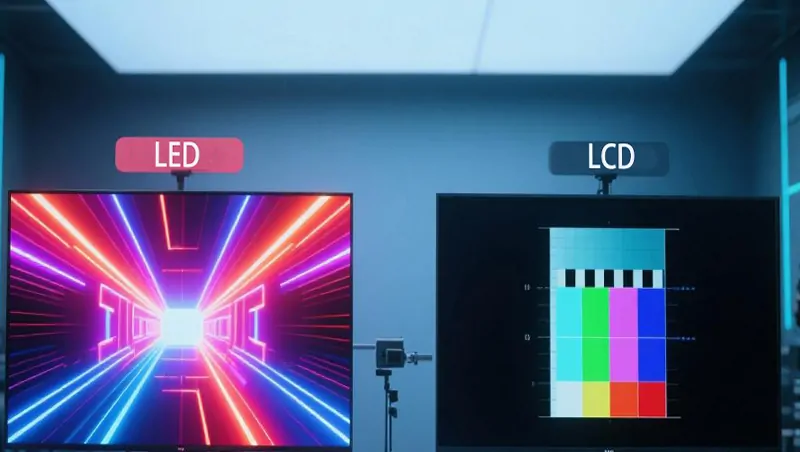
If you observe and compare LED screen panels and LCD screens in a shopping mall, conference room, or trade show display rentals, you’ll notice that LCDs often look dimmer and less vibrant. This makes LED screen display a more visually appealing choice for displays for advertising, events, or outdoor LED screen setups. But why the difference? Let’s explore.
FAQ:
Q: Which looks brighter and has better colors, LCD or LED screens? Why?
A: LED screens generally outperform LCD screens in terms of brightness and color performance. The core reason lies in the different lighting technologies: LCD screens rely on a single backlight layer (CCFL or LED backlight) to illuminate the pixels, which can easily cause uneven lighting, light leakage, and difficulty in precisely controlling local brightness. LED screens, on the other hand, have each pixel emitting light independently, especially screens using technologies like Mini-LED, which can achieve excellent local dimming, resulting in higher contrast, purer blacks, and more vibrant and accurate colors. This makes LED a more attractive choice for applications requiring visual impact, such as advertising, stage performances, and outdoor displays.
Q: Why are LED screens recommended for dynamic events such as concerts or exhibitions?
A: LED screens are recommended primarily due to two key advantages: extremely fast response speed and excellent color performance. LED response times are measured in microseconds, far faster than the millisecond response of LCDs, greatly reducing motion blur and ghosting in high-speed moving images, ensuring clear and smooth dynamic content. At the same time, LED screens support a wider color gamut, displaying more saturated and vivid colors (especially red and green), which is crucial for the strong visual impact required in concert visuals and exhibition displays.
Q: Can LED screens still be seen clearly in bright light (such as outdoors)?
A: Yes, LED screens are very suitable for outdoor environments. Their main advantage is higher peak brightness. The self-emissive nature of LEDs allows them to achieve brightness levels far higher than ordinary LCD screens, effectively counteracting direct sunlight and ensuring that the screen content remains clearly visible. Therefore, whether for outdoor advertising screens, live event broadcasts, or movie screenings, LED is the preferred choice for ensuring optimal display performance.
Q: What is the viewing angle of LED screens? Do they change color when viewed from the side?
A: LED screens have a wider excellent viewing angle. Unlike LCD screens, which often experience color distortion, reduced contrast, and whitening when viewed from the side, LED screens (whether LED walls used for stages or outdoor installations) maintain high consistency in color, brightness, and contrast even at large viewing angles. This makes them ideal for conference rooms, large venues, and other situations where the audience is spread across a wide area.
Q: How to clean and maintain LED screens?
A: Proper cleaning and maintenance can effectively extend the lifespan of the screen. Please follow these steps for daily cleaning:
Basic dusting: Gently wipe the screen surface with a soft, dry microfiber cloth.
Dealing with stains: For stubborn stains or fingerprints, slightly dampen the microfiber cloth with purified water or isopropyl alcohol with a concentration of less than 70%, wring it dry, and then gently wipe the screen. Do not spray liquid directly onto the screen.
Precautions: Avoid using any harsh chemical cleaners, sprays, abrasive materials, or excessive moisture.
Professional maintenance: Regular professional grid testing helps to detect problems early. If repairs are needed (such as for outdoor P6 specification displays), it is recommended to consult professional service personnel, as self-disassembly and repair may void the warranty.