English
Evaluating an LED display's picture quality isn't about one standout spec. It's the result of five interconnected layers—components, drivers, system, calibration, and human perception—working seamlessly from hardware to software to visual experience. Only when each step is precise can "good specs" become a truly high-quality viewing experience.
Let's break down what matters.
Simply put, dynamic range is the span between the brightest whites and the darkest blacks. While LEDs can hit thousands of nits, the usablerange depends on real working brightness and a true black level. Accuracy is governed by the EOTF curve (like Gamma for SDR or PQ for HDR), ensuring details in shadows and highlights are faithfully rendered. Scene adaptation is critical: a cinema IMAX theater demands deep blacks, an outdoor mini jumbotron fights strong light, and a professional 4K monitor needs precision. A one-size-fits-all approach fails.Contrast: "Bright & Punchy, Dark & Pure"
Contrast isn't just a ratio. It's the combined effect of vibrancy, black purity, and resistance to ambient light. For self-emissive LED vs OLED or QLED vs UHD displays, two challenges exist: achieving a sufficiently low and detailed black level, and minimizing surface reflection. Technologies like COB/MIP with black substrates and anti-reflective films cut ambient light interference, boosting subjective contrast. This balance of deep blacks and textured highlights is key for high-end cinemas with IMAX and premium 4K UHD TV experiences.
This is where quality is won or lost. LED chips can be unstable at weak currents, causing low-gray non-uniformity or color shift. The driving method—PWM, PAM, or hybrid—plus the panel's scanning strategy, dictates low-gray detail, flicker, and smoothness. Sophisticated algorithms and point-by-point correction help, but only if the panel's inherent "foundation" is good.
A wide color gamut (like DCI-P3 or BT.2020) is just the start. True color accuracy requires precise RGB primary wavelengths and consistent rendering at every brightness level. This needs accurate color gamut mapping, white point calibration, and unified Gamma/EOTF management to ensure content—from BT.709 to HDR—is reproduced correctly. While OLED offers wide gamut, its color shift over time differs from LED's challenges.
The key isn't the maximum refresh rate, but stable low-gray performance. A high visual refresh rate affects image stability, but the real test is a flicker-free, clear image in dark scenes—whether viewed by the human eye or a camera. This practical stability matters more than numerical specs at high brightness.
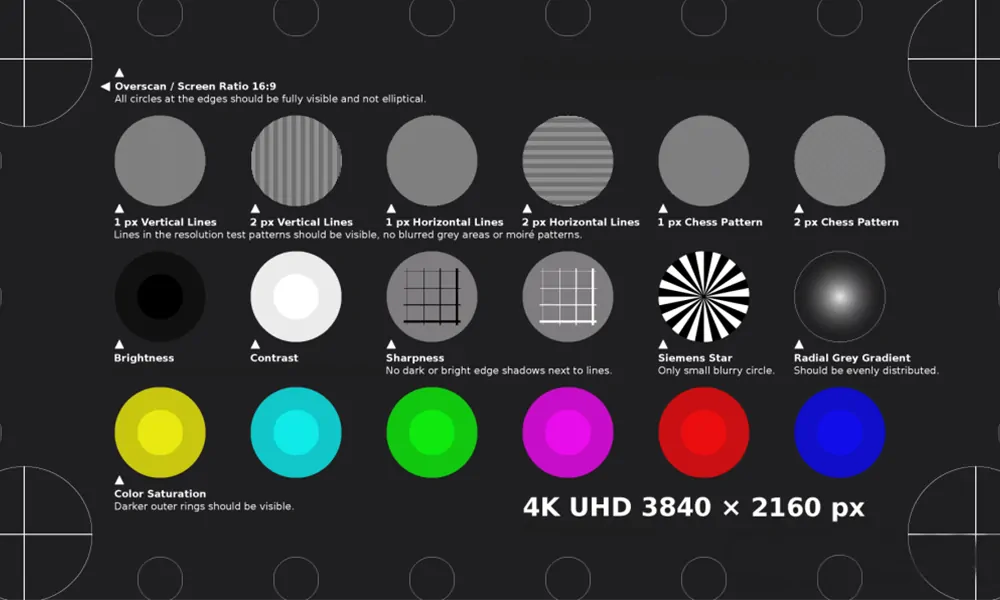
Resolution, like 4K resolution (3840x2160 pixels, a common 16:9 4K screen resolution), defines pixel density. On a large LED display, the viewing distance determines the perceived sharpness. A 4K screen resolution ensures fine detail up close, vital for control rooms or premium viewing.
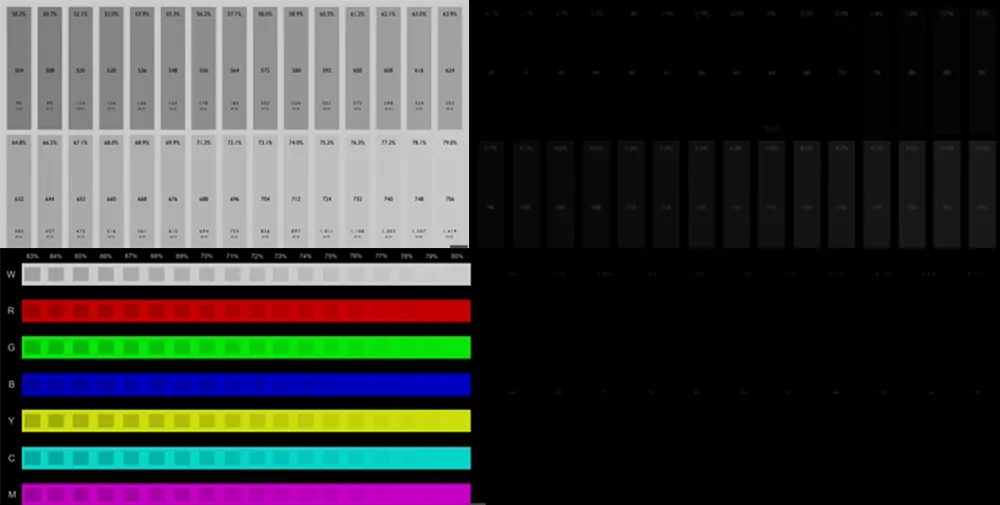
A perfect display has no visible moire effect, black spots on display, or white spot on monitor. These spots on mobile screen or display issues often stem from manufacturing or component flaws. Superior calibration and quality control minimize such imperfections, ensuring a clean, uniform image.
Device Layer (The Foundation): Chip formula, packaging (COB/MIP), and optical design set the limits for brightness, color gamut, black level, and inherent uniformity.
Driver Layer (The Conductor): Scanning, driving strategy (PWM/PAM), and refresh rate management control grayscale fineness, low-gray stability, and flicker.
System Layer (The Interpreter): Through TCON chips, HDR processing, color management, and algorithms, it accurately maps content to the panel.
Calibration Layer (The Finishing Touch): Pixel-by-pixel correction and system-level De-Mura turn theoretical specs into delivered quality, eliminating non-uniformity.
Human Perception (The Final Judge): In real scenarios (ambient light, distance, content), the overall subjective impression of contrast, color, and uniformity is the ultimate standard.
Ultimately, judging an LED display—whether a 4K TV, a commercial video wall, or a cinema screen—requires looking at the entire chain. It's not about winning a "spec war" on 4K resolution dimensions or peak brightness alone. True quality comes from the协同 optimization of all five layers for the specific viewing scenario, ensuring the display effect withstands the scrutiny of both the market and the human eye.
.jpg "How to Choose China Outdoor Stage LED Video Wall Manufacturers?")