 English
If you've been digging through supplier directories trying to find reliable china outdoor stage led video wall manufacturers, you probably already know how frustrating this process can get. Hundreds of companies claim to build outdoor stage panels. Product listings look nearly identical on the surface. And the price spread between suppliers for what appears to be the same spec can swing by 40% or more — which naturally makes you wonder what's actually behind those numbers. I've been working with buyers across North America and Europe on outdoor stage LED sourcing for close to a decade now, and I can tell you from direct experience that the gap between a trustworthy factory and a problematic one doesn't always show up right away. Sometimes it takes weeks, sometimes a full festival season, before you realise the panels you bought can't handle the conditions they were supposed to survive.
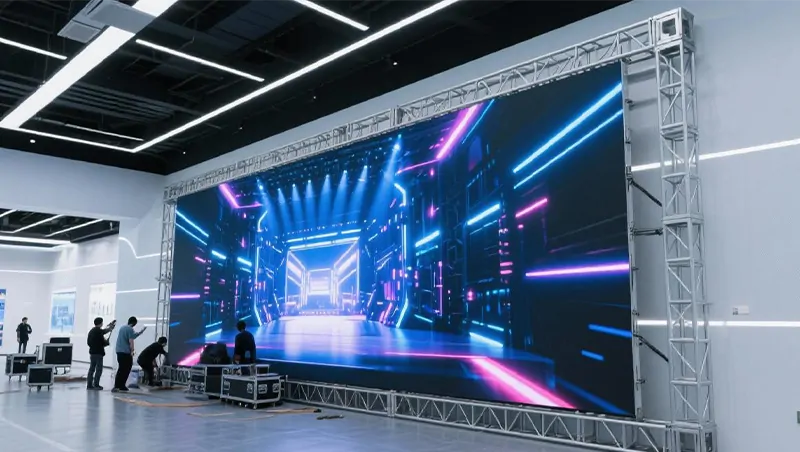
Outdoor stage LED walls face some of the harshest operating conditions in the entire display industry. We're talking about panels that need to deliver bright, vivid imagery under direct sunlight, shrug off sudden downpours mid-concert, handle being loaded into trucks and assembled by crews in the rain, and then get torn down and shipped to the next venue — sometimes within 24 hours. Not every factory that claims to manufacture outdoor stage panels has the engineering depth to handle all of that. So how do you actually find the right one? What specs genuinely matter? And what should you realistically expect to pay? Let me walk through all of this based on years of hands-on experience.
This is worth spending some time on because the application creates a unique set of demands that most other LED display categories simply don't have. An outdoor stage LED video wall isn't just an outdoor advertising panel stuck on a concert stage. The operating profile is fundamentally different:
Extreme brightness requirements — Stage backdrops need to compete with direct sunlight during daytime festivals and outdoor events. We're talking 5,500 to 8,000+ nits depending on the orientation and geographic location. That's significantly brighter than a fixed outdoor advertising billboard, which can often get away with 4,500 to 5,500 nits because the content is static and viewers aren't comparing it to a live performance.
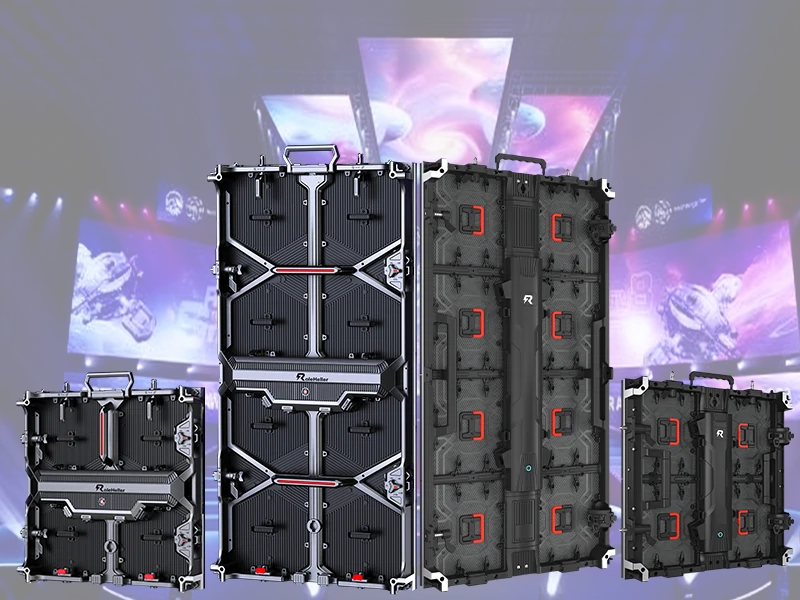
Rental and touring durability — Most outdoor stage LED walls are rental panels that get assembled, used for a show, torn down, packed into flight cases, loaded onto trucks, and reassembled at the next venue. This cycle can repeat dozens or even hundreds of times per year. The cabinets need to withstand constant mechanical stress from locking mechanisms being engaged and disengaged, corners getting bumped during transport, and stacking loads in flight cases.
Rapid setup and teardown — Stage crews work under intense time pressure. Load-in might be 6 hours for a festival stage, and every minute counts. Panels need quick-lock mechanisms that allow a single person to connect and disconnect cabinets without tools. The average target for a seasoned crew is under 60 seconds per cabinet connection.
Weight constraints — Stage structures have load limits. Every kilogram you can shave off a cabinet translates directly into simpler rigging, lighter truss requirements, and faster setup. Die-cast magnesium alloy cabinets have become popular in the stage rental market because they offer a 20% to 30% weight reduction compared to aluminium, though they come at a price premium.
Camera capture performance — Outdoor stage LED walls are constantly being filmed — by broadcast cameras, audience smartphones, and drone footage. High refresh rates (3840Hz minimum) and high gray scale depth are essential to prevent flickering and moiré patterns on camera.
Understanding these requirements is the starting point for evaluating any manufacturer. If a supplier can't demonstrate that their panels are engineered specifically for the rental and touring environment, they're probably not the right fit regardless of how attractive their pricing looks.
Let me break down the specifications that actually matter when you're sourcing panels for outdoor stage applications. Some of these are non-negotiable, while others depend on your specific use case:
| Specification | Recommended for Stage Use | Why It Matters |
|---|---|---|
| Pixel Pitch | P3.91 (most popular), P4.81, P2.97 (premium) | Determines resolution and minimum viewing distance for the audience |
| Brightness | 5,500–8,000 nits | Must overcome direct sunlight during daytime outdoor events |
| Refresh Rate | ≥3840Hz | Prevents flickering and scan lines on broadcast and social media cameras |
| IP Rating | IP65 front / IP54 rear (minimum) | Protection against rain, dust, and humidity during outdoor events |
| Cabinet Weight (500×500mm) | ≤8 kg (aluminium), ≤6.5 kg (magnesium) | Affects rigging load limits and crew fatigue during setup |
| Locking Mechanism | Tool-free quick-lock (≤5 seconds per connection) | Speeds up assembly and reduces labour costs on tight event schedules |
| Curvature Capability | ±5° to ±15° adjustable (concave and convex) | Enables curved stage designs and wraparound configurations |
| Operating Temperature | -20°C to +50°C | Must handle extreme conditions from winter festivals to desert events |
One thing I want to call out specifically — the IP rating breakdown matters more than most buyers realise. A lot of manufacturers will advertise "IP65" without specifying whether that applies to the front, the rear, or both. In reality, the front of an outdoor stage panel (the LED side) needs to handle direct rain impact, while the rear (where cables connect and power supplies sit) faces splash and condensation but not direct water jets. A proper outdoor stage panel should have IP65 on the front face and at minimum IP54 on the rear. If a manufacturer only rates the front and is vague about the rear, that's a potential weak point.
Another detail that catches people off guard — the curvature capability. Stage designers love curved LED walls. A slightly convex curve creates a more immersive backdrop for performers, and concave curves work well for in-the-round stage configurations. Not all outdoor rental panels can handle curvature. The cabinet locking mechanism needs to allow angular adjustment between adjacent cabinets, and the module flexibility needs to accommodate the curve without creating visible gaps or brightness inconsistencies at the joints. If curvature is part of your design, confirm this capability in writing before ordering.
Choosing the right pixel pitch for an outdoor stage LED wall comes down to three factors: the closest audience distance, your budget, and whether the wall will be captured on camera for broadcast or live streaming.
P2.97 — Premium choice for close viewing distances (3+ metres). Used for intimate stage productions, award shows, and corporate outdoor events where the audience is relatively close and camera capture quality is critical. Highest cost per square metre in the stage rental category.
P3.91 — The workhorse of the outdoor stage market. Handles viewing distances of 4+ metres comfortably. Excellent balance of resolution, brightness, and cost. This is the pixel pitch you'll see at the majority of music festivals, outdoor concerts, and large-scale corporate events. If you're buying one pixel pitch for general stage rental, this is the one.
P4.81 — Budget-friendly option for larger stages where the audience is 5+ metres away. Lower resolution but perfectly adequate for festival main stages, sporting events, and large outdoor venues where viewing distance makes the pixel structure invisible. Significantly cheaper than P3.91, which matters when you're building a 200+ square metre stage backdrop.
Here's something that's worth thinking about — if you're building a stage wall primarily for broadcast and live stream capture, the pixel pitch matters less than the refresh rate and processing quality. A P4.81 panel running at 3840Hz with proper colour calibration will look better on camera than a P3.91 panel running at 1920Hz with poor processing. The camera doesn't care about pixel pitch the way a live audience does.
This is probably the most critical skill you'll develop as a buyer in this space. The china outdoor stage led video wall manufacturers market is absolutely packed with trading companies that present themselves as factories. They'll have professional websites, factory photos that look convincing (often borrowed from real manufacturers), and sales teams that can quote specifications with confidence. But when it comes time to handle a custom engineering challenge or a warranty claim on a touring rig, you discover they have zero control over production. Here's my vetting process:
Not a pre-recorded walkthrough. Not a virtual tour with background music. A real-time video call where you can ask them to point the camera at specific equipment, show you the production line running, and walk through the aging test facility. Real manufacturers are proud of their operations and will accommodate this without hesitation. If they stall, make excuses, or only offer marketing videos — that's a significant red flag. I've had manufacturers agree to live tours within 24 hours of my request, and I've had others disappear for weeks when asked. The response time itself tells you something.
The surface mount technology lines are where LED lamp beads and driver ICs get soldered onto PCB boards. For outdoor stage panels, you need high-precision placement machines — the industry standards are Fuji NXT series, Yamaha YSM series, and Panasonic NPM series. Ask how many SMT lines they operate and what placement accuracy they achieve. A genuine factory will have multiple lines running and can show you real-time production. If they're using older or lower-tier machines, the placement accuracy won't be sufficient for consistent outdoor panel quality.
Outdoor stage panels need precision die-cast aluminium (or magnesium) cabinets with tight machining tolerances. If the manufacturer outsources cabinet fabrication to a third-party foundry, they can't control the tolerances that determine how well cabinets lock together, how flat the surface is, and how consistently the panels perform after repeated assembly cycles. Ask to see their die-cast machines and CNC machining centres.
Every quality outdoor stage panel needs extended burn-in testing — typically 72 to 96 hours — after assembly. For outdoor panels, the best factories run aging tests in environmental chambers that simulate high-temperature outdoor conditions. This catches early-failure components before they ever reach your installation site. No aging facility means no real quality gate.
Here's where you'll see the biggest differences between manufacturers who take outdoor stage engineering seriously and those who just assemble bought-in parts. The QC process for outdoor stage panels needs to account for the unique demands of touring and live event environments.
| QC Stage | What Gets Inspected | What Happens If This Step Gets Skipped |
|---|---|---|
| Incoming LED Bin Sorting | Wavelength (±1.5nm), luminous intensity (±5%), forward voltage | Batch-to-batch colour variation visible across large stage installations |
| Post-SMT AOI Scan | Solder joint quality, component alignment, cold joints | Intermittent failures that appear after weeks of thermal cycling on the road |
| IP Rating Verification | Water spray test, dust ingress test per IEC 60529 | Panels that fail during the first rain event at an outdoor event |
| 72-Hour High-Temp Burn-in | Full-colour cycling at 50°C+ ambient in environmental chamber | Latent LED failures that show up during summer festival operation |
| Locking Mechanism Cycle Test | 500+ engage/disengage cycles per cabinet | Locking pins that wear out or break after a few months of touring |
| Final Calibration | Module-by-module brightness and colour correction | Visible seams, colour banding, and uneven brightness across the stage wall |
The locking mechanism cycle test is something that most manufacturers skip entirely, and it's a big deal for stage rental panels. I've seen cabinets where the locking pins worked perfectly out of the factory but started developing play after 100 to 150 assembly cycles. By the time the rig hit 300 cycles, the cabinets were wobbling and the seams were visibly opening up. A proper cycle test catches these mechanical wear issues before the panels ship.
Another detail worth mentioning — the connector durability. Outdoor stage panels get connected and disconnected constantly. The power connectors and signal connectors between cabinets need to be rated for hundreds of mating cycles without degradation. Look for manufacturers that use Neutrik powerCON or equivalent industrial-grade connectors rather than generic alternatives. The connectors are one of the most common failure points on touring rigs, and replacing them in the field during a festival is not fun.
Let me lay out what you should actually expect to pay when sourcing outdoor stage panels from Chinese manufacturers. These are wholesale prices for orders of 10 square metres and above:
| Configuration | Price per m² (USD) | Typical Application |
|---|---|---|
| P2.97 Outdoor Stage (die-cast, 6500 nits, IP65, 3840Hz) | $850–$1,300 | Premium stage productions, award shows, corporate events |
| P3.91 Outdoor Stage (die-cast, 5500 nits, IP65, 3840Hz) | $600–$950 | Music festivals, outdoor concerts, large corporate events |
| P4.81 Outdoor Stage (die-cast, 5000 nits, IP65, 3840Hz) | $450–$700 | Festival main stages, sporting events, large outdoor venues |
| P3.91 Outdoor Stage (magnesium alloy, 5500 nits, ultra-light) | $900–$1,400 | Touring productions where weight reduction is critical |
A critical note on what these prices do NOT include: Video processors and sending boxes, rigging hardware (fly bars, chain motors, truss adapters), mounting frames and ground support structures, signal cabling (fibre optic, Cat6), flight cases or protective packaging for transport, spare parts packages, shipping and freight, import duties and taxes. When you're budgeting a complete stage LED system, plan to add roughly 45% to 70% on top of the panel-only cost for a fully functional touring rig. The exact percentage depends on whether you need ground support or flown configurations, the complexity of your signal distribution, and how many flight cases you need.
I've watched buyers get excited about a quote that looks 30% cheaper than competitors, only to discover later that the lower price covered bare modules without cabinets or power supplies. Sometimes the "price per square metre" is calculated based on module area rather than cabinet area, which can be misleading when cabinets include bezels and framing. Always confirm in writing exactly what's included in any quoted price.
This is probably the single most common complaint from stage rental companies. You buy a batch of outdoor panels, they look fantastic for the first festival season, and then you notice they're getting noticeably dimmer. Here's what happens at the manufacturing level: cheap LED chips with poor heat dissipation characteristics degrade faster when driven at the high currents needed for outdoor brightness. Premium manufacturers use LED chips from established suppliers like NationStar, Kinglight, or HSIOPT, and they design their driving circuits to operate the LEDs within safe current limits even at maximum brightness. The difference in long-term brightness retention between premium and budget LED chips can be 15% to 25% over a two-year period.
Outdoor stage panels live and die by their sealing quality. The connectors between cabinets — power connectors, signal connectors, and data cables — are the most common failure points for water ingress. Look for manufacturers that use IP67-rated connectors (like Neutrik or Amphenol equivalents) and apply silicone sealant at every cable entry point. I've seen panels that passed the factory IP65 test develop leaks after six months of touring because the connector gaskets degraded under UV exposure and repeated mating cycles.
This one is specific to stage rental panels and it's a real problem. The quick-lock mechanisms that connect cabinets together take a beating during touring. They get engaged and disengaged hundreds of times, get bumped during transport, and get exposed to temperature swings that cause metal expansion and contraction. If the locking pins are made from low-grade steel or the tolerances are loose, they'll start failing within a few months of heavy touring use. Ask the manufacturer what material their locking pins are made from and what the rated cycle life is. Anything below 2,000 cycles should be a red flag for a touring rig.
LED chips from different production batches can have slight wavelength variations. Even a 2 to 3 nanometre shift becomes visible on a large outdoor stage wall, especially when panels from different batches are mixed in the same installation. Reputable manufacturers address this by bin-sorting LEDs into tight wavelength groups, maintaining detailed batch records so repeat orders pull from the same LED bin, and aging all panels from the same batch together.
The panel price is just the starting point. Here's what else goes into the total cost when importing outdoor stage panels:
Freight: Sea freight (FCL) is the most economical option for orders over 10 m². A 20-foot container holds approximately 25 to 40 square metres of outdoor stage panels in flight cases, with transit times of 15 to 25 days to the US West Coast and 25 to 35 days to European ports. Air freight delivers in 5 to 7 days but costs 4 to 6 times more — usually only justified for urgent replacement panels needed before an event.
Import duties: LED display panels generally fall under HS code 8528.59. In the United States, standard duty sits around 0% to 5%, but Section 301 tariffs on Chinese-origin products can add an additional 25%. In the EU, standard duty is approximately 1.4% plus VAT. These rates shift periodically, so always verify with a licensed customs broker before finalising your budget.
Spare parts: Here's something I recommend to every stage rental buyer — when you place your initial order, simultaneously order a spare parts package equal to 8% to 12% of your total panel quantity. That's higher than what I'd recommend for fixed installations, and the reason is simple: touring panels take more abuse than fixed panels. You need extra modules from the same LED production batch, spare power supplies, additional receiving cards, spare locking pins and cables, and extra connector gaskets. Having these components on hand prevents a single failure from becoming a cancelled show while you wait for an international shipment. For touring companies, I'd actually push this to 10% to 15% because you can't afford to show up at a festival with a short wall.
Most outdoor stage panels ship with receiving cards pre-installed. The major ecosystems you'll encounter include Novastar (most widely adopted globally, excellent value, broadest hardware compatibility), Colorlight (strong cost-performance ratio, growing ecosystem), and Brompton Tessera (premium choice for broadcast and high-end touring productions). Make sure the receiving card model in your quote matches your preferred control system. Mixing ecosystems can work but adds unnecessary complexity. I've seen situations where a buyer received panels with the wrong receiving cards and had to swap them out on-site at a venue — not the kind of surprise you want when load-in is in four hours.
The wholesale relationships that deliver the best results over time are built on a few principles I've seen work consistently:
Start with a trial order — 5 to 10 square metres is enough to evaluate panel quality, communication responsiveness, documentation accuracy, and logistics reliability before committing to a full touring inventory
Lock in LED bin specifications for repeat orders — once you've received and approved your initial batch, the manufacturer should record the exact LED bin codes and reserve matching stock for your future orders. This is the single most effective way to solve the colour consistency problem across multiple purchases
Establish clear quality acceptance criteria in writing — dead pixel limits, brightness uniformity tolerance, colour temperature range, locking mechanism cycle life, connector specifications. Don't leave these to verbal agreements
Visit the factory if possible — even a single in-person visit transforms the relationship from transactional to collaborative. You'll see things on the production floor that no video call can show you
Provide feedback on field performance — manufacturers genuinely value customers who report how panels perform after a full festival season of real-world touring. This information helps them improve their products and gives you leverage for better terms on future orders
When you become a repeat customer, several advantages kick in: priority production scheduling during peak season (Q2 through Q4 when the event industry is busiest), consistent LED batch allocation for colour consistency, custom engineering support for non-standard configurations like curved walls or unusual aspect ratios, better payment terms (moving from 100% upfront to 30% deposit / 70% before shipment), and dedicated account management instead of rotating through different sales reps.
From where I sit, the china outdoor stage led video wall manufacturers landscape is in a genuinely interesting position right now. Production costs for outdoor rental panels have dropped meaningfully over the past few years as volumes have scaled and die-cast manufacturing processes have matured, but quality variation between manufacturers has actually widened. You've got factories producing outdoor stage panels with build quality and brightness performance that rival displays costing two or three times as much from Western brands, and you've got low-end workshops churning out panels that look fine on a spec sheet but can't survive a single rainy festival without developing water ingress issues.
What I'd suggest to anyone exploring options right now: shortlist 3 to 5 manufacturers, request sample cabinets from each, and do a direct side-by-side comparison. Run the same content on all of them at maximum brightness. Check the colour uniformity across a large white field. Engage and disengage the locking mechanisms 50 times and see how they feel. Leave the panels outside in the rain for a few days and check for any moisture ingress. The quality differences become really obvious once you have physical panels in front of you, and that hands-on evaluation is worth far more than any amount of spec-sheet comparison or online research.
The extra time you invest upfront in evaluation will pay for itself many times over in reduced field failures, longer panel lifespan, and fewer show-stopping emergencies. Outdoor stage LED technology is mature and capable of delivering excellent performance for years of heavy touring — as long as you partner with a manufacturer who takes the engineering seriously and has the production infrastructure to back up their claims. Hopefully this gives you a solid framework for evaluating your options and avoiding the mistakes that keep costing stage buyers real money.
P3.91 is the most popular choice for outdoor stage applications, offering an excellent balance of resolution, brightness, and cost for audience viewing distances of 4+ metres. P2.97 is preferred for premium productions with closer viewing distances or heavy broadcast capture. P4.81 works well for large festival stages where the audience is 5+ metres away and budget is a priority.
For outdoor stages facing direct sunlight, you need a minimum of 5,500 nits. For south-facing stages in tropical or desert climates, 6,500 to 8,000 nits is recommended. Stages that are shaded or face north can operate effectively at 4,500 to 5,500 nits. Higher brightness comes at a cost premium and increases power consumption, so match the brightness to your actual installation conditions.
Request a live video factory tour, verify they own SMT production lines (Fuji, Yamaha, or Panasonic placement machines), confirm in-house die-cast cabinet fabrication capability, check for a dedicated aging test facility with environmental chambers, and ask for verifiable certifications (CE, FCC, RoHS, ETL/UL). Real manufacturers will accommodate all of these requests without hesitation.
Quality outdoor stage panels typically require 25 to 35 working days for orders under 50 square metres. The timeline includes aging tests, environmental testing, and calibration. Larger orders (50 to 200 m²) may require 35 to 50 working days. During peak season (Q2 to Q4), add another 5 to 10 working days. Always confirm the lead time in writing and build buffer time into your event schedule.
IP65 on the front face is the minimum acceptable rating, providing protection against dust ingress and low-pressure water jets from any direction. The rear should be at minimum IP54 to protect against splashing water and condensation. For installations in areas with heavy rain or where panels may be subjected to high-pressure washing between events, IP66 front rating is recommended.
For outdoor stage rental panels, order a spare parts package equal to 8% to 12% of your total panel quantity — higher than the 5% to 8% recommended for fixed installations. Touring panels take significantly more mechanical and environmental abuse. Include extra modules from the same production batch, spare power supplies, additional receiving cards, spare locking pins, and extra connector gaskets.
Most panels work with all major LED control systems. The most common are Novastar (most widely adopted globally, excellent value), Colorlight (strong cost-performance ratio), and Brompton Tessera (premium choice for broadcast and high-end touring). Specify your preferred control ecosystem when ordering so the manufacturer installs the correct receiving card model.
Sea freight to the US West Coast typically takes 15 to 25 days, to European ports 25 to 35 days, and to the US East Coast approximately 25 to 35 days. Air freight delivers in 5 to 7 days but costs 4 to 6 times more. Always factor in customs clearance time (3 to 7 days) when planning your event timeline.
Industry standard warranty is 2 years covering manufacturing defects in LED chips, driver ICs, power supplies, and PCB boards. Some premium manufacturers offer 3-year warranties. Always confirm whether the warranty covers on-site replacement service or requires return-to-factory repair, and whether labour costs for field replacement are included. For touring panels, check whether the warranty covers mechanical wear on locking mechanisms and connectors.
Yes, most outdoor stage rental panels are designed with adjustable locking mechanisms that allow ±5° to ±15° curvature in both concave and convex orientations. This enables curved stage backdrops, wraparound configurations, and弧形 designs. However, not all outdoor panels support curvature — fixed outdoor advertising panels typically have rigid locking systems. Always confirm curvature capability and the specific angle range in your order specifications if your stage design requires curved LED walls.
.jpg "China P1.6 LED Video Wall Manufacturers | How to Choose the Right One")