 English
You have probably typed china led video wall outdoor rental manufacturers into Google, opened twelve tabs, and found the same problem repeated over and over: every supplier claims IP65, 6,000 nits, three-year warranty and "factory direct price," yet the quotes you get back differ by almost double. On top of that, half the listings are trading companies pretending to own an SMT line, and nobody explains why your outdoor screen started flickering the moment a summer storm rolled in.
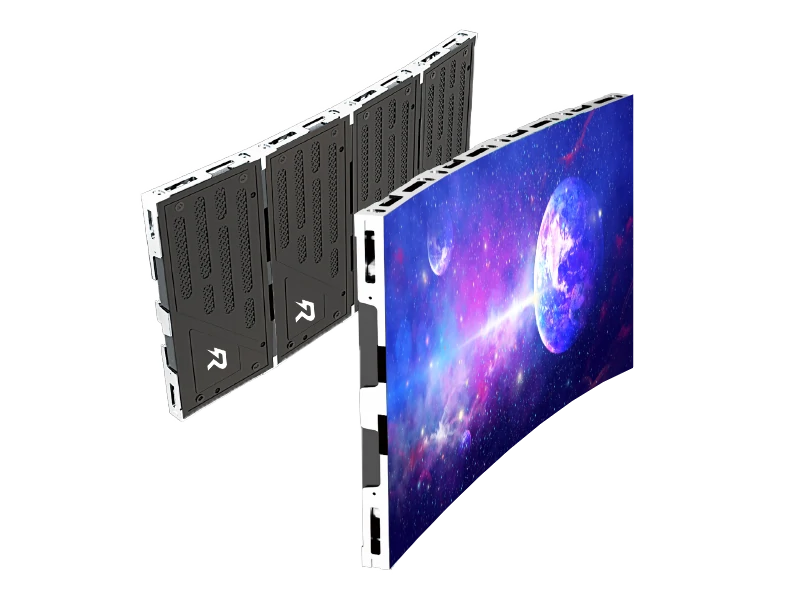
Here is the part that saves time. For outdoor rental, the pitch matters less than the cabinet. A P3.9 or P4.8 panel from a decent die-cast line will outlast a fancier spec built in a warped cabinet every single time. What you are really buying is weather sealing that survives a second season, rigging points that do not deform, and a supplier who still answers when you need replacement modules mid-tour. If a company cannot prove those three things, the per-square-metre number on page one of their quote is just there to stop you asking questions.
Indoor LED and outdoor rental look the same on a spec sheet. In the field they behave like different products. An outdoor rental cabinet gets rained on, stacked on a truck, dropped off a tail lift, rigged thirty feet in the air, and then packed up at 2 a.m. by crew who have been working since 6 a.m. The hardware has to survive all of that and still look flat.
Numbers worth carrying around:
Pixel pitch: P3.91 and P4.81 dominate outdoor rental because they balance resolution with weight and cost. P2.6–P2.9 exists for close-view stage backdrops but costs more and runs hotter. Beyond about 15–20 metres viewing distance, P6 or P8 makes more sense and saves real money.
Brightness: 5,500–6,500 nits for direct sunlight. Anything below 5,000 nits struggles at noon; anything pushed above 7,000 nits burns power, throws heat into the cabinet, and ages the lamps faster.
IP rating: IP65 front / IP54 rear is the realistic standard for genuine outdoor work. IP43 or "water-resistant" is fine for covered stages only. Ask for the test report, not the marketing line.
Refresh rate: 3,840 Hz minimum if the screen is being filmed. Lower rates throw scan lines into camera feeds and broadcast clients notice immediately.
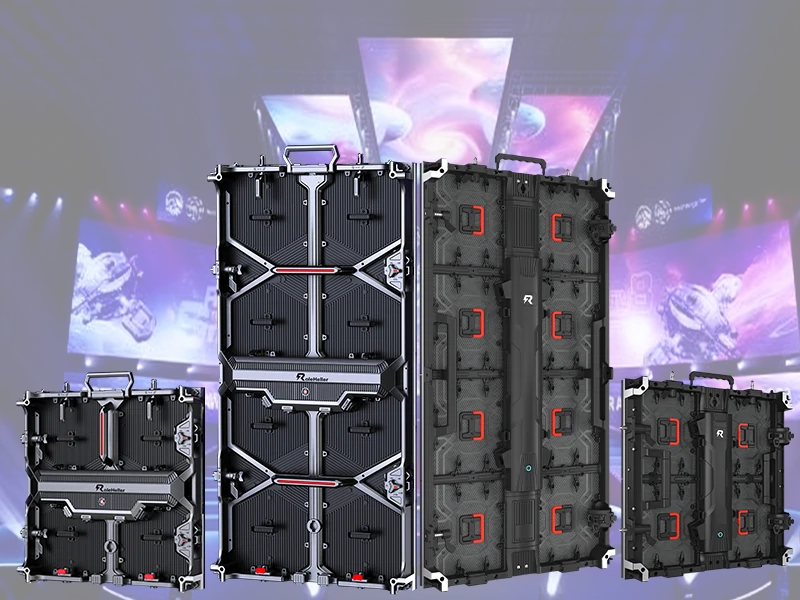
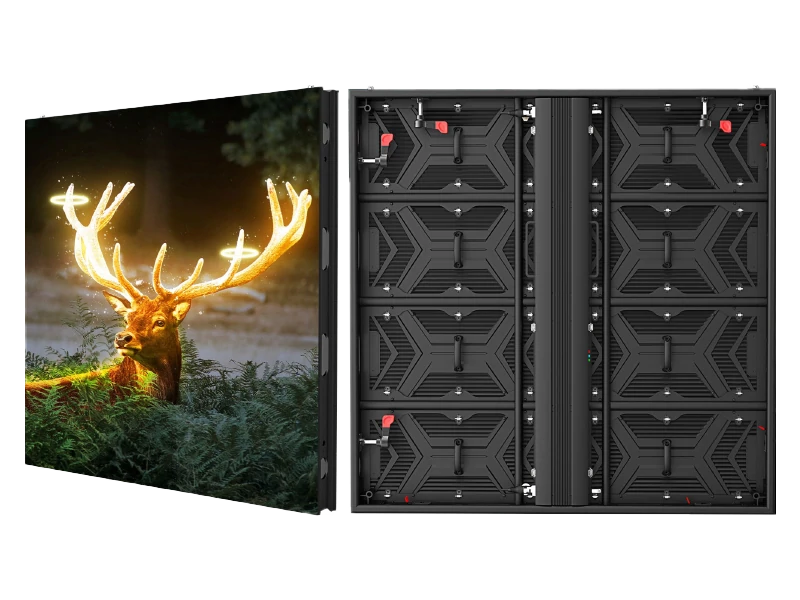
Cabinet material: Die-cast magnesium-aluminium alloy. Magnesium keeps weight down — a 500×1000 mm cabinet should land around 28–35 kg. Heavier than that and your crew starts complaining, and rigging loads climb.
Power: Common-cathode drive saves roughly 20–30% on power and cuts heat. For a touring company running eight hours a day off a generator, that is not a small thing.
The mistake I see most often: someone buys an outdoor-rated screen and mounts it under a roof with no side ventilation. Heat builds up inside the cabinet, the fans cannot move air, and modules start failing within a year. IP rating protects against water. It does not fix bad airflow.
This is where the search results mislead people. Type the keyword and you will see four types of seller, all using the same word.
| Who they are | What they actually do | Price | When they make sense |
|---|---|---|---|
| Own-assembly factory | SMT line, die-cast tooling, aging room, can change LED package and IC | Lowest | You know your spec, order repeats, you can wait |
| Trading company / export agent | Sources from a factory, handles paperwork and English communication | Medium-high | First-time buyer, tight deadline, need someone to chase |
| Brand with overseas warehouse | Rebrands OEM hardware, adds calibration, software, local spares | Highest | Downtime costs more than the premium |
| Hybrid — factory plus regional desk | Plant in Guangdong or Fujian, sales office in your market | Medium | Often the sweet spot for event companies |
A free test that tells you a lot: ask for a live video call and have them walk to the production floor with today's date written on a piece of paper next to the machine. Then ask for the cabinet mould number and search it. If the exact same cabinet design appears under half a dozen brand names, you are looking at a shared OEM platform. That is normal — most of the industry works this way — but it does mean price and support are your real differentiators, so negotiate on those instead of pretending you found something unique.
Also worth saying plainly: plenty of genuine factories assemble cabinets in-house while importing LED lamp packages and driver ICs from the same global suppliers everyone uses. Nothing shady there. What is not acceptable is charging extra for "fully in-house" hardware without being able to show which parts are actually made on site. Ask for a bill of materials by line item. If the brand names come back blanked out, you already have your answer.
Quotations look identical until you put them side by side. This is the list I compare.
| Spec | What to ask for | Why it matters |
|---|---|---|
| LED package | Nationstar or Kinglight gold wire, outdoor-grade SMD with UV-resistant mask | Gold wire handles heat; UV mask stops yellowing in sunlight |
| Driver IC | MBI5153 / ICN2053 or equivalent with good grey scale | Weak ICs cause ghosting and smear on camera |
| Refresh rate | ≥3,840 Hz if filmed; 7,680 Hz for broadcast | Scan lines ruin video feeds |
| Brightness | 5,500–6,500 nits, auto-dimming via sensor | Noon sun needs it; night events need it turned way down |
| IP rating | IP65 front sealed, IP54 rear, with gasket and glue-sealed modules | Ask for the actual test report number |
| Cabinet | Die-cast magnesium-aluminium, precise flatness, locking mechanism that survives repeated use | Warped cabinets show seams; loose locks wobble at height |
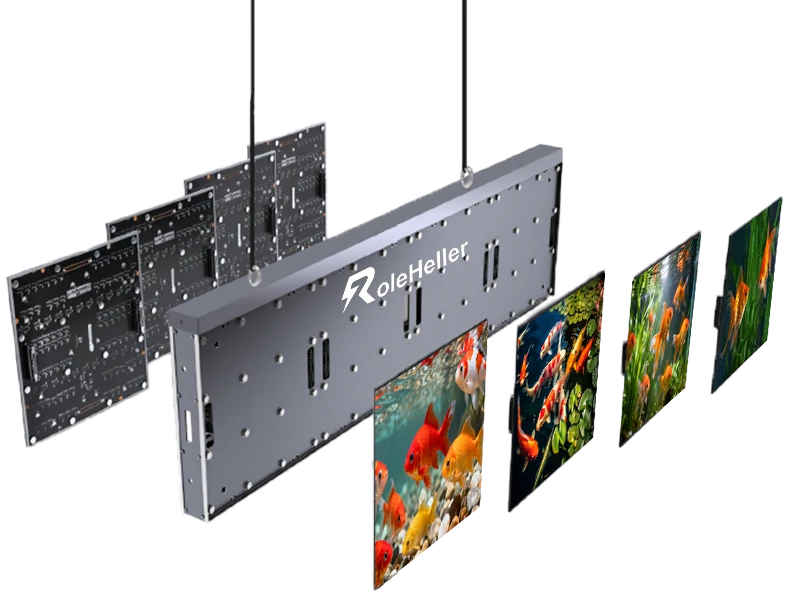
| Service direction | Front and rear service | You will not always have rear access on a truss |
| Stacking load | Confirmed stacking capacity for ground-stack builds | Ground-stacked walls need cabinets rated to carry weight |
| Rigging points | Integrated flying hardware, certified load rating | Never improvise rigging on a cabinet not designed for it |
| Power supply | Branded PSU, correct voltage, surge and lightning protection | Outdoor power is dirty; spikes kill PSUs |
| Mask/bezel | Full face mask, light-tight bezels | Prevents light bleed between cabinets in daylight |
| Spares | 5–8% spare modules plus spare PSUs, receiving cards, cables, spare controller | Touring screens eat modules; be ready |
| Flight cases | Custom cases with foam, wheels, stackable design | Damage in transit is the most common first-year cost |
Two things people consistently forget. Resolution follows size — decide the pixel count you need and let the physical dimensions fall out of that. And wind load: an outdoor wall is a sail. If it is free-standing or mounted on a building face, get a structural letter and confirm the local wind-rating requirement before you order. Nobody wins the argument after the frame goes up.
Ballpark levels for outdoor rental-type LED, FOB China, screen body only. Structure, flight cases, controller, shipping, duty and installation sit on top. These move with LED package pricing and exchange rates, so treat them as a negotiating anchor rather than a promise.
Budget tier: around US$400–700 per sqm. Generic lamps, basic cabinet, minimal QC. Acceptable for occasional use or covered stages where weather exposure is low.
Mid tier: roughly US$700–1,300 per sqm. Decent LEDs, proper IP65 sealing, die-cast magnesium cabinet, 3-year warranty, calibration included. This is where most event companies land.
Premium / branded: US$1,300–2,400+ per sqm. You are paying for calibration reports, engineering support, stocked spares and a named person who answers the phone.
Then add the layers that always get left off the first quotation: sending card and processor, flight cases, structure or truss, rigging hardware and labour, cabling and distribution, generator capacity, content creation, shipping, duty and installation. A working rule of thumb I keep using is that all-in cost lands somewhere between 1.5× and 2.2× the bare screen price. If a quotation looks suspiciously complete at exactly the screen price, ask point blank what is excluded.
Payment terms: 30–50% deposit with balance before shipment or against the bill of lading copy is standard. Anyone asking for 100% upfront before you have seen a single reference install goes to the bottom of the list. And insist the full spec gets written into the proforma — LED brand, IC model, brightness, refresh rate, IP rating with report number, cabinet dimensions and weight, warranty scope, spare parts list, delivery date and a late-delivery clause. People sign a document that says "P3.9 outdoor rental LED wall 30 sqm" and nothing else, then wonder why they got exactly what that sentence says.
Check the entity. Ask for business registration and match the registered name against the bank account name and the name on the quotation. They should be the same. If the money is going to a different entity, pause.
Get the cabinet mould number and LED batch details, then cross-check online. Shared platforms are normal; unexplained premiums are not.
Ask for the IP test report number, not just "IP65" written in an email. If they cannot produce it, assume IP54 at best.
Ask for dated aging-test photos — a wall running 48–72 hours continuously, ideally with a water spray test visible, and today's date in shot. A live video walk-through is better.
Ask for two reference installs from the last 18 months, ideally touring or outdoor, and actually call them. A showroom demo tells you almost nothing; a screen that has survived one rainy season tells you everything.
Confirm who installs and who handles warranty call-outs. Subcontractors are fine as long as one named person owns the outcome.
Lock the spec into the purchase order. Every row from the table above. Delivery date. Late-delivery clause.
Agree dead-pixel and uniformity acceptance criteria before shipment. Industry norms allow a small number of defects per square metre. If you need near-zero, say so upfront and expect to pay for it.
Confirm voltage and plug configuration at order time. Wrong voltage is a common and entirely avoidable mistake.
Plan site readiness early: power phases and load, generator size, whether flight cases fit in the service lift or loading dock, working-hour restrictions, and whether the venue needs a structural letter.
Get the handover folder at commissioning: calibration files, processor configuration backup, wiring diagrams, firmware versions and a spare-parts inventory list. When something breaks at midnight on site, you want that folder, not a promise.
Honestly, step seven is the one everyone skips. Step eleven is the one nobody remembers until it is too late.
Production on a standard outdoor rental order typically runs 20–30 working days after deposit and drawing approval, longer if the LED package needs to be ordered in or if you want custom cabinet colours or logos. Sea freight to Europe or the US West Coast is roughly 3–5 weeks; air freight is a few days but much pricier and rarely makes sense for heavy cabinets. Add customs clearance, local delivery and installation. Realistically, plan ten to sixteen weeks from signed purchase order to go-live.
If someone promises you a full outdoor wall in ten days, they are either pulling stock off a shelf somewhere or telling you what you want to hear. Rushing is how you end up with colour mismatch between cabinet batches, because the LEDs came from different bins. Colour consistency across batches is the hardest thing to fix after the fact, and it cannot be calibrated away completely.
Packaging matters more than people admit. Insist on proper flight cases or reinforced wooden crates with foam, and photograph the unpacking. File a claim the same day you find damage, not two weeks later.
Do I need a China factory or should I buy locally?
If the screen lives in your country and you need someone on site within hours, a local integrator usually wins on service speed and warranty honouring. If you are buying multiple walls, running an events or rental company, or comfortable managing specs yourself, going direct to China saves real money. The hardware comes from largely the same component pool either way. Many smart operators do both: factory for the hardware, local crew for the rigging.
P3.9 or P4.8 for outdoor rental?
P3.9 if the audience is within 10–15 metres and you care about close-up camera shots. P4.8 if viewing distance is longer and you want to save on cost, weight and power. For large festival main stages viewed from 30 metres, P6 or P8 is honestly the better buy.
Is IP65 really necessary?
For anything exposed to rain, yes. For a permanently covered stage or indoor arena used occasionally outdoors, IP54 front can be enough — but only if you accept the risk when weather changes. The cost difference between IP54 and IP65 is small compared with replacing a batch of water-damaged modules.
Can my own crew handle the install?
Structurally and electrically, yes, if they have done LED walls before. Calibration and colour matching across cabinets is not something you pick up from a tutorial. At minimum, have the supplier's engineer handle commissioning, even if you pay a day rate. The difference shows up on day one.
What actually kills outdoor rental walls?
Four things, mostly. Water ingress from failed gaskets or rushed reassembly. Power supplies — cheapest component, works hardest, and outdoor power is dirty. Impact damage during load-in and when ladders are moved nearby. And heat: cabinets baked in direct sun with no airflow fail faster than anything else. Plan shade, plan airflow, and never leave a wall pinned at full brightness between sets.
How do I keep colour consistent over the years?
Buy the spare kit upfront, same LED batch if possible, and store it properly. Run a brightness schedule instead of leaving it at full white all day, because that causes uneven aging. Keep the calibration files. And when you expand the inventory later, understand that new modules will not perfectly match older ones; plan for a recalibration of the whole wall, not just the new section.
I keep a short list. Two or more of these and I walk.
No cabinet model number, no LED package brand named.
Brightness described as "high brightness" with no nit figure.
Claims IP65 but cannot provide a test report number.
Warranty says "3 years" but refuses to specify whether labour or freight is included.
Cannot provide a reference project with a real address and a contactable client.
Price well below everyone else with no explanation of what is different.
Payment terms demanding 100% upfront.
No aging test photos, no calibration data, no test report.
Vague about who performs the installation and who handles warranty call-outs.
Cannot confirm cabinet weight, stacking load or rigging certification in writing.
If I were spending my own money on an outdoor rental wall from China today, I would pick a mid-tier factory that can prove it has a real die-cast line and can show me an IP test report and a calibration report with actual numbers. I would spend the difference on proper IP65 sealing, a bigger spare kit held in my own warehouse, and good flight cases. I would not chase the absolute cheapest quote, and I would not automatically pay top dollar for a big international brand unless local support and stocked spares mattered more than the price gap — which for a main-stage screen on a tight tour schedule, sometimes they do.
The hardware itself is pretty commoditised now. What you are really buying is the person who answers the phone at 6 p.m. on a Friday when a patch of the wall goes dark the day before load-in. Everything else is negotiable.
I would also rather buy a smaller wall done properly than a massive one done cheaply. A clean, well-calibrated screen beats a patchy one every time, and audiences remember whether it looked sharp, not the exact dimensions. Budget properly for content too — a great wall playing a stretched 720p loop looks worse than a modest wall playing a properly mastered file at native resolution. Set a brightness schedule, enable auto-dimming, and train whoever closes the site to cover and switch it off properly. Small habits, big difference over three seasons.
Have you been burned by a supplier who went quiet after payment, or found one that actually delivered through a full tour season? Drop your experience below — the specific details help other buyers more than any brochure does.
1. What does outdoor rental LED video wall mean?
It refers to LED cabinets designed for temporary or touring outdoor use — die-cast, weather-sealed, front and rear serviceable, and built to be stacked, flown and transported repeatedly. Typical pitches are P3.9, P4.8, P6 and P8.
2. How much does an outdoor rental LED wall from China cost?
Bare screen typically US$400–2,400 per square metre depending on tier, with most buyers landing in the US$700–1,300 range. All-in cost often runs 1.5× to 2.2× the bare screen price once structure, flight cases, controller, shipping and installation are added.
3. What IP rating do I need for outdoor use?
IP65 front sealed with IP54 rear is the realistic standard for rain-exposed installations. Ask for the actual test report number, not just the claim in an email.
4. How do I verify a China outdoor LED manufacturer is real?
Request a live video tour of the production floor with a dated note visible, ask for the cabinet mould number and cross-check it online, request the IP test report and recent aging-test photos, and speak to a recent reference client. Also ask for a bill of materials by line item.
5. What is the typical lead time?
Production takes roughly 20–30 working days after deposit and drawing approval. With shipping, customs and installation, plan ten to sixteen weeks total from signed order to go-live.
6. What warranty terms should I insist on?
At least 2–3 years covering modules and power supplies, with a written list of exclusions and clarity on who pays labour and freight. Also secure 5–8% spare modules plus spare power supplies, receiving cards and cables.
7. Does outdoor LED work for filming and broadcast?
Yes, if you specify 3,840 Hz or higher refresh, a quality driver IC and good low-grey performance. Lower refresh rates produce visible scan lines on camera.
8. P3.9 or P4.8 for outdoor rental?
Choose P3.9 for audiences within 10–15 metres and camera-close work; choose P4.8 for longer viewing distances where saving cost, weight and power matters more.
9. What should I check about power and structure?
Confirm voltage configuration at order, verify generator or venue capacity against average consumption, confirm wind-load requirements and get a structural letter for free-standing or building-mounted walls.
10. What maintenance does an outdoor rental wall need?
Inspect and re-seat gaskets regularly, clean modules professionally without spraying liquid directly on the screen, run a brightness schedule to prevent uneven aging, test spare modules before each season, keep firmware and calibration files backed up, and check rigging hardware before every fly.
.jpg "Curved LED Video Wall Rental Manufacturers | How to Find the Right One?")