 English
If you have typed wholesale stage led display manufacturers into a search bar while pricing out a tour, a church install, or a rental fleet, you know the drill. Page one looks like one company copied itself twenty times. "Factory direct wholesale price." "OEM/ODM welcome." "High refresh rate, high brightness." You send the same spec sheet to six suppliers and get back four quotes that look identical and span a range that makes no sense. One of them is so cheap you assume it is a mistake. Another is nearly triple. And none of them explains why.
Here is the thing nobody puts up front: in stage and rental LED, the price gap is almost never about the LEDs. It is about the cabinet casting, the locks, the power distribution, the refresh rate you actually get at your brightness setting, and whether the supplier has ever had to fix something at two in the morning while a crew is striking a stage. Those are the parts that do not show up in a product photo. This is about how you find out which side of that line a manufacturer sits on, in about twenty minutes of questions that cannot be answered with a brochure.
This is where most wholesale orders go sideways. A buyer takes a spec that works fine for a permanent wall — say a church or a lobby — and orders the same thing for a touring show because the price was better. Then the crew spends half the load-in fighting with locks that strip, cabinets that will not curve, and a refresh rate that bands on camera.
| What fixed-install buyers assume | What stage/rental actually needs |
|---|---|
| Any outdoor/indoor cabinet works if the pitch matches | Die-cast magnesium or aluminium with tight tolerance, or seams show on camera |
| Brightness is the main number | Refresh rate and grey scale at camera-relevant settings matter more |
| Rear service is fine | Front access, tool-less locks, and quick power connectors are mandatory |
| Weight is a footnote | Every kilo adds labour hours and truck space; weight per panel is a cost item |
| One spare module per box is enough | Spares must match batch and be packed per rig, not per container |
The honest version: if your screen ever gets loaded into a flight case and moved, you are buying a rental product, and you should be judged by rental standards, not by the indoor fixed-install catalogue. Mixing the two is how you save fifteen percent on the order and lose twice that on labour.
Also worth saying, because suppliers rarely volunteer it: "high refresh rate" is often achieved by cutting bit depth or grey scale. A panel can claim 3840Hz and still band badly in dark scenes because the driver IC and the sending card were not matched properly. Ask for camera footage shot at the brightness you will actually run, not at showroom settings. Dark scenes are where weak controllers confess.
People talk about wholesale like it is just a volume discount. In this category it is more like a trade-off between four things: unit price, consistency across batches, lead time, and after-sales responsiveness. You can usually get two of those easily, three with effort, all four never.
The reason two quotes differ by forty percent on the same stated spec usually comes down to a handful of line items:
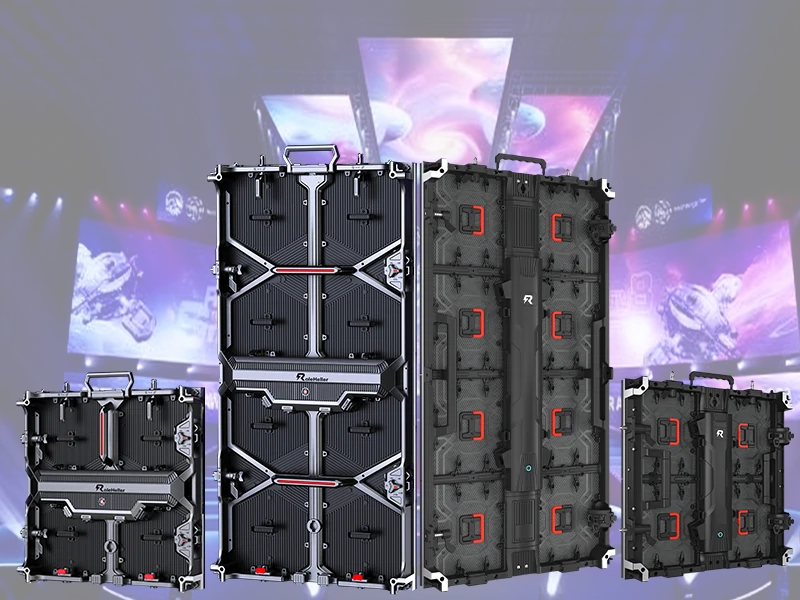
Cabinet material and casting quality. Die-cast magnesium is lighter and holds flatness better than sheet metal dressed up as "aluminium alloy". Flatness errors become visible seams, and seams are what audiences notice before they notice resolution.
Locking system. Rental locks get opened and closed hundreds of times. Cheap locks wear, develop play, and then the wall will not sit flat. Ask what brand of lock and whether replacement locks are available separately.
Power and signal connectors. Tool-less, keyed connectors save real time on load-in. Non-keyed ones get forced the wrong way and fry things.
Power supply derating. A supply running near its limit in a stacked, low-airflow rig fails faster. Derated supplies cost more and fail less.
Batch consistency. If you plan to expand the fleet over time, colour consistency across production batches matters more than almost anything. Ask how they bin LEDs and whether they keep records.
Notice there is no price in any of that. Price follows these decisions. If you let the supplier set the spec, you will never know whether you saved money or just bought a different product.
Send them as a block. Watch two things: response speed and concreteness. Speed does not prove much. Vagueness proves a lot.
Can we do a live video call of the production floor now?
Not a recorded tour. Live. Ask them to walk to the ageing area and read a serial number off a running rental cabinet. Brokers send PDFs and say the engineer is out today. A real factory does this during working hours without making a fuss.
What is the exact cabinet material, weight per panel, and flatness tolerance?
If the answer is "lightweight aluminium alloy, very flat", move on. Factories quote numbers because they have test reports. Traders quote adjectives.
Which LED brand, driver IC, and power supply are in this specific quote?
And ask them to write it into the proforma. "High quality brand, can be arranged" is not a spec, it is a promise with no handle on it.
What refresh rate do I actually get at my target brightness and grey scale?
This is the question that catches most people. Refresh rate and bit depth trade off against each other. Get the combination in writing for the resolution you intend to run.
Can I see camera footage shot at low brightness?
Specifically ask for dark scenes, slow pans, and footage from a phone as well as a professional camera. Phone footage is unforgiving and hard to fake convincingly.
Do you keep stock of spare cabinets and locks, and what is the lead time on a single replacement?
Rental fleets live and die by this. A supplier who only sells full sets and cannot move a single cabinet quickly will leave you stranded mid-tour.
Can you give me two customers who have used your rental cabinets for more than a year?
Then contact them and ask one question only: what broke, and how fast did it get fixed. Especially ask what happened after the first heavy transport cycle. That answer is worth more than any certificate thumbnail on the website.
Will you include a spares kit and flight cases, and are the cases built to fit the actual cabinet dimensions?
Generic cases that do not fit properly cause more transit damage than the shipping itself.
What pixel pitch should I choose for stage work?
It depends on your nearest viewer distance and how much text you show. For general stage and concert backdrops viewed from ten metres and out, P3.9 to P4.8 is the normal range and going finer costs a lot for little visible gain. For corporate stages, churches, and broadcast where cameras get close, P2.6 to P2.9 makes a real difference. But do not let someone upsell you into a finer pitch without checking whether your controller can actually drive the resulting resolution at your desired frame rate. That is a surprisingly common trap: the panels arrive, the wall is huge, and the processor can only do half of it at the refresh rate you need.
Do I need 3840Hz refresh rate?
If the screen will be filmed or photographed, yes, or at least verify what you get at your working settings. If it is purely for a live audience in a bright room, you can spend that money elsewhere. But be aware that many buyers discover the camera requirement only after the first event, and retrofitting is not really possible.
Curved or flat?
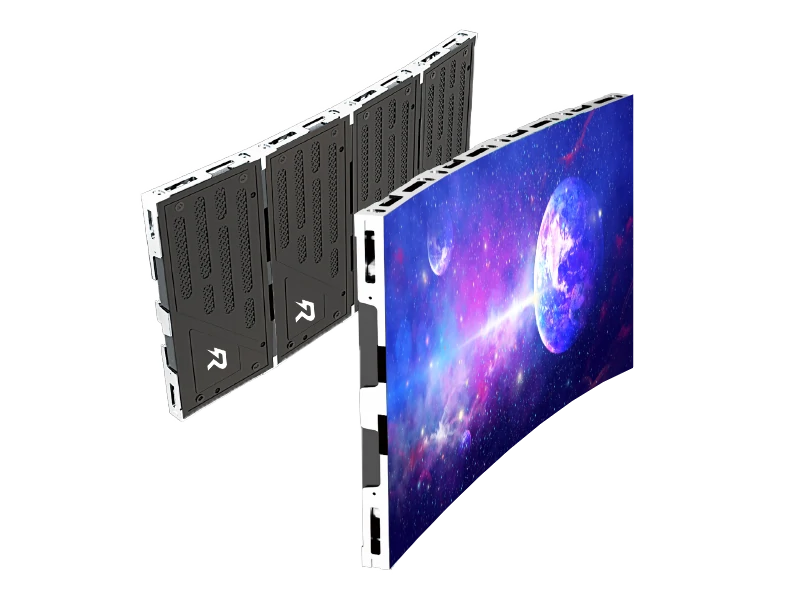
Rental fleets benefit enormously from cabinets that can do both — convex and concave curves with the same hardware. It widens the range of jobs you can take. Ask for the achievable radius in both directions and whether the curve adjustment is tool-less. If curving requires extra brackets or tools, crews will stop doing it, and the feature becomes theoretical.
Front service or rear service?
For rental, front service is nearly always the right call. Stages rarely give you clean access behind the wall, and truss-hung walls definitely do not. Confirm that removing a single module does not force you to dismantle its neighbours. I have seen designs where a five-minute swap becomes forty minutes, and that detail only reveals itself under show pressure.
How much brightness do I need?
Less than you think, most of the time. Indoor stage work typically runs far below outdoor levels, and running a stage wall at maximum brightness washes out the performers and murders your grey scale. What you want is headroom — the ability to hit the number you need at a comfortable drive level — plus reliable dimming down to very low levels without flicker or colour shift. Ask them to demonstrate the lowest stable dimming level. If they cannot, they probably have not calibrated there.
Weight and labour are the same cost item.
A panel that is three kilos heavier does not cost three kilos more to ship; it costs you an extra pair of hands and an extra twenty minutes every time the wall moves. Over a season that adds up to more than the price difference between a cheap cabinet and a good one. Put weight per panel in your comparison sheet right next to unit price.
Flight cases matter more than people think.
Good cases are custom-fitted, have proper foam, and account for the fact that road crews do not handle them gently. Bad cases are where modules get cracked in transit, and then the argument becomes about who is liable. Ask whether cases are included, whether they are custom or generic, and what the policy is on transit damage.
Write your usage facts down first. Indoor or outdoor, hung or ground-stacked, nearest and farthest viewer, whether it will be filmed, typical content type, hours per day, how often it moves, who operates it, and whether you plan to expand the fleet later. The tighter this list, the more comparable quotes become. Suppliers who cannot answer properly tend to stop replying, which is useful filtering.
Get three configuration sheets and compare line by line. Total price for the same configuration, not total price alone. Two stage screens can look identical in a photo and differ wildly in cabinet material, locks, power supplies, and included cases.
Lock the mechanical details. Cabinet dimensions, weight per panel, total rig weight, curve capability, lock type, service clearance, and case dimensions. This is what determines whether your crew can actually build the show.
Confirm the control chain. Processor model, input options, maximum resolution at your target refresh rate, cable lengths, whether the software licence is yours and non-expiring, and whether remote support is available in your time zone.
Write the warranty in operational language. Response time, who pays freight on replacements, whether labour is covered, whether failed units are replaced or repaired, and whether spare parts will still be available in three years. "Two years warranty" with no detail means nothing once you are six time zones apart.
Insist on spares in the first shipment. Same-batch modules, spare power supplies, spare receiving cards, spare locks, extra cables and connectors, and swap tools, all labelled. A dead panel on a Friday load-in is fixed by a spare in your case, not by an email chain.
Arrange pre-shipment inspection. A third-party check at the factory catches mislabeled pitch, wrong components, missing spares, dead pixels, and weak locks before the crate is sealed. It costs a few hundred and it is the cheapest insurance on the project.
Confirm paperwork before shipping. HS code, duty rate, electrical compliance. LED displays get questioned at borders more often than expected, and port storage fees accumulate faster than arguments resolve.
Test on arrival and again after first build. Run powered for an extended period, check seams and flatness, check dimming at low levels, test with your actual content and your actual camera, and physically swap a module using the spares kit to confirm your crew can do it in the time you think they can.
Seams that appear or worsen over time point to cabinet flatness and lock wear — that cannot be calibrated away. Banding in dark scenes points to insufficient bit depth or a driver IC and controller mismatch. Colour drift after a few months points to mixed LED batches or no calibration record. Panels that dim noticeably by the second season point to thermal issues or power supplies running hot. Dead rows after a transport cycle usually point to connector and ribbon cable quality rather than the LEDs themselves. Flicker at low brightness points to poor dimming calibration. Transit cracks point to bad cases or bad packing. Each symptom maps to a corner that was cut. Knowing the map stops you from accepting "just bad luck" as an explanation. It was not bad luck.
Wholesale implies volume, and volume gives you leverage on exactly three things: price, payment terms, and spares inclusion. My advice: spend the leverage on payment terms and spares before you spend it on price. A 30 percent deposit with balance before shipment is standard; if you are committing to a fleet, push for staged payments tied to inspection sign-off. And insist that the spares kit and at least one set of critical wear items — locks and connectors — come in the first shipment at no extra charge. That concession costs the supplier very little and saves you disproportionately.
One more thing on MOQ: some factories will accept a small first order as a trial if you make clear you are evaluating for a larger fleet. Others will not budge. The ones willing to earn the bigger order with a smaller one are usually confident their product survives contact with reality. That is a signal worth noting.
After looking at enough of these projects, the pattern is boringly consistent. The buyers who end up happy wrote down how the screen would actually be used and moved before they spoke to a single supplier — how often it travels, who builds it, whether cameras will be on it, whether they plan to grow the fleet. The buyers who end up disappointed started with price and worked backwards, and discovered on load-in day that the locks were already sloppy, the cases did not fit, and the controller could not drive the wall at the refresh rate they needed.
Specs can be padded, photos can be borrowed, certificates can be faked, but a load-in cannot be faked. Lay your real operating facts out first and the wrong manufacturers remove themselves, because they cannot answer properly. The right ones respond with specifics, ask questions back, and sometimes tell you that you do not need the finer pitch, or that your rigging plan is wrong, or that you would be better off buying fewer square metres and spending the difference on better cases and more spares. That last behaviour is the strongest signal in the whole process. A supplier willing to talk you out of a sale is usually the one who has stood on a dark stage at two in the morning and knows exactly where the problems hide.
Trust that instinct more than any badge on a website. Insist on numbers — weight, tolerance, refresh rate at your settings, lock brand, spares list — written into the proforma. And keep a copy of the configuration file somewhere that is not the sending box. Saving that file takes thirty seconds and it has saved more shows than I can count.
Have you run into a supplier who quoted one thing and delivered another, or found a detail that saved your load-in? Drop it in the comments — the practical stuff is what helps people here.
What should I look for in wholesale stage LED display manufacturers?
Prioritise documented cabinet material and weight per panel, flatness tolerance, lock brand and availability, confirmed refresh rate at your target brightness and grey scale, named components (LED brand, driver IC, power supply), verifiable certifications in the supplier's own name, and a documented spares and fleet-support policy. Compare prices on matching configurations only.
What is the difference between rental stage LED and fixed-install LED?
Rental cabinets are die-cast, lighter, built with tool-less locks and front service, and designed to survive repeated transport. Fixed-install cabinets prioritise cost and weather sealing over weight and service speed. Using a fixed-install cabinet for touring work is the most common wholesale mistake.
What pixel pitch is best for stage LED displays?
For general stage and concert backdrops viewed from around ten metres, P3.9–P4.8 is typical. For corporate stages, churches, and broadcast where cameras get close, P2.6–P2.9 is worth the cost. Always confirm your controller can drive the resulting resolution at your desired refresh rate.
Do I need 3840Hz refresh rate for stage?
If the screen will be filmed or photographed, yes — but confirm what refresh rate you actually get at your working brightness and bit depth, since they trade off. For audience-only viewing in controlled light, you may not need it.
How important is cabinet weight?
Very. Extra weight per panel increases labour, rigging requirements, and shipping cost across an entire season. Put weight per panel in your comparison sheet alongside unit price.
Should I buy flight cases from the same manufacturer?
Generally yes, provided they are custom-fitted to the actual cabinet dimensions. Generic cases cause transit damage, and transit damage disputes are costly. Confirm whether cases are included and what the transit-damage policy is.
What spares should come with a wholesale order?
Same-batch modules, spare power supplies, spare receiving cards, spare locks and connectors, extra cables, and swap tools, all clearly labelled. For rental fleets this is not optional.
How long does a wholesale order take?
Standard rental configurations often run several weeks from deposit plus freight time. Custom sizes, unusual aspect ratios, and large fleet orders take longer, and peak season adds buffer. Plan from the date you need the screen on stage, not the date you pay.
What warranty terms should I insist on?
At minimum two years on modules and control system, plus clarity on response time, who pays freight for replacements, whether labour is covered, whether failed units are replaced or repaired, and whether spare parts remain available for the life of the fleet. Negotiate these explicitly.
How do I tell a real factory from a trading company?
Ask for a live video call of the production floor and ageing area, request component brands and model numbers named in writing and inserted into the proforma, verify that certificates sit in the company's own name, and ask for references from customers who have used the rental cabinets for over a year. Factories name parts and show the floor; traders speak in adjectives and send PDFs.
.jpg "Where to Source China Outdoor Rental LED Video Wall Manufacturers?")
.jpg "China P1.6 LED Video Wall Manufacturers | How to Choose the Right One")