English
If you've ever stood in front of a massive LED wall at a concert, trade show, or corporate gala and wondered where that screen actually came from, chances are it was built by one of the China LED video wall rental screen manufacturers. These companies, mostly based in Shenzhen, supply the overwhelming majority of rental LED panels used at events across Europe, North America, the Middle East, and yes, right here in Hong Kong and across Asia. But with so many factories claiming to be "the best," how do you actually figure out which ones are worth your time and money? That's exactly what we're going to sort out in this piece. We'll walk through the major players, what to watch out for, current pricing, and some practical tips if you're thinking about sourcing rental LED screens from China for your next project.
It's not a coincidence that nearly every major LED display company on the planet has its headquarters or main production facility in Shenzhen. The city's electronics supply chain is unmatched. You've got LED chip suppliers, driver IC manufacturers, cabinet fabricators, and control system companies all within a 30-kilometer radius. This concentration means faster prototyping, lower component costs, and quicker iteration cycles than anywhere else in the world.
Back in the early 2000s, most of these companies were making simple single-color text displays for storefronts. Fast forward to today, and the same industrial ecosystem is pumping out 1.2mm fine-pitch LED walls, transparent mesh screens, and kinetic LED systems that move in sync with live music. The evolution has been remarkable, and it's precisely this ecosystem advantage that keeps China LED video wall rental screen manufacturers ahead of competitors in other regions.
Let's get into the specifics. When people talk about top-tier Chinese LED display companies, a handful of names keep coming up over and over again. These aren't random factories you found on Alibaba; they're publicly listed companies with global service networks, R&D centers, and track records at some of the world's biggest events.
Absen has held the number one spot in China's LED display exports for over a decade. Their A-series rental panels are some of the most widely used in the global rental market, known for being lightweight, color-accurate, and easy to set up. They've got a strong presence in Europe and North America, with local warehouses and service teams in key markets.
Unilumin is another heavyweight. They're the official LED display partner for FIFA, the NBA, and several major broadcast networks. Their Upanel rental series is widely used in live events and virtual production studios. What sets Unilumin apart is their Mini LED technology, which delivers deeper blacks and better contrast than traditional SMD panels.
Leyard, founded back in 1995, is one of the oldest players in the game and currently holds the largest global market share by revenue. They supplied LED screens for multiple Olympic Games and are known for ultra-high reliability. If you need a screen that absolutely cannot fail during a live broadcast, Leyard is often the go-to choice.
LianTronics specializes in small-pitch and broadcast-grade rental screens. Their VT series is popular in TV studios and houses of worship where image quality matters more than sheer size. They've also been aggressive in pushing COB (Chip-on-Board) technology into the rental market.
Qiangli Jucai (QL) occupies a slightly different position. They're known for offering the best cost-performance ratio in the industry. If you're running a mid-budget event or just starting a rental business, QL's standard P3.91 and P4.81 panels give you solid quality without breaking the bank.
| Manufacturer | Founded | Key Strength | Popular Rental Series | Price Range (per sqm) |
|---|---|---|---|---|
| Absen | 2001 | Export leader, lightweight design | A2.5/A3.9 Rental | $900–$1,300 |
| Unilumin | 2004 | Mini LED, XR/virtual production | Upanel Series | $1,000–$1,500 |
| Leyard | 1995 | Largest market share, Olympic-grade | Rental P2.6/P3.9 | $950–$1,400 |
| LianTronics | 2003 | COB technology, broadcast quality | VT Rental Series | $1,100–$1,600 |
| Qiangli Jucai | 2004 | Best value for money | Standard P3.91/P4.81 | $600–$900 |
Note: Prices are approximate for 2026 and vary based on order volume, pixel pitch, and configuration.
Here's the thing that a lot of first-time buyers don't realize. When you're buying LED panels for rental use, the priorities are completely different from buying a permanent installation screen. For rental, you need to think about three things above everything else: setup speed, durability, and serviceability.
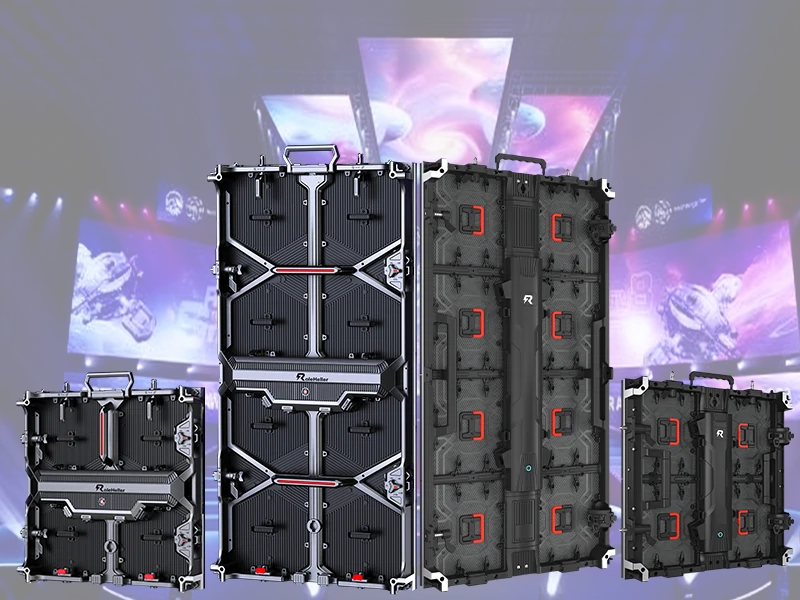
Setup speed is critical because labor costs at events are brutal. If your crew is charging $50–$80 per hour and you can save three hours on assembly by choosing panels with tool-free locking mechanisms and magnetic module attachment, that's literally hundreds or thousands of dollars saved per event. The top China LED video wall rental screen manufacturers have invested heavily in quick-lock systems where a single person can install most modules by hand. Some of the latest cabinets from Absen and Unilumin feature aviation plug connectors that snap together without any tools at all.
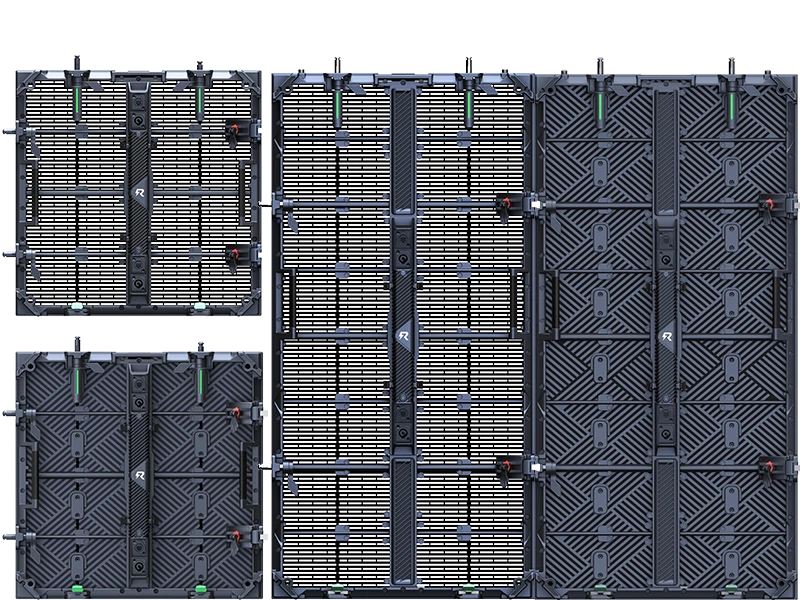
Durability is the other huge factor. Rental screens get shipped in trucks, stacked on pallets, knocked around during load-in and load-out, and reassembled hundreds of times over their lifespan. A panel that looks perfect on day one might start showing dead pixels, color uniformity issues, or broken corner locks after just ten deployments if it wasn't built properly. The better manufacturers use die-cast aluminum cabinets with reinforced corners and precision CNC machining to ensure tight tolerances even after repeated use.
Serviceability is the one that gets overlooked the most. When a module fails during a live event, you need to be able to swap it out in under five minutes, from either the front or the rear. Top-tier rental panels have magnetic front-access modules and hot-swappable power supplies and receiving cards. No soldering, no ribbon cables to fumble with, just pull the old module out and snap a new one in.
One trend that's been accelerating through 2025 and into 2026 is the shift toward COB (Chip-on-Board) and GOB (Glue-on-Board) encapsulation in rental LED panels. Traditional SMD (Surface-Mount Device) LEDs have the individual LED chips mounted on the surface of the PCB, which makes them vulnerable to impact damage, dust ingress, and moisture. COB technology encapsulates the LED chips directly into the PCB with a protective epoxy layer, making the panel surface much more resistant to knocks, scratches, and environmental factors.
For rental applications, this is a game-changer. Think about it: rental screens get handled roughly. During load-in, panels get bumped against door frames, stacked on top of each other, and sometimes dropped. With traditional SMD panels, even a small knock can crack an LED chip or dislodge it from the PCB, creating a dead pixel or a color shift. COB panels can handle significantly more physical abuse without damage.
The adoption numbers tell the story. In 2024, only about 12% of rental LED orders from Chinese manufacturers specified COB technology. By mid-2026, that figure has jumped to over 34%, and it's projected to reach 50% by 2027. The cost premium for COB panels has also come down significantly; you're now looking at maybe 20–30% more than equivalent SMD panels, compared to 50–60% more just two years ago.
Let's talk numbers, because this is where a lot of people get confused or get taken advantage of. The price of rental LED panels from China varies enormously depending on pixel pitch, technology type, cabinet size, and order quantity.
For standard P3.91 outdoor rental panels (the most common spec for general-purpose rental), you're looking at roughly $700–$1,000 per square meter from a reputable manufacturer. The lower end of that range applies to larger orders (50+ sqm) from value-oriented brands like Qiangli Jucai, while the higher end covers smaller orders from premium brands like Absen or Unilumin.
For P2.6/P2.9 indoor rental panels with higher resolution, expect to pay $900–$1,400 per square meter. These are popular for corporate events, trade shows, and indoor concerts where the audience is closer to the screen.
For COB rental panels with enhanced durability and better contrast, add another 20–30% on top of the SMD pricing. So a P2.6 COB rental panel might run you $1,200–$1,800 per square meter.
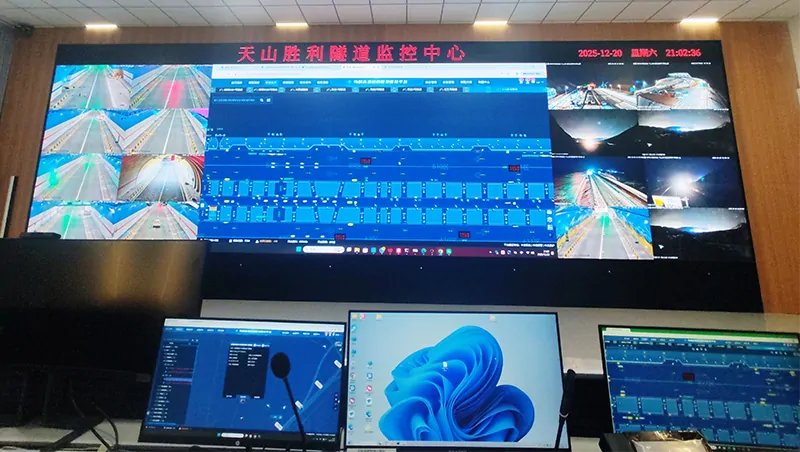
And for fine-pitch panels below P2.0, which are used mainly in broadcast studios and control rooms, you're entering $1,500–$3,000+ per square meter territory.
One thing to keep in mind: these are panel-only prices. You'll also need to factor in shipping (typically 8–15% of the product cost depending on destination), import duties (which vary by country), and any accessories like flight cases, spare modules, and video processors.
A question we get asked constantly is whether you can use the same panels for both indoor and outdoor events. The short answer is: technically yes, but practically it depends.
The main differences come down to brightness and IP rating. Indoor rental panels typically run at 800–1,500 nits of brightness, which is perfect for controlled lighting environments. Outdoor panels need to push 5,000–7,000 nits to remain visible in direct sunlight. If you try to use an indoor panel outdoors on a sunny day, the image will look washed out and virtually unreadable.
On the flip side, using an outdoor panel indoors isn't a technical problem; it'll work fine. But outdoor panels are generally heavier (because of the extra sealing and higher-brightness LEDs), more expensive, and can be uncomfortably bright in a dark venue unless you can dim them sufficiently.
Most China LED video wall rental screen manufacturers offer both indoor and outdoor versions of their popular rental models, often with the same cabinet dimensions so they're physically compatible. The smart move is to buy both types if your business covers both markets, or at least make sure you're ordering the right version for your specific event.
Look, the LED display industry in Shenzhen is massive, and like any large industrial cluster, you've got a mix of excellent manufacturers and questionable ones. Here's how to tell the difference.
Check their listing status. The top manufacturers (Absen, Unilumin, Leyard, LianTronics) are all publicly listed on the Shenzhen Stock Exchange. Their financial statements are public, their production volumes are verifiable, and they have reputations to protect. This doesn't mean smaller companies are bad; it just means listed companies have more accountability.
Ask for verifiable case studies. Any factory can put up a few renderings on their website. But can they show you photos or video footage of their screens actually running at a major event? The top players have documented installations at the Olympics, FIFA World Cup, Super Bowl halftime shows, Coachella, and countless other high-profile events.
Request a factory visit. Most reputable manufacturers in Shenzhen welcome buyer visits. You'll be able to see their production lines, quality control processes, aging test rooms, and shipping facilities. If a company is reluctant to let you visit, that's a yellow flag.
Start with a trial order. Before committing to a large purchase, order a small batch (say, 10–20 cabinets) and put them through their paces at a real event. See how they assemble, how they look after a few uses, and how the supplier responds when you have questions or issues.
Here's something that catches a lot of first-time importers off guard: the total cost of getting LED panels from a Chinese factory to your warehouse isn't just the product price plus shipping. There are layers of costs that you need to budget for.
Freight costs vary significantly depending on whether you ship by sea or air. Sea freight to Europe or North America typically takes 25–40 days and adds about 8–12% to the product cost. Air freight is much faster (5–10 days) but can add 25–40% to costs. For rental panels, which are heavy and bulky, sea freight is almost always the way to go unless you have an urgent deadline.
Import duties depend on your destination country. In the US, LED display panels generally fall under HS code 8528.59 and may be subject to tariffs ranging from 0–5% under normal trade conditions, though additional Section 301 tariffs could apply. In the EU, the standard duty rate is around 1.4–3.9%. In Hong Kong, there are no import duties on electronic goods, which is one reason many regional rental companies source directly from Shenzhen.
DDP vs. FOB shipping terms matter a lot. DDP (Delivered Duty Paid) means the supplier handles everything including customs clearance and duty payment, which is the easiest option if you're not familiar with import procedures. FOB (Free on Board) means you take responsibility once the goods are loaded on the ship, and you'll need your own freight forwarder and customs broker. For first-time buyers, DDP is strongly recommended even though it might cost slightly more.
This is probably the single most important question after price. When you're buying rental equipment that's going to be used at live events where failure is not an option, you need to know what happens when something goes wrong.
The standard warranty from top Chinese manufacturers is 2–3 years on the LED modules and cabinets, covering manufacturing defects. Some premium brands offer extended warranty packages for an additional fee. The warranty typically covers dead pixels beyond a certain threshold (usually 3 per million), color uniformity issues, and component failures.
But warranty is only half the story. What really matters is response time and spare parts availability. The top brands maintain overseas warehouses stocked with spare modules, power supplies, receiving cards, and cables in key markets. If a panel fails during an event in London or Los Angeles, they can typically get replacement parts to you within 24–48 hours. Some even have local service technicians who can be on-site within hours for critical situations.
Most manufacturers also include 3–5% spare modules with every order at no extra charge, which is enough to handle the vast majority of field failures without needing to wait for shipments from China.
The rental LED screen market isn't standing still. Several trends are reshaping how these products are designed, sold, and used.
Kinetic LED systems are gaining serious traction. These are LED panels mounted on motorized tracks or winch systems that can move, rotate, and reconfigure during a show in sync with music or content. They've been used at major concerts and award shows, and the technology is becoming more affordable and accessible for mid-tier events.
XR (Extended Reality) virtual production is driving demand for high-refresh-rate, camera-friendly LED panels. As more film and TV productions use LED volumes instead of green screens, the demand for rental panels with specific optical properties (high refresh rate, low moiré, accurate color under camera) is growing rapidly. Unilumin and Absen have both launched dedicated XR rental product lines.
Sustainability is becoming a real differentiator. Some manufacturers are now offering panels with lower power consumption (up to 30% less than previous generations), recyclable aluminum cabinets, and lead-free soldering processes. European event organizers in particular are starting to factor sustainability into their vendor selection criteria.
Lighter cabinets continue to be a focus. The latest generation of rental panels from top manufacturers are 18–22% lighter than models from just three years ago, thanks to advanced aluminum alloys and optimized structural design. This translates directly into lower shipping costs, easier handling, and reduced labor requirements on site.
Since a lot of our readers are based in Hong Kong and the broader Asia-Pacific region, let's address some specifics that apply to you.
First, the geographic advantage is real. Shenzhen is literally across the border from Hong Kong. You can visit factories, inspect goods, and even arrange same-day courier delivery for small orders. This proximity gives you a huge advantage over buyers in Europe or the Americas when it comes to quality control and communication.
Second, for events in Hong Kong, Macau, and mainland China, you'll want panels that comply with CCC (China Compulsory Certification) in addition to international standards. Most major manufacturers already have CCC certification for their popular models, but it's worth confirming before you order.
Third, the rental market in Asia-Pacific is growing fast, driven by the expansion of trade shows, corporate events, and entertainment venues across the region. If you're thinking about starting or expanding a rental business, now is a good time to invest in quality equipment from established manufacturers. The competition is intensifying, and having reliable, high-quality panels will set you apart from operators using cheaper, no-name products.
After spending years covering the LED display industry and talking to rental company owners, event planners, and manufacturer sales teams, here's my honest assessment. The China LED video wall rental screen manufacturers have reached a level of quality and reliability that genuinely rivals, and in many cases exceeds, their Western competitors. The days of "Chinese LED equals cheap and unreliable" are long gone.
That said, the market is still full of varying quality levels. You've got world-class publicly listed companies at the top, and you've got small workshops cranking out panels with questionable quality control. The key is doing your homework, starting with reputable brands, and building a relationship with a supplier who treats you as a long-term partner rather than a one-time transaction.
If you're budget-conscious, there's absolutely nothing wrong with going for value-oriented brands like Qiangli Jucai, as long as you understand the trade-offs in terms of after-sales support and long-term durability. And if you need the absolute best for high-stakes events, the premium brands like Absen, Unilumin, and Leyard won't let you down.
The most important thing is to match your purchase to your actual needs. Don't overbuy on specs you don't need, and don't underinvest in quality where it matters. The Chinese LED rental screen industry has something for every budget and every use case; you just need to know where to look.
Q1: Who are the most trusted China LED video wall rental screen manufacturers in 2026?
A: The most widely recognized and trusted names include Absen, Unilumin, Leyard, LianTronics, and Qiangli Jucai. These are all publicly listed companies with proven track records at major global events and established after-sales networks across Europe, North America, and Asia-Pacific.
Q2: What is the average price of a rental LED screen from China per square meter?
A: For standard P3.91 outdoor rental panels, expect to pay between $700 and $1,000 per square meter. Higher-resolution indoor panels (P2.6/P2.9) range from $900 to $1,400 per square meter, while COB-encapsulated panels carry a 20–30% premium over traditional SMD models.
Q3: How long does it take to manufacture and ship rental LED panels from China?
A: Standard models typically have a production lead time of 15–25 working days. Sea freight to Europe or North America adds another 25–40 days. For buyers in Hong Kong or Southeast Asia, delivery can be as quick as 3–7 days by land or sea.
Q4: Can I visit the LED display factories in Shenzhen?
A: Yes, most reputable manufacturers in Shenzhen welcome factory visits from international buyers. It's highly recommended, especially for first-time purchasers, as it allows you to inspect production quality, testing facilities, and meet the team face to face.
Q5: What warranty do Chinese LED rental screen manufacturers typically offer?
A: The industry standard is 2–3 years of warranty coverage on LED modules and cabinets, covering manufacturing defects. Most suppliers also include 3–5% spare modules with each order at no additional cost.
Q6: Are COB LED panels worth the extra cost for rental use?
A: For high-traffic rental operations where panels are frequently assembled, disassembled, and transported, COB panels offer significantly better resistance to physical damage, dust, and moisture. The 20–30% price premium is generally considered worthwhile for companies that prioritize long-term durability and lower maintenance costs.
Q7: What pixel pitch should I choose for my rental LED screen?
A: It depends on your typical viewing distance. For close viewing (under 5 meters), go with P1.8–P2.6. For medium distances (5–15 meters), P2.9–P3.91 is ideal. For large outdoor venues with audiences 15+ meters away, P4.81–P6.25 provides the best value.
Q8: Do Chinese LED manufacturers provide technical support during live events?
A: Top-tier manufacturers like Absen, Unilumin, and Leyard offer 24/7 remote technical support and have local service partners in major cities worldwide. For critical events, some suppliers can even dispatch an on-site engineer for an additional fee.
Q9: What certifications should I look for when importing LED rental screens?
A: For international markets, ensure the panels carry CE (Europe), FCC (USA), and RoHS certifications. For the Chinese domestic market, CCC certification is required. Most established manufacturers already hold all relevant certifications for their popular rental models.
Q10: Is it cheaper to buy rental LED screens from China compared to European or American brands?
A: Yes, Chinese-manufactured rental LED panels are typically 30–50% less expensive than comparable European or American brands, while offering similar or equivalent performance in terms of brightness, color accuracy, and reliability. The cost advantage is most significant at the mid-range and value segments of the market.