English

If you want the straightforward answer before wading through dozens of sales catalogs: the most reliable tier for mission-critical billboards, stadiums, and digital out-of-home (DOOH) networks comes down to established Shenzhen and Huizhou heavyweights like Unilumin, Absen, and Leyard for enterprise projects, balanced against dedicated export engineering houses such as Gloshine, Dicolor, and Chipshow when you need 30% to 45% better cost efficiency without sacrificing core component quality. When sourcing from china outdoor led video display manufacturers, avoiding costly failures does not depend on finding a supplier with the glossiest brochure; it depends entirely on bypassing local trading middlemen and locking down exact bill-of-materials (BOM) specifications—specifically gold-wire LED encapsulation, common-cathode driver architectures, and authentic IP66/IP68 sealed aluminum cabinets—directly into your purchase contract.
Have you ever wondered why two outdoor LED video walls with identical pixel pitches and cabinet dimensions quoted by two different suppliers in Guangdong can carry a 50% price difference? On paper, both specification sheets promise 6,500 nits of daytime brightness, IP65 weatherproofing, and a 100,000-hour operational lifespan. In reality, one display runs trouble-free under intense desert sun or coastal freeze-thaw cycles for seven years, while the other begins dropping pixel clusters, warping at cabinet seams, and disfiguring into blotchy color patches within nine months of deployment. Let's pull back the curtain on how outdoor LED hardware is genuinely built, what happens inside South China factories, and how you can run an airtight procurement process from overseas.
An outdoor LED display is essentially an industrial computer wrapped inside a weatherproof structural frame that must endure driving rain, solar radiation, airborne pollutants, and extreme thermal swings—all while pushing high electrical current to generate millions of lumens.
When evaluating hardware from Chinese manufacturers, the display breaks down into four critical layers:
The diode package is your primary point of exposure to the outside environment:
Surface-Mount Diode (SMD): The industry standard for outdoor pitches from P2.5 up to P10. Modern outdoor SMD packages (typically SMD1921, SMD2727, or SMD3535) combine the red, green, and blue dies into a single compact housing. SMD offers wide 140° to 160° horizontal viewing angles and smooth color blending at closer distances, making it ideal for street-level retail facades and roadside billboards.
Dual In-Line Package (DIP): The traditional technology where individual red, green, and blue bulb-style diodes are soldered through the PCB. While largely phased out for fine-pitch indoor use, high-grade DIP (often P10, P16, or P20) remains popular for massive highway billboards and stadium perimeter rings facing direct desert sun, capable of blasting past 8,500 to 10,000 nits with exceptional weather resilience.
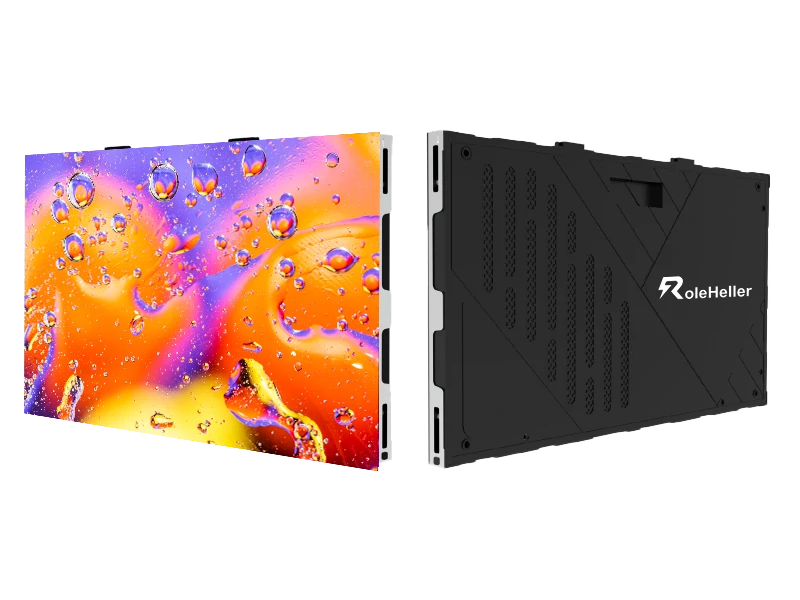
Glue-on-Board (GOB) & Chip-on-Board (COB): The newest packaging frontier for outdoor fine-pitch screens (P1.9 to P2.9). A transparent optical epoxy or polyurethane layer is poured over the SMD surface, providing physical impact resistance, anti-collision protection, and complete moisture isolation.
This is where power bills and thermal management diverge significantly:
Traditional Common Anode: Both red, green, and blue dies share a single positive power supply line (usually 5V). Because red diodes require roughly 2.1V to 2.4V to illuminate while blue and green need around 3.0V to 3.2V, the excess voltage delivered to the red diode is dumped as pure waste heat inside the cabinet. This accelerates diode decay and demands noisy cooling fans.
Energy-Saving Common Cathode: Current is distributed independently. The red diode is driven with a dedicated 2.8V line, while green and blue run on 3.8V. By matching supply voltage directly to the diode's bandgap requirements, operating temperatures inside the cabinet drop by 10°C to 18°C, and overall energy consumption is reduced by 25% to 40%. When operating high-brightness billboards 16 hours a day, common cathode architecture saves thousands of dollars annually in commercial utility bills.
| Display Technology | Typical Pixel Pitch | Standard Brightness Range | Ingress Protection | Horizontal Viewing Angle | Ideal Deployment Scenario |
|---|---|---|---|---|---|
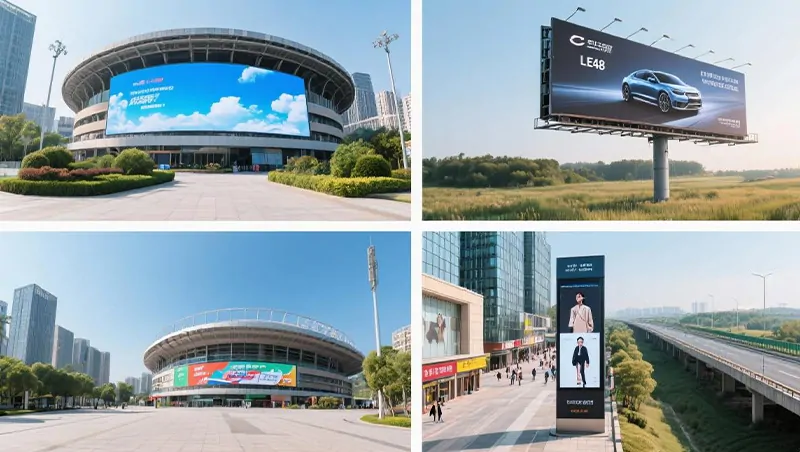
| Outdoor SMD (Common Cathode) | P2.5 – P8.0 | 5,500 – 7,500 nits | Front IP66 / Rear IP65 | 140° – 160° | Urban billboards, shopping mall facades, transit hubs |
| Traditional Outdoor SMD | P3.91 – P10 | 4,500 – 6,000 nits | Front IP65 / Rear IP54 | 120° – 140° | Mid-budget commercial signs, shaded outdoor plazas |
| Outdoor DIP (Direct In-Line) | P10 – P20 | 7,500 – 10,000+ nits | Front IP67 / Rear IP65 | 110° – 120° | Highway super-structures, high-glare desert environments |
| Outdoor GOB / COB Surface | P1.5 – P2.9 | 3,500 – 5,000 nits | Front IP68 / Rear IP65 | 160° – 170° | Close-range luxury storefronts, outdoor touch kiosks |
Almost all global outdoor LED display hardware originates in Guangdong Province. If an overseas trading vendor tells you their manufacturing plant is located outside this corridor, they are almost certainly sourcing modules from the Pearl River Delta, bolting them into generic chassis, and relabeling the crates.
The manufacturing belt is clustered into three key zones:
Shenzhen (Bao'an, Guangming, Longhua): The global brain for LED packaging, driver firmware, precision CNC metal fabrication, and international export operations. R&D-heavy manufacturers and major public enterprises operate here.
Huizhou and Dongguan: Massive industrial campuses where automated SMT placement, powder coating, high-volume die-casting, and large-scale aging yards take place at lower square-footage costs.
Jiangmen & Zhongshan: Specializes in bulk raw components, bare PCBs, stamped sheet-metal cabinets, and budget landscape luminaires.
[Tier 1: Public Industry Leaders]
  ├── Examples: Unilumin, Absen, Leyard, LianTronics
  └── Profile: Multi-acre campuses, proprietary patents, overseas branch offices, enterprise pricing

[Tier 2: Specialized Export Manufacturers]
  ├── Examples: Gloshine, Dicolor, Chipshow, CreateLED, INFiLED
  └── Profile: Deep engineering capabilities, agile customization, transparent BOM, direct engineering access

[Tier 3: White-Label Assembly Workshops]
  ├── Examples: Unbranded workshops across Shiyan, Fuyong, and Dalingshan
  └── Profile: Spot-market parts sourcing, manual soldering, no environmental testing, minimal warranty follow-through
Companies like Unilumin, Absen, and Leyard maintain massive global footprints. Their hardware is thoroughly vetted, carrying native certifications for UL, ETL, CE, and TUV. Their systems light up Times Square, Premier League stadiums, and major international transit hubs. The trade-off? You pay a 30% to 50% brand premium. Their minimum order quantities (MOQs) for custom structural cabinets are restrictive, and their internal sales processes can be slow if you are ordering 20 to 50 square meters rather than 500.
This is where smart AV integrators and commercial billboard networks find the highest value. These factories specialize in overseas B2B markets. Their survival hinges on export quality reputations, meaning they standardize on Tier-1 LED packagers (such as Nationstar Gold Wire) and reputable power units (Mean Well). They are agile: if your structural drawing requires a 90-degree seamless corner cabinet or a non-standard radius curve, their mechanical engineers can modify CAD files and tool up custom extrusions in two weeks. Pricing skips the administrative overhead of publicly traded holding companies.
These outfits buy bare circuit boards from third-party suppliers, purchase low-bin unbranded lamp beads from budget packaging houses, and assemble panels using manual screwdrivers and basic jigs. They can offer startlingly cheap quotes—sometimes under $400 per square meter for outdoor P4 specs. However, these panels rarely undergo proper thermal cycling. Solder joints crack under outdoor wind vibrations, silicone masks degrade under sunlight, and when a client requests a warranty repair two years later, the workshop has often changed company names.
| Evaluation Parameter | Tier 1: Global Giants | Tier 2: Dedicated Export Houses | Tier 3: Budget Assemblers |
|---|---|---|---|
| Typical Target Projects | Stadiums, flagship retail, DOOH networks | Commercial billboards, church facades, live events | Short-term roadside popups, budget domestic signage |
| Diode Wire Bonding | 99.99% Pure Gold Wire (Custom Bins) | Nationstar Gold or High-Bin Copper Wire | Unbranded Alloy or Low-Tier Copper Wire |
| Driver IC Standard | Macroblock MBI5359 / Chipone High-PWM | Macroblock MBI5153 / Chipone 2153 (3840Hz) | Generic ICN / Low-Refresh Double Latch |
| Cabinet Construction | Precision Die-Cast Magnesium/Aluminum | Die-Cast Aluminum or Waterproof Profile Aluminum | Welded Stamped Sheet Iron (Prone to rust) |
| Factory Aging Protocol | 72 hours full-white + thermal spray cycle | 48 to 72 hours continuous thermal testing | 12 to 24 hours static video test (often rushed) |
| Ingress Sealing Standard | True IP66/IP68 hermetic module chambers | IP65/IP66 front and rear with waterproof channels | Basic rear door rubber gaskets (frequently leak) |
| Pricing Baseline (P4 Outdoor) | $1,100 – $1,800 / m² | $650 – $950 / m² | $380 – $520 / m² |
When reviewing factory quotations, looking only at pixel pitch and headline price is a recipe for disaster. Long-term reliability is dictated by sub-component tolerances.
North-Facing or Shaded Facades: 4,500 to 5,500 nits is perfectly readable without wasting energy.
Direct Southern or Western Sun Exposure: A minimum of 6,500 to 7,500 nits is required to prevent midday washout.
The Trap: Cheap manufacturers push small diodes to their absolute electrical limits to hit 7,000 nits on a factory test bench. Running diodes at maximum current generates immense junction heat. Within 12 months, the phosphor decays, the epoxy turns yellow, and output plunges by 40%. Always ask for the calibrated operating drive current: good designs achieve high brightness through high-efficiency LED chips, not by overdriving budget diodes.
Standard Sheet-Metal Cabinets: Made from stamped, folded iron plates painted with powder coating. They are heavy (often 40-50 kg/m²), difficult to align with zero seam gap, and if a technician scratches the paint during installation, rust spots begin bleeding down the building facade within months.
Die-Cast Aluminum or Magnesium Profiles: High-precision CNC-machined cabinets weighing under 25-30 kg/m². They resist corrosion, provide natural passive heat conduction, and hold mechanical alignment tolerances under 0.1mm. If your display is mounted on an elevated pole or architectural rooftop, the lighter weight significantly lowers structural steel engineering and wind-load reinforcement costs.
[Incoming High-Voltage AC Power: 110V/220V]
                     │
                     ▼
  [Mean Well UHP-Series Fanless Power Supply] ──> Over-rated by 30% Headroom
                     │
                     ▼
    [Common Cathode Step-Down Distribution]
          ├── 2.8V Dedicated Rail ──> Red LED Die (Low Heat Generation)
          └── 3.8V Dedicated Rail ──> Green & Blue LED Dies
                     │
                     ▼
  [Hermetically Sealed IP66 Die-Cast Aluminum Module] ──> Heat Dissipates Passively
If your display is installed near retail venues, sports arenas, or city centers, it will be filmed continuously on consumer smartphones.
Entry-Level Drivers (1,920Hz): Look passable to the naked eye. However, on camera lenses or broadcast footage, black horizontal scan bars roll across the content. Furthermore, at low brightness levels (such as nighttime dimming to 10%), basic drivers suffer severe grayscale loss, turning smooth color gradients into harsh banding.
High-PWM Drivers (3,840Hz to 7,680Hz): Ensure zero moiré artifacts or shutter flicker on cameras, while maintaining 14-bit to 16-bit color depth even when the display dims to comply with nighttime municipal light regulations.
How your video display is mounted dictates which mechanical maintenance design you must select:
How it works: Technicians insert a hex key or an automated vacuum extraction tool into front-face access holes, rotate the lock, and pull the waterproof module forward into the street or staging lift.
When you need it: Essential for wall-mounted displays where the screen is bolted flush against a building envelope with no rear walkway, or for compact monument signs.
Engineering challenge: The front gasket seal must maintain airtight compression even after multiple module extractions. High-tier builders use custom molded silicone seals rather than flat foam tape.
How it works: Technicians open rear cabinet doors or unfasten rear modules from inside a dedicated catwalk structure behind the video wall.
When you need it: Standard for elevated highway billboards, stadium scoreboards, and roof-mounted structural trusses where a service platform is permanently integrated.
Advantage: Cabinets can feature solid front masks without access perforations, offering superior structural rigidity at a lower mechanical fabrication cost.
When coordinating with Chinese factory sales teams, you will receive confident reassurances. Let's walk through the tough technical questions you should ask, accompanied by the engineering realities.
Obtaining genuine North American safety certification (such as UL 48 or UL 8750) is an expensive, ongoing regulatory investment.
A certified factory cannot simply swap in cheaper, unlisted internal wire harnesses, terminal blocks, or power units.
Every single component along the high-voltage electrical path must be a recognized component carrying authentic UL file numbers.
Furthermore, the factory pays quarterly inspection fees to testing bodies like Intertek or Underwriters Laboratories.
Budget shops often hold only generic CE self-declarations. When pressed for UL compliance, they either subcontract production to a certified partner or charge you for a bespoke field evaluation, driving up the quote.
LED semiconductor wafers vary slightly with every production batch. Over time, heat and ultraviolet exposure cause diodes to degrade at varying rates.
The solution: Insist on single-bin diode sorting from your packager (such as Nationstar REESTAR or high-tier Kinglight). Specify narrow chromaticity tolerances (wavelength deviation under ± 1.5 nm).
The procurement rule: Always contract for a mandatory 5% to 8% matching spare parts buffer (modules, power supplies, receiver cards, and IC driver reels) produced from the exact same production lot and color bin. If a module fails three years from now, pulling a spare from your original matching batch ensures the replacement blends seamlessly with the existing wall.
[Main Display Production Batch: Lot #2026A]
                  │
                  ├──> 93% Shipped & Installed on Billboard Face
                  │
                  └──> 7% Tagged & Crated as "Matching Batch Spares"
                             │
                             ▼
     Stored in Customer Warehouse (Guarantees Uniform Color Calibration for Years)
In colder regions across Northern Europe, Canada, or the Northern US, winter temperatures drop to -30°C while summer facades bake at +45°C.
Cheap PVC plastic module masks become brittle in freezing temperatures, cracking around the retaining screws and exposing the raw PCB to moisture ingress.
Demand polycarbonate (PC) masks blended with specialized anti-UV and cold-resistant plasticizers, fastened with marine-grade 304 or 316 stainless steel screws. The material must maintain mechanical elasticity without warping under rapid temperature swings.
To protect your investment when sourcing overseas, never wire a full payment based purely on an email quote and sample modules sent by air courier. Follow this structured verification protocol:
[Phase 1: Contract Spec Freeze] ──> Lock down diode brand, IC, power supply, and cabinet metal
                │
                ▼
[Phase 2: Live Video Facility Audit] ──> Verify SMT clean rooms, waterproof testing, aging yards
                │
                ▼
[Phase 3: 72-Hour Continuous Burn-In] ──> Run 100% full-white test to reveal thermal hot spots
                │
                ▼
[Phase 4: High-Pressure Water Spray Test] ──> Verify IP66 seals under active power
                │
                ▼
[Phase 5: Release Final Balance] ──> Cargo leaves factory only after third-party QC approval
Specify Exact Component Model Numbers in the Purchase Agreement:
Avoid ambiguous phrasing like "top-grade Nationstar diodes" or "Taiwan-brand power supplies." The proforma invoice must read:
"Nationstar Gold-Wire SMD2727, Macroblock MBI5153 High-PWM Driver IC, Mean Well UHP-350-5 Fanless Power Supply, NovaStar A5s Plus Receiving Card, 4-Layer High-TG170 1.6mm PCB."
Conduct a Live Video Walkthrough of the Production Floor:
Ask the sales representative to do a live video call via WeChat or WhatsApp during normal Chinese business hours (GMT+8). Ask them to walk from the reception desk into the SMT placement workshop, show you the high-speed Panasonic or Yamaha pick-and-place machines in operation, and take you to the outdoor waterproof testing booth. If they stall or claim that client privacy policies prohibit live video, you are likely dealing with a trading broker operating out of an office suite.
Mandate the 72-Hour Continuous Burn-In Test:
Most component failures occur during the first 48 hours of thermal cycling. Demand that your entire assembled screen run continuously for 72 hours before packing. Crucially, require them to display a static, 100% full-white screen at maximum brightness for at least 24 hours of that test. Full white draws maximum electrical current and generates peak heat, immediately revealing cold solder joints, color-bin discrepancies, or overheating power units.
Verify Waterproof Ingress Protection via Live Spray Testing:
Do not rely on a paper IP65 test report dated three years ago. Instruct the factory QC department to assemble a block of four production cabinets, connect them to live power, and subject them to a high-pressure water spray test for 30 minutes. After the test, inspect the internal electronics for moisture penetration, gasket leaks, or condensation behind the optical mask.
Reflecting on years of handling commercial video display deployments across international venues: the most expensive display you will ever purchase is the one that was quoted 30% below market price.
When an overseas buyer leans on a factory manager in Shenzhen to shave an extra $100 off per square meter, the factory does not take a financial loss to accommodate the budget. Instead, their procurement team quietly substitutes components. They downgrade gold wire bonds to copper-alloy packages. They swap out high-efficiency Mean Well power supplies for generic local switching units operating at 95% thermal load. They replace UV-stabilized polycarbonate masks with cheap recycled plastic, and they cut down the burn-in aging test from 72 hours to 8 hours.
On the morning your installation crew powers up the display for the first time, it will look sharp. But twelve months down the road, when the screen has absorbed summer heatwaves and heavy winter rain, the problems begin. Diodes burn out, power boxes trip under heat spikes, modules bow outward creating visible seam lines, and your client demands a full warranty replacement. The cost of hiring staging lifts, closing traffic lanes, tearing down panels, and handling legal disputes will quickly dwarf any upfront savings.
Focus your efforts on partnering with a dedicated Tier-2 specialist whose primary business is high-reliability outdoor hardware. Lock your component specifications down to the part number in your sales contract, verify their automated assembly and thermal aging lines via live video, insist on a matching 5% to 8% spare parts buffer from the same production bin, and test your waterproof seals thoroughly before shipping. Taking these practical steps guarantees an outdoor video wall that delivers brilliant, dependable visuals for years to come.
For standard outdoor modular cabinets (such as 500×500mm, 500×1000mm, or standard 960×960mm aluminum frames), typical factory production time runs 18 to 25 business days for orders between 20 and 100 square meters. If your project demands custom-radius curved cabinets, bespoke cabinet frame dimensions, or non-standard architectural bracketry, lead times generally extend to 30 to 45 business days to accommodate mechanical re-tooling, CNC milling, and specialized PCB layouts. Always add 3 to 4 days for continuous full-white burn-in aging tests, plus 5 to 7 days for air freight or 25 to 35 days for ocean freight.
For dependable hardware utilizing Tier-1 components (Nationstar gold-wire diodes, high-refresh PWM driver ICs, Mean Well fanless power supplies, die-cast aluminum cabinets), current FOB Shenzhen pricing generally sits in these brackets:
P3.0 / P3.91 Outdoor High-Resolution (5,500 – 6,500 nits): $850 – $1,250 per square meter.
P4.0 / P5.0 Outdoor Commercial Standard (6,000 – 7,500 nits): $650 – $950 per square meter.
P8.0 / P10.0 Highway Billboard / Stadium Perimeter (7,500 – 9,000 nits): $450 – $750 per square meter.
Any quotations falling substantially below these figures typically point to compromised copper-wire LEDs, generic driver chips, stamped iron sheet metal cabinets, or unbranded power supplies running near thermal capacity.
Selecting pixel pitch balances minimum viewing distance against total project budget:
Viewing distance between 3 and 6 meters (pedestrian street level, storefronts): Choose P2.5 to P3.91. This ensures text and high-definition graphics remain sharp to viewers passing on foot.
Viewing distance between 8 and 20 meters (roadside retail, shopping center facades): Choose P4.0 to P6.0. This provides an effective balance of visual clarity, brightness, and cost per square meter.
Viewing distance beyond 25 meters (highway billboards, building-top superstructures): Choose P8.0 to P10.0 or coarser. Individual pixels naturally blend into a cohesive image at long distances, allowing you to maximize screen surface area without paying for unnecessary pixel density.
IP65: Dust-tight; protected against water jets projected by a nozzle from any direction. Standard for traditional outdoor cabinets featuring a waterproof front mask and a sealed rear door.
IP66: Dust-tight; protected against heavy seas or powerful water jets. Increasingly standard for high-end outdoor displays where both front and rear module assemblies utilize hermetically sealed chambers, resisting driving rain and typhoons.
IP68: Completely hermetic; protected against continuous submersion in water under specified pressure. Seen on advanced aluminum-chassis modules where the entire PCB and electrical distribution bus are potted in waterproof silicone, enabling continuous operation in coastal splash zones.
Standard commercial warranties range from 2 to 5 years, depending on the component tier purchased. Because shipping individual defective modules across international borders for warranty repair is slow and cost-prohibitive, manufacturers fulfill warranties through an advance spare parts package. Reputable factories include a 5% to 8% spare parts allocation with your primary shipment, containing matching spare modules, power supplies, receiver cards, ribbon cables, and driver IC reels from the exact same production bin. If an issue occurs, your local technician swaps in a spare module immediately, bundling defective units for periodic batch repair.
Over 85% of Chinese commercial outdoor display manufacturers standardize on NovaStar or Colorlight control platforms. For outdoor billboard networks, specify NovaStar A5s Plus or A8s receiving cards inside the cabinets paired with an asynchronous cloud-managed multimedia player such as the NovaStar Taurus Series (TB50, TB60). These players support 4G/Wi-Fi remote content scheduling, automated brightness adjustment via external light sensors, and cloud-based hardware diagnostics, allowing your operations team to manage dozens of billboards worldwide from a central web dashboard.
High-tier outdoor displays integrate an external ambient optical sensor probe connected directly to the master controller. During bright midday sun, the controller drives the display to full calibrated output (e.g., 6,500 nits) to maintain crisp readability against direct solar reflection. As twilight approaches, the system gradually reduces brightness down to 400 to 800 nits. This automatic dimming prevents dangerous driver glare, complies with municipal light-pollution codes, cuts power consumption by up to 60% during nighttime hours, and extends diode operational lifespans.
European Union: Customs and building authorities require authentic CE-EMC, CE-LVD, and RoHS compliance documentation. Large architectural installations often require EN 13501-1 flame-spread certification for materials integrated into building facades.
North America: The Federal Communications Commission mandates FCC Part 15 Class A (commercial) or Class B (residential) compliance for electromagnetic emissions to prevent interference with local radio networks. Furthermore, commercial electrical inspectors require safety certification under UL 48 (electric signs) or UL 8750 (LED equipment), typically listed via ETL. Verify the factory’s active ETL/UL listing number directly on the testing directory before transferring funds.
Displays engineered for high-altitude building tops or coastal regions must account for aerodynamic drag:
Solid Cabinets: Require heavy structural steel substructures engineered according to local building wind codes (typically rated to withstand wind speeds of 110 to 140 mph).
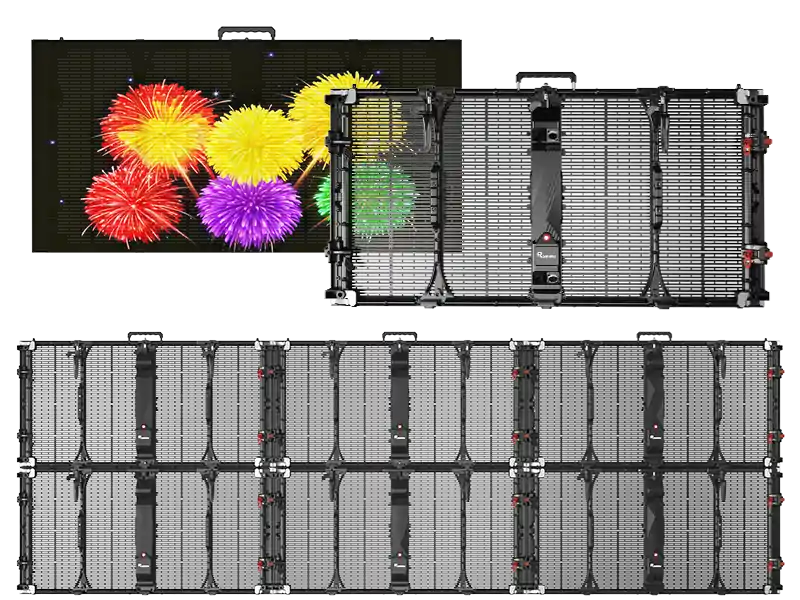
Mesh / Louver Cabinets: Feature integrated air gaps between horizontal LED strip bars, providing 30% to 50% wind transparency. This allows high winds to pass directly through the screen face, dramatically reducing the structural load and steel tonnage required for the support framework.
On an active outdoor installation site, technicians do not attempt micro-soldering while suspended on a lift. Instead, they quickly replace the entire malfunctioning module using a front-access extraction tool or rear thumbscrews, a process taking under three minutes. The damaged module is then brought to a clean indoor workbench. Using a specialized SMD hot-air rework station set to roughly 280°C, a trained technician desolders the defective diode, cleans the solder pads, deposits fresh solder paste, and mounts an authentic replacement diode from the factory’s matching component reel.