 English
You have three quotes on your desk for an LED video wall, the numbers are $980, $1,450 and $2,200 per square metre, and every single datasheet says basically the same thing. Same pixel pitch, same refresh rate, same "high brightness, long life, two-year warranty". Nobody explains the gap. One of the PDFs reads like it was translated twice and put back through a template. Another has a showroom video that could belong to anyone. And you are left wondering which of these people will still answer their phone fourteen months after installation, when a cabinet starts flickering and your boss is asking why the lobby screen looks like a cheap sign.
If you are searching for led display manufacturers in china right now and cannot tell whether you are comparing real products or just different levels of confidence, you are not alone. We get this question every week — from AV integrators fitting out hotel lobbies, from facility managers replacing a tired LCD video wall, from churches and universities, from retail chains rolling out ten stores at once, from rental companies who need cabinets light enough to load at two in the morning. The pattern is always the same. People spend weeks comparing pixel pitch numbers and almost no time checking whether the company quoting them actually runs the SMT line.
The honest answer is not a brand name. It is a method. The right manufacturer is the one that can prove, on a live video call and inside your purchase order, that it builds your exact cabinet, holds the certifications in its own name, and will lock the LED brand, driver IC and power supply so nothing gets quietly swapped once production starts. Everything else is presentation.
This piece is for people who have to sign off on a real screen. Not for people who want a list of names. Lists exist everywhere and half of them are three years out of date. What you actually need is a way to tell, in about an afternoon, who makes fine-pitch panels and who is reselling something they never touched.
Fine. By scale and export volume, the group that keeps showing up year after year is Leyard, Unilumin, Absen, Ledman, LianTronics, AOTO and Qiangli Jucai on the Chinese side; Samsung, LG, Sony, Barco, Daktronics and Planar on the international side. For a permanent installation in a space people care about — lobby, control room, broadcast studio, flagship retail — a Tier-1 Chinese brand or a verified mid-tier factory with locked components both work. The brand gets you the meeting. Calibration, spare parts and a local technician keep you out of trouble.
One thing worth saying plainly: "LED display manufacturer in China" covers everything from a listed company with thousands of employees down to a workshop renting two bays in Bao'an. Treating it as one category is how you end up comparing a production line with a WhatsApp account.
This is where most mistakes happen, and they happen before anyone talks about money. A supplier can be excellent at one of these and completely wrong for another.
SMD fine-pitch fixed install (P0.9 – P2.5). The standard workhorse. Front or rear service, decent brightness, mature supply chain. This is what goes into boardrooms, lobbies, control rooms and retail walls. It is designed to sit there and run.
COB / MIP micro-pitch (P0.4 – P1.2). LEDs encapsulated onto the board surface instead of standing up as individual packages. Much better protection against knocks, better contrast, easier to clean, handles close viewing well. Costs more upfront, fails less often in high-traffic spaces. We have come to prefer this for anywhere the public can reach the screen.
Outdoor cabinets (P2.5 – P10). Bright enough to fight the sun, sealed against rain, built to handle heat and thermal cycling. Here the enclosure, the sealing and the thermal design matter more than the pitch. An indoor panel put outdoors will not last a year, no matter what the datasheet claims.
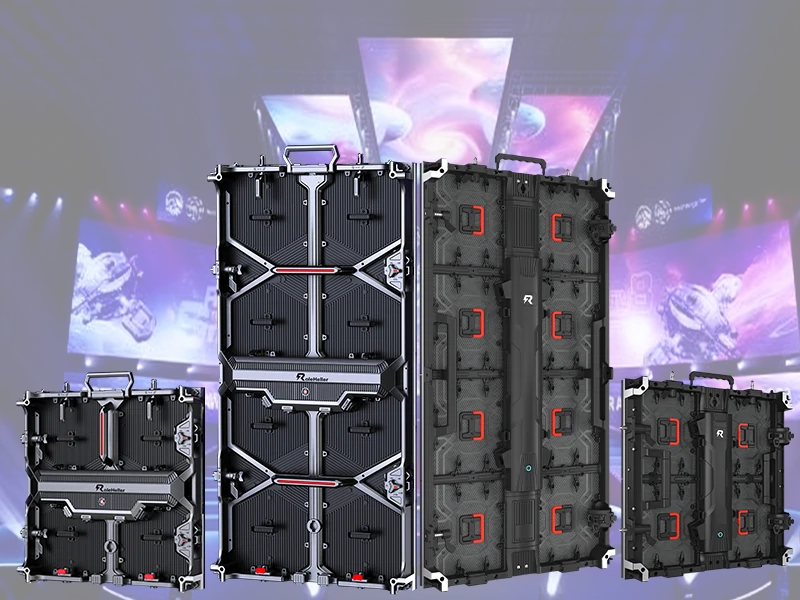
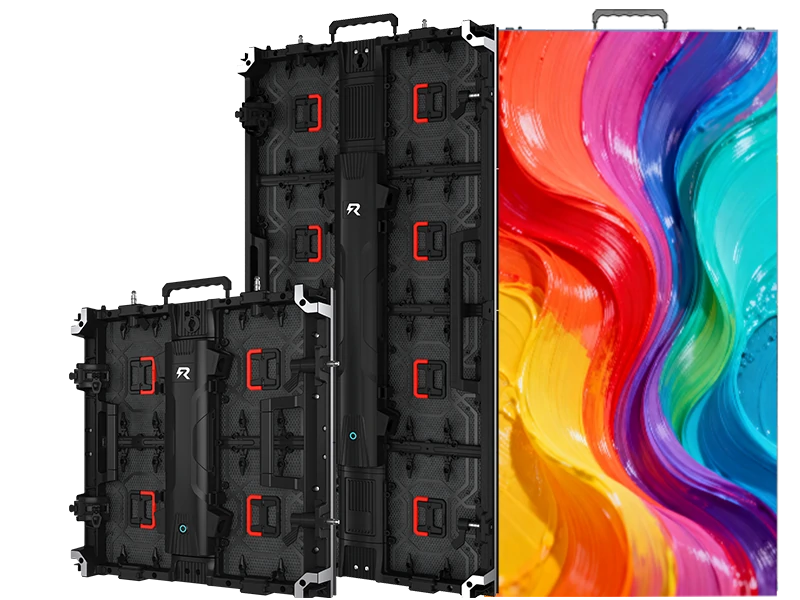
Rental / event cabinets (P1.9 – P3.9). Die-cast aluminium, lightweight, quick-lock, designed to be loaded and unloaded hundreds of times. Do not buy a fixed-install cabinet for a touring show. You will regret it by the third venue.
| Type | Where it wins | Where it struggles |
|---|---|---|
| SMD fine-pitch fixed | Cost-effective, mature, easy to source spares | Vulnerable to impact at close range, needs careful handling |
| COB / MIP micro-pitch | Knock resistance, contrast, close viewing, cleanability | Higher cost, longer lead time, fewer suppliers who do it well |
| Outdoor cabinets | Sun-readable, weather-resistant, long life | Heat management is critical, heavier, needs proper structure |
| Rental cabinets | Weight, speed of build, survives transport | Not optimised for 24/7 operation, shorter design life |
If a supplier does not ask what the room is used for and how close people stand, they are selling a spec sheet. Move on.
Rule of thumb we use without thinking: minimum comfortable viewing distance in metres is roughly the pitch number multiplied by one to one-and-a-half. A P1.5 reads cleanly from about two metres out. Stand closer than that and you are paying for resolution nobody can see. Spend that money on calibration and spares instead.
Two proposals can read identically and describe different hardware. Once you know where to look, the gap stops being mysterious.
| What looks the same on paper | What actually differs | Why it moves the price |
|---|---|---|
| Same pixel pitch | LED brand and bin grade | Top-bin Nationstar vs. a lower bin changes cost and colour consistency noticeably |
| Same cabinet size | PCB layer count and thickness | Thinner boards save money and fail faster under heat |
| Same refresh rate number | Driver IC and actual gray scale at low brightness | Cheap ICs band when the room dims or the camera rolls |
| Same brightness claim | Common-cathode vs. common-anode drive | Common-cathode costs more but cuts power and heat substantially |
| Same warranty length | Who pays parts, labour, freight, response time | A "three-year warranty" with no freight clause is worth much less |
| Same square metres | What is excluded | Structure, rigging, power distribution, content, commissioning arrive later as surprise invoices |
| Same controller spec | Receiving card count, licenses, spares included | Controllers scale with resolution; cheap quotes under-spec here |
Two traps seen too many times. Bare-screen pricing that grows later with accessory fees, processor licenses, calibration charges and commissioning costs. And component substitution — the sample arrives with top-bin LEDs and the production run quietly does not. Lock the exact component list into the purchase order with a clause saying any substitution requires written approval, and insist production units match the approved sample. Get that in writing, not across a dinner table.
This filter does more work than anything else on this page. Most buyers skip it because asking feels slightly awkward. Ask anyway.
Ask for these five things and time how long they take:
Business licence with manufacturing in the registered scope. Sales-only scope means reselling. Simple as that.
ISO 9001 certificate number, verified on the registrar's own website. Not the PDF they emailed — the actual lookup result.
A live video walk-through, today. Ask to see the SMT line, the aging racks, a cabinet being assembled, the warehouse. Ask them to hold up a handwritten note with your company name and today's date. Trading companies stumble here — not always because they are dishonest, but because there is no floor to show.
A component list by brand. LED (Nationstar, Kinglight, Cree), driver IC, power supply (Mean Well, Great Power), receiving card (Novastar, Colorlight), PCB layer count and thickness. Factories recite this. Traders go vague.
Test reports issued in their own company name. If the FCC or CE report lists a different entity, ask why. Rebranding and parent companies are legitimate reasons — but you want the reason in writing, not discovered at customs.
One more move we do not skip: check exhibition history. ISLE Shenzhen, InfoComm, ISE Barcelona, Dubai. Real LED display makers exhibit the same shows year after year. Booth records are harder to fake than a PDF.
If the order is large enough, visit in person. For an order of any size, a day in Shenzhen or Dongguan pays for itself. Bring a torch, look at the solder joints, look at the connector quality, ask to see a cabinet that has been sitting in the aging room for seventy-two hours. You learn fast what paperwork hides.
Define the room first. Viewing distance, ambient light, whether the screen will run twelve hours a day or twenty-four, and whether there will be children or crowds near it. This decides the pitch and the enclosure type. Everything else is detail.
Shortlist three suppliers using the factory-versus-trader filter above. Not ten. Three. Ten gives you analysis paralysis, three gives you a decision.
Demand itemised quotes with locked components. Same spec sheet sent to all three, so you are comparing like with like.
Verify one certification each yourself, and order one sample module or cabinet. One square metre teaches you more than twenty pages of marketing: colour consistency, dead pixels, cabinet fit, and — most telling — how fast they actually ship.
Only then negotiate. Leverage comes after you know what you are buying.
This takes three to four weeks. It removes most of the risk and costs almost nothing except a bit of patience.
United States: FCC Part 15 is mandatory — Class A for commercial and industrial, Class B if the screen lives anywhere near offices or residential. Without it, the container sits. UL is technically voluntary but functionally required for government tenders, many insurers and quite a few landlords; ETL is the common alternative. DOE and California Title 20 energy compliance apply in some categories, Prop 65 labelling may be needed. Confirm the lab's accreditation status and that the SDoC responsible party has a real US address.
EU and UK: CE covering LVD (EN 62368-1), EMC (EN 55032/55035) and RoHS, technical file kept at least ten years. UKCA for Great Britain. RED if wireless is built in.
Middle East: SASO/SABER for Saudi Arabia, plus venue-specific civil defence requirements.
Always ask for ISO 9001, ISO 14001, EMC Class B if the screen faces offices or homes, and a statement on low-blue-light or flicker if it is a broadcast or education environment.
Practical bit: ask for the report number and the issuing body, then look it up yourself. A scanned certificate with a fuzzy logo proves nothing except that someone owns a scanner.
Screens run for years. Power is the biggest ongoing cost, and it is almost never compared side by side.
Two screens, same size, same pitch. One common-anode, one common-cathode. The common-cathode design cuts power draw substantially — often quoted in the thirty to fifty percent range depending on content and brightness setting. At commercial electricity rates and long operating hours, that difference compounds into real money inside three years. Ask suppliers for measured consumption at a defined brightness and a defined test pattern, not the theoretical maximum. Maximum wattage is a marketing number. Average wattage is the number you pay.
Then there is dead pixel drift and colour shift over time. Ask for the stated annual failure rate and how it is measured. Ask what the spare parts strategy looks like after year three, when your original batch may be discontinued. This is where projects quietly become headaches.
And heat. Indoor screens in enclosed walls or recessed niches suffocate. Ask about derating curves and whether the design is fanless. Fanless matters more than you think — fans are the first thing to fail in a 24/7 install, and nobody wants dust being blown across a boardroom screen.
They will not do a live video call, or they keep rescheduling it.
The certification report names a different company and nobody can explain why.
"Any pitch, any brightness, any price." Real factories have limits and they state them.
Price well below the market band while component specs stay vague. Thin PCBs, underpowered supplies and generic receiving cards are where the money disappears.
Warranty says "two years" and says nothing about return freight, response time or who sends the technician.
Payment demanded fully upfront, or into a personal account.
Zero reference projects in your application category, or references that do not answer the phone.
No discussion of heat, access or content. A supplier who never mentions how the content will be managed is not thinking about your screen.
The sample took eight weeks and arrived with uneven cabinet alignment.
Is the cheapest option always wrong? Not always. But cheap with vague specs is a different product from cheap with locked specs. The unit price alone tells you nothing; the itemised quote tells you nearly everything.
Do I need a Tier-1 brand? If the screen is permanent, highly visible and someone important will stand under it, probably yes. If it is a temporary activation or a secondary wall, a verified mid-tier factory usually delivers the same result for less.
Can I trust a supplier I have never visited? Yes, if you run the five checks and order a sample. Physical visits help a lot, but a dated live walk-through plus certificate lookups catch most of the same problems.
Should I just pick the finest pitch available? No. Finer pitch costs more, runs hotter, draws more power and gains you nothing if nobody stands close enough to notice. Spend that budget on calibration, spares and a proper processor instead.
SMD or COB for indoor? High-traffic, close-viewing spaces where people might touch or bump the screen — COB. Standard boardrooms and walls where the audience stays back — SMD is fine and saves money. There is an overlap zone in the middle; that is where you pay for a sample.
What about brightness indoors? You need far less than you think. 600–1,500 nits covers most indoor spaces, and anything above that in a dim room just fatigues the audience. More important than peak brightness is uniformity, gray scale at low brightness, and an auto-dimming curve tied to a light sensor.
Who handles installation and commissioning? Your local integrator should. Confirm in writing before signing, because the supplier in Shenzhen will assume you did, and you will assume they did, and meanwhile the cabinets sit in a crate.
Should I start with a sample? Always. One module teaches you colour consistency, dead pixel rate, cabinet fit and how quickly they actually ship.
Is common-cathode worth the extra? Mostly yes. It costs more upfront but saves power, runs cooler and extends PSU life. Only accept it if the supplier gives measured consumption, not a theoretical figure.
What happens when a module fails five years from now? Ask now, not then. Will that module still be in production? Will the bin match? Will they ship a single module or insist on a minimum order? Projects become headaches here.
We have seen buyers chase the bottom quote and replace power supplies every eighteen months because nobody specified measured power draw. We have also seen buyers overpay for a logo that did nothing for them after handover. The gap between those two outcomes was rarely about the brand. It was about whether someone ran a checklist and wrote things down.
What lasts comes down to three things: component transparency you can verify yourself, test records that exist before you ask for them, and a warranty backed by an address that answers the phone. Get those right and the rest is detail.
If we had to start over with zero contacts and a real deadline, we would define the room, shortlist three suppliers with the factory-versus-trader filter, demand itemised quotes with locked components, verify one certification each ourselves, order one sample, and only then negotiate. Three to four weeks, roughly. It removes most of the risk and costs almost nothing except patience.
Last thing, and we say it because we wish someone had said it to us: do not skimp on the structural, electrical and content side of the install. The finest screen in the world looks wrong on a frame nobody calculated, and no warranty covers that. Get the rigging right, get the power distribution right, get the content designed for the actual viewing distance — the panel itself is the easy part.
1. Who are the main led display manufacturers in china? Leyard, Unilumin, Absen, Ledman, LianTronics, AOTO and Qiangli Jucai lead in China; Samsung, LG, Sony, Barco, Daktronics and Planar lead internationally. Biggest is not automatically best — match capability to your actual room and viewing distance.
2. Are Chinese LED display manufacturers reliable? The majority of the world's LED displays come from the Shenzhen, Dongguan and Huizhou clusters. Reliability varies by individual supplier and quality system, not by country. Audits, test reports and samples settle it.
3. What is the difference between a manufacturer and a supplier? A manufacturer runs the production line; a supplier may be a manufacturer, distributor or trading company. If you want direct pricing and control over components, insist on a manufacturer.
4. How do I verify a factory without travelling? Check the business licence scope, verify the ISO certificate on the registrar's site, run a dated live video walk-through, confirm report numbers with the issuing body and call a reference customer in your application category.
5. What certifications do I need for the US market? FCC Part 15 is mandatory; UL or ETL is often required in practice. DOE, California Title 20 and Prop 65 may apply depending on category. Verify lab accreditation under current rules.
6. What certifications do I need for Europe? CE covering LVD, EMC and RoHS, with a technical file kept at least ten years. UKCA for Great Britain. RED applies if wireless functions are included.
7. Which pixel pitch should I choose for indoor LED? Minimum viewing distance in metres ≈ pitch × 1 to 1.5. P0.9–P1.2 for very close viewing and broadcast, P1.5–P1.8 for boardrooms and lobbies, P2–P2.5 for larger halls and walls viewed from further back.
8. Should I choose SMD or COB for an indoor LED display? High-traffic, close-viewing spaces favour COB for knock resistance and cleanability; standard rooms where the audience stays back favour SMD for cost. Test a sample at actual viewing distance.
9. How bright should an indoor LED display be? 600–1,500 nits for most indoor environments, with auto-dimming tied to a light sensor. Uniformity and low-brightness gray scale matter far more than peak brightness.
10. What warranty should I expect on an LED display? Two to three years on key components is the norm. The detail that matters is who covers parts, labour, freight and on-site visits, what the response window is, and whether matching modules will still be available after year three. Get it in writing.
.jpg "Where to buy LED display panels?")
.jpg "Why P1.9 LED Video Walls Are in Such High Demand")
.jpg "Which China Indoor Outdoor LED Video Wall Manufacturers Can You Actually Trust for Quality and Delivery?")