English
If you've been researching wholesale GOB LED video wall manufacturers and feeling overwhelmed by the sheer number of options out there, you're definitely not alone. I've been in the LED display sourcing game for close to a decade now, and every time a new technology hits the market, the noise level goes through the roof. GOB (Glue-on-Board) technology is one of those innovations that's genuinely worth the hype, but separating the real manufacturers from the middlemen and fly-by-night operations takes some serious digging. Whether you're building an inventory for your rental business, outfitting a chain of retail locations, or deploying displays for a large-scale event production company, finding the right wholesale GOB LED video wall manufacturers is going to make or break your project's success and your bottom line.
Let me walk you through everything I've learned about this space, what to look for, what to avoid, and how to actually get the best value without cutting corners on quality.
Before we get into the sourcing part, let's make sure we're all on the same page about what GOB actually is. GOB stands for "Glue-on-Board," and it's essentially a protective packaging technology for LED display modules. Here's how it works in plain terms: after the LED lamp beads and components are soldered onto the PCB board, a layer of transparent, high-performance epoxy resin or silicone compound gets applied over the entire surface of the module. This creates a smooth, sealed protective layer that covers the LED chips, the solder joints, and the wiring.
Now, why does this matter? Because traditional SMD (Surface Mount Device) LED modules have exposed lamp beads sitting on top of the PCB. Those exposed beads are vulnerable to impact damage, moisture ingress, dust accumulation, and static discharge. In real-world deployment, especially in rental environments where panels get handled frequently, traditional SMD modules tend to accumulate dead pixels and damaged LEDs at a much higher rate. GOB technology essentially wraps all of those vulnerable components in a protective shell, which gives you:
Dramatically improved impact resistance — the resin layer absorbs bumps and knocks that would crack or dislodge exposed LED beads
Superior moisture and dust protection — the sealed surface prevents environmental contaminants from reaching the solder joints and LED chips
Easier cleaning and maintenance — the smooth, flat surface can be wiped clean without worrying about damaging individual LED beads
Better contrast ratios — the resin layer reduces light scattering and improves the black level performance, which makes the image look deeper and more vivid
Extended lifespan — by protecting the most vulnerable components from environmental stress, the overall display life gets significantly extended
I've personally seen GOB panels that were deployed at outdoor music festivals, got rained on, packed up, shipped to another venue, and kept running without a single dead pixel. Meanwhile, traditional SMD panels in the same conditions started showing damage within the first few events. That's the kind of real-world difference we're talking about.
I know a lot of buyers get confused between GOB and COB (Chip-on-Board) because both are advanced packaging technologies. Let me break down the key differences so you can make an informed decision:
| Feature | Traditional SMD | GOB (Glue-on-Board) | COB (Chip-on-Board) |
|---|---|---|---|
| LED Packaging | Individual LED beads soldered on PCB | SMD beads + protective resin layer | Bare LED chips directly bonded to PCB |
| Surface Protection | None (exposed beads) | Full resin encapsulation | Full epoxy/molding compound encapsulation |
| Impact Resistance | Low | High | Very High |
| Moisture Protection | Low (IP40 typical) | High (IP65 achievable) | Very High (IP65 standard) |
| Pixel Pitch Range | P1.2 to P10+ | P0.9 to P5.0 | P0.6 to P3.5 |
| Viewing Angle | 140°/120° | 170°/160° | 175°/170° |
| Cost per m² | Lowest | Mid-range | Highest |
| Repairability | Easy (module swap) | Moderate (module swap) | Difficult (chip-level) |
| Best For | Budget projects, large pitch | Rental, mid-fine pitch, harsh environments | Ultra-fine pitch, permanent installations |
The key takeaway here is that GOB gives you a sweet spot between cost and protection. It's not as expensive as COB, but it delivers significantly better durability than traditional SMD. For wholesale buyers who need panels that can survive the rigors of rental operations, transportation, and frequent assembly/disassembly, GOB is often the smartest choice.
This is where the real work begins. The wholesale GOB LED video wall manufacturers market is flooded with companies that claim to manufacture GOB panels but are actually just assembling components sourced from elsewhere. Here's how I separate the real manufacturers from the rest:
The GOB process requires specialized equipment for resin application, vacuum degassing, and precision curing. A genuine manufacturer will have dedicated GOB production lines on their factory floor. When you request a factory tour (even a live video call), you should be able to see:
Automated resin dispensing equipment
Vacuum degassing chambers (critical for eliminating air bubbles in the resin layer)
Precision curing ovens with controlled temperature and humidity
Clean room environments for the GOB lamination process
If a company can only show you a showroom or a generic assembly area, they're not doing the GOB process in-house.
Even if a company does the GOB lamination in-house, they still need to produce the base PCB modules first. Look for manufacturers that have their own SMT (Surface Mount Technology) lines with high-precision placement machines. This ensures they control the entire process from LED chip placement through to the final GOB encapsulation.
Quality GOB manufacturers run every panel through extended burn-in testing — typically 72 to 96 hours — after the GOB process is complete. This is because the resin curing process can sometimes introduce stress on the LED components, and any latent defects need to be caught before shipping. If a manufacturer doesn't have a dedicated aging room, that's a serious red flag.
For wholesale GOB LED video wall manufacturers serving international markets, I'd want to see at least 2,000 to 3,000 square meters of monthly GOB panel output. Anything below that threshold usually indicates a small workshop operation that may struggle with consistent quality across larger orders.
Here's something I've learned through years of dealing with manufacturers — the quality control program is where you really see the difference between a company that takes pride in their product and one that's just trying to push volume. The best wholesale GOB LED video wall manufacturers implement multi-stage QC checkpoints:
Incoming LED chip inspection — every batch of LED lamp beads gets tested for dominant wavelength (±1nm tolerance), luminous intensity uniformity, and forward voltage consistency
Post-SMT AOI (Automated Optical Inspection) — catches solder bridges, missing components, and misalignment before the GOB process
Pre-GOB visual inspection — verifies all modules are defect-free before the irreversible resin encapsulation step
Post-GOB inspection — checks for air bubbles, resin unevenness, surface contamination, and optical clarity
Extended burn-in testing — 72 to 96 hours of continuous operation at elevated temperature to catch latent failures
Final photometric calibration — cabinet-by-cabinet brightness and color temperature adjustment for uniform appearance
Here's a breakdown of what each QC stage catches:
| QC Stage | Primary Defects Caught | Impact If Missed |
|---|---|---|
| Incoming LED Inspection | Wavelength mismatch, intensity variation | Visible color inconsistency across the wall |
| Post-SMT AOI | Solder bridges, cold joints, missing components | Intermittent failures, dead pixels after deployment |
| Pre-GOB Inspection | Dead pixels, damaged beads | Permanent defects locked inside resin (unrepairable) |
| Post-GOB Inspection | Air bubbles, resin haze, surface defects | Reduced optical clarity, uneven light distribution |
| Extended Burn-in | Latent component failures | Field failures within first weeks of operation |
| Final Calibration | Brightness/color mismatch between cabinets | Visible seams and color banding in tiled displays |
The pre-GOB inspection step is absolutely critical and it's one that some manufacturers skip to save time. Once the resin is applied, any defect in the LED module gets permanently sealed inside. You can't replace a dead pixel in a GOB module the way you can with traditional SMD. That's why catching problems before the GOB step is non-negotiable.
Let's talk about pricing because this is where expectations need to be grounded. GOB panels cost more than traditional SMD panels due to the additional materials and processing steps, but they're significantly more affordable than COB panels. Here's what the wholesale market looks like right now for GOB LED video wall panels:
| Pixel Pitch | Price Range (USD/m²) | Typical Applications |
|---|---|---|
| P1.25 GOB | $1,400–$2,200 | Boardrooms, control rooms, broadcast studios |
| P1.56 GOB | $1,200–$1,800 | Conference rooms, high-end retail, museums |
| P1.87 GOB | $1,000–$1,500 | Corporate lobbies, event stages, houses of worship |
| P2.5 GOB | $800–$1,200 | Large venues, rental inventory, digital signage |
| P3.91 GOB | $600–$900 | Outdoor/indoor rental, large-scale events |
Important note: These prices typically include the GOB-protected LED modules pre-installed in die-cast aluminum cabinets with receiving cards and power supplies. They do NOT include video processors, sending boxes, mounting structures, signal cabling, flight cases, spare parts, or shipping. When budgeting a complete system, plan to add roughly 30% to 50% on top of the panel cost.
One thing I always tell buyers — if a quote comes in significantly below these ranges, something is being cut. It might be lower-grade LED chips, thinner resin layers, skipped aging tests, or non-branded power supplies. The cost savings upfront will almost always come back to haunt you in the form of higher failure rates and shorter panel lifespan.
I've seen a lot of buyers learn these lessons the expensive way, so let me share them upfront.
Here's something that doesn't get talked about enough — not all GOB processes are created equal. The quality of the resin material, the precision of the dispensing equipment, the effectiveness of the vacuum degassing, and the curing parameters all directly affect the final optical performance. Cheap GOB operations use low-quality resin that yellows over time, trapping air bubbles that create visible haziness, or curing at incorrect temperatures that introduces stress on the LED components.
When evaluating wholesale GOB LED video wall manufacturers, ask specifically about their resin material brand and type, their degassing process (vacuum chamber specs), and their curing profile (temperature, duration, humidity control). A manufacturer who can answer these questions in detail is one that actually understands the GOB process.
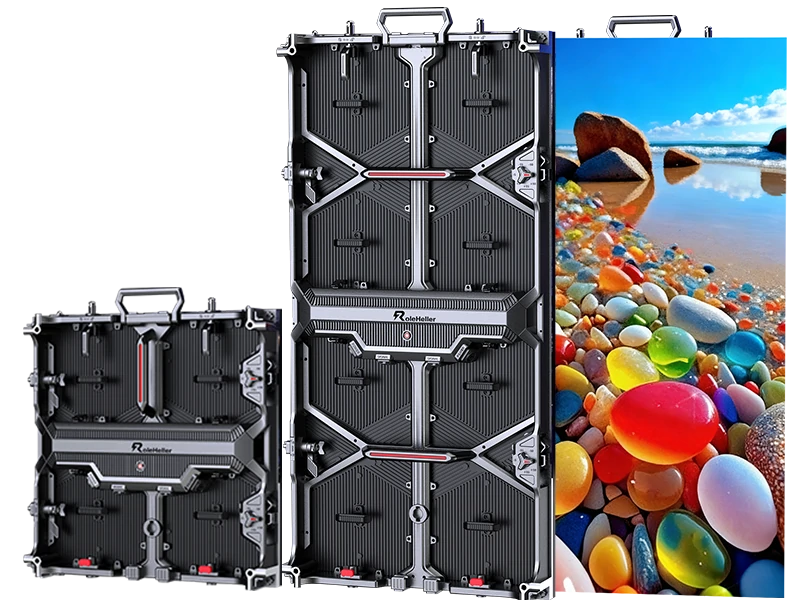
The GOB module is only half the equation. The cabinet it's housed in determines how well the panel performs in real-world deployment. For rental applications especially, you need die-cast aluminum cabinets with precise machining tolerances (±0.1mm), tool-free quick-lock mechanisms between cabinets, integrated rigging points with proper load ratings, front and rear serviceability, and adequate ventilation for thermal management.
I've seen GOB panels that were technically excellent get deployed in poorly designed cabinets, and the result was alignment issues, uneven seams, and overheating problems that negated all the benefits of the GOB technology.
This is a recommendation I give to every wholesale buyer — when you place your initial order, simultaneously order a spare parts package equal to 5% to 8% of your total panel quantity. For GOB panels specifically, this is even more important because individual module repair is more difficult than with traditional SMD. Your spare parts package should include extra GOB modules from the same production batch, spare power supplies, additional receiving cards, spare power and signal cables, extra locking pins and hardware, and spare cabinet rear covers and gaskets.
The major control platforms in the market are Novastar (most widely adopted globally), Colorlight (strong value proposition), and Brompton Tessera (premium broadcast and virtual production). Make sure the receiving card model specified in your quote matches your preferred control ecosystem. Mixing platforms is possible but adds unnecessary complexity.
The panel price is just the starting point. Here's what else needs to be factored into your total project budget when ordering from wholesale GOB LED video wall manufacturers:
Freight: For orders exceeding 10 square meters, sea freight (FCL) is the most economical option. A standard 20-foot container holds approximately 25 to 35 square meters of GOB LED panels in flight cases. Transit times run 15 to 25 days to the US West Coast, 25 to 35 days to European ports, and 7 to 14 days to Middle Eastern ports. Air freight delivers in 5 to 7 days but costs 4 to 6 times more.
Import Duties: LED display panels generally fall under HS code 8528.59. In the United States, standard duty is around 0% to 5%, but Section 301 tariffs on Chinese-origin products can add an additional 25%. In the EU, standard duty is approximately 1.4% plus VAT (which varies by member state, typically 19% to 27%). These rates shift periodically, so always verify with a licensed customs broker before finalizing your budget.
Flight Cases: For rental panels, proper flight cases are essential. GOB panels are slightly heavier than traditional SMD panels due to the resin layer, so make sure your flight cases are rated for the additional weight. A quality road case for a standard 500×500mm GOB cabinet typically costs $100 to $180 per case.
One thing I've learned from years of working in this space — the best deals, the most consistent quality, and the fastest response times all come from building genuine, long-term relationships with your manufacturing partners. When you become a repeat customer, several things change in your favor:
Priority production scheduling — your orders get moved ahead of one-time buyers, especially during peak season (Q3–Q4)
Consistent LED bin allocation — the manufacturer reserves matching LED bins for your repeat orders, which solves the color consistency problem between batches
Custom engineering support — once a factory understands your standard cabinet configurations and requirements, they can pre-engineer solutions that speed up your project timelines
Better payment terms — evolving from 100% upfront payment to 30% deposit / 70% before shipment, or even net-30 terms for well-established relationships
Dedicated account management — instead of dealing with rotating sales representatives, you get a single point of contact who knows your history and technical requirements
My suggestion for anyone starting out — begin with a trial order of 5 to 10 square meters. Use it to evaluate panel quality, communication responsiveness, documentation accuracy, and logistics reliability. Once you're confident in the manufacturer's capabilities, scale up to larger wholesale volumes with much more confidence.
From where I sit, the GOB LED video wall market is in a really interesting place right now. The technology has matured to the point where the quality gap between top-tier and mid-tier manufacturers is becoming more pronounced. You've got factories producing GOB panels that genuinely compete with COB in terms of durability and optical performance, but at a price point that's 30% to 40% more accessible. And then you've got operations that are doing a surface-level version of GOB that looks good on paper but doesn't deliver the real-world performance benefits.
The buyers who consistently do well are the ones who invest real time and effort into due diligence before placing orders. They visit factories or at minimum do thorough live video tours. They order samples and test them under actual operating conditions. They build relationships based on transparency and mutual accountability rather than simply chasing the lowest price per square meter.
If you're just starting to explore your options, I'd recommend shortlisting 3 to 5 wholesale GOB LED video wall manufacturers, getting sample cabinets from each, and doing a direct side-by-side comparison. Run them through your typical deployment scenarios. Subject them to the kind of handling and environmental conditions they'll face in real use. The quality differences become very obvious once you have actual panels in your hands. The extra time you invest upfront will pay for itself many times over in reduced field failures, longer panel lifespan, and fewer project emergencies.
Hope this guide helps you navigate the sourcing process with more confidence. The GOB technology is genuinely transformative for LED display durability, and with the right manufacturing partner, you can build an inventory that serves you well for years to come.
Most wholesale GOB LED video wall manufacturers set their minimum order at 5 to 10 square meters for wholesale pricing. Some will accommodate smaller trial orders of 2 to 3 square meters at a slightly higher per-unit cost. True volume wholesale pricing typically kicks in at the 20 square meter level and above.
GOB's resin encapsulation creates a seamless, waterproof barrier over the LED modules that achieves IP65 protection levels. The resin layer prevents moisture ingress, blocks dust particles, and protects solder joints from corrosion. This makes GOB panels significantly more reliable than traditional SMD panels in outdoor and harsh environments, with failure rates typically 60% to 70% lower.
Yes, but with an important caveat. Individual GOB modules can be swapped out in the field just like traditional SMD modules. However, individual LED bead repair within a GOB module is extremely difficult because the resin layer must be carefully removed and re-applied. For this reason, having spare modules on hand is more critical with GOB panels than with traditional SMD.
Well-manufactured GOB panels carry a rated lifespan of 80,000 to 100,000 hours, similar to high-quality SMD panels. However, the practical service life is often longer because the GOB protection significantly reduces the rate of field failures. In rental applications, GOB panels typically maintain their performance for 8 to 12 years before any significant degradation is observed.
High-quality GOB resin is optically clear with a light transmittance rate of 97% or higher, meaning virtually no brightness loss. Premium manufacturers use resin with a refractive index matched to the LED package, which actually improves light extraction efficiency. The result is that GOB panels often deliver equal or slightly better brightness compared to the same LEDs without GOB protection. Low-quality resin can yellow over time and reduce light output, which is why resin material quality matters.
GOB technology is available in pixel pitches ranging from P0.9 (ultra-fine pitch for close viewing) up to P5.0 (larger pitch for long-distance viewing). The most popular wholesale sizes are P1.25, P1.56, P1.87, P2.5, and P3.91. P1.25 to P1.87 are ideal for indoor fine-pitch applications, while P2.5 to P3.91 work well for both indoor and outdoor rental scenarios.
Request detailed information about their resin material (brand, type, optical properties), vacuum degassing equipment specifications, curing oven parameters (temperature profile, duration, humidity control), and clean room classification for the GOB lamination area. Ask for cross-section photos of their GOB modules showing resin thickness uniformity and absence of air bubbles. A confident manufacturer will provide all of this documentation without hesitation.
GOB panels are typically 15% to 25% heavier than equivalent traditional SMD panels due to the additional resin layer. For a standard 500×500mm cabinet, this translates to roughly 1 to 2 kg additional weight. This is an important factor for rigging calculations and flight case specifications, so make sure your structural planning accounts for the added weight.
Standard GOB panels with rigid resin layers are not suitable for tight-radius curved installations because the cured resin cannot flex without cracking. However, some manufacturers offer flexible GOB variants using specialized silicone-based compounds that allow bending to radii of 500mm or greater. If you need curved installations, specifically request flexible GOB products and verify the minimum bend radius with the manufacturer.
At minimum, look for CE (European conformity), FCC (US electromagnetic compatibility), RoHS (restriction of hazardous substances), and IP65 rating test reports. For North American installations, ETL or UL listing is often required by local building codes. For event and rental applications, fire safety certifications for the cabinet materials and resin compound may also be required. Always verify certifications independently through the issuing body's official database rather than accepting PDF copies at face value.