English
You are sourcing led display screen rental manufacturers because someone in your company said you should own your own gear instead of paying hire fees every month, and now you have a browser full of tabs that all look the same. Same blue render of a stage wall, same promises — factory direct, OEM welcome, best price, MOQ negotiable — and eight different people claiming to be the factory for the exact same cabinet. You send five enquiries on a Tuesday morning and by lunchtime you have eleven replies, three of them quoting P2.6 at prices that cannot possibly include the flight cases. Nobody is lying outright. It is just that the word "manufacturer" does heavy lifting in this trade, and most buyers only find out what it actually covered after the deposit has cleared and the first wall arrives with a latch that does not quite sit flat.
The short answer, before anything else: buying direct from a maker usually saves money if you run screens more than roughly twelve to fifteen show days a year, and the saving comes from cutting out the local house margin plus the repeated rental markup. But the saving only survives if you treat the first order as a test, not a commitment, and if you specify rental-grade hardware rather than accepting fixed-install stock at a rental price. That second point is where most people lose the plot. A cabinet built for a lobby wall that never moves will survive exactly one tour if you put it on a truck every week.
Below is how I would do it if it were my money, which it has been, more than once.
There are three kinds of companies answering your email and they all look like factories online.
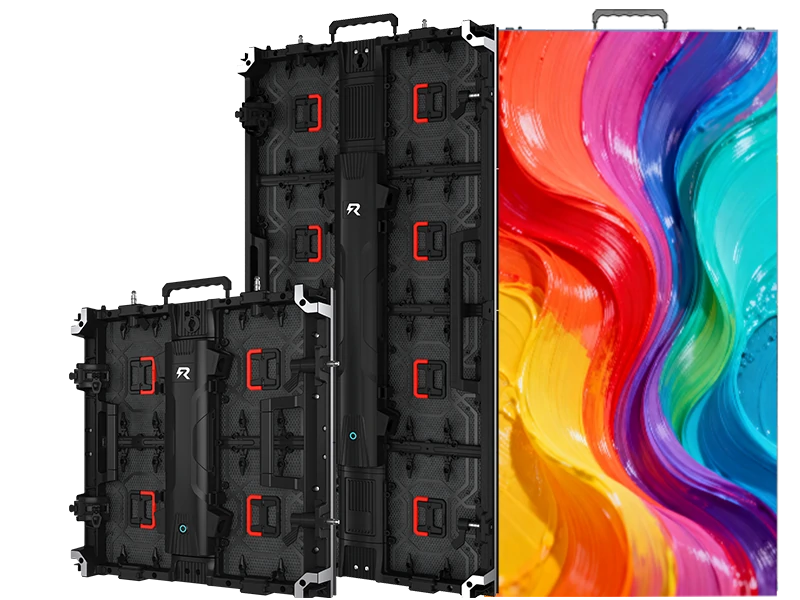
The actual manufacturer runs SMT lines, owns the die-cast cabinet tooling, has an aging room where panels burn in for hours, and can change a lock position or a cable route if your volume justifies a tooling conversation. They want pallets, not one wall. Their lead times are genuine and they do not chase single-quote shoppers.
The assembler buys modules, cabinets, power supplies and sending cards from other people, puts them together, flashes a config file and ships. Nothing dishonest here by default. Plenty of decent rental stock comes out of these shops and for odd sizes they are often more flexible than the big fabs. But their margin sits on top of someone else's margin, and when a batch of modules starts failing fourteen months later they are making a phone call to the same supplier you could have called yourself.
The trader with borrowed photos. Polished site, answers within the hour, quotes fast, quotes low, ships from wherever. Ask a specific technical question — say what refresh rate their P2.6 runs at native, or whether calibration data survives a field module swap — and the reply comes back a day later using slightly different wording than your question used.
One filter I use, takes thirty seconds: ask what refresh rate their standard P3.9 runs at, and whether the cabinet is front-serviceable with magnetic modules. A real person answers inside a minute because they have had that argument before. Someone who must "confirm with engineer" on basic mechanicals is probably not standing next to the production line.
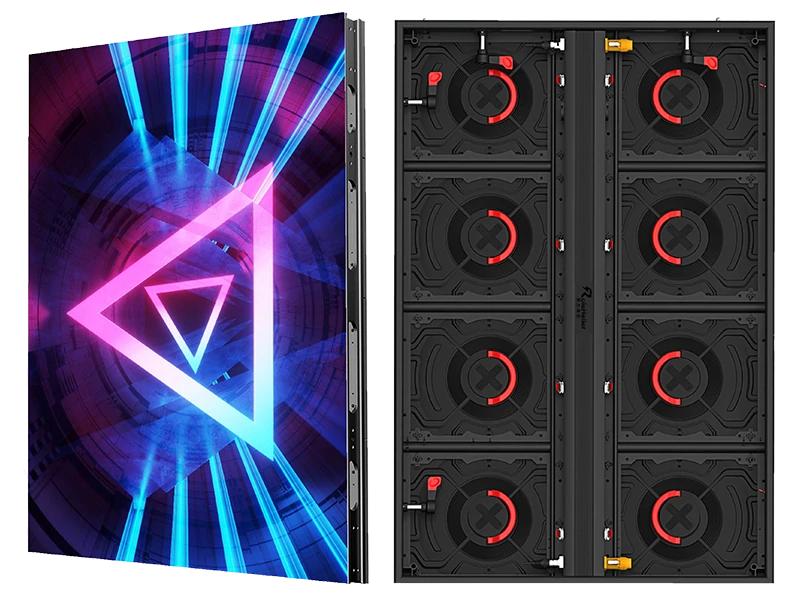
This is where quotes diverge and buyers get confused, because a P2.6 built for a permanent lobby wall and a P2.6 built for rental look identical in a product photo. Not the same thing, and the price gap is not a discount, it is a downgrade.
| Feature | Rental-grade indoor | Fixed-install indoor |
|---|---|---|
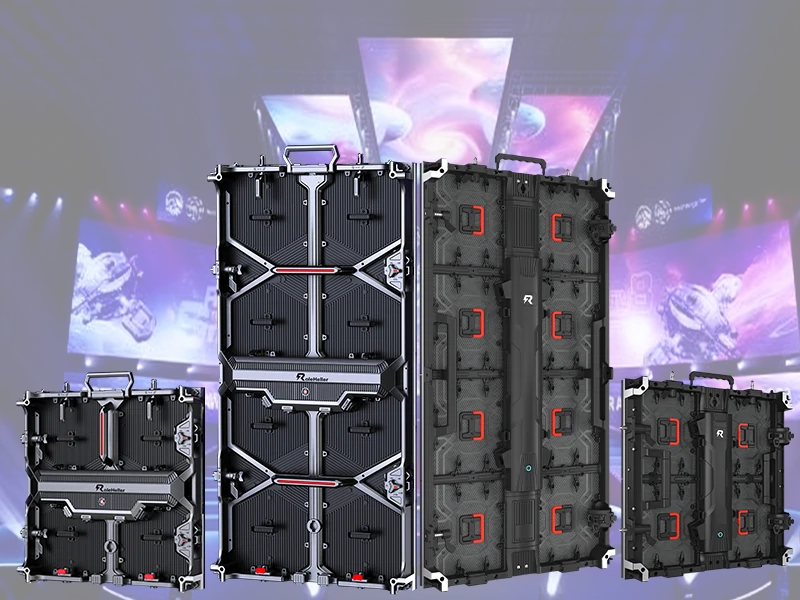
| Cabinet | Die-cast aluminium or carbon fibre, quick-lock, tool-free service | Often sheet metal or simpler aluminium, screwed assembly |
| Weight | As light as possible — faster build, lower rigging load | Weight barely matters |
| Module service | Front-access, magnetic or quick-release, swap in under a minute | Rear access usually fine |
| Flatness tolerance | Tighter, seams show on camera across repeated builds | More forgiving |
| Spare parts | Bundles supplied — modules, power supplies, cables, cards | Minimal |
| Refresh rate | Higher, priority for camera work | Can be lower |
| Price per m² | Higher | Lower |
If a factory quotes you a rental screen at a fixed-install price, something got lost in translation. Either the cabinet is not really rental-grade, or they did not understand what you need. Both problems are fixable, but only if you catch them before the deposit clears. Ask for cabinet weight and flatness tolerance in writing. Numbers do not lie the way adjectives do.
I keep a short list. Takes about ten minutes to send, tells you more than any brochure.
Pitch and canvas. Confirm pixel pitch, cabinet dimensions — 500×500 mm and 500×1000 mm are the standard — and the exact pixel count of the canvas you plan to build. Then ask whether their standard processor can drive that resolution without downscaling. This catches more problems than you would think.
Brightness and uniformity. Indoor rental typically lands between 600 and 1,500 nits. Ask for the measured value and the uniformity figure. ≥97% brightness uniformity is a reasonable ask. Peak brightness is easy to claim. Uniformity is harder to fake.
Refresh rate and gray scale. If anyone films this, you want 3,840 Hz or higher and 14–16 bit gray scale. Below that you get scan lines in footage and banding in gradients. Do not accept ">1920Hz" as an answer.
Calibration. Ask whether panels are calibrated per module at the factory, and whether the calibration data travels with the module after a field replacement. This separates a screen that still looks consistent in year three from one that develops patchy colour by the second tour.
IP rating. Indoors you are usually fine with IP20–IP43. But if your show uses haze, fog or confetti, push for IP54. People forget this until a haze machine kills a batch of panels.
Paperwork. CE, RoHS, UL where relevant — and ask for actual test reports, not just logos on a datasheet. Also insurance documentation if your venue requires it. A logo without a report is decoration.
One detail that surprises people new to this: even the good factories buy most of their components in.
LED packages come from a handful of large suppliers. This is the single biggest driver of colour consistency and long-term brightness decay. Ask which brand and which bin range. Bin matching matters more than the brand name.
Driver ICs are sourced separately. This is what controls refresh rate and gray scale.
Power supplies are third-party — Mean Well and equivalents. A cheap power supply is the most common cause of mid-show failure, and also the easiest place for a factory to save twelve dollars.
Sending and receiving cards — Novastar, Colorlight, Linsn. Bought in, sometimes rebranded.
Die-cast cabinets — this is where the factory's own tooling actually lives. Flatness, lock mechanism, weight, corner durability. This is the part you physically build with, and it ages faster than the electronics.
So the useful question is not "do you make everything." It is which parts do you control, which do you source, and who do you source them from. A supplier who answers that openly is usually worth a longer conversation. One who dodges it is telling you something too, just not in words.
Per-square-metre pricing for rental-grade indoor panels moves with pitch, and the jump from P3.9 to P2.6 is not linear — it feels more like a cliff. On top of the panel cost you need to count the processor and sending cards, flight cases, spare parts kit, freight, duties, and the technician who actually knows how to make it work.
Here is where the trap sits. A quote that comes in thirty percent under the others has almost always left out one of three things: the video processor, the flight cases, or the spares. Sometimes all three. Ask for a line-item breakdown and compare line by line, not total by total. It is boring work and it saves real money.
Also worth saying: total cost of ownership on a rental screen is driven less by the purchase price and more by how many times you can rebuild it before the cabinets go out of flat. That is why cabinet quality deserves more attention than it gets. People obsess over pixel pitch and then wonder why the wall looks tired after eighteen months. A cabinet drifting half a millimetre out of alignment turns a flawless backdrop into a grid of hairline gaps, and no amount of fineness in the pitch fixes that.
For buyers here, there is another layer. Freight into Hong Kong is not the expensive part by itself. The expensive part is getting a forty-foot container off the road at a venue with a loading bay designed for a delivery van, and then finding somewhere dry to store six flight cases between jobs. If you do not have storage, owning screens is a worse deal than the spreadsheet says. Humidity does not care how good the factory was.
Remote buying is normal in this trade. So is getting it wrong. A few checks that actually move the needle.
Ask for a live video call on the factory floor, not a recorded video. Ask them to walk to the aging room and show you a running wall with today's date visible somewhere in frame. Recorded videos get recycled between companies. A live call does not. If they cannot do a live call during their working hours, that is information, not an inconvenience.
Order a sample cabinet before you commit to a wall. Yes, it costs money. Yes, shipping a single cabinet is awkward. But holding it in your hands tells you about weight, lock feel, edge alignment and service access in a way no PDF can. Put two sample cabinets side by side from two different suppliers and the difference becomes obvious inside thirty seconds. You feel it in the latch before you see it on the screen.
Check the references that are not on their website. Anyone can list three happy clients. Ask for a customer who bought eighteen months ago and has been using the screens weekly since. Then actually call them and ask what has broken. The answer to "what has broken" is far more useful than the answer to "are you happy."
Start small. First order one wall, run it on real jobs, see how it behaves when it gets dropped, rained on in the loading bay, and rebuilt at two in the morning. Then scale. The suppliers who survive that test are the ones worth building a relationship with. Patience here is cheaper than courage.
Wholesale implies volume, but thresholds vary wildly. Some factories will do a single wall at a wholesale-adjacent price if the pitch and cabinet are standard stock. Others will not talk seriously unless you are committing to multiple walls or an annual forecast. Be upfront about which one you are, because wasting three weeks of negotiation on a mismatch helps nobody.
Payment terms matter as much as price. A 30% deposit with 70% against a copy of the bill of lading is standard and reasonably balanced. Anything demanding 100% upfront is a red flag regardless of how professional the website looks. Also insist on a pre-shipment inspection window — either your own agent visiting the factory, or at minimum a live video call showing your exact serial-numbered cabinets running your own test content. Factories that have nothing to hide do not object to this.
Lead times: standard configurations typically four to eight weeks plus shipping. Custom pitch, custom cabinet size, or anything involving new tooling pushes that out considerably. And if you are ordering near a major holiday period in China, add time — ports close, factories shut down, and your project does not care. Plan around Chinese New Year and Golden Week the way you plan around your own show dates, because a missed window costs more than the discount you were chasing.
Q: Is buying direct from a Chinese factory actually cheaper?
A: Usually yes, often by twenty to thirty-five percent on the hardware. But that saving comes with responsibility shifting onto you: quality control, spare parts strategy, warranty claims, and technical support. If you run screens fewer than ten to fifteen days a year, the saving may not be worth the hassle. Above that, it starts to make sense.
Q: Should I buy or keep renting?
A: The math is mostly about utilisation. Fewer than ten to fifteen show days a year, renting locally is almost certainly cheaper once you count storage, transport, calibration, firmware and the person who knows how to fix it. Above that, ownership starts to make sense — provided you have somewhere dry to store it and a technician available when something fails on a Friday night. The hidden cost people forget is the technician. Screens do not run themselves.
Q: Can I mix new panels with the ones I already own?
A: Sometimes, and do not assume yes. Even the same pitch from the same factory shifts colour over a couple of years as the LEDs age. New modules next to old ones will show a patch. Practical answer: buy enough extra from the original batch to cover future expansion, and keep them in storage. Future-you will be grateful.
Q: Realistic lead time?
A: For standard configurations, figure four to eight weeks plus shipping. Custom specifications push that out. Ordering near a major Chinese holiday period adds more time.
Q: Local partner or go fully direct?
A: Direct gives better pricing and clearer technical answers. A local partner gives someone who shows up when a panel dies the morning of the show. There is a genuine trade-off. What some buyers do, and it works reasonably well, is buy hardware direct and contract a local AV company separately for installation and on-site support. Keep the price advantage and keep a body on site. Just make sure the local team is comfortable with the control system you bought.
Q: Warranties, really?
A: Read the actual warranty text, not the headline number. Key details: whether spare parts are included or billed, who pays return freight, whether labour is covered, and whether it transfers if you resell. A three-year warranty that requires shipping failed modules back at your own cost is worth considerably less than a one-year warranty with a local spare pool.
Q: What about duties and shipping?
A: Budget for freight, import duty, and customs brokerage separately. These are rarely included in a factory quote and they are not small. Ask for DDP terms if you want a single number, or get a freight forwarder involved early so the surprise arrives before you sign, not after.
Ordering the finest pitch available because it sounds impressive. Pitch should follow viewing distance and content, not ambition. If the front row is eight metres back, nobody can tell the difference between P2.6 and P3.9, but your budget certainly can. Spend that money on more square metres instead. Bigger almost always beats sharper in a live room.
Designing content after ordering the screen. Do it the other way around. Decide the canvas, then design to its native resolution. Putting a 1920×1080 video onto a panoramic canvas is how you end up with letterboxing on a very expensive setup.
Skipping the spare parts conversation. Modules fail. Power supplies fail. Cables definitely fail. Order a spares kit at the same time as the wall. Cheap insurance, and the only kind that pays out the same day.
Assuming brightness is the only number that matters. Uniformity, gray scale and viewing angle do more for perceived image quality than another two hundred nits ever will.
Forgetting rigging and power until delivery week. Every square metre carries weight and draws current. Check your venue's load limits and available amperage before you sign. Peak draw is notably higher than average draw — size circuits for peak.
Buying once and expecting to expand later without planning. Colour matching between new and aged panels is not guaranteed. Buy extra from the original batch and store it properly.
The best outcome in this category rarely comes from finding the absolute cheapest factory. It comes from finding a supplier who answers the phone at inconvenient times and ships a replacement module without arguing. Rental screens get abused. They get loaded in the rain, bumped by forklifts, rebuilt by tired crews at odd hours. You are not buying a static product, you are buying a long-term arrangement with a company that needs to still exist and still care three years from now.
That is why I lean toward starting with a modest order, running it hard for a season, and then deciding. Costs a bit more upfront, prevents a lot of expensive disappointment. And if you can, go see the factory. Not because you need to inspect the SMT line personally, but because the conversation you have standing next to a running wall is qualitatively different from the one you have over email. People behave differently when they know you have seen where the thing comes from.
If you run an event company and plan to deploy screens regularly, buying direct from a competent manufacturer makes sense and the payback is real. If you are a brand or organiser doing a handful of shows a year, rent from a house that owns its gear and employs its own technicians, and spend your energy on the content instead. The screen is only as good as what you put on it, and great content on a mediocre wall beats perfect hardware with lazy graphics every single time.
1. What does an LED display screen rental manufacturer do?
They design and build rental-grade LED panels, cabinets and flight cases in volume, supplying event companies, AV houses and distributors. Most are based in Guangdong province, particularly Shenzhen and Dongguan.
2. What is the difference between rental-grade and fixed-install LED screens?
Rental-grade uses lightweight die-cast cabinets with quick locks and front service access, higher refresh rates and bundled spares. Fixed-install uses heavier, simpler cabinets where weight and speed of build do not matter.
3. What pixel pitch should I choose for indoor rental?
P2.6 to P3.9 covers most indoor event work. Choose finer pitch when the front row is within four metres or the screen will be filmed. Beyond eight metres, P3.9 delivers comparable sharpness at lower cost.
4. What refresh rate is needed for camera work?
Specify 3,840 Hz or higher with 14–16 bit gray scale for any filmed or livestreamed application. Reject vague answers such as ">1920Hz."
5. What should be included in a quote?
Panels, video processor and sending cards, flight cases, spare parts kit, rigging or ground support, plus a line-item breakdown. Freight, duty and customs brokerage are usually quoted separately.
6. Are spare parts important?
Yes. Order a spares kit with your initial purchase — extra modules, power supplies, receiving cards and cables. Module and power supply failures are routine in rental use.
7. How do I know if a supplier is a real factory?
Request a live video call showing the production floor and aging room with today's date visible, ask technical questions requiring immediate answers, order a sample cabinet, and speak to a customer who has used their screens for over a year.
8. What certifications should I ask for?
CE, RoHS and UL listings appropriate to your market, plus actual test reports rather than logos on a datasheet. Also request insurance documentation if your venue requires it.
9. How long does production take?
Standard configurations typically require four to eight weeks plus shipping. Custom specifications or orders placed near major Chinese holidays require additional lead time.
10. Should I buy or keep renting?
Fewer than ten to fifteen show days per year generally favours renting. Frequent use favours ownership, provided you have storage, transport and technical support in place.
.jpg "China Outdoor LED Video Wall Panel Manufacturers | Price")