English

Have you ever stood in the middle of an exhibition hall or festival backstage at midnight, watching your crew hoist a twelve-meter video wall, only to find three panels glitching into bright red vertical stripes right before the morning dress rehearsal? Finding trustworthy china led video wall rental display manufacturers feels like a high-stakes gamble when every single supplier on the web claims to own a top-tier factory in Shenzhen, promises Grade-A diodes, and swears their cabinets align with zero seams.
When you run an audio-visual staging company, an event production house, or a commercial equipment rental fleet in North America or Europe, a slick promotional brochure means absolutely nothing. What actually matters is whether those cabinets can endure being slammed into flight cases at 3:00 AM by exhausted roadies, hauled over hundreds of miles in damp trailers, rigged in thirty-minute load-in windows, and powered up night after night without dropping a single data packet.
Let's be brutally practical about how rental video gear gets handled on tour. Unlike fixed architectural displays that stay bolted securely inside climate-controlled corporate headquarters, rental hardware operates in an open warzone. If your purchasing team chooses a supplier based on an invoice that looked forty dollars cheaper per square meter, that modest upfront discount disappears the first weekend you are forced to pay an emergency client rebate because a power supply tripped mid-keynote. Some friends want the lowest upfront price, but what should you do when maintenance costs start piling up? Let's look down together and walk through the mechanical physics, component silicon, factory inspection standards, and contracting rules you need to secure a rental fleet that earns steady profit for years.
When we are deploying mobile LED walls for corporate conventions, touring concerts, sporting arenas, or outdoor music festivals, the mechanical and electrical demands are merciless. The hardware does not fail from peaceful operation; it fails from physical impact, thermal shock, and rapid handling cycles.
Touring gear is exposed to repeated physical abuse:
Constant Mechanical Shocks: Fast-locking pins get hammered shut, cabinets get dropped an inch onto hard stage decks, and panels bump against aluminum box trusses during rapid hoisting. If the cabinet edges lack protective corner-flip shields, edge-mounted surface diodes get sheared clean off the circuit board during teardown.
Severe Thermal Cycles: An outdoor festival screen might bake under direct sunlight in 40°C afternoon heat, generating intense internal thermal loads, only to experience an abrupt drop to 15°C at midnight with heavy dew settling across the frame.
Harsh Atmospheric Infiltration: Stage pyrotechnics, glycol-based theatrical haze, spilled beverages, and fine festival dust settle across internal power distribution lines. If the internal circuit boards lack thick conformal coating and water-resistant signal connectors, micro-shorts trigger intermittent data dropouts that are impossible to isolate during a live show.
Rapid Assembly Stress: Staging crews work against strict union load-in deadlines. If cabinet fast-locks require excessive muscle, seize up with road grit, or force technicians to hunt for alignment pins in dim stage lighting, labor hours skyrocket and stress builds on the crew.
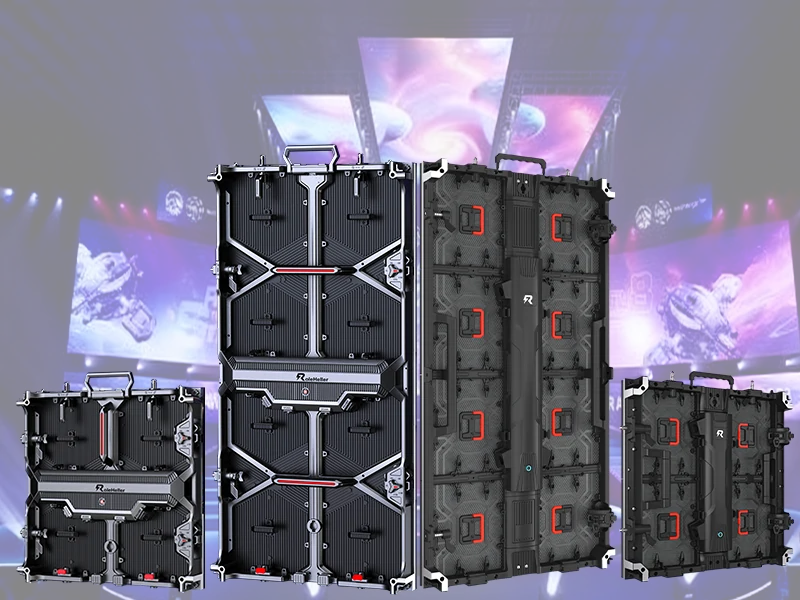
The primary difference between a disposable budget screen and a commercial rental panel lies in the metallurgy and machining of the cabinet chassis. Fixed-installation screens often use inexpensive sheet metal or rough casting frames, but mobile rental cabinets demand ultra-lightweight, high-tensile alloys.
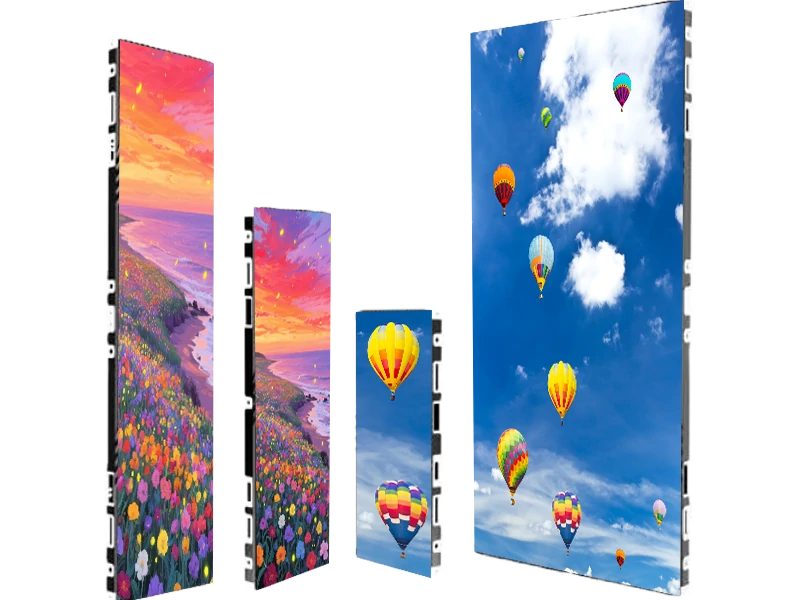
A standard rental panel comes in either a 500 mm × 500 mm format or a 500 mm × 1000 mm format. When you evaluate chassis construction, examine the material specifications:
Die-Cast Magnesium Alloy: This is the gold standard for tour-grade rigging. Magnesium alloy panels weigh between 6.5 kg and 7.2 kg per 500 × 500 mm frame. Shaving two kilograms off each panel means you can hang significantly more screen area from standard single-point motors before hitting the structural trim height or truss weight limits of the venue.
Die-Cast Aluminum Alloy: Highly durable, thermally stable, and cost-effective, weighing roughly 7.5 kg to 8.5 kg per 500 × 500 mm cabinet. It handles rough handling well, though the extra weight adds up on large arena builds.
5-Axis CNC Precision Finishing: Molten alloy shrinks unevenly when pulled from casting dies, leaving deviations of 0.2 mm to 0.4 mm. Premium manufacturers place every cast blank into a multi-axis computer numerical control (CNC) milling center to mill down the mating surfaces, locator pin sockets, and module mounting faces to a strict tolerance of ±0.03 mm.
Look closely at the mechanical fast-locks. A technician should be able to slide panel B against panel A and throw a single, ergonomic vertical latch with one hand, feeling a mechanical click as internal steel cam-gears lock the frames into sub-millimeter alignment. Low-tier workshops cut costs by substituting cheap zinc alloy castings for internal locking cams; after twenty shows, the softer metal rounds off, leaving ugly gaps and uneven seams between cabinets that ruin high-resolution video content.
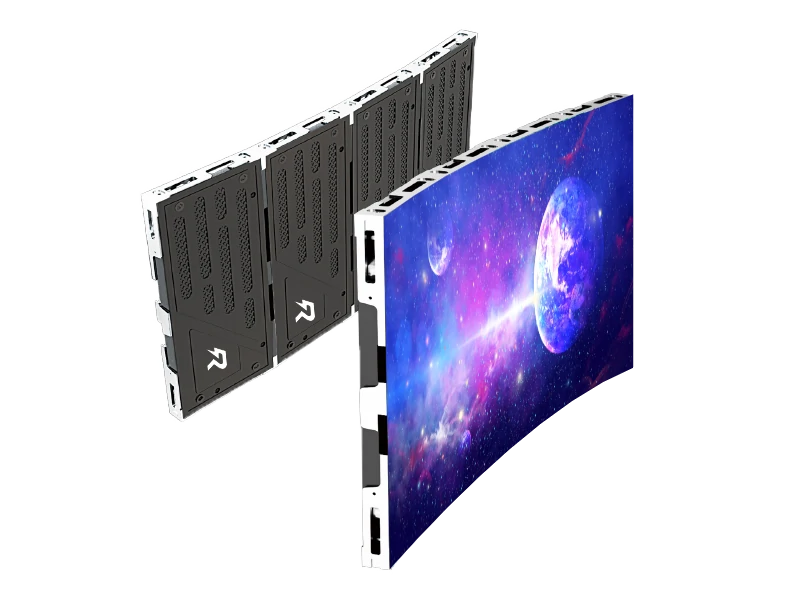
Modern stage designers rarely settle for a simple flat rectangular backdrop. They want smooth concave curves wrapping around DJ booths, convex visual ribbons tracing curved truss arches, or cylindrical 90-degree corner pillars.
When evaluating china led video wall rental display manufacturers, inspect the curving lock mechanisms built into their cabinet side profiles. Budget models rely on clumsy interchangeable wedge plates that must be screwed in with hand tools—a slow process that leads to lost parts in flight cases. In contrast, advanced rental frames feature integrated rotational disc angle locks calibrated from -10 degrees (concave) to +10 degrees (convex) in precise 2.5-degree steps.
When you adjust the curving dial to 5 degrees, the internal gears must seat with rigid locking strength. If there is mechanical play in the curve mechanism, the weight of a thirty-foot hanging drop will pull the center of the wall out of alignment, creating optical seam distortion and stressing the electrical connectors between cabinets.
Selecting the appropriate pixel pitch for your rental fleet is a critical commercial decision. Finer pixel pitch yields stunning close-up resolution, but it costs significantly more, demands delicate handling, and requires larger video processing systems.
Pixel Pitch P1.95 mm: Optimal for corporate executive presentations, luxury indoor brand launches, broadcast studio backgrounds, and close-up trade show booths where viewers stand within two meters (six feet) of the screen. Because SMD diodes at P1.95 are microscopic, you must specify GOB (Glue-On-Board) surface shielding; otherwise, corner diode damage will destroy your rental margins.
Pixel Pitch P2.6 mm: The universal workhorse for high-end indoor rental fleets worldwide. It delivers sharp image clarity at three meters (ten feet), accommodates standard Full HD and 4K video canvas layouts effortlessly, maintains excellent physical durability, and commands the highest rental utilization rates across corporate meetings and galas.
Pixel Pitch P2.97 mm: The versatile crossover pitch. Often manufactured in dual-rated indoor/outdoor cabinets with 3,500 to 4,500 nits of brightness. Ideal for large ballroom events, esports tournaments, and shaded outdoor festival stages where audience viewing begins at four meters (thirteen feet).
Pixel Pitch P3.91 mm to P4.81 mm: The undisputed industry benchmark for large-scale outdoor concert tours, sports fan zones, and wide-area outdoor festivals. Operates between 5,000 and 6,500 nits to punch through direct midday sunlight, built with heavy-duty weatherproofing, and offers exceptional physical resilience during fast festival turnarounds.
When you inspect modular display tiles from overseas factories, how the semiconductor dies are shielded on the printed circuit board determines your ongoing repair costs.
In standard SMD modules, miniature plastic-cased LED packages are soldered directly onto the copper pads of the circuit board. While SMD delivers high viewing angles and uniform color blending, it is vulnerable to lateral physical impact. If an audio-visual technician bumps the corner of a tile against a flight case extrusion or drops a screwdriver across the module face, dozens of delicate solder joints fracture immediately. Repairing SMD modules requires microscopic hot-air desoldering tools and highly trained bench technicians, leading to lingering backlogs of damaged tiles in your repair depot.
To solve the chronic vulnerability of rental gear, leading manufacturers have adopted GOB technology for fine-pitch rental lines. After the SMD diodes undergo reflow soldering and automated optical testing, a precision robotic dispensing system floods the entire front face of the module with an optically clear, matte-finish polyurethane or epoxy resin.
This transparent shield provides four massive advantages on tour:
Complete Impact Resistance: You can strike the module face with a firm hand or brush it against a stage truss without dislodging a single diode.
Moisture and Liquid Ingress Sealing: Beverage splashes, humid condensation, and cleaning fluids cannot penetrate to the live electrical pins.
Dust and Haze Protection: Oily atmospheric residue from theatrical haze machines wipes right off the flat optical face with a damp cloth, eliminating the tedious work of vacuuming dust out of traditional plastic louver masks.
Anti-Static Protection: The cured polymer face prevents electrostatic discharge (ESD) shocks from transferring from human hands to the semiconductor dies in dry winter convention halls.
| Performance & Engineering Metric | Cut-Rate Budget Rental Panel | Professional Mid-Tier Rental | Tour-Grade Enterprise Rental |
|---|---|---|---|
| Average Wholesale Price (P2.6 mm) | $420 – $550 per m² | $750 – $950 per m² | $1,200 – $1,800+ per m² |
| Chassis Metallurgy | Standard Die-Cast Aluminum | Lightweight Magnesium-Aluminum | CNC-Milled High-Tensile Magnesium |
| Cabinet Weight (500×500 mm) | 8.8 kg – 9.8 kg (Heavy) | 7.2 kg – 7.8 kg | 6.2 kg – 6.8 kg (Ultra-Light) |
| Surface Diode Protection | Bare SMD, weak plastic corners | SMD with fold-out corner tabs | Optical GOB Shield + auto-flip locks |
| Driver IC & Refresh Capability | Basic dual-latch, 1,920 Hz | Chipone ICN2053, 3,840 Hz | Macroblock MBI5359, 7,680 Hz |
| Low-Brightness Grayscale (at 15%) | 10-bit (Visible color banding) | 14-bit (Acceptable gradients) | 16-bit Pure Linear Grayscale |
| Curving Mechanism | Screw-in fixed plates (Clumsy) | Rotary disc locks (-5° to +5°) | Precision disc gears (-10° to +10°) |
| Power Distribution Architecture | Traditional 5V, noisy fans | Common Anode with passive cooling | Common Cathode, fanless, PFC > 0.95 |
| Data & Power Connectors | Low-cost plastic twist-locks | Seetronic IP65 connectors | Authentic Neutrik PowerCON True1 |
| Processing Card Platform | Generic unbranded cards | NovaStar A5s Plus / Colorlight | NovaStar Armor A10s Pro / Brompton |
| Spare Parts Inclusions | 1% loose modules, mixed bins | 3% spare modules, matched bin | 5% single-bin spares + fly bars & cases |
| Annual Pixel Failure Rate on Tour | Over 45 PPM (Frequent repairs) | Under 12 PPM (Manageable) | Under 2 PPM (Virtually zero) |
Have you ever looked through a professional broadcast camera or smartphone lens at a digital stage backdrop and seen dark, rolling scan lines running up the screen? That visual defect will instantly prompt complaints from corporate event clients, videographers, and broadcast directors.
The issue stems from cheap driver integrated circuits (ICs) operating at low pulse-width modulation (PWM) refresh frequencies. Budget panels run baseline driver chips clocked at 1,920 Hz. When a broadcast camera shoots at high shutter speeds (such as 1/125th or 1/250th of a second) to capture moving dancers or keynote speakers, the camera sensor records the off-cycles of the LED switching, creating black rolling bars and jittery horizontal banding.
When evaluating china led video wall rental display manufacturers, you must mandate constant-current driver ICs with integrated PWM control, such as the Macroblock MBI5153 / MBI5359 or the Chipone ICN2053 / ICN2069. These advanced chips deliver true refresh rates of 3,840 Hz to 7,680 Hz, completely eliminating rolling scan lines even under high-speed digital film cameras.
Furthermore, pay close attention to low-brightness grayscale performance. In corporate staging, the display rarely runs at 100% brightness. Inside a darkened hotel ballroom, operating an LED wall at 1,200 nits will blind the audience and ruin stage lighting. Technicians pull the master brightness down to 15% or 20%.
On inferior screens, dropping the brightness crushes the grayscale depth:
Smooth background gradients posterize into harsh, stair-stepped stripes.
Delicate company logos display jagged edge artifacts.
Dark shadows in presentation graphics turn into solid black blocks.
The screen develops an unwanted reddish or greenish tint across uniform grey backgrounds.
Top-tier driver ICs maintain full 16-bit grayscale depth even when dimmed down to 10% operating power, ensuring that visual content retains buttery-smooth transitions and accurate color saturation.
Heat is the sworn enemy of digital electronics on the road. Inside a packed convention center or an outdoor staging truss, an LED video wall drawing dozens of kilowatts radiates enormous heat.
Most budget rental displays use traditional Common Anode power distribution. In this layout, a single 5V electrical rail feeds the Red, Green, and Blue semiconductor dies simultaneously.
Here is the engineering mismatch:
The Red diode die requires an operating forward voltage of only 1.8V to 2.1V.
The Green and Blue dies require 2.8V to 3.2V.
In a Common Anode circuit, that extra 3.0V of potential pumped into the Red diode is not converted into light—it dissipates directly into the cabinet as pure heat!
Modern touring hardware utilizes Common Cathode architecture. The power supply splits its output into independent circuits: a dedicated 2.8V rail powers the Green and Blue diodes, while a separate 1.8V rail feeds the Red diode.
This architectural improvement yields three direct operational benefits:
Power Draw Drops: Total electrical consumption falls by 25% to 40%, allowing you to run more cabinets on a single 20-amp power drop or smaller generator.
Cabinets Run Cooler: Internal cabinet operating temperatures drop by 10°C to 15°C, eliminating noisy cooling fans and prolonging component life.
Reduced Color Drift: Because the Red diodes do not suffer from chronic thermal overdriving, the screen avoids the premature red-channel lumen decay that turns older displays sickly yellow-green over time.
When sourcing wholesale rental displays, amateur buyers make the mistake of focusing entirely on the cabinet price while ignoring the ancillary touring accessories. An LED panel cannot float in the air by itself, and poor support hardware will eat away your profit margins.
Stage environments are rough. Power and data cables get stepped on, run over by flight cases, and yanked out of line by stagehands. Cheap PVC-jacketed cables turn stiff in cold weather and crack along their stress collars.
Specify authentic Neutrik PowerCON True1 or IP65-rated Seetronic power connectors. Unlike older blue-and-grey twist-locks, True1 connectors can be connected and disconnected under electrical load without arcing.
Data jumper cables must feature gold-plated pins, heavy rubber strain relief boots, and locking etherCON shells to prevent data loss when cables sway in crosswinds.
Overhead hanging hardware must be accompanied by certified engineering documentation. Never purchase generic steel fly bars that lack stamped Working Load Limit (WLL) ratings.
Inspect the hanging hardware: look for certified high-tensile 6061-T6 aluminum extrusion fly bars fitted with rated Crosby lifting shackles and dual-point hoist rings.
If your company works in corporate hotel ballrooms where ceiling rigging is prohibited, verify that the manufacturer provides a robust ground-stacking base system. The ground-stack baseplates must incorporate leveling jacks, heavy-duty rear ladder trusses, and outrigger pipes that anchor counterweight sandbags securely to prevent audience crowd surges from tipping the wall forward.
Many overseas exporters ship panels in flimsy 7 mm plywood cases lined with soft foam to save on ocean freight weight. After two months of interstate trucking, those cheap boxes splinter, the foam padding compresses flat, and cabinet frames start colliding inside the truck.
Insist on professional 9 mm to 12 mm birch plywood flight cases built with heavy-duty Penn Elcom hardware:
Deep caster dishes on the lid to allow secure, non-slip stacking in warehouses and cargo trailers.
Heavy-duty, 4-inch blue polyurethane swivel casters with dual pedal brakes, rated for at least 400 kg gross working loads.
CNC-milled high-density EVA foam inserts contoured to fit the exact profile of the cabinet, preventing magnetic modules from shifting during transit.
Standard 8-in-1 configurations for 500 × 500 mm panels or 6-in-1 setups for 500 × 1000 mm panels to optimize standard truck pack dimensions (matching the 96-inch or 2.4-meter internal width of standard freight trailers).
The physical LED cabinet is only half the system; the signal processing platform controls image quality and live workflow flexibility. In the commercial rental market, two ecosystems dominate:
NovaStar is the industry workhorse, powering over 85% of standard commercial rental screens globally.
Standard Cards & Controllers: NovaStar A5s Plus or A8s receiving cards; VX-series all-in-one processors (such as VX600 or VX1000) for standard events; and the enterprise COEX series (MX40 Pro controllers paired with Armor A10s Pro cards) for high-end corporate staging.
Advantages: Highly cost-effective, supported by freelance video technicians worldwide, features rapid cloud configuration, and handles versatile inputs cleanly. For corporate meetings, festivals, and general party rentals, NovaStar is the smart financial choice.
Brompton (utilizing Tessera R2 or R2+ receiving cards paired with Tessera SX40 or S8 processors) is the undisputed gold standard for enterprise concert touring, broadcast television, and virtual production (XR) film stages.
Unmatched Processing: Delivers pristine low-brightness color reproduction, sub-pixel edge smoothing, frame-rate multiplication up to 240 Hz, and multi-camera frame remapping.
Premium Cost: Brompton processing commands a heavy price tag—often adding $15,000 to $35,000 to a mid-sized video wall setup. Unless you are cross-renting your inventory to film studios, high-end touring acts, or national broadcast productions, Brompton is an over-investment for routine event staging.
The Component-Only Safety Certification Scam: A sales representative emails a slick certificate bearing a recognized UL or CE testing mark. When you verify the certificate registration numbers, you discover that only the internal power supply carries a component-level UL recognized mark (UR). The completed video cabinet—including high-speed driver circuit boards, internal power wiring, and chassis fire ratings—was never evaluated as an integrated electrical appliance by an accredited laboratory. If local municipal electrical inspectors red-tag your stage before a show, the screen stays dark and you face steep municipal penalties.
Mixed Diode Binning (The Patchwork Quilt): During semiconductor wafer manufacturing, LED dies naturally show minor variances in color wavelength, forward voltage, and luminous intensity. Tier-1 manufacturers purchase tightly sorted single-bin diode lots to build an entire customer order. Budget workshops cut costs by purchasing surplus bins left over from multiple production runs. On dynamic music video loops, the screen looks passable; but the moment your corporate client opens a uniform white PowerPoint slide or a corporate blue background, the display reveals ugly blotches and color shading like a mismatched quilt.
Fragile Corner Protection Designs: During rapid load-out at 2:00 AM, roadies pull locking latches fast and slide panels onto flight case guide rails. On cheap cabinets, the corner LEDs take the brunt of every impact. If the manufacturer uses static, screw-on plastic corner guards, technicians remove them during assembly to eliminate visual gaps and forget to screw them back on during teardown. Demand automated, spring-loaded flip-out corner protectors: when the cabinet is unlatched from its neighbor, a mechanical corner shield automatically snaps over the outer diodes, shielding them from transit bumps.
Undersized Internal DC Power Wiring: To save on raw copper, shady assemblers use thin 18-gauge internal DC wire harnesses operating near their thermal limit. This creates a severe voltage drop from the bottom power supply box to the upper modules. Upper tiles end up noticeably dimmer, and the hot wires pose an outright fire hazard inside closed cabinets during summer outdoor heat waves.
False Outdoor Waterproof (IP65) Claims: Many suppliers slap an "Outdoor IP65" sticker on standard indoor rental panels that merely have an extra bead of rubber around the rear door. A true outdoor rental cabinet requires fully potted waterproof modules, silicone-sealed driver compartments, breathable membrane balance vents (such as Gore-Tex vents) to prevent internal pressure condensation, and IP65-rated Seetronic or Neutrik power connectors with sealing rubber caps.
Weak Zinc Alloy Fast-Lock Cams: To shave manufacturing costs, workshops substitute cheap zinc alloy castings for the internal locking gears inside the fast-locks. After a dozen shows, the soft metal teeth round off, creating play between panels. You will see visible black seam lines across the video wall that no software calibration can fix. Always mandate hardened steel locking pins and internal heat-treated steel cam gears.
The Vanishing Batch Replacement Problem: You purchase a 50-square-meter rental wall, and the supplier includes two extra loose modules in bubble wrap. Two years later, a forklift puncture damages six panels. You contact the factory to order replacements, only to be told that the driver IC model is obsolete, the PCB layout has been revised, or the diode bin is long gone. Without batch-matched spares, new replacement modules will stand out like sore thumbs against your existing screen.
Before paying your initial deposit, ensure your commercial proforma invoice lists exact, non-substitutable manufacturer part numbers. Never accept vague terms like "High Quality Nationstar LED." Write:
LED Diodes: Nationstar 2020 Black Shell, Gold Wire bonding, Single Wafer Binning Lot.
Driver ICs: Macroblock MBI5359 with integrated PWM, supporting minimum 3,840 Hz refresh at full 16-bit grayscale.
Power Supply Units: Fanless Common-Cathode 2.8V/1.8V supplies with active PFC > 0.95 (Mean Well UHP series or Megmeet equivalent).
Controller System: NovaStar Armor A10s Pro receiving cards supporting 22-bit+ ClearView processing.
Cabinet Frame: 500×500 mm 5-axis CNC-machined die-cast magnesium alloy, integrated corner guards, rotary curve locks (-10° to +10°).
Electronics follow the classic bathtub failure curve: manufacturing flaws in silicon dies or solder joints will manifest within the first 48 hours of thermal and electrical stress. Require the factory to assemble your complete screen order onto testing frames and run an uninterrupted 72-hour test run:
24 hours of continuous 100% full-raster white screen to max out the power rails and stress thermal dissipation.
24 hours of alternating primary Red, Green, Blue, and White raster screens to identify dead sub-pixels, dim diodes, and chromatic drift.
24 hours of high-frame-rate dynamic video content with aggressive strobe cues to test receiving card and power supply stability.
The factory must supply an unedited, continuous video walkthrough of your specific screen order on the test floor, clearly showing your purchase order number, company name, and a running digital clock in front of the active wall.
During the full-white burn-in test, have a technician or independent inspector walk the back of the cabinets with a calibrated thermal imaging camera (such as a Fluke or FLIR unit). On an adequately engineered common-cathode cabinet, the thermal spread should be remarkably even, with no single driver IC, power terminal, or transformer spiking above 65°C in a 25°C ambient room. If the thermal scan reveals isolated hot spots exceeding 75°C, the PCB copper traces are undersized and will suffer premature trace degradation.
Demand that the factory assemble a 4×4 cabinet test section pulled at random from your crated batch. Test the seam tolerances across all junctions with a precision feeler gauge: seam gaps between cabinets must measure less than 0.05 mm across every joint. Then, have a technician demonstrate module extraction using the standard front-service magnetic or vacuum tool: each tile must decouple cleanly within ten seconds without binding against adjacent frames or flexing the PCB substrate.
Ensure your contract mandates a minimum 5% batch-matched spare parts kit: fully assembled and calibrated display modules, spare power supplies, pre-configured receiving cards, replacement flat ribbon signal cables, internal DC power jumper cables, extra rubber gaskets, and fifty spare fast-lock cam pins. All spare modules must be drawn from the exact same diode wafer lot and calibrated to the primary screen.
Answer: For a versatile commercial rental inventory, always specify dual-service (front and rear) cabinets. Rear-service is completely fine when your screen is suspended from a box truss in the center of an arena with open catwalk access behind the frame. However, rental staging often takes place in hotel ballrooms where screens are pushed flush against perimeter banquet walls, recessed into decorative stage alcoves, or integrated into custom wooden corporate sets. In those flush-mount setups, accessing the back of the cabinet is physically impossible. With dual-service panels, a technician can use a magnetic extraction tool to pop out a malfunctioning module or pull the central power/processing box directly from the front face in under twenty seconds, without having to unbolt the entire hanging structure.
Answer: Absolutely, and doing so is one of the most effective strategies for maximizing staging efficiency. The 500×1000 mm panels allow your crew to erect massive flat walls in half the time because each cabinet covers twice the surface area with half the locking points. Meanwhile, the 500×500 mm panels provide the modular flexibility needed to build staggered creative shapes, banner ribbons, or intricate curved sections. The critical prerequisite is ensuring that the manufacturer builds both cabinet sizes with identical die-cast frame depths, identical fast-lock centerlines, identical magnetic module pin placements, and most importantly, identical diode wafer lots and calibration files.
Answer: Look for modern rental cabinets that feature integrated internal pass-through routing and blind-mating connectors. Rather than having loose AC power cables and network patch cords dangling behind every single panel, advanced touring systems utilize combined multi-conductor power/data cables running from central breakout distribution boxes. In these systems, one primary heavy-duty drop feeds four to six cabinets vertically in a daisy chain. This clean cabling reduces load-in time by 40%, minimizes snag hazards for moving stage trusses, and presents a tidy appearance on open corporate stages.
Having spent years troubleshooting touring video walls, resolving overseas factory discrepancies, and watching staging companies burn through working capital on fragile hardware, here is my direct advice: never buy rental LED panels from an export trading agency that operates out of a generic commercial office tower without a physical assembly factory. Trading brokers will promise you the world, mark up prices by twenty to thirty percent, and vanish the moment a major batch defect requires component-level factory replacement. Work directly with established, dedicated manufacturing fabricators located in recognized industrial hubs like Shenzhen's Bao'an district (such as Shiyan or Fuyong) or Huizhou that own automated SMT lines, nitrogen reflow ovens, and cleanroom encapsulation facilities.
When structuring your payment terms, adhere strictly to international commercial conventions: a 30% deposit to initiate raw material procurement and automated SMT production, with the remaining 70% balance payable only after an independent third-party inspection agency (such as SGS, QIMA, or a trusted local engineering representative) verifies your completed screen operating on the factory burn-in floor. Never wire the final balance based on staged photos or prerecorded videos. That small third-party inspection fee is the cheapest insurance policy your business will ever buy.
Finally, treat the video processor as the vital core of your system. Pairing a high-end P2.6 rental wall with a cut-rate video processor or cheap unbranded power supplies is like putting low-grade budget fuel into a high-performance sports car. Standardize on proven processing ecosystems like NovaStar COEX or Colorlight enterprise processors, ensure your electrical distribution utilizes multi-stage surge protection devices, and specify fanless common-cathode power supplies.
Working directly with legitimate, engineering-driven china led video wall rental display manufacturers takes more preparation, technical diligence, and strict contracting upfront than buying off-the-shelf catalog gear. But when your commercial rental wall hoists smoothly into the air, survives five consecutive touring seasons without a single dark pixel, and earns praise from road crews and corporate clients alike, that upfront discipline pays dividends for years to come.