English
You've probably found yourself in this exact spot — staring at a long list of LED video display wall manufacturers, each one promising the best panels at the best price, and you're genuinely stuck trying to figure out who actually delivers on their claims. I get it. Sourcing LED video display wall panels is one of those purchases where making the wrong call can cost you thousands in replacement panels, recalibration headaches, and project delays that nobody budgeted for. Whether you're building out a corporate boardroom display, setting up a broadcast studio backdrop, or rolling out digital signage across multiple retail locations, connecting with the right LED video display wall manufacturers is the foundation everything else gets built on.
I've been on the procurement side of this industry for quite a while now, and I've worked with factories ranging from massive vertically integrated operations to small assembly shops that outsource everything. The quality gap between them is enormous — and it's not always obvious from a spec sheet or a marketing brochure. What I'm going to share here is the kind of practical, field-tested guidance that actually helps you make a smarter sourcing decision. Let's get into it.
Before we dig into how to evaluate manufacturers, it helps to understand what sets LED video display walls apart from single-panel digital signage or projection-based solutions. This context matters because it directly shapes which manufacturers have the right capabilities for your project.
LED video display walls are modular by nature — you're tiling multiple cabinets together to create one large, seamless image surface. This introduces challenges that single-display products simply don't face:
Cabinet-to-cabinet color uniformity — when you're joining 20, 50, or 100+ cabinets side by side, even slight color temperature variations between units become immediately visible to viewers
Physical alignment precision — cabinet edges need to mate within fractions of a millimeter, otherwise you get visible seams or gaps that destroy the seamless illusion
Scalable signal distribution — the video processing chain needs to handle massive pixel counts while maintaining frame synchronization across every cabinet in the wall
Thermal management at scale — more cabinets means more cumulative heat output, and poorly managed thermals accelerate LED degradation and color shift over time
When you're evaluating LED video display wall manufacturers, these engineering challenges become your baseline for separating serious operations from companies that are really just assembling purchased parts.
This is where the rubber meets the road. I've refined my evaluation approach over years of sourcing, and it consistently helps separate manufacturers who can deliver from those who can't.
The first thing I look at is how much of the production process the company actually controls in-house. There's a meaningful difference between a factory that owns its SMT lines and one that buys pre-assembled modules from third parties:
Own SMT (Surface Mount Technology) production lines — this is where LED lamp beads and driver ICs get soldered onto PCB boards. In-house SMT means direct control over solder paste quality, component placement accuracy, and reflow temperature profiles
Dedicated aging test facilities — quality manufacturers run every panel through 48 to 72 hours of continuous burn-in at elevated temperatures before shipping. This catches early-failure components that would otherwise become dead pixels or color anomalies in the field
Monthly production capacity — for LED video display wall manufacturers serving international markets, I'd want to see at least 2,500 to 4,000 square meters of monthly output. Below that threshold, you're often dealing with a workshop rather than a scalable factory
In-house R&D and customization capability — the ability to modify cabinet dimensions, adjust brightness levels, or integrate specific control system requirements based on your project specs
I always ask for live video footage of the production floor during initial evaluation. If a supplier hesitates or can only provide polished marketing renders, that tells me something about their transparency.
Here's something I've learned the hard way — not all quality control programs are created equal. Some manufacturers run a quick visual inspection at the end of the line and call it QC. Others implement rigorous multi-stage testing that catches issues at every production phase. The best LED video display wall manufacturers I've worked with implement these checkpoints:
Incoming material inspection — every batch of LED lamp beads gets tested for dominant wavelength, luminous intensity, and forward voltage before entering production
Post-SMT automated optical inspection (AOI) — catches solder bridges, missing components, and misaligned parts immediately after the SMT process
Module-level aging — individual modules run for 24 hours before cabinet assembly to identify early failures at the component level
Full-cabinet burn-in — assembled cabinets run for another 48 to 72 hours with content cycling through various color temperatures and brightness levels
Final calibration and uniformity correction — brightness and color get adjusted cabinet-by-cabinet to ensure visual consistency across the entire batch
| QC Stage | What Gets Tested | Why It Matters |
|---|---|---|
| Incoming Material | LED wavelength, brightness bin, driver IC specs | Prevents batch-to-batch color variation |
| Post-SMT AOI | Solder joints, component placement, electrical shorts | Catches manufacturing defects before they propagate |
| Module Aging | Dead pixels, color shift, brightness uniformity | Identifies early-failure LED beads |
| Cabinet Burn-in | Full-system performance under sustained load | Reveals power supply and receiver card issues |
| Final Calibration | Color temperature, brightness matching across cabinets | Ensures seamless visual appearance when tiled |
For any deployment in regulated markets, certifications are not optional — they're your legal and safety baseline. Here's what I verify:
CE marking — required for European Union market access, covers electrical safety and electromagnetic compatibility directives
FCC Part 15 Class B — mandatory for United States installations, ensures electromagnetic emissions stay within acceptable limits for commercial environments
ETL or UL listing — often required by North American building codes and commercial insurance policies; don't skip this one
RoHS compliance — confirms the product is free from restricted hazardous substances
ISO 9001 — indicates the manufacturer operates under a documented quality management system with auditable processes
I always verify certificate numbers directly on the issuing body's official database. It takes five minutes and has saved me from non-compliant product more times than I can count.
Let's talk numbers, because this is where confusion runs rampant and where buyers get burned the most. LED video display wall pricing varies dramatically based on pixel pitch, order volume, component quality, and whether you're buying direct from a manufacturer or through a trading company adding their margin on top.
Here's a realistic wholesale pricing breakdown:
| Pixel Pitch | Price per m² (USD) | Typical Application |
|---|---|---|
| P1.2–P1.5 | $1,000–$2,200 | Boardrooms, control rooms, close viewing |
| P1.8–P2.5 | $700–$1,400 | Conference rooms, retail, lobbies |
| P2.6–P3.9 | $450–$900 | Large venues, stage backdrops, rental |
| P4.0–P6.0 | $300–$600 | Auditoriums, houses of worship, large signage |
A critical note on what these prices include: The figures above typically cover LED display cabinets with modules, receiving cards, and power supplies pre-installed. They do NOT include video processors, mounting structures, signal cabling, spare parts packages, or shipping costs. When you're budgeting a complete deployed system, plan to add roughly 35% to 55% on top of the panel-only cost.
I've watched buyers get excited about a quote that looks 30% cheaper than competitors, only to discover later that the lower price covered bare modules without cabinets or power supplies. Always confirm in writing exactly what's included in any quoted price — this is one of the most common traps in LED display sourcing.
When you're ready to send a Request for Quotation to LED video display wall manufacturers, having a precise specification sheet makes all the difference. Here's what your spec sheet should explicitly address:
Pixel pitch — confirm the actual measured pitch, not just the model number designation
Pixel configuration — SMD is standard for indoor; confirm LED package size (SMD1010, SMD1515, SMD2020)
Cabinet dimensions — common sizes include 500×500mm, 480×480mm, 600×337.5mm (16:9 ratio)
Cabinet material — die-cast aluminum for precision and heat dissipation; stamped steel as a budget option
Brightness — 600 to 1,000 nits for standard indoor; 1,500+ nits for high-ambient environments
Refresh rate — 3840Hz minimum for camera-friendly applications; 1920Hz may work for static signage
Gray scale — 14 to 16 bit for smooth color gradation
Contrast ratio — 5000:1 or higher for rich image reproduction
Most panels ship with receiving cards pre-installed. The major ecosystems include Novastar (most widely adopted globally), Colorlight (strong value proposition), Brompton Tessera (premium broadcast choice), and Megapixel VR (virtual production specialist). Make sure the receiving card model in your quote matches your preferred control system.
Let me share some hard-won lessons. These are the mistakes I see buyers make over and over when sourcing from LED video display wall manufacturers.
This is probably the single most common — and most expensive — complaint. You order panels for your installation, they look great. Eight months later you need to expand, and the new batch has a visible color temperature difference next to the original panels.
Here's what happens: LED lamp beads from different production batches can have slight wavelength and intensity variations. Even a 1 to 2 nanometer shift becomes noticeable when panels are tiled side by side. Reputable manufacturers address this by:
Bin-sorting LEDs into tight wavelength groups (±1nm) before assembly
Maintaining detailed batch records so repeat orders pull from the same LED bin
Aging panels together for uniform brightness decay before shipment
When you place an order, specifically request all panels come from the same LED production batch — and put that in writing.
For fine-pitch LED video display walls, dead pixel standards should be tighter than larger-pitch products:
≤3 dead pixels per module
≤1 bright (stuck-on) pixel per module — bright pixels are far more visible than dead ones, especially on dark content
Zero dead pixels in the center 60% of any module — edge-located dead pixels are considerably less noticeable
Some manufacturers quote “PPM ≤ 5” which sounds precise but can be misleading. Always clarify whether the spec applies per module, per cabinet, or per square meter.
Working with overseas manufacturers means navigating time zones and cultural differences. The relationships that work best are built on:
Clear written specifications — never rely on verbal agreements alone
Defined production milestone checkpoints — material procurement, SMT completion, aging test, final QC, packing
Realistic lead time expectations — quality panels typically need 20 to 30 working days for orders under 50 m²
Pre-shipment video inspections — ask for a live video call where the factory shows you actual panels running content before packing
When purchasing from LED video display wall manufacturers overseas, the panel price is only one piece of your total cost.
Sea freight (FCL) is the most cost-effective for orders over 10 m². A 20ft container holds roughly 30 to 40 square meters of panels in flight cases, with transit times of 15 to 25 days to the US West Coast and 25 to 35 days to European ports. Air freight costs 4 to 6 times more but delivers in 5 to 7 days — usually only justified for urgent small orders.
LED display panels typically fall under HS code 8528.59. US standard duty is around 0% to 5%, but Section 301 tariffs on Chinese-origin products can add 25%. EU standard duty is approximately 1.4% plus VAT. Always verify current rates with a licensed customs broker.
Order a spare parts package equal to 3% to 5% of your total panel quantity — extra modules from the same batch, spare power supplies, additional receiving cards, spare cables and connectors. This prevents a single failed module from becoming weeks of downtime.
The best wholesale deals don't come from one-off purchases. They come from building genuine relationships with manufacturers who understand your standards.
Repeat buyers get:
Priority production scheduling — your orders jump ahead of one-time buyers during peak season (typically Q3 through Q4)
Consistent LED batch allocation — the manufacturer reserves matching LED bins for your repeat orders, solving the color consistency problem entirely
Custom engineering support — once a factory knows your standard configurations, they can pre-engineer solutions that speed up project timelines
Better payment terms — moving from 100% upfront to 30% deposit / 70% before shipment, or even net-30 terms for established relationships
Dedicated account management — instead of rotating through different sales representatives, you get someone who knows your history and preferences
I usually suggest starting with a trial order of 5 to 10 square meters to evaluate quality, communication responsiveness, and logistics reliability before committing to larger wholesale volumes.
From where I sit, the LED video display wall manufacturing landscape is in a genuinely interesting position. Production costs have dropped as volumes scaled, but quality variation between manufacturers has actually widened. You've got top-tier factories producing panels that rival any premium brand at a fraction of the cost, and you've got low-end workshops churning out panels that look fine on paper but fall apart in practice.
The buyers who consistently succeed are the ones who invest real time in due diligence. Visit the factory or do a live video tour. Request physical samples and test them in your actual environment. Build relationships based on transparency rather than chasing the lowest price per square meter.
If you're just starting to explore options, shortlist 3 to 5 manufacturers, get samples from each, and do a direct side-by-side comparison. Quality differences become obvious pretty quickly once you have actual panels running the same content. The extra time you invest upfront in evaluation will pay for itself many times over in reduced maintenance costs, longer panel lifespan, and fewer project headaches down the road.
Hope this guide helps you navigate the LED video display wall manufacturer landscape with more confidence. If you've sourced LED panels before, I'd love to hear what worked for you — your experience might help someone else avoid the same pitfalls.
Most LED video display wall manufacturers set wholesale pricing thresholds at 5 to 10 square meters. Some offer wholesale rates from 3 m² for first-time buyers demonstrating repeat order potential. True factory-direct wholesale pricing typically starts at 10 m².
Well-manufactured panels carry a rated lifespan of 80,000 to 100,000 hours — roughly 9 to 11 years of continuous 24/7 operation. In typical commercial use running 8 to 12 hours daily, expect 15 to 20+ years before brightness degrades to 50% of original output.
Multiply your minimum viewing distance in meters by 1 to get the maximum recommended pixel pitch in millimeters. For boardrooms (1.5m viewing), P1.2 to P1.8 works best. For conference rooms (2–3m), P2.5 is ideal. For large venues (4m+), P3.0 to P3.9 provides excellent value.
P1.2 to P1.5 panels typically draw 400 to 600W per square meter during normal content display. P2.5 to P3.9 panels consume 250 to 400W per square meter. Peak consumption (full white at max brightness) can reach 800 to 1,000W/m². Plan electrical infrastructure based on peak figures with a 20% safety margin.
Request all panels be produced from the same LED bin — the same wavelength and brightness grouping. Reputable LED video display wall manufacturers maintain detailed batch records and can match repeat orders to your original LED bin. Always order spare modules from the same batch.
For basic single-source setups, Novastar VX600 or Colorlight Z6 series work well. For multi-source switching with seamless transitions, consider Novastar VX1000 or Brompton Tessera. The processor must support the total pixel resolution of your configured wall.
Industry standard is 2 years covering manufacturing defects in LED chips, driver ICs, power supplies, and PCB boards. Some premium manufacturers offer 3-year warranties. Confirm whether warranty covers on-site replacement or requires return-to-factory repair.
Panels with front-maintenance design and tool-free connections can be installed by trained AV technicians. However, post-installation calibration — color uniformity adjustment, brightness matching across cabinets — requires LED control software familiarity. For installations over 15 m², professional installation is strongly recommended.
Common methods include wall-mounted steel frames (most popular for fixed installs), floor-standing structures with base plates, ceiling-hung configurations using aluminum trusses, and recessed wall-mounted designs for seamless architectural integration. The optimal choice depends on structural constraints and aesthetic requirements.
LED walls offer seamless imagery without bezel lines, wider viewing angles (160°+), significantly longer lifespan (100,000 vs. 50,000 hours for LCD), and flexible sizing beyond standard panel dimensions. LCD walls still hold cost advantages for small single displays. For walls larger than 2×2 configurations, LED generally provides better total cost of ownership and superior visual impact.
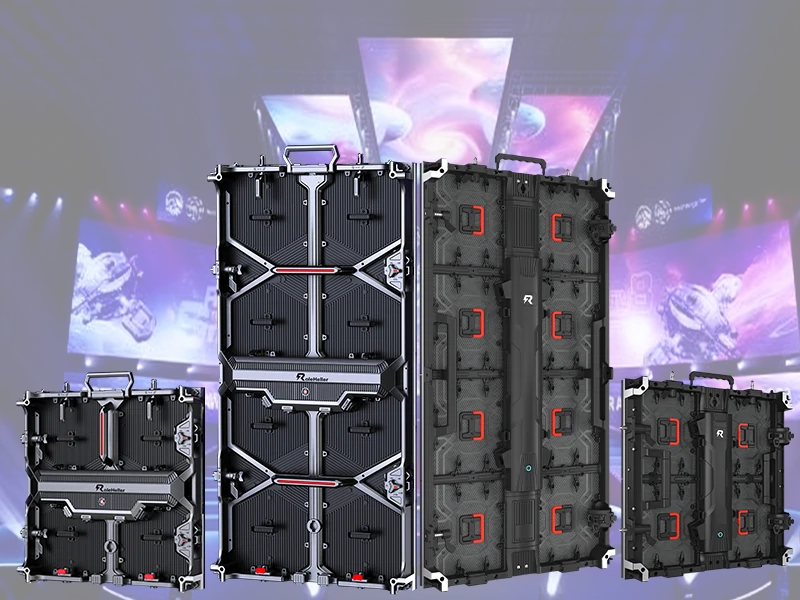
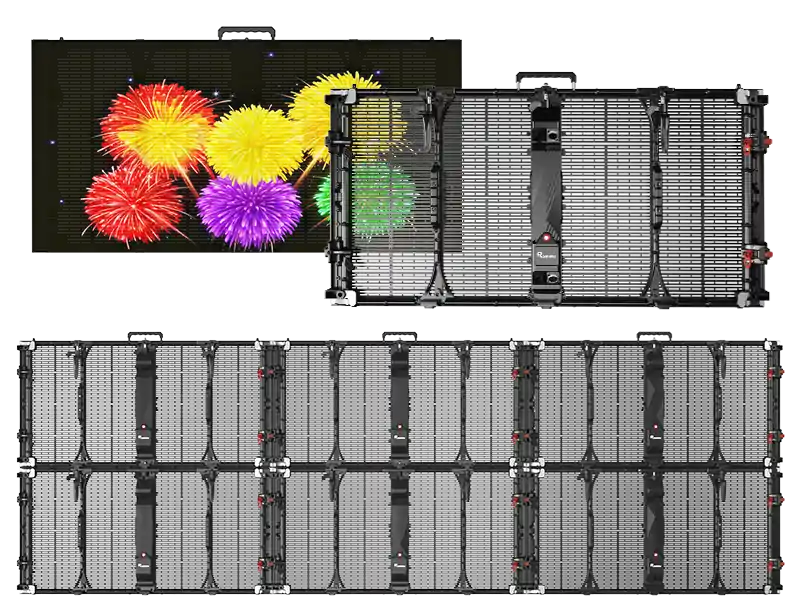
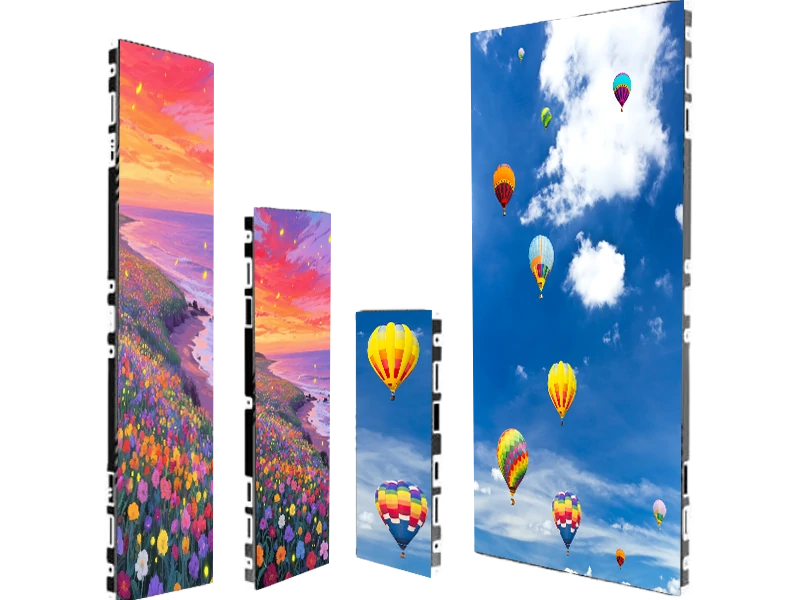
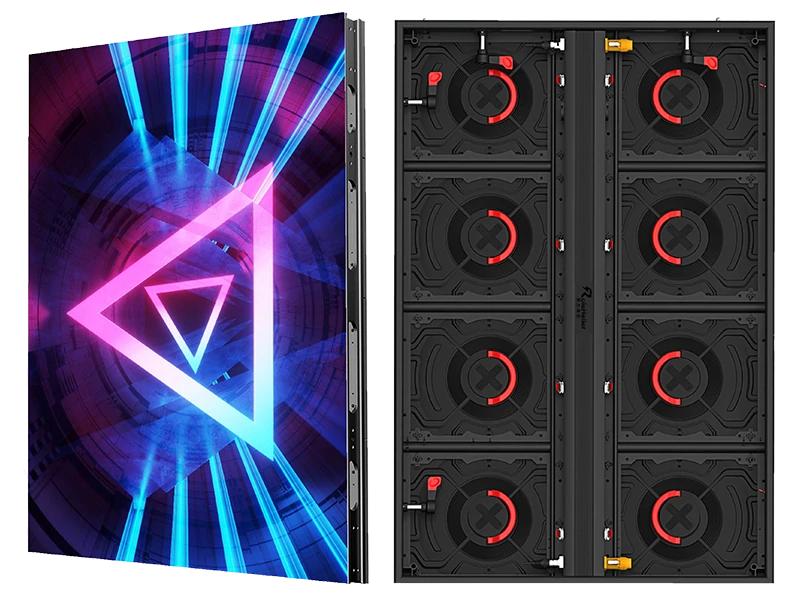
.jpg "China Indoor Stage LED Video Wall Manufacturers, Rental Panels, High Refresh")