 English
You've got a massive outdoor event coming up, maybe a music festival, a corporate launch, or a sports broadcast, and you need an LED video wall that can handle rain, direct sunlight, and thousands of eyes staring at it. The problem? You type "outdoor led video wall rental manufacturers" into Google and suddenly you're drowning in hundreds of listings, factory websites with barely readable English, and Alibaba pages that all look the same. How do you figure out which manufacturer actually delivers what they promise? I've been in this exact situation, and honestly, it took me way too many mistakes before I figured out what really matters. Let me walk you through everything I've learned so you don't have to repeat my errors.
China produces roughly 85-90% of the world's LED display panels, and when it comes to outdoor rental LED video walls specifically, the manufacturing hub is concentrated in Shenzhen and the surrounding Guangdong province. The outdoor led video wall rental manufacturers I'm about to cover aren't names I pulled from some random directory, they're companies I've evaluated based on their outdoor rental product lines, international export records, and real feedback from event production companies across North America and Europe.
Here's the thing, an indoor LED panel is relatively straightforward. You set it up, it stays dry, the temperature is controlled, done. An outdoor rental panel faces a completely different set of challenges, and that's exactly why choosing the right manufacturer matters so much more.
Waterproofing is the number one concern. Outdoor panels need to handle rain, humidity, and even accidental water exposure from sprinklers or cleaning. The industry standard for outdoor LED cabinets is IP65 rating, meaning the panel is completely dust-tight and protected against water jets from any direction. Some manufacturers cut corners here by using cheaper gaskets or inadequate sealing around cable connections. I've watched a perfectly good display short out during a light drizzle because the manufacturer skimped on the sealing around the power input connector.
Brightness is another critical factor. Outdoor environments, especially in direct sunlight, require significantly higher brightness levels than indoor setups. You're looking at a minimum of 5,000 nits for shaded outdoor areas, and 6,500-8,000 nits for full sun exposure. If a manufacturer quotes you 4,000 nits for an "outdoor" panel, that's a red flag. The panel will look washed out and unreadable the moment the sun comes out.
Wind load resistance is something most buyers completely overlook until it's too late. An LED video wall acts like a giant sail. If the cabinet structure isn't engineered to handle wind loads, you're looking at a potentially dangerous situation. Quality outdoor rental manufacturers design their cabinets with reinforced frames and provide wind load calculations for different configurations.
Temperature management is also huge. Outdoor panels generate significant heat, especially when running at high brightness. The cabinet needs proper ventilation or active cooling to prevent LED degradation and color shift over time. I've seen panels from budget manufacturers where the red LEDs shifted noticeably after just two days of continuous outdoor use in summer heat.
Let's get into the companies that have earned their reputation specifically in outdoor rental LED video walls.
Absen is one of the most recognized names in the global LED display market, and their outdoor rental lineup is extensive. Their outdoor rental cabinets span P3.91 to P9.52 pixel pitches, with brightness levels reaching up to 7,500 nits on their flagship models. What sets Absen apart is their factory calibration process that accounts for outdoor conditions, meaning color and brightness consistency is maintained even after prolonged sun exposure. Their cabinets feature IP65 front and rear protection, and the die-cast aluminum construction keeps weight manageable at around 28-35kg per 500x1000mm cabinet. They ship to over 100 countries and have service centers in major markets, which is a real advantage when you need emergency replacement panels during a multi-week event.
Unilumin takes a slightly different approach with their outdoor rental series. Their Upanel outdoor line supports P2.6 to P4.81 pixel pitches with brightness up to 6,500 nits. The standout feature here is their manufacturing consistency at scale. When you order 200 outdoor cabinets for a touring production, every single unit maintains tight tolerances on hinge mechanisms, LED module alignment, and color calibration. Unilumin's production volume means batch-to-batch variation is minimal, which matters when you're adding to your rental inventory over multiple orders. Their cabinets also feature tool-free assembly, which speeds up load-in and load-out significantly.
LianTronics has invested heavily in outdoor rental solutions with a focus on versatility. Their outdoor rental cabinets cover P3.91 to P10 pixel pitches and feature a unique curved-capable design that works for both flat and curved configurations outdoors. The cabinets are IP65 rated with enhanced UV-resistant face masks that prevent the black PCB material from degrading under prolonged sun exposure. LianTronics also offers front-serviceable designs, meaning your crew can replace individual modules from the front without dismantling the entire wall. For events where rear access is limited, this is a game-changer.
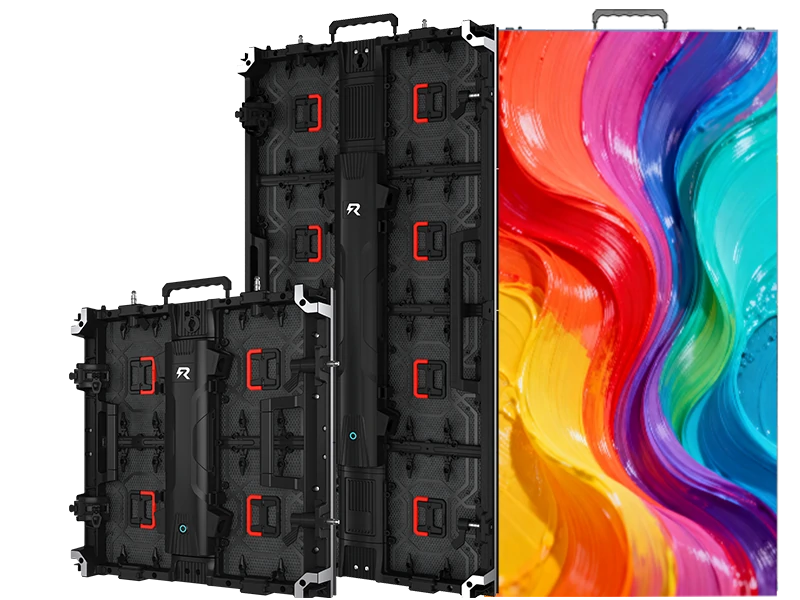
RYSE LED focuses specifically on the rental and events market, and their outdoor lineup reflects that specialization. Their outdoor rental cabinets feature quick-lock mechanisms that allow a two-person crew to assemble a standard 6m x 4m wall in under 45 minutes. The P3.91 and P4.81 outdoor models hit 6,500 nits brightness with IP65 protection. What I appreciate about RYSE LED is their lightweight design philosophy, their outdoor cabinets come in at around 25-30kg per 500x1000mm panel, which reduces shipping costs and makes manual handling feasible without mechanical lifts for smaller installations.
Visualeader is a Shenzhen-based manufacturer that's been gaining serious traction in the outdoor rental segment. Their outdoor T-Series features reinforced locking systems, integrated cabling channels, and an independent modular design that simplifies maintenance. Their engineering-first approach means they provide structural wind load calculations and CAD files for different outdoor configurations, which saves integrators significant time during the planning phase. Their outdoor panels cover P3.91 to P6.25 with brightness up to 7,000 nits.
Runbo offers outdoor rental cabinets at a more aggressive price point, covering P3.91, P4.81, and P6.25 for outdoor use. Their cabinets feature die-cast aluminum construction with IP65 ratings and brightness levels up to 6,500 nits. For rental companies building out outdoor inventory on a tighter budget, Runbo is worth evaluating. The trade-off is that their calibration consistency isn't quite at the level of Absen or Unilumin, so ordering a sample batch before committing to a large order is strongly recommended.
Let me put this in a format that's easy to scan when you're comparing options.
| Manufacturer | Pixel Pitch Range | Brightness | IP Rating | Cabinet Weight (500x1000mm) | Best For |
|---|---|---|---|---|---|
| Absen | P3.91–P9.52 | Up to 7,500 nits | IP65 | ~30kg | Large-scale touring, festivals |
| Unilumin | P2.6–P4.81 | Up to 6,500 nits | IP65 | ~32kg | Corporate outdoor, consistency |
| LianTronics | P3.91–P10 | Up to 6,500 nits | IP65 | ~28kg | Versatile, front-service |
| RYSE LED | P3.91–P4.81 | Up to 6,500 nits | IP65 | ~27kg | Fast deploy, lightweight |
| Visualeader | P3.91–P6.25 | Up to 7,000 nits | IP65 | ~29kg | Engineering-heavy projects |
| Runbo | P3.91–P6.25 | Up to 6,500 nits | IP65 | ~30kg | Budget-conscious rental |
These specs represent typical ranges across each manufacturer's outdoor rental lineup. Always confirm exact specifications for the specific model and configuration you're ordering.
This is where I see buyers make the most expensive mistakes. Let me break down the technical factors that separate a smooth outdoor deployment from a disaster.
Waterproofing beyond the IP rating. IP65 on a spec sheet is one thing. In practice, you need to verify that the manufacturer has sealed every potential entry point: cable connectors, module edges, cabinet seams, and especially the power input area. Ask specifically about the gasket material used (silicone gaskets outperform rubber over time in UV exposure) and whether they perform water spray testing on every batch or just sample testing.
Brightness uniformity across the panel. A panel might claim 6,500 nits, but if the brightness varies by more than 5% across the surface, you'll see hot spots and dark zones that become painfully visible on camera. Request brightness uniformity data from the manufacturer. Quality outdoor panels maintain within ±3% uniformity.
Wind load engineering. Ask the manufacturer for wind load calculations for your intended configuration. A 6m x 4m outdoor wall in an open field can experience significant wind force. The cabinet frame, the connection locking mechanisms, and the supporting structure all need to be rated for the expected conditions. If a manufacturer can't provide this data, look elsewhere.
Module replacement speed. When an LED module fails during a live event (and it will happen eventually), how quickly can your crew swap it? Front-serviceable designs allow module replacement in under 2 minutes without tools. Rear-serviceable designs require access behind the wall, which isn't always possible in outdoor setups against buildings or stages.
Color consistency between batches. If you're ordering outdoor panels in multiple shipments over several months, color temperature and brightness can drift between production batches. Top manufacturers maintain strict binning standards and can guarantee color matching across batches ordered within a 12-month window.
Outdoor rental LED cabinets cost more than indoor equivalents, and understanding the reasons helps you evaluate quotes without getting overcharged.
The premium comes from the waterproofing engineering (IP65 sealing, corrosion-resistant connectors), higher brightness LED chips (which cost more per unit), reinforced cabinet frames for wind resistance, and UV-resistant materials throughout. Expect to pay roughly 25-40% more than equivalent indoor rental panels.
| Product Category | Pixel Pitch | Price Range/Panel (500x1000mm) | Brightness | Typical Use |
|---|---|---|---|---|
| Standard outdoor rental | P4.81 | $500–$750 | 5,500–6,500 nits | Mid-size events, concerts |
| Fine-pitch outdoor rental | P3.91 | $700–$1,000 | 6,000–7,000 nits | Corporate, broadcast |
| Long-distance outdoor | P6.25–P10 | $350–$600 | 6,500–8,000 nits | Sports, large venues |
| High-brightness outdoor | P3.91–P4.81 | $900–$1,300 | 7,500–10,000 nits | Direct sunlight, billboards |
Prices are approximate and vary based on order volume, specific manufacturer, LED chip brands, driver IC quality, and current raw material costs. Always request a formal quotation with a detailed breakdown.
A few things that affect the price significantly: the brand of LED chips (Nationstar and Cree command premiums over generic options), the driver IC brand (Macroblock MBI series costs more but delivers better grayscale performance), and whether the cabinet includes integrated power distribution or requires external power boxes. Don't just compare the per-panel price, compare the total system cost including flight cases, spare modules, processing equipment, and structural supports.
Ordering outdoor LED panels from China involves logistics decisions that can significantly impact your timeline and total cost.
Shipping method. Air freight gets outdoor LED panels to you in 7-10 days but costs 3-5x more than sea freight. Sea freight takes 25-40 days depending on your destination but is dramatically cheaper. For a first order where you want to test quality before committing to a full inventory build, air freight a small batch of 5-10 panels. For full fleet purchases, plan at least 8-10 weeks ahead and use sea freight. Most Shenzhen manufacturers ship from Yantian or Shekou ports.
MOQ expectations. Established manufacturers like Absen and Unilumin typically require minimum orders of 20-50 panels for standard outdoor models. Smaller manufacturers may accept orders as low as 5-10 panels. For outdoor rental cabinets specifically, MOQs tend to be slightly higher because these aren't as commonly stocked as indoor panels. Expect 30-50 panel minimums from most factories for outdoor-specific models.
Customs and duties. LED displays imported into the US typically face a base duty rate of 0-5%, but additional Section 301 tariffs may apply depending on current trade policy. For the EU, the duty is typically 0-1.4% plus VAT at the destination country's rate. For the UK, UKCA marking is required. Check with a licensed customs broker before placing your order to get accurate landed cost calculations that include all fees.
Packaging for outdoor panels. Outdoor cabinets with waterproof seals and reinforced frames need protective packaging that prevents damage to the sealing surfaces during transit. Quality manufacturers use custom-molded EPE foam inserts and flight cases designed specifically for outdoor cabinets. If a manufacturer ships outdoor panels in standard flat-panel packaging without specific protection for the gasket surfaces, that's a red flag for how they treat quality overall.
After spending years evaluating outdoor LED rental options from Chinese manufacturers, here's where I've landed. The technology has matured to the point where the gap between top-tier Chinese manufacturers and Western-branded alternatives (which, let's be honest, are often manufactured in China anyway) has narrowed dramatically. Absen, Unilumin, and LianTronics are producing outdoor rental systems that compete directly with products costing two to three times as much from Western brands.
The key is matching the manufacturer to your specific use case. If you're running a high-end touring production company where every detail matters and clients expect broadcast-quality imagery, invest in Absen or Unilumin outdoor cabinets with individual panel calibration. If you're building a mid-market rental inventory for outdoor weddings, corporate launches, and mid-size concerts, RYSE LED or Visualeader offer excellent value with solid build quality. If your budget is tight but you still need reliable outdoor performance, Runbo is worth testing with a sample order.
What I'd strongly caution against is buying from manufacturers who can't provide project-specific engineering support. Outdoor rental installations aren't plug-and-play. You need a manufacturer who can provide wind load calculations for your specific site, brightness recommendations based on your orientation to the sun, and remote technical support during your first deployment. If they can't do that, keep shopping regardless of how attractive the price looks.
One more thing, and I can't stress this enough: always order a sample batch before committing to a large purchase. Three to five panels is enough to test waterproofing (literally spray them with a hose), brightness uniformity, color consistency, and build quality. The cost of a sample shipment via air freight is nothing compared to the cost of receiving 150 panels that don't meet your standards and trying to return them internationally.
Q1: What is the minimum brightness needed for an outdoor LED video wall?
A: For shaded outdoor areas (under a canopy or on the north side of a building), you need at least 4,500-5,000 nits. For partially exposed areas with some direct sunlight, aim for 5,500-6,500 nits. For full sun exposure where the screen faces south or west in the afternoon, you need 7,000-8,000 nits minimum. Anything below these thresholds will result in a washed-out image that's difficult to read, especially for text and detailed graphics.
Q2: How long do outdoor rental LED panels typically last?
A: Quality outdoor rental LED panels from established manufacturers have a rated lifespan of 50,000-100,000 hours to half brightness. In real-world rental use with regular setup, teardown, transport, and outdoor exposure, expect 5-8 years of reliable service before major component replacement becomes necessary. The LED chips themselves last the longest; hinge mechanisms, power supplies, and receiving cards are the components most likely to need replacement first.
Q3: Can outdoor rental LED walls operate in rain?
A: Yes, provided the panels are rated IP65 or higher, which is the standard for quality outdoor rental cabinets. IP65 means the panels are protected against water jets from any direction, which covers rain, sprinklers, and even light pressure washing for cleaning. However, IP65 does not mean submersible. Standing water at the base of the installation or submersion of any part of the panel will cause damage. Always ensure proper drainage around the base of your outdoor installation.
Q4: What pixel pitch should I choose for my outdoor event?
A: It depends on viewing distance. For audiences within 10 meters, P3.91 provides excellent image quality. For 10-20 meter viewing distances, P4.81 is the sweet spot for cost and performance. For distances beyond 20 meters (large sports venues, festival main stages), P6.25 or even P8-P10 works well and saves significant money. The general rule of thumb is minimum viewing distance in meters equals approximately the pixel pitch in millimeters times 1,000.
Q5: How do I protect outdoor LED panels from wind damage?
A: Start with the manufacturer's wind load specifications for your specific configuration. Most quality outdoor rental cabinets are rated for wind speeds of 60-80 km/h when properly secured. Use rated structural supports (truss systems or ground supports engineered for the specific wall dimensions), anchor the structure to the ground or a solid surface, and consider wind breaks or screens if the installation is in an exposed location. Always have a plan to lower or secure the wall if wind speeds exceed the rated threshold.
Q6: What's the difference between IP65 and IP68 for outdoor LED panels?
A: IP65 means the panel is dust-tight and protected against water jets from any direction, which covers all normal outdoor weather conditions including heavy rain. IP68 means the panel can be submerged in water beyond 1 meter depth, which is overkill for virtually all outdoor rental applications and comes at a significant cost premium. For outdoor events, IP65 is the industry standard and is more than sufficient. IP68 is typically reserved for permanent installations in flood-prone areas or underwater applications.
Q7: How much does it cost to rent versus buy outdoor LED video wall panels from China?
A: Buying outdoor rental panels from Chinese manufacturers typically costs $500-$1,300 per 500x1000mm panel depending on pixel pitch and brightness. Renting the same panels from a local rental house typically costs $50-$150 per panel per day. If you have more than 8-12 events per year, buying usually becomes more cost-effective within 12-18 months. Factor in shipping, storage, maintenance, and crew training costs when making the buy-versus-rent calculation.
Q8: Do outdoor LED rental panels need special video processors?
A: Outdoor panels use the same control systems as indoor panels (NovaStar, Colorlight, Brompton, etc.), but outdoor installations often require higher brightness calibration and may need ambient light sensors for automatic brightness adjustment throughout the day. Some processors offer built-in brightness scheduling that adjusts output based on time of day, which extends LED lifespan and reduces power consumption during evening hours. Confirm that your chosen processor supports the specific cabinet model and resolution configuration.
Q9: What certifications are required for importing outdoor LED panels?
A: For the US market, FCC certification (electromagnetic compatibility) is required, and UL listing is strongly recommended for liability and insurance purposes. For the EU, CE marking and RoHS compliance are mandatory. For the UK, UKCA marking is required. For Australia, RCM certification. Additionally, some venues and event insurance policies require specific fire safety certifications for the cabinet materials and cables. Always ask the manufacturer for actual certificates and verify them with the issuing body before placing your order.
Q10: What are the most common issues with outdoor LED rental panels from Chinese manufacturers?
A: The most frequent problems include: insufficient waterproofing at cable connection points leading to shorts during rain, brightness and color drift after prolonged sun exposure due to poor-quality LED chips or inadequate UV protection on the face mask, hinge mechanisms that corrode or seize after repeated outdoor use, and inconsistent brightness between panels in the same batch. These issues are largely avoidable by choosing established manufacturers with proven outdoor track records, ordering sample panels for testing, and specifying quality components (Nationstar or Cree LEDs, Macroblock driver ICs, silicone gaskets) in your purchase agreement.
.jpg "Where to Find Reliable Wholesale P2.6 LED Video Wall Manufacturers?")
.jpg "China COB LED Video Wall Manufacturers | Find Verified Suppliers")