 English
If you are trying to figure out who among the top LED display manufacturers actually deserves your money, here is the honest answer up front: do not pick by brand name or by the lowest price. Pick the one whose factory can prove—on a video call, today—that it builds your exact pixel pitch, holds the right certification in its own name, and will put the component list into the purchase order. Everything else is noise.
I have watched people spend six figures on a screen because the brochure looked good, then spend the next two years replacing power supplies. It does not have to be that way. Below is the way I would do it if I were buying again tomorrow.
You probably want a name. In terms of scale and export volume, the group that shows up every year is Leyard, Unilumin, Absen, Ledman, LianTronics, AOTO and Qiangli Jucai. Outside China you will see Daktronics, Planar, Samsung, LG and Barco. But here is the thing nobody puts in a headline: for most mid-size projects—a church video wall, a retail lobby, a handful of rental cabinets—the difference between a Tier-1 logo and a verified mid-tier Shenzhen factory is smaller than the difference between a good install and a bad one.
So the real question is not "who is biggest". It is "who will still answer my email in month eighteen".
Tier-1 Chinese brands: Leyard has held the largest global share position for a long stretch. Absen ships to well over a hundred countries. Unilumin covers outdoor, creative and sports heavily. These are the right call when the project is visible, permanent and politically sensitive—broadcast studios, stadiums, flagship retail.
Tier-1 international: Daktronics for scoreboards, Planar for control rooms, Samsung and LG for premium Micro LED indoors. If your buyer recognises the name, that matters. Just know what you are paying for.
Mid-tier factories in Shenzhen, Dongguan, Huizhou: this is where most importers actually buy. Pricing is noticeably better; quality on standard products is often indistinguishable once calibrated. You have to do the verifying yourself.
Trading companies: no production line. Not automatically a problem—some are faster and more flexible—but warranty flow and component traceability work differently through them.
| What you need | Who makes sense | Why | Where it hurts |
|---|---|---|---|
| Stadium scoreboard, broadcast studio | Daktronics, Planar, Leyard, Unilumin | Engineering depth, redundancy, service networks | Price, lead time, less flexibility on small changes |
| Fine-pitch boardroom or control room, 24/7 | Absen, Leyard, Ledman, LianTronics | COB/MIP fine pitch, low-light gray scale, fanless options | Premium per square metre |
| Church, lobby, retail, mid-size indoor | Verified mid-tier factory | Best value at P2.5–P3.9, fast turnaround | You must verify certifications and components yourself |
| Outdoor billboard / DOOH | Unilumin, Absen, mid-tier with IP65 record | Common-cathode drive, anti-UV, brightness headroom | Structural and wind-load work is on you |
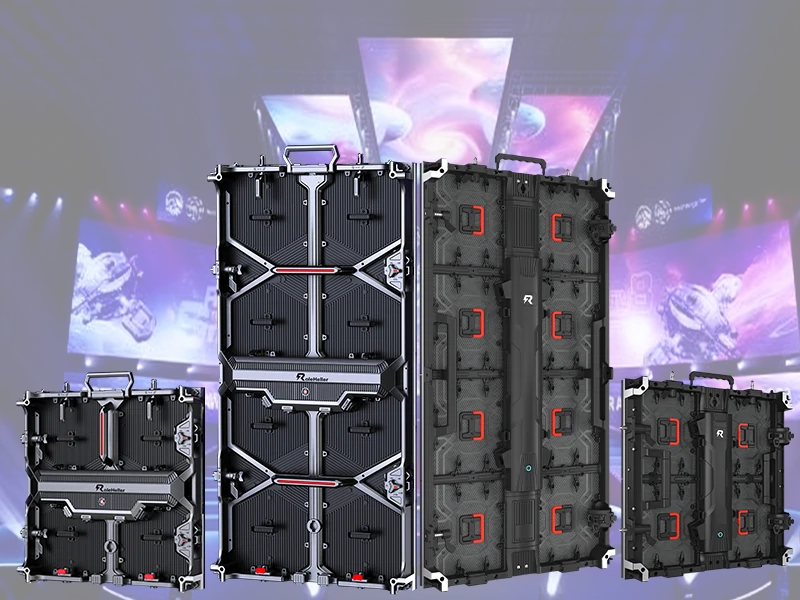
| Rental and touring | Mid-tier with die-cast cabinet line | Weight, lock systems, refresh rate, spare parts | Cabinet compatibility across batches matters a lot |
| Tight budget, small order, mixed SKUs | Trading company or small factory | Flexibility, lower MOQ | Traceability and warranty response can be slower |
One thing I keep learning the hard way: the brand gets you the sale, the installer keeps you out of trouble. A mediocre screen mounted properly beats a great screen on a frame nobody calculated.
Business license with manufacturing in the registered scope. Sales-only scope means they are reselling.
ISO 9001 certificate number, checked on the registrar's own website—not the PDF they sent.
A live video walk-through, today. SMT line, aging rack area, a cabinet being assembled. Ask them to hold up a paper with your company name and today's date.
A component list by brand. LED lamp (Nationstar, Kinglight, Cree), driver IC, power supply (Mean Well, Great Power), receiving card (Novastar, Colorlight), PCB layer count.
Test reports issued in their own company name. If the FCC report lists a different entity, ask why—and get the answer in writing.
One more move I do not skip: check their exhibition history. ISLE in Shenzhen, InfoComm, ISE in Barcelona, Dubai. Real manufacturers exhibit the same show year after year.
| Scenario | Pixel pitch | Brightness | What actually matters |
|---|---|---|---|
| Small meeting room, viewing 3–6 m | P1.2 – P1.8 COB/fine pitch | 600–1000 nits | Low-light gray scale, not raw brightness |
| Lobby, retail, church | P2.5 – P3.9 | 800–1500 nits | Color uniformity, dead pixel rate ≤5 ppm |
| Control room, 24/7 | P0.9 – P1.5 with dual backup | 600–800 nits | Redundancy, fanless design, documented MTBF |
| Outdoor billboard / DOOH | P4 – P10 | 5000–10000 nits | IP65 front and rear, anti-UV, common cathode |
| Stadium, facade media | P6 – P16 | 6000+ nits | Wind-load calculation and maintenance access |
| Rental and stage | P2.6 – P3.9 die-cast | 4500+ nits | Panel weight, lock system, refresh ≥3840 Hz |
Rule of thumb: minimum comfortable viewing distance in metres ≈ pitch × 1 to 1.5. A P2.5 reads cleanly from about 2.5–4 m. If your audience sits closer, go down a pitch.
Brightness is not quality. An overdriven screen looks harsh, kills its own power supply faster and creates glare complaints. Uniformity tuned properly beats a big nit number every time.
FCC Part 15 is mandatory—Class A for commercial/industrial, Class B near residential. Without it, your container sits.
UL is technically voluntary but functionally required for government tenders, many insurers and quite a few retailers; ETL is the common alternative.
DOE and California Title 20 energy compliance apply in some categories; Prop 65 labeling may be needed.
FCC rules around foreign-controlled labs and the SDoC responsible party have been tightening—confirm lab accreditation and a real US address.
CE covering LVD (EN 62368-1), EMC (EN 55032/55035) and RoHS. Technical file kept at least ten years.
RED applies if the display includes Wi-Fi or Bluetooth. UKCA for Great Britain.
SASO/SABER for Saudi Arabia, plus local civil-defense requirements on some venues.
Practical tip: ask for the report number and issuing body, then look it up yourself. A scanned certificate with a fuzzy logo proves nothing except that they own a scanner.
Module and cabinet model, dimensions, pitch, native resolution
LED brand and bin, encapsulation type (SMD, COB, GOB, MIP)
Driver IC, refresh rate, gray scale depth
Power supply brand and rated wattage; common-cathode or not
Receiving card and controller brand, plus licenses included
Cabinet material, weight, IP rating, front or rear maintenance
Spare parts ratio (norm: 3–5% modules, plus spare power supplies and cards)
Warranty length and exactly what it covers: parts, labour, freight, response time
Packaging, Incoterms, lead time, payment terms
Exclusions: structure, installation, commissioning, content, import duties
Two traps I have seen too many times: bare-screen pricing that grows later with "accessory fees", and component substitution where the sample has top-bin LEDs and the production run does not. Lock the exact component list into the purchase order with a clause requiring written approval for any substitution. Lead time on custom orders usually runs twenty to thirty-five days after deposit.
They will not do a live video call, or they keep rescheduling it.
The certification report names a different company.
"We can do any pitch, any brightness, any price." Real factories have limits and they tell you what they are.
Price well below the market band while component specs stay vague.
Warranty says "one year" and nothing about return freight.
Payment demanded fully upfront, or into a personal account.
Zero reference projects in your application category.
Is the cheapest option always a mistake? Not always. But cheap with vague specs is a different product than cheap with locked specs. The price itself tells you nothing; the itemised quote tells you everything.
Do I need a Tier-1 brand? If the screen is permanent, public-facing and someone important will stand in front of it, probably yes. If it is ten lobby screens or a rental kit, probably not.
Can I trust a supplier I have never visited? Yes, if you run the five checks above. Physical visits help, but a dated live walk-through plus certificate lookups catch most of the same problems.
Should I just go as fine a pitch as possible? No. Finer pitch costs more, runs hotter and gains you nothing if nobody sits close enough to notice. Spend that money on calibration and spare parts instead.
Should I start with a sample? Always. One sample panel teaches you more than twenty pages of marketing.
I have seen buyers chase the bottom quote and replace power supplies every eighteen months. I have also seen buyers overpay for a logo that did nothing for them after handover. The gap between those two outcomes was never really about the brand. It was about whether someone ran a checklist.
What lasts, in my experience, comes down to three things: component transparency you can verify, testing records that exist before you ask for them, and a warranty backed by an address that answers the phone. Everything else is presentation.
If I had to start over with zero contacts and a deadline, I would shortlist three suppliers using the factory-versus-trader filter, demand itemised quotes with locked components, verify one certification each myself, order one sample and negotiate from there. Three weeks, roughly. It removes most of the risk.
Last thing: do not skimp on the structural and electrical side of the install. The finest screen in the world looks wrong on a frame nobody calculated, and no warranty covers that.
1. Who are the top LED display manufacturers? Leyard, Unilumin, Absen, Ledman, LianTronics, AOTO and Qiangli Jucai lead in China; Daktronics, Planar, Samsung, LG and Barco lead internationally. Match capability to what you are actually building.
2. Are Chinese LED display manufacturers reliable? The majority of the world's LED screens come from the Shenzhen, Dongguan and Huizhou clusters. Reliability varies by supplier, not by country.
3. Manufacturer vs supplier—what is the difference? A manufacturer runs the production line; a supplier may be a manufacturer, distributor or trading company. Insist on a manufacturer if you want direct pricing and component control.
4. How do I verify a factory without travelling? Check business license scope, verify ISO on the registrar's site, run a dated live video walk-through, confirm report numbers with the issuing body and call a reference customer.
5. What certifications for the US? FCC Part 15 mandatory; UL/ETL often required in practice. DOE, California Title 20 and Prop 65 may apply.
6. What certifications for Europe? CE covering LVD, EMC and RoHS, technical file kept ten years. UKCA for Great Britain. RED if wireless functions are included.
7. Which pixel pitch should I choose? Minimum viewing distance in metres ≈ pitch × 1 to 1.5. P1.2–P1.8 for close-view meeting rooms, P2.5–P3.9 for lobbies and churches, P4–P10 for outdoor billboards.
8. How long does production take? Standard products move quickly; custom orders typically take twenty to thirty-five days after deposit, plus transit.
9. What warranty should I expect? Two to three years on key components is the norm. What matters is who covers parts, labour and freight, and how fast they respond.
10. Is a trading company a bad choice? Not inherently. Traders can be faster and more flexible on small or mixed orders, but you trade off direct traceability and sometimes slower warranty resolution.
.jpg "Which P1.6 LED Video Wall Manufacturers Offer the Best Value for Your Project?")

.jpg "How to choose outdoor LED video wall display manufacturers?")