English
Your boss or your client just said "we need an outdoor screen" and dropped it on your desk like it was a simple shopping trip. Maybe it's for the side of a building, maybe a drive-in church, maybe a sports venue, maybe a retail frontage where the council will have opinions. You typed outdoor led digital display manufacturers into Google and got back four hundred companies that all look identical — same showroom renders, same "15 years experience", same promise of factory-direct price and any size you want. You send one enquiry to nine of them. Seven reply within an hour with a glossy PDF. Two never reply. And when the quotes come back, the cheapest is nearly half the most expensive for what is apparently the same product.
It is not the same product. Nobody tells you this until installation day and the sun comes out.
Short answer, because you probably want it before the long version: outdoor LED is not one product and "P" number alone does not define anything. The difference between a display that reads cleanly at noon for eight years and one that fades, patches up and cooks its own power supplies in two summers comes down to LED package and bin consistency, driver IC and refresh rate, real brightness versus claimed brightness, cabinet sealing and thermal design, whether the manufacturer can still supply matching modules three years later, and whether they have actually installed something at your pitch, your size and your viewing distance. So pick on technical evidence and continuity, not on who quoted the lowest per-square-metre figure.
Now the longer version, because that is where the money goes.
This is where enquiries go sideways fast, because "outdoor screen" means very different things to different people and suppliers do not always ask which one you need.
Fixed-installation building face or freestanding. Rigid cabinets, usually die-cast aluminium or iron, bolted to a steel structure, wired hard, designed to stay put for years. This is the majority of the market. Service is normally rear access unless the screen is mounted flush, in which case front service becomes mandatory and expensive.
Rental / touring. Lightweight magnesium or aluminium cabinets with quick-lock mechanisms, designed to be assembled and struck repeatedly. These are built for speed and abuse, not for twenty-four-seven operation. Buying rental gear for a permanent install is a false economy — the seals, latches and masks are not rated for the same life. Conversely, buying a heavy fixed cabinet for a touring show is a nightmare for the crew and you pay for weight you do not use.
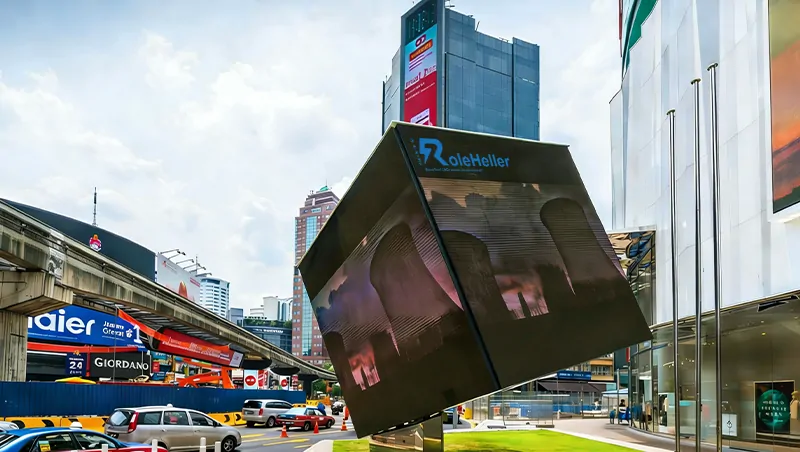
Creative / custom shapes. Cylinders, curves, transparent mesh, pole-mounted banners. Different engineering entirely. Do not let a standard-cabinet supplier convince you their regular product can be bent.
Pitch selection. Outdoor pitches run roughly P3.9, P4.8, P5.95, P6.67, P8, P10 and up. The old rule of thumb — minimum comfortable viewing distance equals pitch in millimetres times about 1.5 to 2 — still works as a starting point. P4.8 wants viewers around 8–10 metres away and beyond. P10 is fine when people are thirty metres back. Go finer than you need and you pay more upfront, draw more power, generate more heat and buy more pixels that can fail. Go coarser and your text becomes unreadable and nobody forgives you.
One thing people forget: content dictates pitch as much as distance does. If you are showing video and wide graphics, a coarser pitch survives. If you need readable text, logos and fine detail, go finer or accept that you are buying a billboard that looks like a billboard.
Brightness is the number suppliers lead with because it is easy to print and easy to exaggerate. You will see claims of 5,500, 6,500, even 10,000 nits. Treat any number above about 7,000 nits with suspicion unless it is backed by a test report from a recognised lab. And note this: more brightness is not automatically better. A screen running flat out at maximum brightness runs hotter, ages faster, draws more power and often looks worse because contrast collapses in direct sun. What you actually want is enough brightness plus good contrast and proper auto-dimming.
Enough brightness. For most outdoor installations, 4,500–6,000 nits is plenty, provided the mask is dark and the cabinet does not reflect. In direct southern sun on a white wall, lean higher. In shade or north-facing, you can go lower and save money and power. Ask for the test method — was it measured per module, per cabinet, with all LEDs on white, and by which standard. Vague answers here are a signal.
Contrast and mask design. This matters more than raw brightness in daylight. A deep black mask with good fill factor, plus matte surface treatment to cut glare, makes the image readable when the sun is up. Glossy masks look great in a showroom render and disappear at noon. Ask to see photos of an actual install in daylight, not a darkened room shot. If they only have night shots, that is information.
LED package and bin. Outdoor still uses a lot of through-hole DIP for larger pitches and SMD for finer work — SMD 2727, 3535, 1921 depending on pitch. The brand matters less than the bin code and batch consistency. LEDs from different bins look different, and colour mismatch shows up badly on large surfaces viewed from far away where the eye integrates the whole wall. Ask for the bin code on the proforma invoice and insist the whole job comes from one production lot. Write it in. If it is not written down, it does not exist.
Driver IC and refresh rate. Same story as indoor, but with an extra wrinkle: outdoor screens get filmed constantly, by phones, by broadcast cameras, by drones. 3,840 Hz minimum if there is any camera work. Also ask about grey scale at low brightness, because the screen will be dimmed at night and cheap drivers band badly when dimmed. A screen that looks great at noon and stripes at dusk is a very common complaint.
Cabinet material and sealing. Die-cast aluminium holds flatness and dissipates heat better than sheet iron; iron is cheaper and heavier and rusts if the coating is thin. IP rating matters outdoors — front face IP65 is standard, rear IP54 or better, and for harsh climates push for IP65/IP66 across the whole cabinet. But here is the thing nobody puts in the brochure: the rating is only as good as the gaskets and the workmanship, and gaskets degrade. Ask how seals are retained, whether replacement gaskets are available, and whether the cabinet has been tested to a named standard with a report you can check.
Thermal design. Heat kills outdoor displays. Ask about the temperature range the cabinet is rated for, whether there is active or passive cooling, what the internal temperature rise is at full brightness, and whether there is a heater or dehumidification for cold or humid climates. Condensation inside a cabinet is a silent killer — it shows up months later as corrosion and dead rows. If you are in a coastal, tropical or high-humidity location, say so explicitly and get the answer in writing.
Power and headroom. Ask for maximum and typical watts per square metre, and ask what load the power supplies run at. PSUs at sixty to seventy percent of rated load run cooler and last longer. Also ask about surge protection, lightning protection and grounding — outdoor installations need proper earthing and SPDs, and this is frequently omitted from quotes until you ask. It is not optional.
Service access. Front service or rear service, and how long does one module actually take to swap with the tools on site. Work this out before the structure goes up. Watching a crew build a screen flush to a wall with no access panel and then spend half a day extracting one module is a memorable lesson. Also ask about hot-swap capability and whether modules can be replaced without taking the whole screen offline.
Weight and structure. Get cabinet weight and wind-load figures, and make sure your structural engineer signs off on the steel, the fixings and the foundation. Manufacturers provide drawings but they do not sign off on your building. That is on you. Wind load is the thing that turns a cheap install into an insurance claim.
Pixel failure policy. Agree dead-pixel and bright-pixel allowances in writing before production. Industry practice permits a small number per square metre with limits on clustering and on bright pixels in the central zone. Zero-defect is achievable but costs more and takes longer due to extra screening. Discovering you disagree on this at handover is unpleasant for everyone.
Outdoor quotes are structured to resist comparison and it is not accidental. One supplier prices per square metre of module area. Another includes cabinets. Another excludes the processor and sending cards. A fourth quotes FOB Shenzhen and lets you discover crating, freight, duty, installation, steel structure, electrical work, permitting and content later. By the time everything is added up the ranking has changed, usually twice.
Build your own table and make every supplier fill the same rows:
| Item | What to demand |
|---|---|
| Display | Pitch, module size, dot resolution, total native resolution, cabinet dimensions and weight |
| LEDs | Type (DIP/SMD), package code, brand, bin code, single batch confirmed |
| Electronics | Driver IC, scan rate, refresh rate, receiving/sending cards, processor included or not |
| Image | Brightness nits with test method, contrast/mask, viewing angle, dimming curve |
| Build | Cabinet material, IP ratings front/rear, cooling method, operating temp range, front or rear service |
| Power/Protection | Max and typical W/m², PSU brand and wattage, headroom, SPD/lightning protection, grounding |
| Commercials | Structure drawings, crating, freight, insurance, duties, commissioning, spares kit, warranty terms, pixel policy |
Do this and the cheap quote migrates to the middle. Sometimes it rises to the top. Either way you finally know what you are paying for, which is the entire point.
Payment terms: thirty percent deposit, seventy against copy of bill of lading is standard. On larger jobs push for a small retention held until commissioning signs off. Never pay fully upfront. Get lead times in writing with a penalty clause, because "four weeks" has a habit of becoming ten weeks right before your opening. And plan around Chinese New Year — factories shut and ports take weeks to clear. Budget also for the half nobody quotes: steel structure, electrical work and signage permits, content creation, media player and scheduling software, commissioning days, and the local technician who keeps it running. The panels are rarely the biggest surprise. The rigger usually is.
Three layers, same as every hardware category, same polished PDFs from all of them.
The factory with its own SMT line and cabinet tooling. They buy LED packages and driver ICs, run pick-and-place, reflow, aging rooms and calibration rigs. This is where you want to be for a permanent outdoor install, because continuity matters — replacement modules in year three must come from the same place with the same bin and the same calibration method. MOQs apply, lead times are real, and they will not cheerfully do odd one-off sizes.
The assembler who buys modules upstream and builds cabinets. Faster, more flexible on non-standard sizes, sometimes cheaper. Quality depends on which lot they bought that week. Fine if you lock the BOM in writing and check it when the crates arrive. For outdoor I would add: all modules for the entire screen from a single production batch. Write it in.
The trader or sourcing agent. Genuinely useful for spare parts, a single sample, urgent small jobs. But your warranty lives inside one person's message history, and if that person changes jobs your support leaves with them. For a screen that will run daily for years, that is a risk you cannot insure against.
And the fourth category nobody labels honestly: the company making decent indoor product that will happily sell you outdoor cabinets sourced from someone else while presenting them as their own. Nothing automatically wrong with that, but your technical questions now travel further and your spare parts come from a third party. Ask directly whether the outdoor cabinets and the aging tests are done in-house. Watch how long the answer takes.
Live unscheduled video call. Not a scheduled tour, not a pre-recorded walkthrough. Ask them to walk to the aging racks right now, pick any cabinet at random, and read the label — model, bin code, date. A real factory does this in five minutes on a Tuesday afternoon. Someone who resells will reschedule twice, blame the network, and send a very polished video. Everybody sends polished videos. That is not evidence.
Business license scope. Manufacturing versus trading is written on it. Cross-check the establishment date against any "fifteen years experience" claim. Two minutes of work. Websites claiming 2008 with licenses dated 2021 are not rare.
BOM on the proforma invoice. LED type and bin code, driver IC, PSU brand and wattage, receiving card model, cabinet material, IP rating, cooling method, seal type. If it is not on the purchase order it does not exist. Verbal promises about high-quality LEDs have never helped anyone win anything.
Photos of an actual installed job at your pitch and size. Not a render. Photos with a date, ideally a contact you can call. Outdoor portfolios get reused heavily because there are fewer good installs than there are websites. Renders alone mean prototype, not product.
Call two references yourself. Not the testimonial letter with the nice logo. The actual installer or end client, preferably in a similar climate to yours. Ask whether anything failed, whether water got in, how fast spares arrived, whether a reorder matched colour. Installers tend to be blunt because they have been burned before and owe the factory nothing.
Order a sample cabinet or module first. Put it outside in the actual location for a few weeks if you can. Look at it at noon and at dusk. Run a solid grey field — that is where patchiness shows itself. Dim it down at night and look for banding. Leave it through a rain event. A sample costs a few hundred dollars and saves a much larger mistake.
Verify certifications yourself. CE, RoHS, and whatever your local authority requires for electrical safety and EMC. Certificate numbers can be checked on the issuing body's website. Ten minutes. No verifiable number means the certificate is decoration.
What pitch should I choose?
Start with viewing distance and content. Text-heavy or logo-heavy content needs finer pitch than pure video. If your closest viewer is around 10 metres away, P4.8–P6 is a sensible band. At 20–30 metres, P8–P10 is fine and much cheaper. When in doubt, go one step finer rather than coarser — nobody complains that a screen is too sharp, but everyone notices when they cannot read it.
Direct from China or through a local integrator?
Depends entirely on whether you have technical cover on the ground. Buying direct saves hardware money, no question. But you then own the structure design, electrical sign-off, permitting, commissioning and fault-finding at 11 p.m. before an event. If you have a competent local technician already, going direct makes sense. If not, the integrator's margin buys you someone to call, worth considerably more than it looks. For outdoor specifically — where wind load, water ingress and service access matter — I lean toward having local support even if it costs more.
How bright does it need to be?
4,500–6,000 nits covers most situations, provided contrast is handled properly. More brightness costs more upfront, draws more power, generates more heat and shortens life. Fit an ambient light sensor and auto-dimming so the screen drops down at night. This saves power, extends life and stops you becoming a light-pollution complaint.
Do I need IP65?
Outdoors, yes, at minimum for the front face, and higher for harsh or coastal climates. But remember the rating depends on gasket condition and workmanship, and seals degrade over time. Ask about replacement gaskets and service intervals.
How many spare modules?
Three to five percent extra from the original LED bin, plus at least one spare power supply per cabinet group, spare receiving cards, cables and a handful of spare gaskets and latches. Store anti-static and dry, and power them up briefly every few months. Record exact model numbers somewhere your successor can find — in three years nobody remembers.
Can I add to the screen later?
Only if the product line and LED bin are still available. Colour difference between old and new modules shows up clearly on solid colours over a large area. This is why a spare kit up front is cheaper than trying to match later. Some manufacturers will recalibrate new modules to match an aged screen — ask whether they offer this before you need it.
How long will it last?
Seven to ten years is realistic for a well-specified install with sensible brightness, proper ventilation and periodic maintenance. Four years or less is what you get when the screen runs at full brightness around the clock in direct sun and nobody ever cleans the filters or checks the seals. Both outcomes can come out of the same factory. The difference is operating discipline, not hardware.
What about permits and light pollution?
This gets overlooked until someone complains. Check local signage regulations, brightness limits, curfews and flicker rules before you spec the screen. Many jurisdictions cap brightness and require automatic dimming after a certain hour. Designing this in from the start is free. Retrofitting it after a complaint costs money and goodwill.
Choosing pitch from a render instead of from viewing distance and content type
Comparing prices without a BOM and assuming the pitch defines the product
Chasing maximum brightness and losing contrast, power budget and lifespan
Ignoring bin codes and getting a patchy screen from mixed lots
Assuming IP65 on the brochure means the specific cabinet has been tested to a named standard
No thermal plan — enclosing the screen, ignoring sun load, skipping ventilation
Comparing FOB prices and being surprised by structure, freight, duty and commissioning
No spare parts plan, then finding the product line discontinued eighteen months later
Vague acceptance criteria — "good picture quality" is not a standard; brightness, uniformity, IP rating, pixel policy, noise and refresh rate must be numbers in the contract
Letting the manufacturer's drawing stand in for a structural engineer's sign-off
Forgetting lightning protection, grounding and surge suppression
Testing only at night and in a showroom, never at noon in direct sun
Running the screen at full brightness permanently to impress at handover
Paying fully upfront because the discount looked good
I would shortlist three suppliers and send all three the identical spec sheet, asking them to fill in: LED type and bin code, driver IC, scan rate, refresh rate, brightness with test method, cabinet material and IP ratings, cooling method and operating temperature range, PSU brand and wattage with headroom, lead time, spare part unit prices, and two reference contacts I could call myself. That one move reveals more than any amount of browsing. Serious suppliers return it filled in within a day. The others suddenly cannot find the information, or send back the same PDF with a different logo.
Then I would put a sample cabinet in the actual location for a few weeks. Look at it at noon and at dusk. Lights on the building, lights off. Solid grey field, slow walk past. Dimmed right down at night, watching for banding. And I would pay close attention to how quickly the supplier answers messages during that trial month. Response speed when there is no money on the table predicts future support better than any certificate on their website. Fast replies now mean fast replies when a cabinet goes dark the day before an event. Slow replies now mean slow replies forever.
Then I would sign with the BOM attached, acceptance criteria expressed as numbers not adjectives, a spare kit included, and a small retention held until commissioning signs off cleanly. Whatever budget remains goes to a better structure, proper ventilation and drainage, decent cable management, an ambient light sensor with a sensible dimming curve, and a maintenance agreement with someone local who picks up the phone.
Outdoor screens do not fail because they are cheap. They fail because the cheap option moved money away from the unglamorous parts — LED bin consistency, mask and contrast, sealing and gaskets, thermal design, power headroom, lightning protection, spares, service access — and those are precisely the parts that determine whether the display still reads cleanly at noon, years later. Nobody remembers who saved twelve percent on the quote. Everybody notices when the centre has gone dull and the bottom row has a string of bright pixels, right before the busiest week of the year, and by then the factory has changed its name twice.
What do outdoor LED digital display manufacturers supply? Companies producing outdoor LED displays — fixed-installation and rental cabinets in pitches from P3.9 to P10+ — plus processors, steel structures, control software and spare parts for buildings, venues, retail, sports and roadside applications.
What pixel pitch should I choose for an outdoor screen? Start with viewing distance and content. Roughly pitch × 1.5–2 metres gives minimum comfortable viewing distance; text-heavy content needs finer pitch. P4.8–P6 suits viewers around 10 m away, P8–P10 suits 20–30 m.
How many nits of brightness do I need? 4,500–6,000 nits covers most outdoor situations when contrast and mask design are handled properly. Always fit an ambient light sensor and auto-dimming.
What IP rating is required outdoors? Minimum IP65 on the front face, higher for coastal, tropical or high-humidity locations, with verified test reports and available replacement gaskets.
How do I verify an outdoor LED manufacturer is genuine? Request a live unscheduled video walkthrough of the aging racks, check the business license scope, demand a written BOM with LED bin and driver IC on the proforma invoice, and call reference clients yourself.
Is a sample worth ordering? Yes. Place a sample cabinet in the actual location for a few weeks and view it at noon, at dusk and fully dimmed at night. A few hundred dollars here saves a much larger mistake.
How many spare modules should I keep? Typically 3–5% extra modules from the original LED bin, plus spare power supplies, receiving cards, cables, gaskets and latches, stored anti-static and dry.
What are typical payment terms and lead times? 30% deposit and 70% against copy of B/L is standard; production typically runs four to six weeks plus shipping, with significant delays around Chinese New Year.
How long does an outdoor LED display last? With proper thermal design, power headroom, sensible brightness, sealed cabinets and periodic maintenance, seven to ten years is realistic; constant full-brightness operation in direct sun cuts that substantially.
Should I buy direct or use a local integrator? If you have competent local technical support for structure, electrical sign-off and commissioning, buying direct saves money. If not, the integrator's margin buys you someone to call, which is worth more than it looks — especially outdoors where wind load and water ingress matter.




.jpg "Where to find LED video wall makers?")
.jpg "Where to find China LED video wall display manufacturers?")