 English
Have you ever walked into a corporate lobby, broadcast studio, or high-end retail space and been stopped in your tracks by a massive, seamless display that looks more like a window into another world than a screen? Chances are, you were looking at a direct view LED video wall. And if you are considering investing in one of these immersive display systems, the first question you probably have is: which manufacturers actually deliver the quality, reliability, and support you need for your project?
Choosing the right direct view LED video wall manufacturers is one of the most important decisions you will make for your project. The wrong choice can lead to poor image quality, frequent downtime, and unexpected costs down the line. The right partner will give you a display that performs flawlessly for a decade or more, with support that matches the quality of the hardware. This guide will walk you through everything you need to know to make an informed decision, from the technical specs that matter most to the top manufacturers in the market and how to get your installation right the first time.
Before you start comparing manufacturers, it helps to understand exactly what a direct view LED video wall is and how it differs from other large-format display options.
Unlike LCD video walls that use multiple panels with visible bezels between them, or projection systems that rely on reflected light, direct view LED walls use self-emissive LED pixels to create the image directly. Each pixel is a tiny cluster of red, green, and blue LEDs that produce their own light, meaning you get true blacks, infinite contrast ratios, and seamless visuals no matter how large the display is.
The performance of your LED wall comes down to a few key technical parameters. Understanding these will help you evaluate what different manufacturers offer and ask the right questions during the sales process.
Pixel pitch: This is the distance between the centers of two adjacent pixels, measured in millimeters. It is the single most important spec for determining image clarity and optimal viewing distance. The general rule of thumb is that the minimum comfortable viewing distance in feet is roughly 8 times the pixel pitch in millimeters. So a 1.5mm pixel pitch display looks great from as close as 12 feet away, while a 4mm pitch is best viewed from 32 feet or further.
Brightness: Measured in nits (cd/m²), brightness determines how well your display performs in different lighting conditions. Indoor installations typically need 600–1,500 nits, while outdoor or sunlit spaces require 5,000+ nits to remain visible.
Refresh rate: A higher refresh rate (measured in Hz) eliminates flicker and ensures smooth motion, which is critical if your content will be captured on camera. Professional-grade walls typically offer 3,840Hz or higher refresh rates.
Color depth and gamut: High-end walls support 16-bit color processing and cover 100% or more of the DCI-P3 color space, delivering lifelike colors that match what you see on professional reference monitors.
It is worth taking a moment to understand why direct view LED has become the go-to choice for so many high-profile installations, and where other technologies still hold an advantage.
Compared to LCD video walls, LED walls offer truly seamless visuals with no bezel lines interrupting your content. They also scale to virtually any size without a loss of image quality, and they are significantly brighter, making them suitable for spaces with high ambient light. The tradeoff is that LED walls typically cost more per square foot than LCD solutions, especially at very fine pixel pitches.
Compared to projection, LED walls deliver much higher brightness and contrast, and they are not affected by ambient light in the room. Projection systems still have an edge for extremely large, temporary installations where budget is a primary concern, but for permanent commercial installations, LED is almost always the better choice.
Not all direct view LED video wall manufacturers are created equal. Here are the factors that separate the best from the rest.
The best manufacturers offer a broad portfolio that covers everything from ultra-fine pitch MicroLED displays for close-viewing boardrooms to large-pitch outdoor screens for stadiums and highways. They also invest heavily in R&D to push the boundaries of what LED displays can do, whether that is developing new LED packaging technologies like COB (Chip on Board) for better durability and wider viewing angles, or integrating advanced processing capabilities directly into the display tiles.
LED video walls are expected to run for tens of thousands of hours, often in 24/7 mission-critical environments. The quality of the LED chips, driver ICs, power supplies, and PCB materials used in the display tiles directly impacts long-term reliability. Top-tier manufacturers use automotive-grade components, implement rigorous quality control processes, and design their products with redundancy built in for power and data signals.
Even the best hardware will need service at some point. The manufacturers worth working with have established service centers and certified partner networks around the world, so you can get fast response times no matter where your installation is located. Look for companies that offer remote monitoring capabilities, predictive maintenance analytics, and clear SLAs for response and resolution times.
The upfront purchase price is only part of the equation. You also need to consider power consumption, expected maintenance costs, the availability and cost of spare parts, and the expected lifespan of the display. A slightly more expensive wall from a premium manufacturer may actually cost less over a 10-year period than a cheaper alternative that requires more frequent repairs and consumes more power.
Here is a breakdown of the most established and respected manufacturers in the market, along with their core strengths and ideal use cases.
| Manufacturer | Headquarters | Flagship Product Lines | Key Strengths | Ideal Use Cases |
|---|---|---|---|---|
| Leyard / Planar | China / USA | DirectLight Ultra, Komodo, Crystal LED | Global market share leader, widest pixel pitch range (0.6mm–10mm), strong in mission-critical and architectural installs | Control rooms, corporate lobbies, broadcast studios |
| Samsung | South Korea | The Wall (MPF, MMF, IAC series) | Premium MicroLED technology, integrated AI processing, end-to-end ecosystem with content management software | Executive boardrooms, luxury retail, high-end residential |
| Sony | Japan | Crystal LED (B-series, C-series) | Industry-leading contrast and black levels, exceptional color accuracy, strong in cinematic and virtual production | Film/TV production, virtual production stages, premium simulation |
| Absen | China | V series, A series, NXTGEN driver platforms | Strong international export presence, excellent rental market products, 72-hour swap-out guarantee in 35 countries | Live events, rental/staging, commercial advertising |
| Barco | Belgium | Odin series, Infinipix processing, UniSee | 24/7 mission-critical reliability, advanced image processing, predictive maintenance with SmartCare | Control rooms, healthcare, command centers, residential |
| Unilumin | China | UTV series, UMini series | Strong in sports and virtual production, energy-efficient designs, cost-competitive at scale | Sports venues, XR virtual production, large-scale advertising |
| Daktronics | USA | Galaxy, Venus, All-Pro series | Dominant in North American sports and transportation markets, ruggedized outdoor designs | Stadium scoreboards, highway message signs, outdoor advertising |
| ROE Visual | Germany | Black Pearl series | Specialized in virtual production LED volumes, camera-friendly refresh rates, optimized for Unreal Engine workflows | Film/TV virtual production stages, LED volume studios |
There is no single "best" manufacturer for every project. The right choice depends on your specific requirements:
For mission-critical 24/7 environments like control rooms or air traffic towers, Barco and Leyard/Planar are the go-to choices, with built-in redundancy and proven long-term reliability.
For premium corporate and residential installations where image quality is paramount, Samsung The Wall and Sony Crystal LED offer the finest picture quality available.
For live events and rental applications, Absen and Unilumin provide lightweight, fast-deploy solutions with strong global logistics networks.
For virtual production and film/TV, ROE Visual and Sony are the leaders, with displays optimized for camera capture and real-time rendering workflows.
For large-scale outdoor installations in North America, Daktronics has decades of experience building ruggedized displays that withstand extreme weather.
Even the highest-quality LED wall will underperform if it is not installed correctly. Here are the key steps to ensure a successful deployment.
Site survey: Assess the structural capacity of the wall or floor where the display will be mounted. LED walls can be heavy, and you need to ensure the mounting surface can support the load with an adequate safety margin (typically 30% or more).
Viewing distance analysis: Use the pixel pitch viewing distance formula to determine the optimal pitch for your space. Installing a display with a finer pitch than necessary wastes budget, while a pitch that is too coarse will result in a pixelated image for close viewers.
Power and cooling assessment: Ensure your electrical infrastructure can handle the load with a 20% safety margin, and plan for adequate ventilation or air conditioning to keep the display operating within its specified temperature range.
Signal infrastructure: Plan your video cabling and processing chain in advance. For long cable runs, use fiber optic connections to avoid signal degradation. Ensure your video processors and switchers can handle the resolution and frame rate of your content.
Mounting structure installation: Build and secure the mounting framework to the wall or floor, ensuring it is perfectly level and plumb. Even small deviations can compound across a large video wall and result in visible seams or misalignment.
Tile mounting and alignment: Mount the LED tiles to the framework one by one, using the manufacturer's alignment tools to ensure precise positioning. Most high-end tiles feature tool-free magnetic or pin-based alignment systems that make this process faster and more accurate.
Power and data connections: Connect the power and data cables according to the manufacturer's wiring diagram. Use cable management systems to keep everything organized and accessible for future maintenance.
Calibration and commissioning: Once all tiles are installed, perform a full calibration to ensure uniform brightness, color temperature, and grayscale performance across the entire wall. This typically involves using a colorimeter and the manufacturer's calibration software to adjust each tile individually.
Content testing: Run your actual content through the system to verify that everything looks as expected. Check for any dead pixels, color shifts, or signal issues, and address them before the system is handed over for daily use.
What is the typical lifespan of a direct view LED video wall?
Most high-quality LED video walls are rated for 100,000 hours of operation before brightness degrades to 50% of the original level. At 24/7 operation, that translates to roughly 11 years of continuous use. With proper maintenance and environmental controls, many installations continue to perform well beyond that point.
How do I determine the right pixel pitch for my project?
The right pixel pitch depends primarily on the minimum viewing distance. Use the rule of thumb: minimum viewing distance in feet ≈ 8 × pixel pitch in millimeters. For example, if viewers will be as close as 10 feet from the display, you need a pixel pitch of 1.25mm or finer. If the closest viewers will be 25 feet away, a 3mm pitch is sufficient and more cost-effective.
Can LED video walls be curved or shaped into custom configurations?
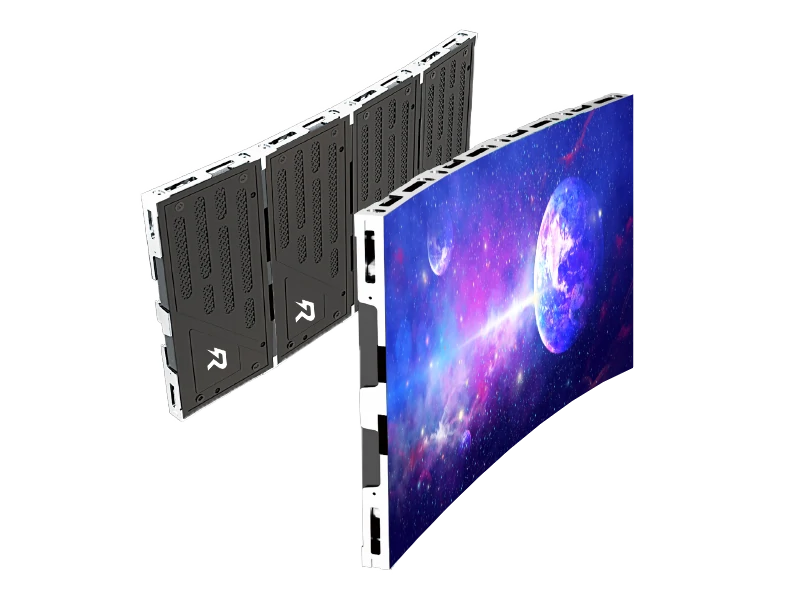
Yes. Many modern LED tiles are designed to accommodate curved installations, with some models supporting concave curves of up to 5 degrees per tile. For more complex shapes like columns, spheres, or freeform installations, manufacturers like Leyard and Absen offer specialized flexible or modular products designed for creative applications.
What is the difference between SMD and COB LED technology?
SMD (Surface Mounted Device) LEDs have the LED chips mounted on the surface of the PCB, while COB (Chip on Board) technology bonds the LED chips directly to the PCB and covers them with a protective epoxy layer. COB displays offer better protection against physical damage, wider viewing angles, and improved contrast, but they typically cost more than SMD equivalents.
How much does a direct view LED video wall cost?
Pricing varies widely based on pixel pitch, size, brightness, and manufacturer. As a rough guide, indoor fine-pitch displays (1.2–1.8mm) from premium manufacturers typically range from $8,000 to $20,000 per square meter, while larger-pitch outdoor displays can range from $2,000 to $6,000 per square meter. Samsung The Wall and Sony Crystal LED command a premium, while Chinese manufacturers like Absen and Unilumin often offer more competitive pricing.
Do I need a dedicated video processor for my LED wall?
Yes, in most cases. While some entry-level LED walls have basic built-in processing, professional installations typically require an external video processor or controller to handle scaling, switching between multiple input sources, color calibration, and advanced features like HDR tone mapping. Manufacturers like Barco, Novastar, and Megapixel offer processors designed specifically for LED video walls.
How do I maintain an LED video wall?
Regular maintenance includes keeping the display surface clean with a soft, lint-free cloth (never use abrasive cleaners or solvents), ensuring adequate ventilation around the tiles, and periodically checking for dead pixels or color shifts. Most manufacturers offer remote monitoring tools that can alert you to potential issues before they become visible problems. For front-access designs, individual tiles or modules can be replaced in minutes without removing the entire wall.
Can LED video walls be used outdoors?
Yes, but outdoor installations require displays specifically designed for the environment. Outdoor LED walls have higher brightness (5,000+ nits), higher IP ratings (IP65 or above for dust and water resistance), wider operating temperature ranges, and enhanced UV protection. They also typically use larger pixel pitches since viewing distances are greater outdoors.
What content resolution should I design for?
The ideal resolution depends on your pixel pitch and the physical size of your wall. For a wall with a 1.5mm pixel pitch that is 5 meters wide, the native horizontal resolution would be approximately 3,333 pixels, which is close to 4K. It is best to design your content to match the native resolution of the wall for the sharpest image, though most video processors can scale lower-resolution content to fit.
How long does a typical LED video wall installation take?
For a standard indoor installation of moderate size (e.g., 3m × 2m), the physical installation typically takes 2–4 days, including mounting structure setup, tile installation, cabling, and calibration. Larger or more complex installations can take 1–3 weeks. Pre-assembled all-in-one solutions from manufacturers like Samsung and Planar can be deployed in as little as a few hours.
.jpg "Where to Find Reliable China P2.6 Outdoor LED Video Wall Manufacturers?")