English
If you've been sifting through endless supplier pages trying to find legitimate china outdoor led video wall panel manufacturers and wondering what the real price should be, you're dealing with one of the most frustrating sourcing challenges in the LED display industry. I've spent close to a decade helping buyers across North America, Europe, and the Middle East navigate this exact market, and let me tell you — the gap between what shows up on a spec sheet and what actually performs in the field is wider than most people realise. Outdoor LED panels face brutal conditions: direct sunlight, torrential rain, temperature swings from -20°C to 60°C, salt spray in coastal installations, and constant UV bombardment. Not every factory that claims to manufacture outdoor panels has the engineering depth to handle all of that.
So what should you actually pay? How do you separate a real factory from a trading company? And which specifications genuinely matter when your panel needs to survive five to ten years of outdoor exposure? Let me walk through all of this based on hands-on experience working with factories and helping buyers avoid the mistakes that cost real money.
The core difference comes down to environmental protection and brightness. Indoor panels operate in controlled conditions — stable temperature, no rain, no direct sunlight. Outdoor panels need to handle all of that and more. Here's what changes:
Brightness — Outdoor panels need 5,000 to 10,000 nits to remain visible under direct sunlight. Indoor panels typically run 800 to 1,500 nits.
IP Rating — Outdoor panels require at minimum IP65 (dust-tight and protected against water jets). Many premium outdoor installations specify IP66 for protection against powerful water jets.
Temperature Range — Outdoor panels must operate reliably from -30°C to +60°C, with some extreme-climate installations requiring -40°C capability.
UV Resistance — The front mask, cabinet coating, and cable insulation all need UV-stabilised materials to prevent degradation over years of sun exposure.
Wind Load — Large outdoor installations need structural engineering to handle wind pressures, especially on building facades and highway gantries.
These requirements push manufacturing costs higher than indoor panels, and they also narrow the field of manufacturers who can do the job properly.
Understanding which pixel pitch fits your project is critical because it directly impacts price, viewing distance, and application suitability:
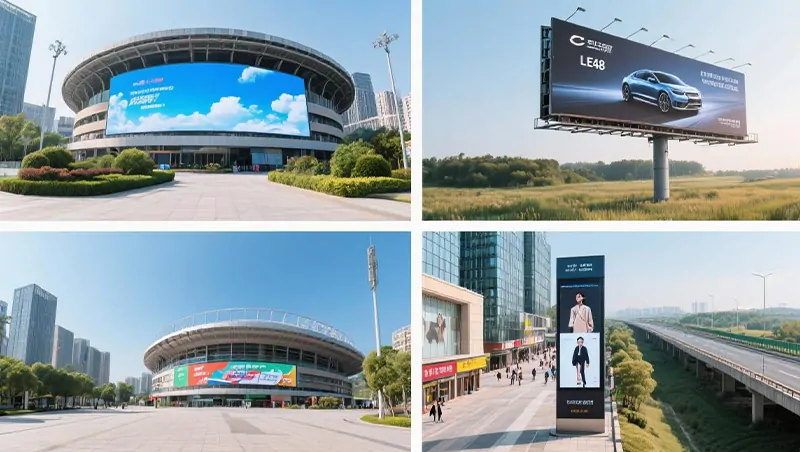
P3 to P4 — High-resolution outdoor panels for close viewing distances (3–5 metres). Used for building facades in pedestrian areas, retail storefronts, and premium advertising locations.
P4.81 to P5 — The workhorse range for outdoor rental and fixed installations. Good balance of resolution and cost for viewing distances of 5–8 metres.
P6 to P8 — Standard outdoor advertising panels for medium viewing distances (6–12 metres). Common for highway billboards, building-side advertising, and sports venue perimeter displays.
P10 to P16 — Long-distance viewing panels for large-scale installations where viewers are 10+ metres away. Used for stadium scoreboards, large highway billboards, and landmark displays.
| Feature | Outdoor Panels | Indoor Panels |
|---|---|---|
| Brightness | 5,000–10,000 nits | 800–1,500 nits |
| IP Rating | IP65 to IP68 | IP30 to IP43 |
| Operating Temp | -30°C to +60°C | 0°C to +45°C |
| UV Protection | Required (front mask, coating) | Not needed |
| Cabinet Material | Die-cast aluminium with anti-corrosion treatment | Standard aluminium or steel |
| Price per m² (P4–P6) | $450–$900 | $300–$600 |
| Weight per Cabinet | 12–18 kg (heavier due to sealing) | 6–10 kg |
| Typical Lifespan | 80,000–100,000 hours | 100,000+ hours |
The price premium for outdoor panels is real and justified — you're paying for waterproofing, higher-brightness LED chips, UV-resistant materials, and more robust thermal management.
This is where most buyers get burned, and I want to be blunt about it. The market is absolutely swarming with trading companies that present themselves as manufacturers. They'll have professional websites, factory photos borrowed from real manufacturers, and convincing sales pitches. But when it comes time to handle a custom outdoor engineering challenge or a warranty claim, you realise they have zero control over production.
Request a real-time video call where they walk you through the production floor. Not a pre-recorded video, not a virtual tour. A live call where you can ask them to point the camera at specific equipment. If they hesitate or make excuses, that's a significant red flag.
The surface mount technology lines are where LED beads and driver ICs get soldered onto PCB boards. For outdoor panels, you need high-precision placement machines — the industry standards are Fuji NXT series, Yamaha YSM series, and Panasonic NPM series. Ask how many SMT lines they operate and what placement accuracy they achieve.
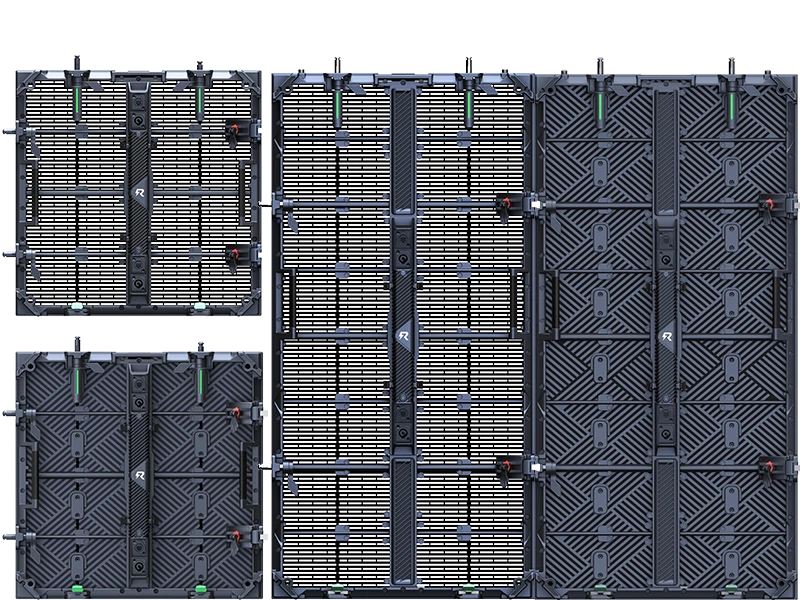
Outdoor panels require specialised sealing processes — silicone gaskets, waterproof connectors, conformal coating on PCB boards, and drainage design within cabinets. If the manufacturer outsources cabinet fabrication, they can't guarantee the IP rating that outdoor installations demand.
Every quality outdoor panel needs extended burn-in testing — typically 72 to 96 hours — and the best factories run aging tests in temperature-controlled chambers that simulate outdoor operating conditions. This catches early-failure components before they ever reach your installation site.
For manufacturers serving the international outdoor display market, I'd want to see at least 2,000 to 3,000 square metres of monthly outdoor panel output. Below that threshold, you're usually dealing with a small workshop that may struggle with consistency on larger orders.
Here's where you'll see the biggest differences between manufacturers who take outdoor engineering seriously and those who just add a waterproof label to an indoor panel.
| QC Stage | What Gets Inspected | What Happens If This Step Gets Skipped |
|---|---|---|
| Incoming LED Chip Inspection | Wavelength (±1.5nm), luminous intensity, forward voltage | Batch-to-batch colour variation visible across large installations |
| Post-SMT AOI Scan | Solder joint quality, component alignment, cold joints | Intermittent failures that appear after months of thermal cycling |
| IP Rating Verification | Water spray test, dust ingress test per IEC 60529 | Panels that fail in first rain event, causing short circuits |
| 72-Hour High-Temp Burn-in | Full-colour cycling at 50°C+ ambient | Latent LED failures that show up during summer operation |
| Thermal Cycling Test | Repeated -20°C to +60°C cycles | Solder joint cracks and connector failures after seasonal temperature changes |
| Final Calibration | Module-by-module brightness and colour correction | Visible seams, colour banding, and uneven brightness across tiled panels |
One thing I've learned the hard way — the thermal cycling test gets skipped by many manufacturers who are trying to cut production time. It's tempting because it adds 24 to 48 hours to the timeline, but it's also the step that catches solder joint weaknesses and connector issues that only appear after repeated expansion and contraction. Skipping it is a false economy that always comes back to bite you, usually in the first year of operation.
Let me lay out what you should actually expect to pay when sourcing outdoor panels from Chinese manufacturers. These are wholesale prices for orders of 10 square metres and above:
| Configuration | Price per m² (USD) | Typical Application |
|---|---|---|
| P3.91 Outdoor Rental (die-cast, 5000 nits, IP65) | $650–$900 | Concert stages, outdoor events, temporary installations |
| P4 Outdoor Fixed (SMD1921, 6500 nits, IP65) | $500–$750 | Building facades, retail advertising, medium-distance viewing |
| P5 Outdoor Fixed (SMD2525, 5500 nits, IP65) | $400–$600 | General outdoor advertising, community displays |
| P6 Outdoor Fixed (SMD2727, 5500 nits, IP65) | $350–$500 | Highway billboards, large-format advertising |
| P8 Outdoor Fixed (SMD3535, 5000 nits, IP65) | $280–$420 | Long-distance viewing, stadium displays, large landmarks |
| P10 Outdoor Fixed (SMD3535, 5000 nits, IP65) | $200–$350 | Very large installations, long viewing distances |
A critical note on what these prices do NOT include: Video processors and sending boxes, mounting structures (steel frames, poles, or building brackets), power distribution equipment, signal cabling (fibre optic, Cat6), flight cases or protective packaging for transport, spare parts packages, shipping and freight, import duties and taxes. When you're budgeting a complete deployed outdoor system, plan to add roughly 40% to 65% on top of the panel-only cost for a fully functional installation.
I've watched buyers get excited about a quote that looks 30% cheaper than competitors, only to discover later that the lower price covered bare modules without cabinets or power supplies. Sometimes the "price per square metre" is calculated based on module area rather than cabinet area, which can be misleading. Always confirm in writing exactly what's included in any quoted price.
This is probably the single most common complaint. You install a beautiful outdoor display, it looks fantastic for three months, and then you notice it's getting noticeably dimmer. Here's what happens at the manufacturing level: cheap LED chips with poor heat dissipation characteristics degrade faster when driven at the high currents needed for outdoor brightness. Premium manufacturers use LED chips from established suppliers like NationStar, Kinglight, or HSIOPT, and they design their driving circuits to operate the LEDs within safe current limits even at maximum brightness.
Outdoor panels live and die by their sealing quality. The connectors between cabinets — power connectors, signal connectors, and data cables — are the most common failure points for water ingress. Look for manufacturers that use IP67-rated connectors (like Neutrik or Amphenol equivalents) and apply silicone sealant at every cable entry point. I've seen panels that passed the factory IP65 test develop leaks after six months because the connector gaskets degraded under UV exposure.
LED chips from different production batches can have slight variations in dominant wavelength and luminous intensity. Even a 1 to 3 nanometre shift becomes visible on a large outdoor installation, especially when panels are tiled side by side. Reputable manufacturers address this by bin-sorting LEDs into tight wavelength groups, maintaining detailed batch records so repeat orders pull from the same LED bin, and aging all panels from the same batch together.
If your installation is within 5 kilometres of the ocean, standard powder-coated aluminium cabinets will start showing corrosion within 12 to 18 months. You need cabinets with marine-grade anodising or specialized anti-corrosion coatings rated for salt spray resistance (minimum 500 hours per ASTM B117 salt spray test). Not all outdoor panel manufacturers offer this — you need to specifically request it.
The panel price is just the starting point. Here's what else goes into the total cost when importing outdoor LED panels:
Freight: Sea freight (FCL) is the most economical option for orders over 10 m². A 20-foot container holds approximately 25 to 40 square metres of outdoor panels depending on cabinet size, with transit times of 15 to 25 days to the US West Coast and 25 to 35 days to European ports. Air freight delivers in 5 to 7 days but costs 4 to 6 times more — usually only justified for urgent replacements.
Import duties: LED display panels generally fall under HS code 8528.59. In the United States, standard duty sits around 0% to 5%, but Section 301 tariffs on Chinese-origin products can add an additional 25%. In the EU, standard duty is approximately 1.4% plus VAT. These rates shift periodically, so always verify with a licensed customs broker before finalising your budget.
Spare parts: Here's something I recommend to every buyer — when you place your initial order, simultaneously order a spare parts package equal to 5% to 8% of your total panel quantity. This should include extra modules from the same LED production batch, spare power supplies, additional receiving cards, spare cables, and a few extra cabinet rear covers and sealing gaskets. Outdoor panels are exposed to environmental stress that indoor panels never face, and having matched spare parts on hand prevents a single failure from becoming extended downtime while you wait for an international shipment.
Most outdoor panels ship with receiving cards pre-installed. The major ecosystems you'll encounter include Novastar (most widely adopted globally, excellent value), Colorlight (strong cost-performance ratio), and Brompton Tessera (premium choice for broadcast and high-end installations). Make sure the receiving card model in your quote matches your preferred control system. Mixing ecosystems can work but adds unnecessary complexity.
The wholesale relationships that deliver the best results over time are built on a few principles I've seen work consistently:
Start with a trial order — 5 to 10 square metres is enough to evaluate panel quality, communication responsiveness, documentation accuracy, and logistics reliability
Lock in LED bin specifications for repeat orders — once you've received and approved your initial batch, the manufacturer should record the exact LED bin codes and reserve matching stock for your future orders
Establish clear quality acceptance criteria in writing — dead pixel limits, brightness uniformity tolerance, colour temperature range, IP rating verification method. Don't leave these to verbal agreements
Visit the factory if possible — even a single in-person visit transforms the relationship from transactional to collaborative
Provide feedback on field performance — manufacturers genuinely value customers who report how panels perform after 12 or 24 months of real-world outdoor exposure
When you become a repeat customer, several advantages kick in: priority production scheduling during peak season (Q3 through Q4), consistent LED batch allocation for colour consistency, custom engineering support for non-standard configurations, better payment terms (moving from 100% upfront to 30% deposit / 70% before shipment), and dedicated account management.
From where I sit, the outdoor LED video wall panel manufacturing landscape in China is in a genuinely interesting position. Production costs have dropped meaningfully over the past few years as volumes have scaled and manufacturing processes have matured, but quality variation between manufacturers has actually widened. You've got top-tier factories producing outdoor panels with build quality that rivals any premium Western brand at a fraction of the cost, and you've got low-end workshops churning out panels that look fine on a spec sheet but can't survive a single rainy season.
The buyers who consistently do well in this market are the ones who invest real time in due diligence before placing orders. Visit the factory or at minimum do a live video tour. Request physical samples and test them in conditions that simulate your actual installation environment. Build relationships based on transparency and mutual accountability rather than chasing the lowest price per square metre.
If you're just starting to explore options, my honest advice is to shortlist 3 to 5 manufacturers, get samples from each, and do a direct side-by-side comparison. Run the same content on all of them. Check the colour uniformity across a large white field at maximum brightness. Leave them outside in the rain for a week and see what happens. The quality differences become really obvious once you have actual panels running the same content under real conditions, and that hands-on evaluation is worth far more than any amount of spec-sheet comparison.
The extra time you put into proper evaluation upfront will pay for itself many times over in reduced field failures, longer panel lifespan, and fewer project emergencies. Outdoor LED technology is mature and capable of delivering excellent performance for a decade or more — as long as you partner with a manufacturer who takes the engineering seriously.
Most china outdoor led video wall panel manufacturers set their wholesale pricing threshold at 5 to 10 square metres. Some will accommodate smaller trial orders of 2 to 3 square metres at a slightly higher per-unit cost. True volume wholesale pricing with the best per-square-metre rates typically kicks in at 15 to 20 square metres and above.
Well-manufactured outdoor panels carry a rated lifespan of 80,000 to 100,000 hours, which translates to roughly 9 to 11 years of continuous 24/7 operation. In typical commercial use running 16 to 20 hours daily, you can expect 10 to 15 years before brightness degrades to 50% of original output. Actual service life depends heavily on operating temperature, local climate conditions, and how well the manufacturer's thermal management is designed.
For outdoor panels facing direct sunlight, you need a minimum of 5,000 nits. For south-facing installations in tropical or desert climates, 6,500 to 8,000 nits is recommended. Panels facing north or in shaded locations can operate effectively at 4,000 to 5,000 nits. Higher brightness comes at a cost premium and increased power consumption, so match the brightness to your actual installation conditions.
IP65 is the minimum acceptable rating for outdoor installations — it provides protection against dust ingress and low-pressure water jets from any direction. For installations exposed to heavy rain, coastal environments, or locations where panels may be subjected to high-pressure washing, IP66 is recommended. Some premium manufacturers offer IP68-rated cabinets for extreme conditions including temporary submersion.
Request that all panels be produced from the same LED wavelength bin (±1.5nm) and same brightness bin (±5%). Reputable manufacturers maintain detailed batch records and can match repeat orders to your original LED bin specification. Always order spare modules from the same production batch as your main order to guarantee visual consistency.
Outdoor panels typically draw 200 to 500 watts per square metre during normal content display, depending on pixel pitch, brightness settings, and content type. Peak consumption (full white at maximum brightness) can reach 800 to 1,200W/m² for high-brightness panels. Plan your electrical infrastructure based on peak figures with a 20% safety margin.
Industry standard warranty is 2 years covering manufacturing defects in LED chips, driver ICs, power supplies, and PCB boards. Some premium manufacturers offer 3-year warranties for outdoor products. Always confirm whether the warranty covers on-site replacement service or requires return-to-factory repair, and whether labour costs for field replacement are included.
Quality outdoor panels typically require 20 to 30 working days for orders under 50 square metres. The timeline includes aging tests, environmental testing, and calibration. Larger orders (50 to 200 m²) may require 30 to 45 working days. During peak season (Q3 to Q4), add another 5 to 10 working days.
At minimum, look for CE (European conformity), FCC (US electromagnetic compatibility), RoHS (restriction of hazardous substances), and ISO 9001 (quality management system). For North American installations, ETL or UL listing is often required by local building codes. For outdoor-specific validation, ask for IP rating test reports from accredited laboratories and salt spray test certificates if installing in coastal environments.
Yes, but you need to specify your climate requirements when ordering. Standard outdoor panels are rated for -20°C to +50°C. For extreme cold environments (northern Canada, Scandinavia, Russia), request panels with internal heating elements and low-temperature-rated components rated to -40°C. For extreme heat environments (Middle East, desert regions), specify panels with enhanced cooling systems and components rated for +60°C ambient operation. Not all manufacturers offer these extreme-climate variants as standard, so confirm capability before ordering.