English
Looking for reliable China LED video wall rental manufacturers to power your next event, concert, or exhibition? You're not alone. Event organizers, AV rental companies, and production houses across North America and Europe are increasingly turning to Chinese manufacturers for high-quality, cost-effective LED display solutions. But with hundreds of suppliers claiming to offer the best deal, how do you separate genuine quality from empty promises?
The global LED video wall rental market has experienced explosive growth, driven by rising demand for immersive visual experiences at concerts, trade shows, corporate events, and sports venues. China, as the world's dominant manufacturing hub for LED display technology, produces over 80% of the world's LED screens. This concentration of manufacturing capability means buyers have access to an extraordinary range of options — from budget-friendly standard panels to cutting-edge Micro LED solutions. Yet this abundance also creates a challenge: navigating the landscape efficiently without falling prey to unreliable suppliers or mismatched products.
This guide cuts through the noise. We'll walk you through exactly what to look for in China LED video wall rental manufacturers, how to evaluate their capabilities, which companies have proven track records, and how to structure your sourcing process for maximum value. Whether you're a first-time buyer or an experienced procurement manager, you'll find actionable insights to make informed decisions.
Before diving into specific manufacturers, it's worth understanding why China has become the go-to destination for LED video wall rental equipment. The answer lies in a combination of factors that are difficult to replicate elsewhere.
Unmatched supply chain concentration. The Pearl River Delta region, particularly Shenzhen, hosts the world's densest cluster of LED display component suppliers, assembly facilities, and R&D centers. This ecosystem enables manufacturers to source high-quality LED chips (from brands like NationStar, Kinglight, and Nichia), driver ICs (from Macroblock and My-Semi), and power supplies (from Mean Well) within a tight geographic radius — reducing costs and lead times significantly.
Scalable production capacity. Top-tier Chinese LED manufacturers operate production lines capable of outputting thousands of square meters of LED panels per month. This scale means they can fulfill large orders for international rental companies without compromising quality or delivery timelines. For context, leading manufacturers like Unilumin have reported annual revenues exceeding RMB 7.4 billion, with LED video wall shipments ranking first among publicly listed companies for multiple consecutive years.
Rapid technology iteration. Chinese manufacturers have been at the forefront of key technology transitions — from SMD (Surface Mount Device) to COB (Chip on Board), from standard pixel pitches to Micro LED solutions reaching P0.3. This pace of innovation means buyers sourcing from China gain access to display technologies that may not yet be available from Western competitors, often at a fraction of the cost.
Competitive pricing without sacrificing quality. It's a misconception that "Made in China" automatically means low quality. Many Chinese LED manufacturers serving the international rental market operate under stringent quality management systems, holding certifications including ISO 9001, CE, FCC, RoHS, and UL. The price advantage typically ranges from 30% to 50% compared to equivalent products from European or North American brands, primarily due to lower manufacturing costs rather than inferior components.
What separates a reliable rental LED video wall from a problematic one? The answer lies in understanding the technical specifications that directly impact performance, durability, and total cost of ownership. Here are the critical parameters you need to evaluate.
Pixel pitch (the distance between individual LED pixels, measured in millimeters) determines the optimal viewing distance and image clarity. For rental applications, the most common pixel pitches fall into these ranges:
P1.9–P2.6: Ideal for indoor events with close viewing distances (3–10 meters), such as corporate conferences, wedding venues, and broadcast studios
P2.9–P3.9: The sweet spot for most rental applications, balancing resolution and cost for mid-size venues
P4.8–P6.25: Best suited for outdoor events and large venues where viewing distances exceed 10 meters
Indoor rental screens typically operate at 800–1500 nits, while outdoor rental screens require 4500–6500 nits to maintain visibility under direct sunlight. Contrast ratio affects image depth and black level performance — look for ratios of 5000:1 or higher for professional-grade results.
A refresh rate of 3840Hz is the minimum acceptable standard for rental screens, ensuring flicker-free video capture by professional cameras. Premium products offer 7680Hz refresh rates, which is essential for broadcast-quality applications where cameras operate at high frame rates.
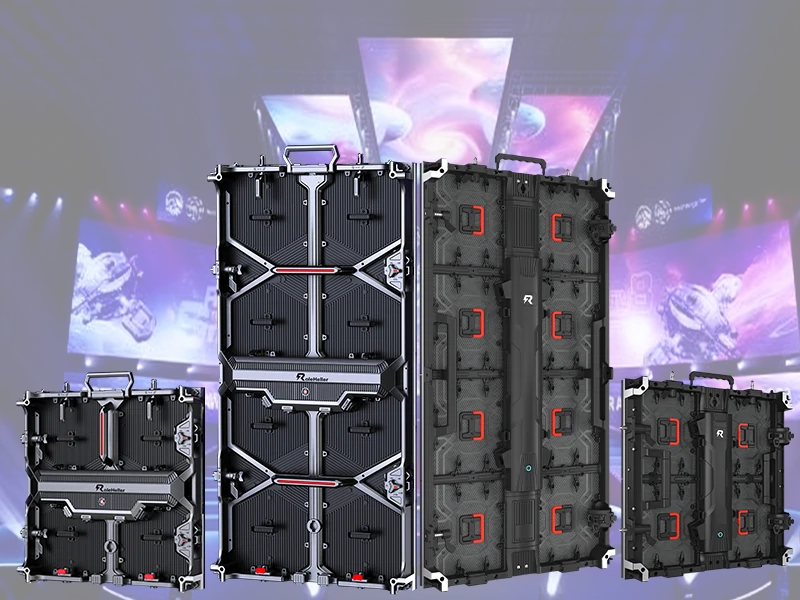
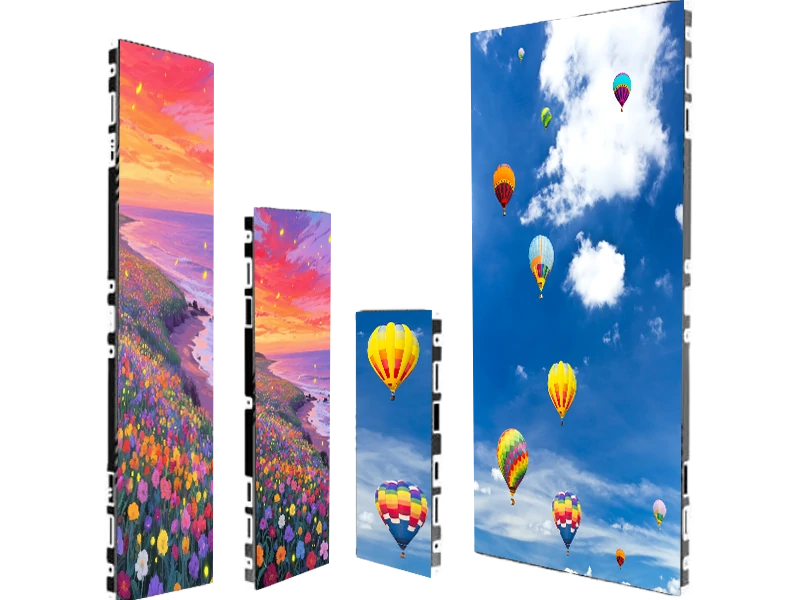
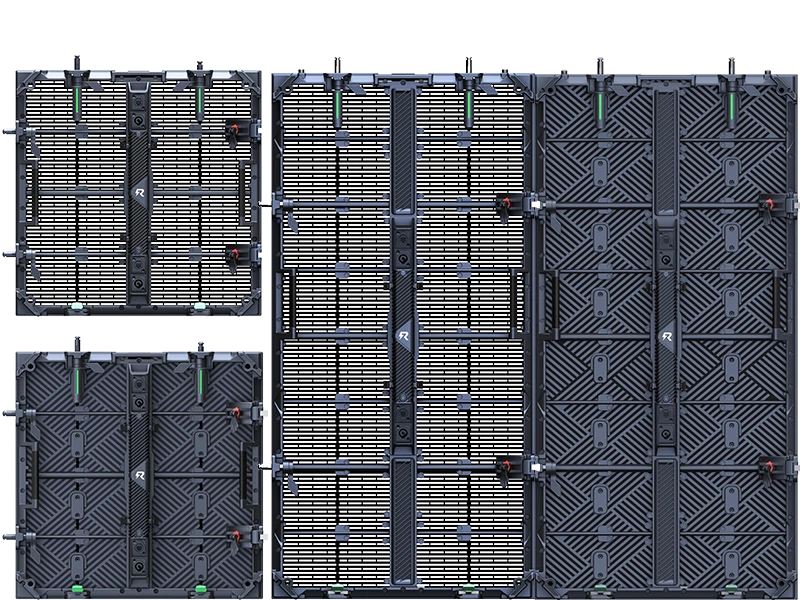
Rental screens undergo frequent assembly and disassembly, making weight a critical factor. Die-cast aluminum cabinets are the industry standard, offering an optimal balance of structural rigidity and lightweight portability. Premium rental cabinets typically weigh between 7–12 kg per panel (for 500mm × 500mm or 500mm × 1000mm formats), enabling single-person handling in many cases.
For outdoor rental applications, an IP65 rating (dust-tight and protected against water jets) is the baseline requirement. Some manufacturers offer enhanced protection with front-and-rear IP65 sealing, which is particularly valuable for events in tropical or coastal environments.
The best rental LED walls feature tool-free module replacement, allowing on-site technicians to swap individual modules or power supplies in under 60 seconds without dismantling the entire structure. Front-service and dual-service (front and rear access) designs significantly reduce downtime during live events.
The Chinese LED display industry includes several tiers of manufacturers, ranging from publicly listed industry giants to specialized niche producers. Below is a curated selection of manufacturers with proven track records in the international rental market, organized by their market positioning.
Headquartered in Shenzhen and listed on the Shenzhen Stock Exchange (stock code: 300232), Unilumin has consistently ranked first globally in LED video wall revenue and shipment volume among publicly listed companies. The company operates three brands — ROE (targeting the premium international rental market), Unilumin (mainstream professional displays), and LAMPRO (specialized creative solutions) — providing coverage across virtually every market segment.
Rental product highlights: Ultra-lightweight rental cabinets with fast-lock mechanisms, supporting curved installation from -10° to +10°; integrated cabling systems that reduce setup time by up to 40%
Global footprint: Marketing network spanning 160+ countries with 5,400+ distribution partners and 20+ overseas subsidiaries
Best suited for: Large-scale rental companies, major event production houses, and buyers requiring consistent supply of high-volume orders
Established in 2001 and headquartered in Shenzhen, Absen is widely recognized as China's leading LED display export enterprise, with products sold in over 120 countries. The company's A-series rental screens have become a familiar sight at major concerts, exhibitions, and sporting events worldwide.
Rental product highlights: Lightweight, fast-installation design with proprietary "True Color" technology for exceptional color reproduction; 140+ invention patents
Quality assurance: Rigorous aging tests (72+ hours), IP65 protection for outdoor models, and comprehensive international certifications
Best suited for: Mid-to-large rental companies seeking a balance of brand recognition, product reliability, and competitive pricing
As the global leader in LED display market share (a position held for multiple consecutive years), Leyard brings unmatched R&D capabilities and production scale. Founded in 1995 and headquartered in Beijing with major manufacturing bases in Shenzhen, Leyard was the first company globally to mass-produce Micro LED displays.
Rental product highlights: Full product range from P0.7 Micro LED to standard rental pitches; advanced COB technology for superior protection and image quality
Notable projects: Core display supplier for the Beijing Winter Olympics opening ceremony
Best suited for: Premium-tier buyers requiring cutting-edge technology and brand prestige for high-profile events
Based in Shenzhen and established in 2009, LeiLing Display has spent over 15 years specializing exclusively in LED rental screens. The company commands an estimated 40% share of China's domestic stage rental market and exports to over 130 countries, with more than 20,000 successful project installations.
Rental product highlights: Comprehensive product matrix covering indoor/outdoor rental screens, creative rental displays, LED ice screens, flexible screens, and floor tiles; automated production lines ensuring consistency
Service model: Full integration of R&D, manufacturing, and sales with dedicated export teams
Best suited for: Rental companies seeking a specialized partner with deep expertise in the unique demands of the rental market
A Shenzhen-based high-tech enterprise founded by a team from leading global LED display companies, VISUALEADER focuses on providing integrated LED display system solutions. The company offers a comprehensive rental product lineup including the T-Series (standard rental), Color Crystal Series (premium rental), and TG Series (GOB rental displays).
Rental product highlights: Enhanced locking systems with adjustable arc (0° to ±10°); independent modularized design with self-protection features; integrated cabling for rapid deployment
Production capacity: Significant monthly output with dedicated R&D investment
Best suited for: Buyers seeking a technology-driven manufacturer with strong customization capabilities
With over 20 years of experience, D-King positions itself as a one-stop LED display solution provider based in Shenzhen. The company's product range spans stage and rental displays, commercial screens, DOOH/OOH applications, and creative LED installations, with a monthly production capacity of 8,000 square meters.
Rental product highlights: Competitive wholesale pricing directly from factory; comprehensive certification portfolio; wide range of conventional and creative LED solutions
Service model: Emphasis on cutting out middlemen to deliver professional-grade panels at true wholesale prices
Best suited for: Cost-conscious buyers and emerging rental companies seeking factory-direct pricing
Selecting the right China LED video wall rental manufacturer requires a structured evaluation process. Here's a practical framework that experienced procurement professionals use.
Before reaching out to any supplier, document your specific needs:
Primary use case: Concert touring, corporate events, trade shows, fixed installation, or mixed use?
Environment: Indoor-only, outdoor-only, or both?
Pixel pitch preference: Based on your typical viewing distances
Volume: How many square meters per order? How many orders per year?
Budget range: Per-square-meter target price, including shipping
Not all "manufacturers" in China are actual manufacturers. Some are trading companies that source from factories and add a markup. Here's how to verify:
Business license: Check the registered business scope — actual manufacturers will list "production" or "manufacturing" (生产/制造)
Factory audit reports: Request recent audit reports from third-party inspection agencies (SGS, Bureau Veritas, TÜV)
Certification documents: Verify CE, FCC, UL, and RoHS certificates directly with the issuing bodies
Production facility video tour: Reputable manufacturers will offer live video calls showing their production lines
Never place a large order without first testing samples. A proper evaluation includes:
Visual inspection: Check for dead pixels, color uniformity, and build quality
Brightness and color calibration verification: Use a colorimeter to measure actual performance against specifications
Assembly and disassembly test: Time how long it takes to connect and disconnect cabinets — this directly impacts your labor costs on-site
Aging test: Request 48–72 hour continuous operation data to identify early failure patterns
For international buyers, after-sales support is often the make-or-break factor. Key questions to ask:
Do they maintain spare parts inventory specifically for your order?
What is their response time for technical issues (target: under 24 hours)?
Do they offer remote technical support via video call during your events?
Can they provide on-site technical personnel for large projects?
What is their warranty policy (standard: 2–3 years for LED modules, 1–2 years for other components)?
Understanding how LED video wall rental panels are priced helps you negotiate effectively and avoid hidden costs. Here's a general pricing framework based on current market conditions.
| Product Category | Pixel Pitch | Typical Price Range (USD/sqm) | Key Differentiators |
|---|---|---|---|
| Economy Indoor Rental | P3.91–P4.81 | $400–$700 | Standard SMD, basic cabinet, suitable for short-term events |
| Mid-Range Indoor Rental | P2.6–P2.97 | $700–$1,200 | Better color uniformity, lighter cabinets, higher refresh rate |
| Premium Indoor Rental | P1.9–P2.5 | $1,200–$2,500 | High refresh (≥3840Hz), superior calibration, lightweight design |
| Economy Outdoor Rental | P3.91–P4.81 | $600–$1,000 | IP65 rated, high brightness (≥5000 nits) |
| Mid-Range Outdoor Rental | P2.97–P3.91 | $1,000–$1,800 | Enhanced brightness, robust cabinet, front/rear service |
| Premium Outdoor Rental | P2.5–P2.97 | $1,800–$3,500 | GOB protection, ultra-high brightness, advanced calibration |
Important cost considerations beyond the panel price:
Shipping: Sea freight from Shenzhen to major US/European ports typically adds $50–$150 per cubic meter. Flight cases add significant volume
Import duties: Vary by country (US: typically 0–5% for LED displays under current trade agreements; EU: 0–1.4%)
Controller systems: Novastar or Colorlight processing systems are usually priced separately ($500–$3,000 depending on configuration)
Spare parts package: Budget an additional 3–5% of order value for spare modules, power supplies, and receiving cards
Customs brokerage and local delivery: Factor in $200–$500 per shipment for port handling and last-mile delivery
Sourcing LED video walls from China is not without its challenges. Here are the most common issues international buyers encounter, along with practical solutions.
Quality inconsistency between samples and bulk production. This is perhaps the most frequently reported complaint. The solution is to include detailed technical specifications in your purchase agreement — specifying exact LED chip brands, driver IC models, power supply brands, and acceptable tolerance ranges for brightness and color uniformity. Request pre-shipment inspection by a third-party agency (cost: approximately $300–$500 per day) to verify compliance before goods leave the factory.
Communication barriers and time zone differences. While most export-oriented manufacturers have English-speaking sales teams, technical discussions can sometimes lose nuance. Best practice: establish a dedicated communication channel (WeChat or WhatsApp group) with both sales and engineering contacts; use annotated diagrams and specification sheets rather than relying solely on text descriptions; schedule regular video calls during overlapping business hours.
Intellectual property concerns. Some buyers worry about design copying or unauthorized use of proprietary technology. Reputable manufacturers will sign NDA (Non-Disclosure Agreement) and IP protection agreements. Additionally, choosing manufacturers with their own R&D teams and patent portfolios (rather than those relying entirely on OEM designs) reduces this risk significantly.
Logistics and lead time management. Standard production lead times range from 15–30 days for stock items and 30–45 days for custom orders. Add 25–40 days for sea freight to North America or Europe. Build buffer time into your project schedule, and consider maintaining a strategic spare parts inventory to cover unexpected failures between orders.
Payment security for first-time transactions. For initial orders, use secure payment methods such as Letter of Credit (L/C) or escrow services through platforms like Alibaba Trade Assurance. As trust builds over multiple transactions, you can transition to more flexible payment terms (typically 30% deposit, 70% before shipment).
When evaluating China LED video wall rental manufacturers, understanding the certification landscape helps you set appropriate quality benchmarks. Here are the key certifications and standards to look for.
North America: FCC (electromagnetic compatibility), UL/cUL (electrical safety), ETL (alternative safety certification)
European Union: CE (covering LVD for electrical safety, EMC for electromagnetic compatibility, and RoHS for hazardous substance restrictions)
International: ISO 9001 (quality management system), ISO 14001 (environmental management)
LED module aging test: 48–72 hours of continuous operation at elevated temperature to identify early-failure components
Vibration and shock testing: Simulates transportation conditions (look for compliance with IEC 60068-2-6 or ISTA standards)
IP rating verification: Independent lab testing confirming dust and water ingress protection levels
Color uniformity measurement: Using spectrophrometers to ensure chromaticity deviation (Δu, Δv) falls within acceptable ranges (typically Δu, Δv ≤ 0.003 for premium products)
Manufacturers who cannot provide original certification documents (only photocopies or expired certificates)
Absence of third-party test reports from recognized laboratories
Refusal to allow factory audits or live production line inspections
Specifications that seem too good to be true at the quoted price point
For those ready to begin or optimize their sourcing process, here's a step-by-step workflow that minimizes risk and maximizes value.
Identify 5–8 potential manufacturers through industry directories, trade show exhibitor lists (InfoComm, ISE, LED China), and peer recommendations
Review each company's website, product catalog, and case study portfolio
Verify business registrations and certifications through official databases
Send a detailed RFQ (Request for Quotation) specifying pixel pitch, cabinet size, quantity, target price, delivery terms, and certification requirements
Evaluate responses based on technical accuracy, communication quality, and willingness to customize
Request product datasheets, specification comparisons, and reference project lists
Order 2–4 sample cabinets from your top 2–3 candidates
Conduct thorough testing: visual inspection, brightness/color measurement, assembly/disassembly timing, and compatibility checks with your existing control systems
Document findings in a standardized comparison matrix
Visit the shortlisted manufacturer's facility (or arrange a video audit if travel isn't feasible)
Inspect production lines, quality control processes, warehouse management, and testing equipment
Negotiate final pricing, payment terms, warranty conditions, and delivery schedules
Place order with clear contractual terms including technical specifications, quality acceptance criteria, penalty clauses for delays or defects, and warranty provisions
Request weekly production updates with photos and videos
Arrange pre-shipment inspection for orders exceeding $10,000
Coordinate logistics with your freight forwarder
Provide installation guides and video support to your technical team
Collect performance data after the first few events and share feedback with the manufacturer for continuous improvement
The LED video wall rental industry is evolving rapidly, and understanding emerging trends helps you make forward-looking sourcing decisions.
COB (Chip on Board) technology adoption. COB encapsulation provides superior protection against impact, moisture, and dust compared to traditional SMD LEDs. As COB production costs decrease, expect it to become the standard for premium rental screens within the next 2–3 years, offering longer lifespan and reduced maintenance costs.
Finer pixel pitches for rental applications. The trend toward smaller pixel pitches (P1.5 and below) for rental screens is accelerating, driven by demand for higher-resolution content and closer viewing distances at premium events. Manufacturers investing in Micro LED production lines are positioning themselves for this shift.
Integrated smart features. Next-generation rental cabinets are incorporating built-in sensors for temperature, humidity, and voltage monitoring, with wireless data transmission to cloud-based management platforms. This enables predictive maintenance and remote diagnostics — reducing on-site technical staffing requirements.
Sustainability and energy efficiency. Growing environmental regulations in Europe and North America are pushing manufacturers toward more energy-efficient LED drivers, recyclable cabinet materials, and reduced power consumption. Buyers who prioritize these factors today will be better positioned for future regulatory compliance.
AI-driven content management. Integration of AI-powered content scaling and real-time optimization is beginning to appear in high-end rental systems, automatically adjusting brightness, contrast, and color balance based on ambient conditions and content type.
Q1: What is the minimum order quantity (MOQ) for most China LED video wall rental manufacturers?
Most manufacturers set MOQs at 10–20 square meters for standard products, though some accommodate smaller trial orders of 5–10 square meters for first-time buyers at a slightly higher per-unit price.
Q2: How long does it typically take to receive LED panels after placing an order?
Standard products ship within 15–20 business days from order confirmation. Custom configurations may require 30–45 days. Sea freight to North America adds 25–35 days; to Europe, 30–40 days. Air freight is available at 3–5x the sea freight cost, reducing transit to 5–7 days.
Q3: Can Chinese manufacturers provide LED panels compatible with Novastar and Brompton control systems?
Yes. The vast majority of established Chinese LED manufacturers design their products to be fully compatible with mainstream control systems including Novastar, Colorlight, Brompton, and ROE. Confirm compatibility during the quotation stage and request configuration files.
Q4: What warranty terms should I expect from a reputable manufacturer?
Industry standard warranty covers LED modules for 2–3 years, power supplies for 1–2 years, and structural components (cabinets, connectors) for 2–3 years. Premium manufacturers may offer extended warranties of up to 5 years on LED modules for an additional fee.
Q5: Are there significant quality differences between Shenzhen-based manufacturers and those in other Chinese cities?
Shenzhen benefits from the most concentrated LED supply chain ecosystem, giving its manufacturers advantages in component sourcing, technical talent availability, and production efficiency. However, quality varies more by individual company practices than by geography. Manufacturers in cities like Xiamen, Zhengzhou, and Hangzhou can also produce excellent products if they maintain rigorous quality control.
Q6: How do I handle customs clearance and import duties for LED displays?
LED displays typically fall under HS code 8528.59 (other monitors and projectors) or 8504.40 (static converters, for LED modules). Duty rates vary: the US currently applies 0–5% for most LED display products; the EU applies 0–1.4%. Consult a licensed customs broker in your country for precise classification and duty calculation.
Q7: What payment methods are commonly accepted by Chinese LED manufacturers?
For initial orders: T/T (bank transfer) with 30% deposit and 70% before shipment, or Letter of Credit (L/C) at sight. For established relationships: open account terms (net 30–60 days) may be available. Alibaba Trade Assurance and similar escrow services provide additional payment protection for online transactions.
Q8: Can manufacturers provide on-site technical support for large international events?
Many Tier 1 and Tier 2 manufacturers offer on-site technical support for large projects, typically at a daily rate of $200–$400 per engineer plus travel expenses. This service is particularly valuable for first-time installations or high-profile events where downtime is unacceptable.
Q9: What is the expected lifespan of rental LED panels under normal usage conditions?
Quality LED rental panels have a rated lifespan of 50,000–100,000 hours (approximately 5.7–11.4 years of continuous operation). In typical rental usage (200–400 hours per year), panels can last 15–25 years. The practical replacement cycle is usually 5–8 years, driven by technology upgrades rather than physical failure.
Q10: How do I verify that a manufacturer's claimed production capacity is accurate?
Request a live video tour of the production facility during working hours. Ask to see production records, equipment lists (specifically SMT machine brands and models — look for Yamaha, Panasonic, or Juki pick-and-place machines), and recent shipping records. Third-party factory audits by SGS, Intertek, or Bureau Veritas provide the most reliable capacity verification.