 English
To give you the direct answer right up front: the most dependable led display for advertising manufacturers are based in Guangdong province, split between Shenzhen (specifically the industrial belts in Bao'an, Shiyan, and Guangming) for precision engineering and Huizhou for massive automated production lines. If you want a commercial advertising video wall that runs seven to ten years without constant pixel dropouts, target established Tier-2 specialized export OEMs rather than unverified trading storefronts or overpriced corporate giants. A genuine commercial-grade outdoor advertising screen with Nationstar gold-wire LEDs, high-refresh driver chips, and certified Mean Well power supplies should run between $480 and $750 per square meter on an EXW basis, while high-brightness indoor retail displays hover between $550 and $950 per square meter. Any factory offering you complete outdoor cabinets for $300 is substituting cheap alloy wiring, skipping mandatory burn-in cycles, and putting your installation at risk.
Have you ever spent three weeks trading messages with sales reps, thinking you found an incredible bargain on a P4 outdoor billboard, only to have the crates arrive at your job site with mismatched module colors, warped frames that leave bright lines down the screen, and power supplies that run so hot you can barely touch the cabinet? If you have been through that headache, you know how tricky sourcing hardware from overseas can be. Walking through trade halls or scrolling through supplier catalogs makes every vendor look like an industry leader with pristine automated facilities. The truth is quite different once you look past the glossy product photography. Let us walk through how the advertising display manufacturing ecosystem actually operates, where factories quietly cut corners, and how you can run a smooth procurement process that protects your capital.
When we source equipment from overseas, we must realize that not every vendor with a corporate catalog operates an actual production line. The market for advertising displays in mainland China splits into three separate tiers, each serving totally different customer profiles.
These are the massive public corporations whose names you see on airport terminals, sports stadiums, and giant trade show booths.
Their Strengths: They run automated surface-mount technology (SMT) lines in temperature-controlled cleanrooms that look like semiconductor plants. Their mechanical tolerances stay within fractions of a millimeter, and their products hold valid international safety marks (UL, ETL, CE, FCC, RoHS).
The Sourcing Catch: You pay a substantial brand premium of 35% to 50%. Unless your order covers hundreds of square meters, your project gets assigned to a junior sales rep who cannot negotiate on cabinet customization, and payment terms remain completely rigid.
This tier consists of mid-sized, engineering-driven factories that focus heavily on international export standards. Many of them build white-label hardware for well-known American and European AV distributors.
Their Strengths: They source the exact same tier-one raw materials as the corporate giants—genuine Nationstar LEDs, Macroblock or Chipone driver ICs, and Mean Well power supplies—while running lean operations. You get roughly 90% of the visual performance and longevity of Tier 1 brands at 60% to 70% of the cost.
Engineering Flexibility: Their engineering teams readily accommodate custom cabinet dimensions, front-access servicing mechanics, and unique corner-bevel angles for curved building facades.
These operations rent floor space in older industrial parks, buy bare printed circuit boards (PCBs) from wholesale markets, and mount parts using older pick-and-place machines or manual soldering.
The Hazards: They survive by winning bids purely on price. They substitute copper-wire LEDs for gold wire, run power supplies past 90% of rated capacity, and skip the critical 72-hour continuous thermal aging test. When modules start dropping pixels four months after installation, their customer support becomes completely unresponsive.
To help you balance viewing distances, physical resolution, and budget limits, here is a breakdown of standard advertising display configurations based on realistic factory bills of materials.
| Screen Type & Pixel Pitch | Optimal Viewing Distance | Target Brightness (Nits) | Refresh Rate (Hz) | Recommended Cabinet Metallurgy | Realistic Factory EXW Price ($/m²) | Best-Fit Advertising Location |
|---|---|---|---|---|---|---|
| Indoor P1.53 SMD | 1.5 m – 3.0 m | 600 – 800 | 3840 – 7680 | Die-Cast Magnesium / Aluminum | $850 – $1,250 | Luxury retail storefronts, auto showrooms, corporate atrium walls |
| Indoor P2.0 SMD | 2.0 m – 4.5 m | 600 – 900 | 3840 | Die-Cast Aluminum (640×480mm) | $620 – $850 | Shopping mall corridors, hotel lobbies, conference centers |
| Indoor P2.5 SMD | 2.5 m – 6.0 m | 700 – 1,000 | 3840 | Extruded Aluminum / Slim Profile | $480 – $650 | Large indoor retail concourses, transit station ticketing halls |
| Outdoor P3.91 SMD | 4.0 m – 12.0 m | 5,500 – 6,500 | 3840 | CNC Die-Cast Aluminum (IP65) | $650 – $820 | Pedestrian shopping streets, outdoor store facades, transit shelters |
| Outdoor P5 SMD | 5.0 m – 25.0 m | 6,000 – 7,000 | 3840 | Die-Cast Aluminum (960×960mm) | $480 – $620 | Roadside pylon displays, commercial plazas, building lower facades |
| Outdoor P8 SMD | 8.0 m – 50.0 m | 6,500 – 8,000 | 1920 – 3840 | Aluminum Profile / Sealed Iron | $420 – $540 | Highway digital billboards, sports stadium perimeters |
| Outdoor P10 SMD | 10.0 m – 80.0 m | 7,500 – 9,000 | 1920 – 3840 | High-Strength Sealed Profile | $380 – $480 | High-elevation highway gantries, large rooftop advertising boards |
When comparing quotes from led display for advertising manufacturers, the price tag is dictated entirely by the components mounted on the circuit board and inside the frame. If a quote looks unusually cheap, the factory is trimming margins off components that you cannot easily inspect from a distance.
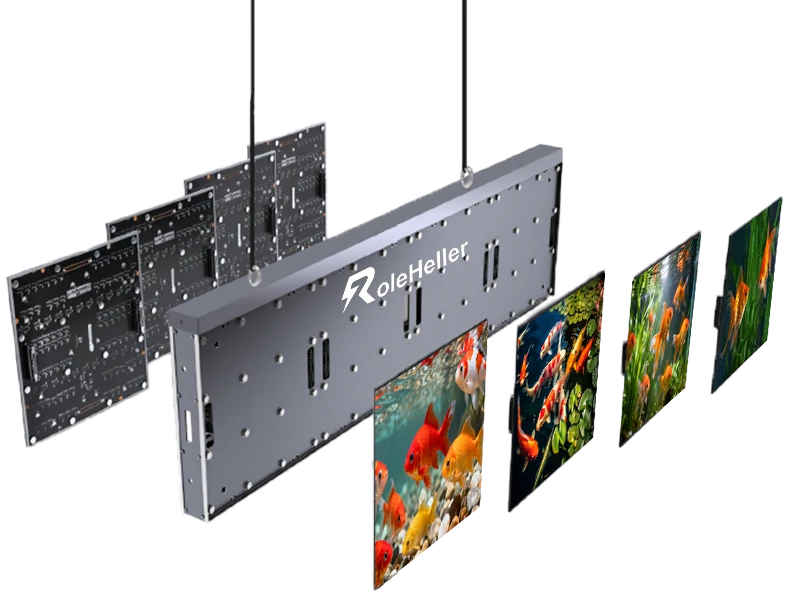
Inside every tiny surface-mount diode, microscopic bond wires connect the semiconductor dies (Red, Green, Blue) to the lead frame.
Pure Gold Wire (99.99%): Gold resists oxidation, handles thermal expansion and contraction gracefully during winter freezes and summer heatwaves, and ensures steady conductivity over seven to ten years of continuous operation. Nationstar Gold Wire series represents the industry benchmark.
Copper and Alloy Wire: Budget builders cut diode costs by 20% to 30% by substituting copper or composite alloy wire. Copper oxidizes rapidly when ambient humidity works its way into the plastic casing. That oxidation creates micro-fractures in the bond, which show up on your screen as dead pixels, flickering rows, or single-color lines that remain stuck on red or blue.
Our Rule of Thumb: Always require the specific diode part number written into the commercial invoice, rather than accepting a generic statement like "Nationstar brand diodes."
The driver chip controls how current flows through the diodes to render colors and refresh frames.
PWM High-Performance Drivers: Chips such as the Macroblock MBI5153 or Chipone ICN2153 deliver refresh rates from 3840Hz up to 7680Hz. This ensures that when passersby film your screen with modern smartphones, the footage remains completely clear without dark rolling horizontal scan bars. Furthermore, these chips preserve clean 16-bit grayscale depth when the display dims automatically after sunset.
Basic Dual-Latch Drivers: Low-cost chips run at 1920Hz. On camera lenses, the display flickers severely. When you dial down screen brightness to 20% for nighttime operation, the colors turn blocky and muddy, ruining the visual quality of your advertisements.
Advertising displays pull heavy continuous current, especially when displaying advertisements with bright white backgrounds.
Certified Power Supplies: Brands like Mean Well, G-Energy, and Great Wall provide high power factor correction (PFC) and run cool. Well-engineered displays run power supplies at 60% to 70% of maximum rated capacity.
Overstressed Clones: Cheap assemblers install unbranded power supplies and run them at 90% capacity to shave a few dollars off each cabinet. The result is intense internal heat, capacitor failure, and electrical tripping during hot afternoons.
Before committing to a cabinet design, we must determine how our technicians will physically access the screen for maintenance.
+----------------------------------------------------------------------------------------------------+
|                                    MAINTENANCE ACCESS PATHWAYS                                     |
+--------------------------+---------------------------------+---------------------------------------+
| SYSTEM FEATURE           | FRONT-SERVICE CABINETS          | REAR-SERVICE CABINETS                 |
+--------------------------+---------------------------------+---------------------------------------+
| Structural Depth Needed  | Very thin: 100mm to 180mm       | Deep: 600mm to 900mm                  |
| Maintenance Platform     | Front access via scissor lift   | Requires permanent steel catwalk      |
| Facade Integration       | Mounts flat against solid walls | Needs structural space for back doors |
| Module Removal Tool      | Magnetic or vacuum suction tool | Manual screws from inside the frame   |
| Total Steel Frame Cost   | Lower structural fabrication    | Higher steel fabrication expense      |
| Primary Application      | Retail storefronts, wall mounts | Highway pylons, elevated billboards   |
+--------------------------+---------------------------------+---------------------------------------+
When installing an advertising display flat against a commercial building, front-service access is essential. Front-service modules pull straight out from the front face using a motorized vacuum extraction tool or a magnetic release wrench in under thirty seconds. From there, a technician can replace a power supply or receiving card without touching the structural wall brackets.
If a buyer mistakenly orders rear-service cabinets for a wall-mounted location, the installation crew will be forced to leave a thirty-inch walkway for a person to squeeze into the space to open back doors. That extra framework drives up steel fabrication expenses and requires additional structural permits from city building authorities.
Outdoor video walls face severe environmental abuse: torrential rains, coastal salt air, winter blizzards, and summer sun. A factory that takes weatherproofing lightly will leave you with short circuits and rusted structural frames.
Two-Component Polyurethane Potting: The rear side of each outdoor module PCB must be filled with flexible, thick potting compound that seals every surface-mounted component. Inferior single-component glue turns hard and develops tiny cracks after one summer of UV exposure, allowing moisture to reach the driver ICs.
Compression Silicone Gaskets: Each module must seal against the cabinet face using molded silicone gaskets featuring deep compression ribs, never flat adhesive foam strips that lose elasticity after a few months.
Die-Cast Aluminum vs. Heavy Iron Cabinets: Traditional iron sheet-metal cabinets are heavy (often 40 to 45 kg per square meter) and prone to rust if the surface paint gets chipped during shipping. Modern precision die-cast aluminum cabinets weigh roughly half as much (22 to 28 kg per square meter), resist corrosion completely, and provide tight alignment tolerances under 0.05mm, preventing unsightly bright or dark seams between panels.
To see how these hardware choices affect real operational costs, consider an actual project from our procurement records involving an outdoor digital billboard in the southern United States.
Project Overview:
- Display Dimensions: 9,000mm wide x 4,000mm high (36 m²)
- Native Pixel Pitch: P5 Outdoor SMD (1800 x 800 pixels)
- Operating Environment: High humidity, summer highs of 39°C (102°F), occasional coastal storms
- Target Daily Operation: 18 hours per day (commercial DOOH advertising loop)
During the initial bidding stage, two distinct proposals landed on the desk:
Vendor A (Low-Cost Workshop): Quoted $340 per square meter using cold-rolled sheet iron boxes, Kinglight copper-wire LEDs, generic driver chips (1920Hz), and unbranded 5V power units. Total equipment cost: $12,240.
Vendor B (Vetted Tier-2 OEM): Quoted $560 per square meter using precision die-cast aluminum cabinets, Nationstar Gold Wire RS LEDs, Chipone ICN2153 PWM drivers (3840Hz), and Mean Well RSP-320-5 power units. Total equipment cost: $20,160.
The client chose Vendor B to ensure reliability.
The Outcome After 36 Months:
The display has logged over 19,000 hours of continuous runtime. Total component failures over three full years consist of two individual modules with isolated pixel dropouts (quickly swapped with matching-bin spares in twenty minutes) and zero power supply replacements.
Because the die-cast cabinets maintained precise alignment tolerances, installation took two technicians just two days using a standard boom truck without structural shimming. The client avoided thousands of dollars in emergency crane rentals, lane closures, and lost advertising revenue, proving that spending more upfront on reliable hardware is the smartest investment a media company can make.
Most international buyers cannot hop on a plane to Shenzhen for every purchase order. You can still vet prospective led display for advertising manufacturers effectively by using this systematic verification process.
+----------------------------------------------------------------------------------------------------+
|                                  REMOTE FACTORY AUDIT WORKFLOW                                     |
+----------------------------------------------------------------------------------------------------+
| [Step 1: Check License]  --> Verify factory business scope for actual manufacturing (生产/加工)    |
|            |                                                                                       |
|            v                                                                                       |
| [Step 2: Video Walk]     --> Conduct an unannounced live video walkthrough of active SMT lines     |
|            |                                                                                       |
|            v                                                                                       |
| [Step 3: Audit Aging]    --> Inspect the 72-hour burn-in bay cycling solid R/G/B/W patterns        |
|            |                                                                                       |
|            v                                                                                       |
| [Step 4: Confirm Spares] --> Lock down 5% matching-bin spare modules from the exact same SMT run  |
+----------------------------------------------------------------------------------------------------+
Ask the supplier for their official Chinese business registration certificate. Look up their unified social credit identifier on official company registry portals.
Check the registered business scope carefully. Does it explicitly include terms like "manufacturing, processing, and assembly of optoelectronic displays" (生产、加工)?
If the certificate only lists "sales, wholesale, and export of electronic merchandise" (销售、贸易), you are dealing with a trading broker rather than an actual factory.
Skip scheduled marketing presentations. Request a direct video call via WeChat or Microsoft Teams during standard Chinese working hours (10:00 AM to 5:00 PM China Standard Time). Ask the sales engineer to walk the camera through three key areas:
The SMT Workshop: Look at the pick-and-place machinery. Reliable manufacturers run modern, high-speed lines from Yamaha, Fuji, Panasonic, or ASM.
The Water Ingress Testing Booth: Ask to see active high-pressure water spray testing on assembled outdoor cabinets.
The Burn-In Testing Bay: Inspect the screens currently running on the racks. If the screens are only playing promotional video loops, that is a warning sign. Legitimate thermal testing requires cycling continuously through full-screen solid red, green, blue, and pure white test patterns to reveal solder defects, driver chip issues, and color deviations.
Never accept a proforma invoice that uses ambiguous terms like "High-Quality Outdoor Advertising Screen." Demand that your purchase agreement lists:
Diode manufacturer, packaging series, and bond wire metallurgy (e.g., Nationstar SMD2727 High-Brightness Gold Wire)
Driver IC brand and exact model number (e.g., Chipone ICN2153 or Macroblock MBI5153)
Power supply manufacturer and part code (e.g., Mean Well LRS-350-5)
Video receiving card model (e.g., NovaStar MRV328 or Armor Series)
Cabinet metallurgy and verified IP rating (e.g., Die-cast aluminum alloy, IP65 Front / IP65 Rear)
Optoelectronic manufacturing naturally produces slight chromatic variations between different wafer production runs.
Contractually require that the factory supplies at least 5% spare modules, 3% spare power units, and 3% spare receiving cards.
Ensure the contract states that all spare modules must come from the exact same production batch and LED binning run as the main screen. If you order replacement modules eighteen months later, the new diodes will display a visible color and brightness difference against your weathered screen.
Even high-end hardware will fail to generate revenue if your video control architecture is unreliable. The global standard for commercial LED billboard control centers on NovaStar processing hardware.
+----------------------------------------------------------------------------------------------------+
|                                 REMOTE DOOH CONTROL ARCHITECTURE                                   |
+----------------------------------------------------------------------------------------------------+
|                                                                                                    |
|    [Cloud CMS / VNNOX]  ----(4G/5G Cellular / Fiber)---->  [NovaStar Taurus TB50/TB60]             |
|                                                                     |                              |
|                                                                     v                              |
|                                                      [Gigabit Ethernet Data Lines]                 |
|                                                                     |                              |
|                                      +------------------------------+------------------------------+
|                                      |                              |                              |
|                                      v                              v                              v
|                                [Cabinet 1]                    [Cabinet 2]                    [Cabinet N]   |
|                               (MRV328 Card)                  (MRV328 Card)                  (MRV328 Card)  |
|                                                                                                    |
+----------------------------------------------------------------------------------------------------+
For unattended outdoor advertising displays, our preferred configuration utilizes an asynchronous cloud media player (such as the NovaStar Taurus TB50 or TB60 series) equipped with an onboard 4G/5G cellular modem and an external ambient light sensor.
Automated Brightness Management: An optical sensor mounted on the cabinet exterior continuously measures sunlight. The controller automatically ramps screen brightness to 100% under direct midday sun to maintain crisp readability, and smoothly dims the output down to 15% or 20% after dark. This prevents blinding drivers, complies with municipal light-pollution bylaws, and reduces monthly electrical consumption by up to 30%.
Remote Content Scheduling: Cloud management platforms allow advertising networks to push new video campaigns, change day-parted schedules, monitor internal cabinet temperatures, and check hardware health logs remotely from any web browser without maintaining an on-site computer.
Before installing an advertising display on a rooftop or building wall, civil and electrical engineers must account for real structural loads.
Large outdoor video walls act like massive sails in open air. In hurricane or storm-prone zones, advertising screens must withstand wind gusts exceeding 140 miles per hour (62 meters per second).
Choosing open-back or heavy iron cabinets increases static dead-weight and structural drag.
Modern aluminum cabinets with slim profiles reduce structural stress, allowing smaller steel columns, less concrete foundation footings, and faster sign erection.
An advertising screen converting electrical wattage into luminous output generates considerable internal heat.
Maximum Peak Wattage: An outdoor P5 screen draws roughly 650 to 800 watts per square meter when displaying a 100% full-white test screen at maximum brightness.
Average Operating Draw: Real-world commercial advertising loops with mixed imagery average between 200 and 280 watts per square meter.
Heat Management: If your screen is mounted into an enclosed architectural recess without rear ventilation, you must calculate thermal dissipation (BTU/hour) and integrate forced exhaust louvers or auxiliary HVAC cooling fans. Leaving electronic cards to bake inside an unventilated recess will degrade green and blue diodes, throwing off your white balance within months.
Sourcing direct from overseas is an effective way to protect commercial profit margins, provided you negotiate with clear technical specifications. Here is how we recommend approaching your procurement:
Avoid the lowest bidder: When four manufacturers quote $550 per square meter and one offers $320, the low bidder is not cutting their profit margin. They are shaving costs off copper wiring, unbranded driver chips, and skipped burn-in cycles. You will pay that price difference several times over in emergency field service visits and lost ad revenue.
Standardize on NovaStar Control Hardware: While there are alternative control brands on the market, NovaStar remains the global industry standard. Sourcing screens with NovaStar receiving cards ensures that any local AV technician in your home market can service, calibrate, and troubleshoot your screen without calling overseas.
Draft a Performance-Linked Milestone Agreement: Structure payments around verifiable quality gates: 30% deposit to initiate raw material procurement and SMT placement, 60% upon passing a comprehensive pre-shipment audit (including full burn-in video verification and spare parts counting), and the remaining 10% held against bill of lading issuance or initial site delivery inspection.
Treating procurement as an engineering collaboration rather than simple shopping ensures you receive dependable hardware. When you demonstrate to a factory engineering department that you understand driver IC architectures, cabinet metallurgy, and diode binning, they assign their top personnel to your order, ensuring you receive a broadcast-ready advertising display built to run for years.
When built with genuine gold-wire SMD LEDs, high-grade PWM driver ICs, and certified power supplies operating under 70% of rated capacity, an outdoor advertising display provides an operational lifespan of approximately 100,000 hours to 50% brightness. Under standard commercial advertising operation (running 16 to 18 hours per day with automated light-sensor dimming), this translates to 8 to 10 years of reliable commercial service.
For direct, unfiltered midday sun exposure, an outdoor screen must deliver a minimum brightness of 5,500 to 6,500 nits (cd/m²) to prevent the image from washing out. If your installation faces south or west in an unshaded open setting, specifying high-brightness diodes capable of 7,000 to 7,500 nits provides comfortable visual contrast and lets you run the screen at 70% power capacity, significantly prolonging diode life.
Standard factory production lead time for a custom die-cast outdoor advertising screen typically ranges from 18 to 25 working days. This timeline covers PCB surface mounting, automated waterproof silicone potting, cabinet assembly, and the mandatory 72 hours of uninterrupted dynamic burn-in testing. Be cautious of vendors offering to ship custom outdoor video walls in under seven days, as this usually indicates they are offloading older, mismatched stock or skipping the burn-in cycle.
Yes, standard commercial-grade outdoor screens are rated to operate from -20°C to +50°C (-4°F to 122°F). For installations in extreme northern climates (such as Canada, Scandinavia, or the northern US Midwest), ask the manufacturer to supply low-temperature power units rated down to -40°C, cold-resistant silicone cabling, and an internal thermostatic heating system inside the cabinets.
Dual In-Line Package (DIP) uses three separate red, green, and blue through-hole diodes per pixel, offering high brightness (8,000+ nits) and durability on large highway billboards with wide pixel pitches (P10 to P16). Surface Mount Device (SMD) encapsulates red, green, and blue dies into a single compact housing, providing superior color mixing, wider viewing angles (140° horizontal and vertical), and tighter pixel pitches (P3 to P6) suitable for close and medium viewing distances. Modern high-brightness SMD has largely replaced DIP for most commercial advertising applications.
An outdoor advertising screen draws a maximum peak power of roughly 650 to 800 watts per square meter (displaying a 100% full-white test screen at maximum brightness) and an average operational draw of 200 to 280 watts per square meter during normal commercial advertising playback. Ensure your main distribution panel includes dedicated commercial circuit breakers, solid earth grounding, and commercial surge protection devices (SPDs) to protect against electrical spikes and lightning.
Visible seams result from poor mechanical cabinet tolerances, warped sheet-metal frames, or improper structural alignment during installation. Precision CNC-machined die-cast aluminum cabinets maintain mechanical tolerances within 0.05 millimeters and feature multi-axis alignment locator pins that draw adjacent cabinets together seamlessly. High-grade cabinets eliminate the dark or bright vertical seams frequently seen on low-cost iron cabinet video walls.
Always contractually require the manufacturer to provide a dedicated spare parts package from the exact same production lot:
5% extra LED modules (sealed in moisture-barrier bags with desiccant packs)
3% to 5% extra power supply units
3% extra video receiving cards
A complete package of spare flat ribbon data cables, 5V DC power harnesses, and replacement waterproof module rubber gaskets.
For the United States and Canada, electrical safety compliance requires UL 48 / UL 8750 or ETL equivalent certifications, along with FCC Part 15 Class A compliance for commercial electromagnetic emissions. For the European Union, the screen must hold valid CE certification (covering both the Low Voltage Directive and EMC Directive) and RoHS compliance. Ensure these certificates cover the entire finished cabinet assembly, not just the isolated internal power supply brick.
The standard commercial payment structure across the Guangdong optoelectronics sector is 30% deposit via Telegraphic Transfer (T/T) upon signing the sales agreement to initiate raw material purchasing and SMT production, and 70% balance payment due after the completed screen passes pre-shipment quality inspection on the factory's burn-in floor but before container loading. For major commercial orders exceeding $100,000, reputable Tier-1 and Tier-2 factories will also accept an irrevocable, confirmed Letter of Credit (L/C at sight).
.jpg "Need a P3.9 indoor rental LED screen?")




.jpg "Who makes P3.91 LED walls in China?")