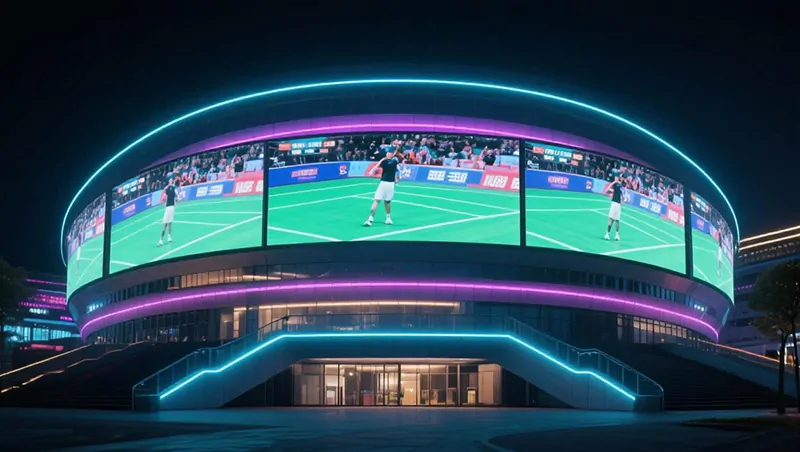
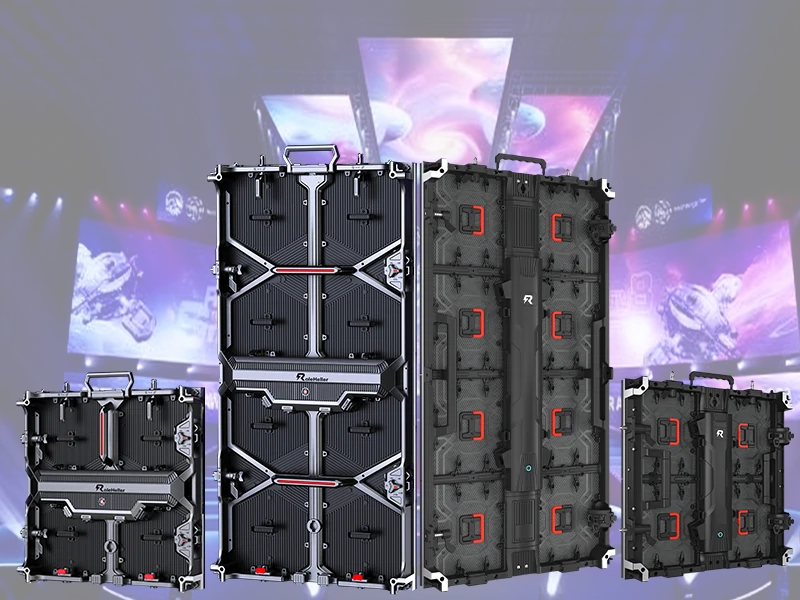
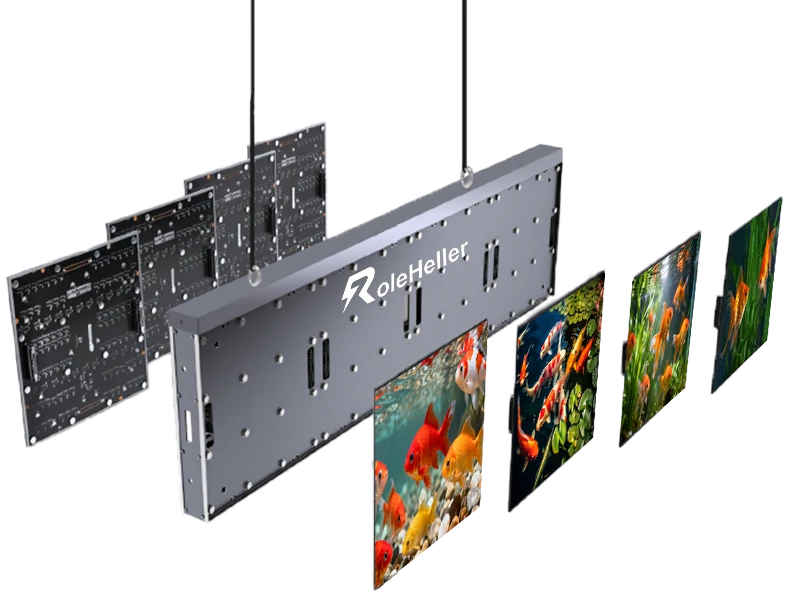
The "lifeline" of a large LED display for outdoor advertising—the support structure—comes in three types: floor-standing, wall-mounted, and rooftop-mounted! The stress and deformation characteristics of different digital advertising boards vary significantly!
In short, here's the selection tip: for floor-standing led ad boards, choose circular cross-section columns for strength and durability; for wall-mounted advertising screen displays, use a combined steel frame for horizontal support for excellent stability; for rooftop led billboard advertising, go directly for a spatial truss system—you can't go wrong! Additionally, adding small optimizations to the critical connection points of the support structure—such as installing shear keys or adding cross-shaped reinforcement ribs—can greatly improve stress distribution and provide maximum safety for your outdoor LED screen!
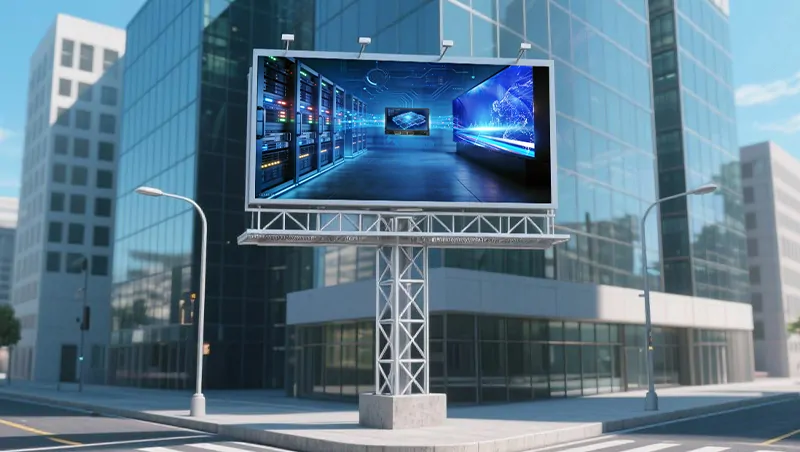
Floor-standing LED displays are usually installed in very open areas such as city squares and major road intersections.
From a stress perspective, a spatial steel truss system is the most suitable support structure for such digital sign boards! A solid foundation is laid underground, and four steel columns form a lattice column above ground, with several layers of horizontal spatial trusses behind the led ad screen. This not only ensures stable stress distribution but also provides a maintenance channel, making future upkeep much easier!
Depending on the actual building conditions, attached screens are divided into wall-mounted and rooftop types. Wall-mounted advertising outdoor LED screens are simpler, directly fixing a single-layer steel structure to the building's exterior wall, and also allowing for a maintenance channel inside, perfectly suited for the compact spaces of bustling commercial areas!
While wall-mounted
LED screens save space, they occupy the building's exterior wall and affect indoor lighting, making them more suitable for large commercial buildings like shopping malls. If you want to install an LED screen for advertising outdoor on a building with a moderate height, such as an office building or residential building, without blocking the light, then choose the rooftop type! The support structure and large video wall panel are installed directly on the roof, without occupying the facade—a perfect solution!
Whether it's floor-standing, wall-mounted, or rooftop-mounted, when designing the support structure for your led advertising board, all kinds of "pressures" must be carefully calculated! This includes the weight of the video wall screen itself (permanent load), the weight of maintenance personnel and tools (live load), and external forces from wind, snow, ice, and earthquakes. The coefficients for these superimposed forces must be calculated strictly according to the specifications, without any room for error!
The vibration frequencies of wall-mounted and rooftop advert display screens must be analyzed in conjunction with the building structure, especially for rooftop screens, where the impact of high-frequency vibrations must be given special attention; Wind loads should be calculated according to the standards for building envelopes, and large support structures require separate detailed analysis; During an earthquake, both horizontal and vertical forces must be considered, especially during rare major earthquakes, where the impact of vertical forces on wall-mounted screens must be closely monitored!
There are also two easily overlooked points in led advertising:
firstly, LED screens for advertising generate heat during operation, so the support structure must consider heat dissipation; secondly, the structure is filled with electrical wires, which pose a risk of aging and fire over time. Therefore, the support structure must be able to withstand various accidents to prevent overall collapse! The core principle is to make the key components and connections robust and provide multiple layers of safety protection!
Selection Tips:
Floor-standing type: Lattice columns are more practical than circular columns for digital advertising boards!
The support structure of a floor-standing led advertising screen is like an extended "cantilever beam," relying entirely on the columns and foundation to support the weight of the screen. The structural form can be a single column, double columns with a crossbeam, or customized according to the building's design. The columns can be made of concrete, steel pipes, or lattice steel columns, and the crossbeams should preferably be lattice steel structures. The foundation must be determined according to local geological conditions, and its compressive, tensile, bending, and overturning resistance capabilities must all meet the standards!
Key point!
If a maintenance passage is required for your outdoor LED advertising screen, lattice columns are far superior to circular columns! Because lattice columns have internal voids that can serve as maintenance passages; if circular columns are chosen, opening maintenance openings will weaken the strength of the columns and require additional reinforcement. Unless there are special aesthetic requirements, prioritize lattice columns!
Wall-mounted type: Horizontal trusses are the core for advertising screen displays, use diagonal braces if nodes are insufficient!
The support structure of a wall-mounted
LED ad board is fixed to the building structure with steel nodes, preferably fixed to the building's frame columns; if the column spacing is too large, frame beams are used for auxiliary fixing. The horizontal beams are absolutely crucial! They must withstand the force of the wind and also serve as a maintenance passage, and the screen's keel is also installed on them. Horizontal supports can use truss structures. If the spacing between nodes is small, you can simply use structural steel as beams, and calculate them as continuous beams. Additionally, truss structures with diagonal web members are more durable than those with straight web members! If the axial spacing of the main building structure is too large and it's impossible to place nodes in the middle, adding more diagonal web members will help control structural deformation!
Rooftop type: Space trusses are cost-effective for led billboard advertising, and overall modeling is key!
The support structure for rooftop
LED displays for outdoor advertising must be installed along the existing rooftop structure, utilizing the main building structure to bear the weight as much as possible. The structural form is very flexible; planar trusses, space trusses, and space frames can all be used, but professional software must be used for modeling and calculation. Because the rooftop structure is relatively light, special attention should be paid to vibration frequency and the "whiplash effect"—simply put, the amplitude of the rooftop's sway will be greater than that of the building itself! It's best to model and analyze the support structure and the building as a whole to understand its stress characteristics!
From the perspective of construction difficulty and subsequent maintenance, the stress performance of space trusses and space frames is similar, but space trusses are easier to construct and maintain, and are more cost-effective for video wall installations. Choosing them is definitely the right choice!
LED advertising screen support structures are mostly steel structures, and the design of the connections directly determines the overall safety! Here are a few ironclad rules that must be remembered:
For connections to concrete foundations, special embedded parts must be used; for connections to the main building structure, chemical bolts or rebar anchoring should be used; for beam connections, through-bolts should be prioritized, and expansion bolts should never be used! They are unsafe and prone to failure!
The number of anchor bolts in the foundation must be sufficient and arranged symmetrically and evenly;
Both floor-standing and wall-mounted digital sign boards are cantilever structures, and the roots of the columns and nodes bear the greatest stress! Adding a shear key or cross-reinforcing ribs at the root can significantly improve the load-bearing capacity and save a lot of steel!
Summary: Remember these 4 key points, and you won't make mistakes when choosing support structures for led advertising!
For floor-standing LED screens, choose lattice columns, considering both load-bearing capacity and maintenance;
For wall-mounted advertising screens, prioritize diagonal-braced trusses, adding more diagonal members if the node spacing is large;
For rooftop LED billboards, choose spatial trusses, and remember to perform overall structural modeling and analysis;
Don't be lazy with node design for outdoor advertising LED displays; adding a shear key or stiffening rib can double the safety factor!
 English