 English
The direct answer is that you can source directly from legitimate wholesale color LED display manufacturers like Unilumin, Absen, Qiangli Jucai, Gloshine, and specialized Bao'an OEM builders like Chipshow or Cinstar, but only if you buy by the cabinet or complete module lot and handle your own component-level verification. Buying wholesale slashes equipment acquisition costs by 45% to 65% compared to purchasing through local AV integrators, dropping indoor P2.5 display prices down to $400 to $650 per square meter and outdoor P3.9 rental panels to $650 to $950 per square meter. However, wholesale factories sell industrial components, not consumer televisions; you are responsible for calculating power supply loads, demanding unified batch calibration files, and catching defective driver ICs before the shipping container leaves the dock.
Have you ever sat down with a $45,000 quote from a domestic distributor for a mid-sized church or sports bar video wall, started calculating the raw hardware cost of the receiving cards and power supplies, and realized more than half of that total price tag is pure middleman markup?
It is enough to make anyone want to jump straight onto an export directory and wire money to an overseas factory. But finding reliable wholesale color led display manufacturers is not as simple as clicking "add to cart." You are stepping directly into the industrial supply chain of Shenzhen and Huizhou. If you know how these factories tier their production lines, which driver silicon to specify, and how to spot recycled test certificates, you can save tens of thousands of dollars on enterprise-grade hardware. Let’s dive right into it and look at how this wholesale ecosystem actually functions on the factory floor.
When dealing with wholesale color LED display manufacturers, buyers often assume one single facility manufactures the silicon chips, molds the plastic louvers, solders the surface-mount diodes, and writes the control software. In reality, the LED video wall supply chain is divided into four distinct industrial tiers:
The Diode and Silicon Packaging Houses: Giants like Nationstar and Kinglight buy microscopic raw LED dies from foundries like San'an Optoelectronics, encapsulate them with epoxy and wire bonding (gold or copper wire), and ship them as surface-mount devices (SMD 1515, SMD 2121) on reels. Meanwhile, semiconductor specialists like Macroblock (MBI) and Chipone manufacture the pulse-width modulation (PWM) constant-current driver ICs.
The High-Speed SMT Module Fabricators: Facilities like Qiangli Jucai and Meiyad operate automated surface-mount lines. Their high-speed Panasonic and Yamaha pick-and-place machines shoot thousands of diodes per minute onto bare PCB boards, producing raw 320×160mm modules. They move enormous container volumes at razor-thin margins.
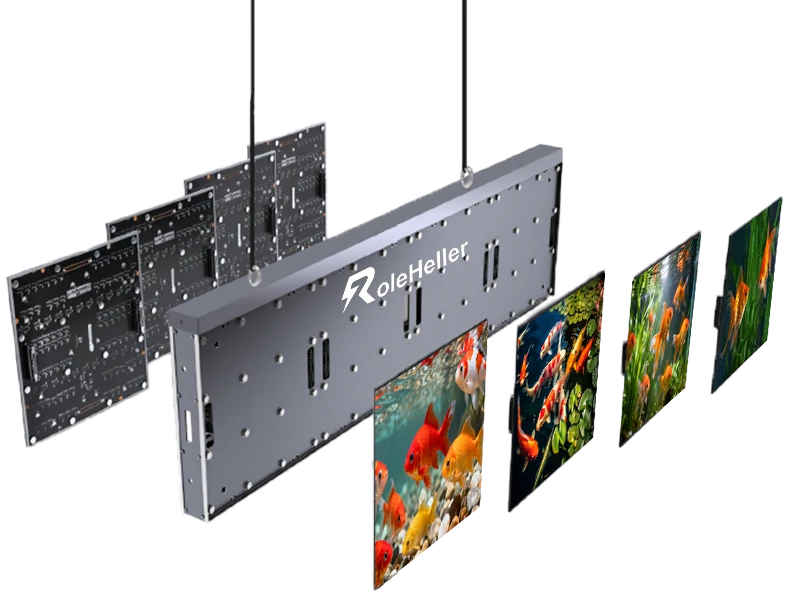
The Cabinet Assembly and OEM System Builders: This is the tier you communicate with when negotiating a wholesale order. Builders like Gloshine, Chipshow, AOTO, and custom OEM factories take raw modules, screw them into CNC-milled die-cast aluminum cabinets, wire up the 5V DC power bus bars, install receiving cards, and run pre-shipment aging tests.
The Controller Developers: NovaStar dominates roughly 80% of the commercial wholesale market, with Colorlight serving budget installations and Brompton Technology commanding premium virtual production and touring concert rigs. Wholesale factories build their cabinets around NovaStar receiving cards (such as the MRV or Armor series).
If you contact a company on Alibaba advertising a price that sounds too good to be true, you are almost certainly talking to a trading firm operating out of a residential high-rise. They buy discarded, off-bin module lots from tier-three SMT fabricators, slap them into cheap stamped-steel frames, and ship them overseas without running a full color-calibration pass. When we use reputable wholesale channels, we bypass those traders and deal directly with OEM system builders that provide certified component bills of materials (BOM).
When you request a wholesale proforma invoice, the sales representative will send you a spec sheet. If that sheet simply reads "High Quality P2.5 Indoor Cabinet," reject it immediately. You need explicit component line items written into the contract.
| Component Category | Premium Tier (Broadcast / Corporate) | Commercial Wholesale Standard | Budget Warning (Avoid for Commercial Use) |
|---|---|---|---|
| LED Diode Packaging | Nationstar Gold-Wire (RS-1515 / RS-2121) | Nationstar Copper-Wire or High-Grade Kinglight | Unbranded white-label diodes, recycled copper wire |
| Driver IC Model | Macroblock MBI5359 / Chipone ICN2163 | Macroblock MBI5153 / Chipone ICN2153 | Unbranded double-latch ICs (severe ghosting & low refresh) |
| Refresh Rate | 3,840 Hz to 7,680 Hz (Camera-Ready) | 3,840 Hz (Standard Commercial) | 1,920 Hz (Flickers on smartphone video recordings) |
| Cabinet Construction | Die-Cast Magnesium / CNC Aluminum | Die-Cast Aluminum (640×480mm or 500×500mm) | Stamped Sheet Iron (Heavy, warps, misaligned seams) |
| Power Supplies | Mean Well UHP Series (Fanless, low-profile) | Mean Well LRS / Great Wall / G-Energy | Unbranded generic switching supplies (high coil whine) |
| Power Architecture | Common Cathode (Dual rail 2.8V / 3.8V) | Common Cathode or Quality Common Anode | Standard Common Anode 5V (Overheats cabinet) |
| Receiving Card | NovaStar A8s / A10s (16-bit HDR, Low Latency) | NovaStar MRV328 / MRV366 / Armor A5s Plus | Outdated NovaStar MRV208 or cloned unbranded cards |
A screen can pack four million diodes, but if the constant-current driver ICs behind them are cheap 1,920 Hz double-latch chips, the screen will look terrible on camera. High-frequency driver ICs like the Macroblock MBI5153 or Chipone ICN2153 use internal SRAM to buffer grayscale transitions. This allows the display to achieve 3,840 Hz refresh rates while maintaining a full 14-bit to 16-bit grayscale depth even when dimmed down to 15% brightness in dark indoor venues.
Cheap chips drop grayscale resolution drastically when you lower brightness, turning smooth shadow gradients into ugly, stepped color bands.
Wholesale pricing looks remarkably cheap at first glance, but you must calculate total landed cost before celebrating. Let’s break down the realistic numbers for a standard 16:9 indoor video wall measuring 16.4 feet wide by 9.2 feet high (roughly 5 meters by 2.8 meters, or 14 square meters) using P2.5 fine-pitch hardware.
| Expense Category | Wholesale Direct (Shenzhen OEM) | Domestic AV Distributor / Integrator | Notes & Field Reality |
|---|---|---|---|
| Display Cabinets (14 m²) | $5,600 – $8,400 ($400–$600/m²) | $22,000 – $35,000 ($1,570–$2,500/m²) | Factory cabinets include internal receiving cards and PSUs |
| Video Processor / Sender | $850 – $1,400 (NovaStar VX1000) | $2,800 – $4,200 (Rebranded box) | Supports multiple 4K/1080p inputs with scaling |
| 12% Spare Parts Package | $650 – $1,000 (Modules, ICs, PSUs) | Often billed as a paid service SLA | Mandatory to secure matching diode bins |
| Flight Cases / Wooden Crating | $700 – $1,100 (Reinforced road cases) | Often charged separately | Keeps delicate die-cast corners safe during transit |
| Ocean / Air Freight | $1,200 (Ocean DDP) / $3,200 (Air) | Handled domestically ($400–$800) | Ocean takes 25–35 days; air takes 5–7 days |
| Customs Duty & Tariffs | Varies by territory (e.g., US Section 301) | Absorbed into dealer margin | Classified under HS Code 8528.59 |
| Mounting Hardware & Rigging | $600 – $1,200 (Extruded aluminum rails) | $2,500 – $4,500 | Unistrut or custom factory cantilever brackets |
| Installation Labor | You or hired local tech ($1,500–$2,500) | Included in quote ($6,000–$12,000) | Direct wholesale requires hands-on assembly |
| Estimated Total Landed | $11,200 – $16,300 | $34,100 – $56,500 | Direct sourcing saves 60% to 70% |
Direct manufacturers rarely sell single modules to end-users unless you are requesting an evaluation sample. For loose modules, standard wholesale MOQs typically range from 20 to 50 modules (about 1 to 2.5 square meters). For fully assembled die-cast cabinets (such as standard 500×500mm or 640×480mm frames), factories generally set an MOQ of 4 to 8 cabinets.
If you need a smaller quantity for testing, most sales reps will accommodate a sample order, but expect to pay a 15% sample surcharge over the volume wholesale rate.
The single biggest mistake buyers make when purchasing from wholesale color LED display manufacturers is failing to enforce strict single-batch diode binning.
LED diodes are semiconductor crystals grown inside high-temperature epitaxial reactors. No two silicon production runs yield identical characteristics. Factories group finished diodes into microscopic sorting bins based on dominant color wavelength (nanometers), luminous intensity (millicandela), and forward voltage.
If a wholesale factory runs out of modules from your assigned lot and completes your order using 10 cabinets from a previous production run, your screen will show severe color mismatches. When displaying a solid white background, sections will look noticeably pink, while others look green or blue.
Contract Requirement: Always specify in your purchase agreement that 100% of the display modules, plus a mandatory 10% to 15% spare parts allowance, must originate from the exact same packaging batch and silicon wafer run.
Demand that the factory saves the comprehensive optical calibration file (NovaStar chroma and brightness calibration coefficients, along with the .rcfgx module configuration file). Have the engineer email these files directly to you and back them up on an external drive. If a receiving card fails in three years, loading that .rcfgx file restores proper panel parameters in seconds.
Heat is the primary enemy of LED video walls. High operating temperatures cause solder joints to crack, speed up diode lumen degradation, and shift color balance over time. When evaluating wholesale options, you will choose between two underlying electrical architectures.
In older Common Anode systems, a single 5V DC line supplies power to all three color diodes. Because red diodes only need about 2.8V to light up, the driver chip burns off the remaining 2.2V as waste heat right on the circuit board.
In modern Common Cathode cabinets, the power supply provides independent voltage rails: 2.8V for red and 3.8V for green and blue.
The screen surface runs 10°C to 15°C cooler to the touch.
Overall electricity consumption drops by 25% to 35%.
The cabinet requires no noisy cooling fans, making it ideal for quiet environments like church sanctuaries, boardrooms, and private screening rooms.
Whenever your budget allows, opt for Common Cathode hardware from your wholesale supplier. The small 10% price premium easily pays for itself through lower energy bills, reduced air conditioning demand, and extended diode longevity.
How do you plan to access the back of the screen once it is mounted? Commercial buyers often forget about physical service access until the display is bolted against a structural concrete wall.
Front-Service Maintenance: Bare modules secure to the cabinet frame via high-strength neodymium magnetic lugs. To service a dead pixel or replace a driver card, a technician places an electric vacuum suction tool against the face of the module, presses a button to generate suction, and pulls the module straight out from the front. This allows you to mount the entire video wall flat against a wall, saving valuable floor space.
Rear-Service Maintenance: Cabinets feature hinged or screwed access doors on the back. While mechanically sturdy and popular for outdoor billboards and mobile concert touring rigs, this layout requires building an access walkway behind the screen with at least two to three feet of clearance.
For indoor installations in boardrooms, retail shops, or house-of-worship stages, insist on front-service magnetic modules.
Do not release the final 70% payment balance to any overseas wholesale manufacturer until their engineering team passes your pre-shipment inspection. If you cannot fly to Shenzhen or Huizhou yourself, hire a local third-party inspection agency or conduct a thorough live video audit over Teams, Zoom, or WeChat.
The 72-Hour Continuous Burn-In Test: The factory must set up your complete display layout on their testing floor and run continuous aging loops for a minimum of 72 hours. Diodes that are prone to early failure almost always burn out during this initial operational window.
The Low-Brightness Grayscale Sweep: Have the engineer dim the screen down to 10% brightness and display a monochromatic gray background. Look closely for vertical banding, purple color shifts, or flickering modules. High-quality driver ICs maintain consistent, neutral grayscale tracking across the entire surface.
The Flatness and Seam Tolerance Inspection: Direct the technician to angle a bright shop light along the face of the assembled cabinets and slide a 0.1mm feeler gauge across the module seams. You should see no light bleed, raised cabinet lips, or dark seam gaps.
The Hi-Pot Grounding Test: The quality team must verify ground continuity between the mains AC earth pin and the exposed aluminum chassis to prevent dangerous chassis leakage.
The Spare Parts Verification: Open the spare parts crates on camera. Confirm that spare modules carry the exact same serial and batch stickers as the main display panels.
Technically, yes, if you install an internal PCI-e sending card like the NovaStar MSD300 directly inside a desktop tower. But in practical field deployments, this setup is inconvenient.
A dedicated all-in-one video processor (such as a NovaStar VX400, VX600, or VX1000) acts as an external switcher, scaler, and sending card in a single rack-mount chassis. You connect your laptop, Apple TV, media server, or camera switcher via standard HDMI, and the processor handles EDID handshake emulation, canvas scaling, and pixel mapping over CAT6 gigabit lines to the video wall.
This is where low-end wholesale suppliers run into trouble. European and North American building codes require commercial display hardware to carry authentic CE, FCC, or ETL/UL certifications.
Ask the factory sales representative for their complete 30-to-60-page laboratory testing report from accredited inspection agencies (such as SGS, TÜV Rheinland, Intertek, or certified CNAS laboratories). Check that the model numbers, switching power supplies (like Mean Well), and manufacturer names in the report match your proforma invoice. Unverified one-page certificates downloaded off the internet will not pass a commercial electrical inspection.
It is straightforward once you understand the basic workflow. NovaLCT requires a Windows PC connected to your sending processor via USB or Ethernet.
After logging into the "Advanced Synchronous User" mode (default password is usually admin or 666666), you load the factory-provided .rcfgx file onto the receiving cards, specify the pixel width and height of each cabinet, and draw the data connection path matching how your physical CAT6 cables snake through the rear ports. The entire mapping process takes about fifteen minutes once your cables are properly connected.
When sourcing directly from wholesale color LED display manufacturers, remember this core operational truth: never optimize strictly for the lowest price per square meter.
Saving $800 on a 15-square-meter video wall by settling for unbranded driver chips or recycled copper-wire diodes might look like a great deal on paper. But when the screen runs hot, draws customer complaints about high-pitched electrical hum, or produces distracting black scan lines on smartphone video recordings, that initial savings quickly turns into frustrating maintenance headaches.
Focus your conversations on structural cabinet tolerances, verifiable Nationstar gold-wire diodes, high-refresh Macroblock or Chipone driver ICs, and genuine NovaStar receiving hardware. Insist on authentic laboratory test dossiers and enforce the single-batch diode binning rule. Take those sensible precautions, and you will secure enterprise-grade video wall hardware directly from the factory line at a fraction of domestic distributor pricing.
The standard commercial payment arrangement across Chinese LED manufacturing hubs is 30% T/T (Telegraphic Transfer) deposit upon signing the proforma invoice to commence production, with the remaining 70% balance paid after passing pre-shipment factory inspection and before cargo dispatch. For first-time wholesale buyers placing substantial orders, using third-party escrow services like Alibaba Trade Assurance or an irrevocable Letter of Credit (L/C) provides added financial protection.
For reliable indoor displays featuring genuine Nationstar copper or gold-wire diodes, 3,840 Hz high-refresh driver ICs, and die-cast aluminum cabinets, wholesale factory costs typically range from $400 to $650 per square meter for P2.5, $600 to $900 per square meter for P1.8, and $1,100 to $1,800 per square meter for fine-pitch P1.2 to P1.5.
SMD (Surface Mount Device) solders individual diodes directly onto the surface of the PCB; it is cost-effective and easy to repair, but vulnerable to physical impacts. GOB (Glue-on-Board) applies an optically clear epoxy resin over standard SMD modules, providing splash-proofing and impact protection for high-traffic environments. COB (Chip-on-Board) mounts microscopic bare silicon LED dies directly onto the board, encapsulating them under a smooth resin layer for exceptional contrast, wide viewing angles, and long-term durability.
Standard production lead times range between 15 and 25 business days, which includes circuit board SMT assembly, cabinet wiring, and a mandatory 72-hour aging burn-in test. Standard ocean freight typically adds 20 to 35 days depending on your destination port, while express air freight delivers crated cabinets within 5 to 8 business days for time-sensitive installations.
LED diodes are manufactured in unique production lots known as "bins," which exhibit subtle, microscopic differences in brightness output and dominant color wavelength. If a diode fails two years later and you source a replacement module from a different manufacturing run, the replacement section will clash with the rest of your wall. Always purchase an additional 10% to 15% spare modules, extra receiving cards, and spare power supplies from the exact same production lot.
At a minimum, you need a high-precision laser level to align your support structure, metric hex wrenches (specifically M3, M4, and M6), a precision digital multimeter to confirm 5V DC power bus stability and grounding continuity, an electric vacuum extraction tool for servicing magnetic modules, and a Windows laptop equipped with NovaStar NovaLCT configuration software.
No. Standard drywall bows under load and shifts with ambient humidity changes. A fine-pitch display requires structural flatness within 0.1mm to avoid unsightly seams. Install a rigid substructure using industrial extruded aluminum profile channels (such as 2040/4040 aluminum extrusions or steel Unistrut channels) attached directly into building studs or concrete walls, leveling the mounting rails with precision shims before bolting down your cabinets.
Wholesale LED video display panels are categorized under international Harmonized System code HS 8528.59. Import duties vary by country: European imports generally incur standard national VAT along with low customs tariffs (typically 0% to 2% depending on precise monitor classifications), whereas imports into the United States may be subject to additional Section 301 tariffs. Always consult an experienced customs broker prior to dispatch.
Scrambled lines typically point to one of three issues: an incorrect .rcfgx module configuration file loaded into the receiving card, a mismatched scan frequency setting inside NovaLCT, or a loose 16-pin HUB75 flat ribbon cable. First, verify that your flat ribbon data cables are firmly seated between the receiving card and module ports. If physical connections are sound, reload the original .rcfgx file provided by your manufacturer to restore proper pin mapping.
Request the manufacturer's complete 30-to-60-page testing laboratory dossier for CE (EMC EN 55032 Class B, LVD EN 62368-1) or ETL/UL standards, rather than relying on a decorative single-page certificate of conformity. Legitimate reports contain full test data, photographs of the cabinet inside an anechoic chamber, circuit board schematics, and an official report reference number that can be independently validated on the issuing testing laboratory's website.




.jpg "P2.6 LED Video Wall Manufacturers | Price")
.jpg "Rental LED Screen Indoor Manufacture_Pick the Right Factory")
.jpg "How to Vet Truck LED Display Manufacturers in China?")