English

If you need an immediate, field-proven answer on how to select china taxi top led display manufacturers without dealing with dead screens, electrical fires, or fleet-wide battery drain, here is the direct benchmark: do not source from generic indoor/outdoor billboard assemblers who simply take standard stationary cabinets and weld roof brackets onto them. You must partner with specialized mobile digital out-of-home (DOOH) vehicle display fabricators that engineer hardware around four non-negotiable automotive baselines. First, mandate an isolated automotive-grade wide-voltage DC-DC power system supporting 9V to 36V input with integrated ISO 7637-2 load-dump transient surge suppression. Second, demand Glue-on-Board (GOB) surface encapsulation over 99.99% gold-wire bonded LEDs (such as Nationstar or Kinglight) to protect diodes from highway debris, car wash brush impacts, and constant structural vibration. Third, require an aerodynamic, cast-aluminum or magnesium alloy double-sided housing rated at certified IP65 or IP67 with active automotive ignition sensing (ACC wire detection) that automatically powers down the display to prevent draining the vehicle battery. Fourth, ensure the control architecture uses an industrial-grade 4G/5G cloud IoT media player with integrated GPS geofencing, automatic brightness photocells, and real-time remote diagnostics. If a prospective supplier cannot show you real-time multi-axis vibration test reports or tries to brush off questions about automotive electrical compliance, move on immediately.
Picture this situation: your advertising company just signed an exclusive three-year franchise agreement to install digital rooftop advertising screens on three hundred hybrid and electric taxis operating across major urban centers like London, New York, or Hong Kong. The business model depends on running location-targeted commercial video loops sixteen hours a day. You search for china taxi top led display manufacturers, and within forty-eight hours your inbox is flooded with thirty different quotations ranging wildly from $700 to $2,800 per double-sided unit. Every factory sales rep promises that their screens are ultralight, plug-and-play, and built to survive anything. But what happens when your local mechanics finish bolting the first fifty units onto vehicle roof racks, the drivers hit the road, and problems start cascading? When a taxi sits in bumper-to-bumper traffic on a sweltering July afternoon, the screens overheat and turn off. When winter hits, road salt spray penetrates cheap perimeter gaskets, short-circuiting the power distribution boards. Worse yet, several taxi drivers call dispatch in a panic because the screen's parasitic standby current completely killed their car batteries overnight, leaving them stranded.
Replacing roof displays across an active commercial fleet requires pulling revenue-generating vehicles off the road, paying certified auto electricians high hourly rates, and renegotiating ad delivery guarantees with furious brand clients. When we are using mobile LED screens on public roads, saving a few hundred dollars on an unverified supplier turns into a massive operational liability. To make sure you navigate the international supply chain with complete confidence, let's break down the automotive electrical requirements, structural engineering standards, control workflows, and factory auditing protocols you must enforce before wiring a deposit.
When we install a stationary digital billboard on a steel pylon or building wall, the display operates in a predictable environment. It sits bolted to a rigid structure, receives clean 110V or 230V alternating current through regulated sub-panels, and experiences no physical movement other than wind load.
A taxi top DOOH screen lives in an entirely different physical realm. A vehicle display is an active mobile electrical appliance subjected to extreme mechanical shock, hostile weather, and severe electrical volatility.
Constant Multi-Axis Vibration and Road Shock: As a taxi navigates potholed city avenues, highway expansion joints, and cobblestone alleys, the roof display experiences relentless vertical and lateral accelerations. Over months of operation, standard soldered ribbon cables work loose, PCB solder joints develop micro-fractures, and structural mounting bolts back out if they lack nylon locking rings.
Electrical Load Dumps and Alternator Spikes: A car's 12V or 24V electrical system is notoriously dirty. When an internal combustion engine cranks, system voltage can drop below 8V DC. Conversely, when the alternator disconnects an inductive load while charging—an event known as an automotive load dump—voltage spikes can surge beyond 40V to 60V DC for several hundred milliseconds. If the display's internal power converters lack fast transient-voltage-suppression (TVS) diodes and heavy inductive chokes, those spikes will fry your driver ICs instantly.
Extreme Thermal Cycling and Highway Wind Shear: At highway speeds of 65 mph (105 km/h), the frontal surface of the display faces intense dynamic air pressure, rain driven into micro-seams, and sub-zero wind chills. An hour later, the same vehicle sits idling in stationary traffic under direct midday sun, with heat radiating off the asphalt, heat radiating off the vehicle's steel roof, and heat generated by the display's internal electronics trapped inside an aluminum enclosure.
Aggressive Chemical Exposure: Roof displays must endure high-pressure automatic car washes, detergent chemicals, winter road de-icing brine (calcium chloride), acidic urban smog, and intense ultraviolet radiation. Cheap plastic masks warp, crack, and turn yellow within six months under these combined forces.
In our experience auditing overseas production lines, power supply engineering is where cut-rate factories take the most dangerous shortcuts. Stationary LED cabinets use standard AC-to-DC switching power supplies (like 110V/220V AC input stepping down to 5V DC output). A vehicle, however, provides direct current from an onboard battery and alternator.
[Vehicle Alternator / 12V-24V Battery Bus]
                     │
                     ▼
[In-Line Automotive Fuse & Transient Surge Suppressor (ISO 7637-2)]
                     │
                     ▼
[ACC Ignition Line Sensing Circuit] ──► Auto Sleep / Wake Delay Logic
                     │
                     ▼
[High-Efficiency Synchronous Step-Down DC-DC Converter (9V - 36V Input)]
                     │
                     ├─ Isolated 3.8V Rail ──► High-Luminance GOB LED Modules
                     ├─ Isolated 5.0V Rail ──► 4G/5G IoT Media Player & GPS Engine
                     └─ Filtered 12V Rail  ──► Temperature-Controlled Exhaust Fans
Never accept a taxi top display that uses an external DC-to-AC power inverter to power standard stationary 110V/220V power supplies. Inverters introduce high energy conversion losses (wasting 20% to 30% of power as heat), create immense electrical hum, and take up valuable space.
High-standard china taxi top led display manufacturers utilize integrated wide-voltage DC-DC buck converters designed for vehicular applications, accepting inputs ranging from 9V to 36V DC.
This allows the exact same rooftop display model to be deployed across standard 12V passenger sedans, hybrid fleets, and heavy 24V commercial transit vans without requiring internal hardware changes.
Taxis do not run twenty-four hours a day. When a driver turns off the ignition key to go off shift, the roof display must respond intelligently:
The display's power harness must incorporate a three-wire automotive connection: Constant Battery Positive (+12V/24V), Chassis Ground (-), and the Accessory/Ignition Sensing Line (ACC).
When the ACC line detects that the engine has stopped, an onboard microcontroller initiates a graceful operating system shutdown sequence for the embedded media player, saving current GPS logs and playback verification proofs to flash memory.
Once shut down, the power circuit cuts off power to the LED modules completely, dropping the system's standby parasitic current draw to under 20 milliamperes. This ensures that even if a taxi sits parked over a long four-day holiday weekend, the vehicle battery remains fully charged and ready to start the engine.
Because an automobile's alternator has a finite output capacity (typically 90 to 150 amps), power efficiency on the roof directly impacts vehicle fuel economy and the driving range of electric taxis like Teslas or Nissan Leafs.
Traditional common-anode LED circuits deliver a uniform 4.2V or 5V rail to red, green, and blue semiconductor dies simultaneously. Since red diodes require only around 2.0V forward voltage, the extra 2.2V to 3.0V is wasted as pure heat inside the driver chips.
Common-Cathode driver architecture splits the voltage planes: feeding 2.8V to blue and green diodes, and an independent 1.8V to red diodes. This reduces the screen's peak power consumption from 850W down to roughly 450W to 500W, keeping the cabinet interior running 15°C cooler and relieving massive electrical strain on the car's alternator.
Bolting an electronic sign to the roof of a passenger car moving at freeway speeds involves serious structural and municipal liability. If a mounting bracket snaps or an aerodynamic housing acts like a kite in crosswinds, the safety consequences on a highway can be severe.
[Vehicle Roof Airflow Boundary Layer]
                 ▲
                 │ (High-Velocity Wind Stream: 100+ km/h)
   ┌─────────────┴─────────────┐
   │  Tapered Front Nosecone   │ ──► Reduces Frontal Air Resistance & Lift
   ├───────────────────────────┤
   │  Double-Sided GOB Panels  │ ──► Optical Display Surface (Left / Right)
   ├───────────────────────────┤
   │  Die-Cast Aluminum Frame  │ ──► Structural Skeleton & Thermal Conduction
   └─────────────┬─────────────┘
                 │
[Reinforced Crossbars with Anti-Vibration Neoprene Bushings]
                 │
[Vehicle Door-Gutter Clamps / Roof Rail Anchor Brackets]
A rectangular, sharp-edged box mounted on a roof generates high aerodynamic drag and destructive vertical lift forces at highway speeds.
Top-tier manufacturers design housings with streamlined, wind-tunnel-optimized profiles: tapered front nosecones, rounded aluminum corners, and sloped aerodynamic top covers.
This reduces the drag coefficient, minimizing wind noise inside the passenger cabin and preventing aerodynamic drag from penalizing vehicle fuel consumption.
Tapered nosecones frequently house the forward-facing ambient light photocell, GPS antenna, and cellular transceivers beneath RF-transparent polycarbonate domes.
How the housing is fabricated determines whether the display will maintain weatherproofing over years of road vibration.
Welded Sheet Iron/Aluminum: Inexpensive factories use sheet metal cut on basic laser tables, bent on press brakes, and manually welded at the seams. Over time, road vibration flexes the thin sheet metal, breaking silicone caulking lines and allowing water to enter through corner welds. These sheet metal units are also heavy, often exceeding 28 to 35 kg per double-sided unit.
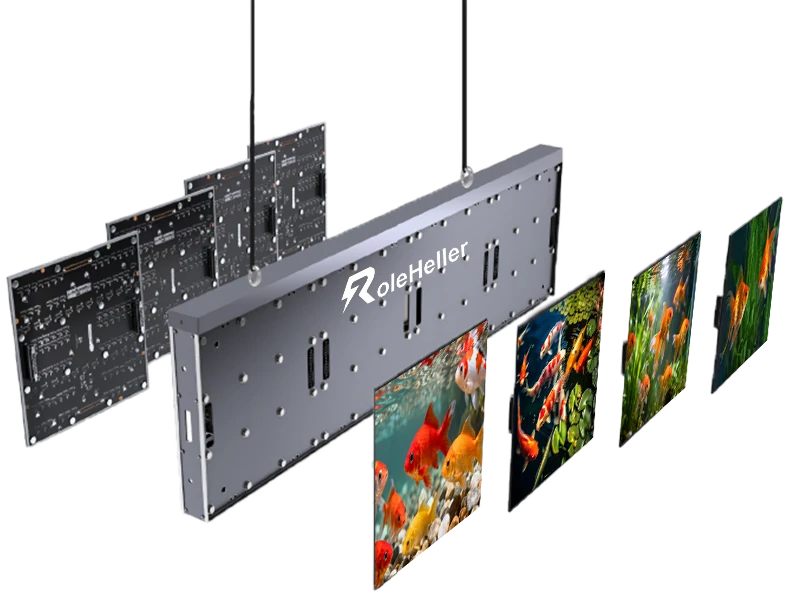
Precision Die-Cast Aluminum or Magnesium Alloy: Enterprise-grade displays utilize two-piece or three-piece die-cast aluminum or magnesium clamshell housings. The mating perimeter incorporates a precision CNC-machined tongue-and-groove channel fitted with a continuous, seamless EPDM or silicone compression gasket. Die-cast structures weigh under 18 to 22 kg per complete double-sided unit, provide exceptional rigidity, and act as a large passive heatsink to conduct heat away from the electronics.
Taxis come in various roof shapes: vehicles with factory roof rails, bare metal roofs, and curved vehicle gutters.
Adjustable Rack Clamps: The most secure commercial mounting system utilizes heavy-duty aluminum extruded crossbars that clamp directly onto the vehicle's door-frame weather-stripping or factory roof rack tracks.
Magnetic Mounts (A Word of Caution): Some budget vendors offer magnetic foot mounts for fast installation. Magnetic mounts must be avoided for high-speed highway fleets. Magnetic mounts can slide during emergency braking, scratch vehicle paint, and risk detaching completely under severe crosswind turbulence. Demand mechanical bolt-on bracket systems featuring 304 or 316 stainless steel fasteners and anti-vibration neoprene isolation pads.
To help your procurement team evaluate competing proposals from china taxi top led display manufacturers, the table below maps out component selections, thermal tolerances, and performance parameters across three primary market tiers:
| Engineering Parameter | Economy Fleet Spec (High Risk) | Professional DOOH Fleet Spec | Enterprise Smart Fleet Tier |
|---|---|---|---|
| Wholesale FOB Price Range | $650 – $950 per unit | $1,250 – $1,800 per unit | $2,200 – $3,200+ per unit |
| Pixel Pitch & Diode Type | P3.3 or P5 Standard SMD | P2.5 or P3.3 GOB Shielded | P1.87 or P2.5 Flip-Chip GOB |
| Diode Wire Bonding | Unbranded copper/alloy wire | Kinglight / Nationstar Gold Wire | Nationstar Gold / Cree Automotive |
| Peak Calibrated Output | 4,500 – 5,500 nits (Washes out) | 6,500 – 7,500 nits (Direct sun) | 7,500 – 9,000 nits (Ultra-bright) |
| Input Operating Voltage | Fixed 12V DC (No wide range) | 9V – 36V DC Isolated | 9V – 36V DC Dual-Stage Isolated |
| Automotive Surge Protection | Basic MOV / Weak protection | ISO 7637-2 Pulse 5a Compliant | Military-Spec TVS + Active Clamping |
| Power Distribution Scheme | Traditional Common Anode | Common Cathode Energy Saving | Dynamic Common Cathode Drive |
| Housing Construction | Folded sheet metal, spray paint | CNC Die-Cast Aluminum Alloy | Die-Cast Magnesium-Aluminum Shell |
| Ingress Protection (IP) | IP54 Front / IP43 Rear | IP65 True Sealed Enclosure | IP67 Full Pressure Submersion |
| Total System Weight | 28 – 35 kg (Heavy, stresses roof) | 18 – 22 kg (Balanced) | 14 – 17 kg (Ultra-lightweight) |
| Standby Parasitic Current | 150mA – 300mA (Drains battery) | < 20mA (Safe for 3+ weeks) | < 10mA (Micro-power sleep) |
| IoT Connectivity & CMS | Basic 4G USB dongle, local Wi-Fi | Industrial 4G Cat-4 + GPS engine | 5G Sub-6GHz + RTK Precision GPS |
| First-Year Failure Rate | > 25% (Frequent fleet downtime) | < 3% (Standard DOOH uptime) | < 0.8% (Mission-critical reliability) |
When we look at a taxi top screen cruising down a broad commercial boulevard at noon, ambient solar illumination can easily exceed 80,000 to 100,000 lux. If the display lacks adequate luminance and contrast engineering, commercial advertisements become unreadable, causing brand advertisers to cancel campaign contracts.
[Direct Solar Radiation (80,000+ Lux)]
                  │
                  ▼
┌────────────────────────────────────────────────────────┐
│ Matte-Black Anti-Glare Surface Polycarbonate Finish    │
├────────────────────────────────────────────────────────┤
│ Optical Polyurethane GOB Encapsulation Layer           │
├────────────────────────────────────────────────────────┤
│ High-Output SMD LEDs (Nationstar Gold Wire: 7,000 Nits)│
├────────────────────────────────────────────────────────┤
│ Deep-Profile Matte Louvers (Horizontal Sun Shading)    │
└────────────────────────────────────────────────────────┘
                  ▲
                  │
[Automatic Optical Sensor Feedback] ──► Scales output down to 300 Nits at Night
Traditional surface-mount diodes (SMD) leave individual diodes and micro-solder pads exposed on the circuit board surface.
On a moving car, tires from preceding vehicles kick up fine gravel, road grit, and salt particles.
In traditional SMD panels, flying road debris chips diodes right off the board, creating dead pixels that look like missing teeth.
Furthermore, commercial high-pressure touchless car washes fire water jets at pressures exceeding 1,200 PSI. Water under this pressure easily breaches traditional silicone perimeter caulk.
Glue-on-Board (GOB) technology solves this completely. After automated surface-mount soldering, the entire front face of the module is encased in an optically clear, impact-resistant epoxy or polyurethane resin shield. GOB provides an impenetrable IP65/IP67 mechanical barrier that shrugs off flying gravel, automated car wash brushes, and torrential rain without diode detachment.
A rooftop display running at 7,000 nits is essential to punch through blinding midday sunshine. However, running that same 7,000-nit luminance at 11:00 PM on a dark city street will blind passing drivers, trigger police citations, and violate municipal advertising lighting regulations.
The system must integrate an external, automotive-grade optical light sensor (photocell) tied directly into the media controller.
The controller must dynamically adjust brightness across a continuous curve—scaling smoothly from 7,000 nits under direct midday sun down to 300 to 500 nits at midnight.
The transition must be gradual (stepped over several seconds) so that passing motorists are not startled by sudden brightness jumps when the vehicle enters a shaded underpass or tunnel.
Operating a fleet of three hundred mobile rooftop displays is fundamentally a software and communications challenge. You cannot dispatch technicians with USB thumb drives to update ad schedules across taxis scattered across an entire metropolitan area.
[Enterprise Web CMS & Ad Booking Portal]
                    │
                    ▼ (Encrypted TLS API / 4G-5G Cellular Data)
[Carrier Cloud Server Network / Media Distribution Engine]
                    │
   ┌────────────────┼────────────────┐
   ▼                ▼                ▼
[Taxi 001 Client]  [Taxi 002 Client]  [Taxi 300 Client]
   │                │                │
   ├─ Real-Time GPS Geofencing Engine (Triggers Location Ads)
   ├─ Proof-of-Play Logging (Timestamp + GPS Coordinates + Camera Check)
   ├─ Automated Vehicle Battery Voltage Monitoring & Alerting
   └─ Internal Cabinet Temperature & Fan Speed Telemetry
The primary commercial value of mobile DOOH advertising is spatial relevance. Advertisers want their messages displayed in specific commercial zones:
A luxury watch brand wants their campaign running exclusively when taxis are within financial district boundaries.
A sports apparel brand wants ads running within a two-mile radius around an arena two hours before game time.
An airline wants ads displayed along the highway corridor approaching the international airport.
The onboard controller must house a high-sensitivity GPS/GLONASS/Galileo receiver that checks position coordinates every second.
When the vehicle crosses a virtual geofence polygon pre-configured in the cloud CMS, the player seamlessly interrupts the generic playlist and triggers the location-specific creative within 500 milliseconds.
Corporate media buyers demand independent, verified auditing data before releasing campaign payments.
The media player must record tamper-evident cryptographic log files documenting every single ad impression: exact timestamp, GPS latitude and longitude, vehicle velocity, and ambient brightness level.
Higher-end systems integrate optional forward-facing and rear-facing wide-angle diagnostic cameras that capture proof-of-performance snapshot photos of the active display, uploading periodic visual verification to the cloud CMS alongside telemetry data.
The fleet controller must continuously report internal hardware diagnostics back to the central server:
Input battery voltage (alerting the fleet manager if a specific taxi has a failing alternator).
Internal cabinet operating temperature.
Individual module electrical connectivity (detecting missing data loops or dark tiles).
4G/5G cellular signal strength and data consumption tracking.
The controller's operating system (embedded Linux or Android) must support dual-partition A/B fail-safe Over-the-Air (OTA) firmware updates. If an OTA firmware upgrade fails mid-transmission due to poor cellular reception in a tunnel, the controller automatically rolls back to the previous stable operating partition without bricking the device.
When you are ordering a fleet deployment worth hundreds of thousands of dollars from china taxi top led display manufacturers, relying on digital brochures or showroom samples is a major commercial risk. You should visit the assembly plant in person or engage an accredited third-party automotive engineering inspection firm to audit the production run.
[Raw Component Intake & SMT Placement (ISO 9001/IATF 16949)]
                           │
                           ▼
[3D Solder Paste Inspection & Nitrogen Reflow Soldering]
                           │
                           ▼
[Optical Resin Vacuum GOB Potting & UV Curing Chamber]
                           │
                           ▼
[Automotive Multi-Axis Dynamic Vibration Shaker Table]
                           │
                           ▼
[ISO 7637-2 Electrical Load-Dump & Transient Pulse Testing]
                           │
                           ▼
[72-Hour Continuous Full-Load Burn-In & Thermal Scan]
                           │
                           ▼
[High-Pressure Water Chamber Deluge Test (IP65/IP67)]
                           │
                           ▼
[Reinforced Foam-Cradled Export Flight Cases / Plywood Crating]
Demand to see the factory's on-site electrical test equipment.
The manufacturer must hook up a production display to an automotive electrical transient simulator (such as an EM TEST or AMETEK system).
Subject the unit to ISO 7637-2 electrical pulses, specifically Test Pulse 5a (simulated alternator load dump surge of 40V+ for 400 milliseconds) and Test Pulse 2a/2b (ignition switch transients).
The display must continue operating through these transient pulses without resetting, flickering, or damaging its internal DC-DC converter stages.
A taxi top screen will experience millions of road vibrations over its operating lifespan.
Request a live test on a multi-axis electromagnetic shaker table.
The completed screen assembly—including its vehicle mounting brackets—must be subjected to a swept-sine and random vibration test compliant with ISO 16750-3 (Road vehicles - Environmental conditions and testing for electrical equipment - Mechanical loads) for at least four hours per axis (X, Y, and Z).
Following the vibration run, inspect the unit: zero internal screws must back out, all internal connectors must remain fully seated, and the display must power up with zero dead pixels or planar warping.
Standard stationary rain tests are completely inadequate for vehicles traveling at highway speeds in storms.
Place the assembled display inside a specialized water test enclosure equipped with high-pressure oscillating spray nozzles (simulating IPX6 / IPX7 compliance).
Spray the unit with water at a flow rate of 100 liters per minute at a pressure of 100 kPa from a distance of 2.5 meters for at least fifteen minutes from all angles.
Immediately following the deluge test, dry the exterior, open the clamshell housing, and inspect the internal electronics cavity under magnification. Zero liquid water or moisture condensation must be present inside the perimeter sealing zone.
Semiconductor component failures follow the classic bathtub curve: weak solder points, defective driver ICs, and internal power supply faults occur within the first 48 to 72 hours of electrical stress.
The factory must wire the completed double-sided displays to test racks powered by 12V DC power supplies, running an uninterrupted 72-hour burn-in cycle.
The cycle must include: 24 hours of full-raster white screen at 100% brightness (stressing the DC-DC converters and thermal dissipation paths to their peak load), 24 hours of alternating primary RGB patterns (exposing stuck sub-pixels), and 24 hours of dynamic, high-frame-rate commercial video playback.
During the full-white burn-in test, walk the line with a calibrated thermal imaging camera. If any internal DC-DC power component spikes above 75°C in an ambient 25°C room, the thermal coupling to the exterior housing is inadequate.
When you compare quotations across different factories, understanding how production capital is allocated across the bill of materials (BOM) helps you distinguish genuine automotive engineering from dangerous cost-cutting.
┌───────────────────────────────────────────────────────────┐
│ Typical Taxi Top LED Display Bill of Materials Allocation │
├───────────────────────────────┬───────────────────────────┤
│ GOB LED Modules (P2.5 Gold)   │ 32% - 38% of total cost   │
│ Die-Cast Aluminum Shell Frame │ 18% - 24% of total cost   │
│ Automotive DC-DC Power Unit   │ 12% - 16% of total cost   │
│ 4G/5G IoT Media Player & GPS  │ 10% - 14% of total cost   │
│ Mounting Crossbars & Brackets │ 8%  - 12% of total cost   │
│ SMT Assembly & 72h Shake QA   │ 6%  - 10% of total cost   │
└───────────────────────────────────────────────────────────┘
The table below illustrates what you actually receive across different market price brackets:
| Hardware Tier | Average Unit Cost (Double-Sided) | LED & Module Packaging | Housing & Sealing | Power & Automotive Electronics | Expected Fleet Failure Profile |
|---|---|---|---|---|---|
| Budget Assembly Tier | $650 – $950 | P3.3 / P5 bare SMD, copper wire, low-grade potting | Welded sheet iron, silicone caulking, IP54 | Uncertified non-isolated DC buck, no ACC sleep | High dead pixels from gravel, dead car batteries, leaks |
| Mid-Market Commercial Spec | $1,250 – $1,800 | P2.5 / P3.3 GOB, gold wire Kinglight/Nationstar | Cast aluminum shell, EPDM gasket, IP65 | Isolated 9V–36V DC-DC converter, ACC sleep <20mA | Reliable 3–4 year operation, good weather resistance |
| Enterprise Infrastructure Spec | $2,200 – $3,200+ | P1.87 / P2.5 Flip-Chip GOB, Nationstar Gold Wire | Aerodynamic die-cast magnesium, IP67 seals | Dual-stage isolated DC-DC, TVS clamping, <10mA sleep | Flawless 5+ year lifespan, survives automatic car washes |
Question: Will a taxi roof display drain the vehicle battery when parked overnight?
Answer: A properly engineered taxi top display will not drain the vehicle battery. The display's power harness incorporates an Accessory (ACC) ignition-sensing wire connected to the car's fuse box. When the driver turns off the engine, the ACC circuit signals the media controller to perform a clean operating system shutdown. Once shut down, internal solid-state relays disconnect power to the LED modules, dropping the standby current draw to under 20 milliamperes (less than the vehicle's own factory security alarm system). The vehicle can sit parked for three weeks without discharging the battery. However, if a low-end supplier lacks ACC sensing and leaves the power converters idling on the battery bus, the parasitic drain can easily exceed 250 milliamperes, completely killing the battery overnight.
Question: How do you prevent the display from causing radio or cellular interference with the driver's taximeter and dispatch radio?
Answer: High-frequency switching circuits inside the display's DC-DC converters and high-refresh driver ICs can emit severe electromagnetic interference (EMI) if not shielded. This EMI can disrupt the vehicle's AM/FM radio, taximeter, onboard dispatch telematics, and fare-collection card readers. Professional manufacturers engineer their electronics to comply with CISPR 25 (Radio disturbance characteristics for the protection of receivers used on board vehicles) and FCC Part 15 Class B standards. This requires placing all power electronics inside grounded cast-aluminum Faraday enclosures, installing ferrite bead chokes on internal wiring harnesses, and utilizing multi-layer PCBs with continuous copper ground planes.
Question: Can a double-sided taxi top screen play completely different advertisements on the left and right sides simultaneously?
Answer: Yes. Commercial DOOH fleet controllers support independent dual-asynchronous channel output. The software maps the left-facing and right-facing display surfaces as separate virtual screens. This allows advertising operators to sell the curbside screen (facing sidewalk pedestrians and shopfronts) to local retail businesses, while simultaneously selling the street-side screen (facing passing vehicular traffic) to automotive brands or highway service advertisers, doubling the revenue potential of every vehicle in your fleet.
When you are ready to issue purchase orders and sign commercial contracts with china taxi top led display manufacturers, keep these field-tested procurement guidelines in mind:
First, never buy production quantities based on small desktop samples. A tabletop sample sitting in a bright showroom tells you nothing about how a complete double-sided unit will handle highway wind turbulence, road vibration, or vehicle alternator spikes. Always order a paid evaluation package containing at least two fully operational rooftop displays complete with roof crossbar brackets. Mount those test units on real fleet vehicles and run them on active city roads for thirty days through heavy rain, car washes, and highway speeds before approving your full production deposit.
Second, lock down your bill of materials (BOM) in your legally binding commercial agreement. Never accept vague marketing phrases like "High-Definition Automotive Taxi Screen." Your purchase contract must explicitly state:
Module construction: Nationstar Gold-Wire SMD2121 or Flip-Chip with full Glue-on-Board (GOB) polyurethane optical encapsulation, minimum 6,500 nits calibrated output.
Power architecture: Isolated wide-voltage DC-DC buck converter, 9V to 36V DC input, active ISO 7637-2 pulse suppression, ACC ignition sleep mode with verified parasitic current under 20mA.
Housing and mechanics: Aerodynamic die-cast aluminum or magnesium alloy enclosure, certified IP65 or IP67 ingress protection with EPDM perimeter gaskets, 304 stainless steel mounting hardware.
Controller and IoT platform: Industrial 4G/5G Cat-4 cloud media player with integrated GPS geofencing, ambient light photocell, and automatic temperature-controlled ventilation.
Packaging: Shock-isolated export flight cases or heavy-duty plywood crates with high-density molded EPE foam cradles and external tilt/shock watch indicators.
Third, secure batch-matched spare parts upfront. Vehicle displays experience occasional physical accidents—such as tree branch strikes, garage overhead clearance scrapes, or rear-end collisions. If a housing or module is damaged eighteen months into an active advertising campaign, you need replacement parts immediately. Contractually mandate that the manufacturer supplies a 5% to 8% spare parts package drawn from the exact same production wafer run and optical color bin, including spare GOB tiles, DC-DC converter boards, receiving cards, and roof bracket clamps. Store those spares safely in your local operations hub so your maintenance technicians can swap damaged components in minutes without pulling taxis off the street.