 English
You have a glass facade and a deadline. Three suppliers sent proposals that all say "transparent LED display, 80% transparency, high brightness" — and the prices sit at $1,200, $1,800 and $2,600 per square metre. Nobody explains the gap. One email reads like a spec sheet translated by a machine, another comes with a video of a screen that might be someone else's showroom, and you are left wondering which one will still pick up the phone when a strip goes dark six months after handover. If you are looking at transparent led display manufacturers right now and cannot tell whether you are comparing real products or just different levels of confidence, you are not alone. We get this question every week from retail fit-out managers in London, mall operators in Dubai, museum curators, architects who specified "see-through screen" without knowing what that means structurally, and rental companies asked to do a window activation for a fashion launch. The same mistake keeps happening: people spend weeks comparing transparency percentages and almost no time checking whether the company quoting them actually builds the panel.
The honest answer is not a brand name. It is this: the right manufacturer is the one that can prove, on a live video call and inside your purchase order, that it makes your exact panel type, holds the certifications in its own name, and will lock the LED, driver IC and power supply so nothing gets quietly swapped when production starts. Everything else is brochure talk.
This piece is written for people who have to sign off on a real transparent screen. Not for people who want a list of company names. Lists exist everywhere and half of them are three years out of date. What you actually need is a way to tell, in about an afternoon, who runs an SMT line for transparent panels and who is reselling something they never touched.
You probably want names anyway. Fine. In the transparent space the names that show up year after year are Absen (ClearStorm / A series transparent products), Unilumin (UPanther / transparent glass screens), Leyard, Ledman, LianTronics, Qiangli Jucai, and a cluster of Shenzhen and Guangzhou specialists that focus almost entirely on glass-adhesive and film-type transparent screens. On the international side you see Planar, Daktronics for large-format, and a handful of European integrators who rebrand Chinese-made transparent panels. For permanent architectural work — flagship stores, airport glazing, atrium balustrades — a Tier-1 Chinese brand or a verified specialist with real installed references is the safe call. For a three-week pop-up window, a mid-tier factory with locked components usually does the job for less.
One thing worth saying plainly: transparent LED is not one product. It is four different products that happen to look similar in a render. Buying the wrong type is how you end up with a screen that looks great in a PDF and impossible to install on site.
This is where most confusion starts, and it starts before price ever enters the conversation.
Glass-adhesive / self-adhesive strip panels. Thin PCB strips with LEDs on both sides or one side, stuck directly onto existing glass with optical adhesive or mechanical clips. Transparency typically 60–85%. Best when you cannot touch the building structure and the landlord will not allow framing. Downside: heat has nowhere to go, service means working from the outside, and if the glass is replaced the screen is gone.
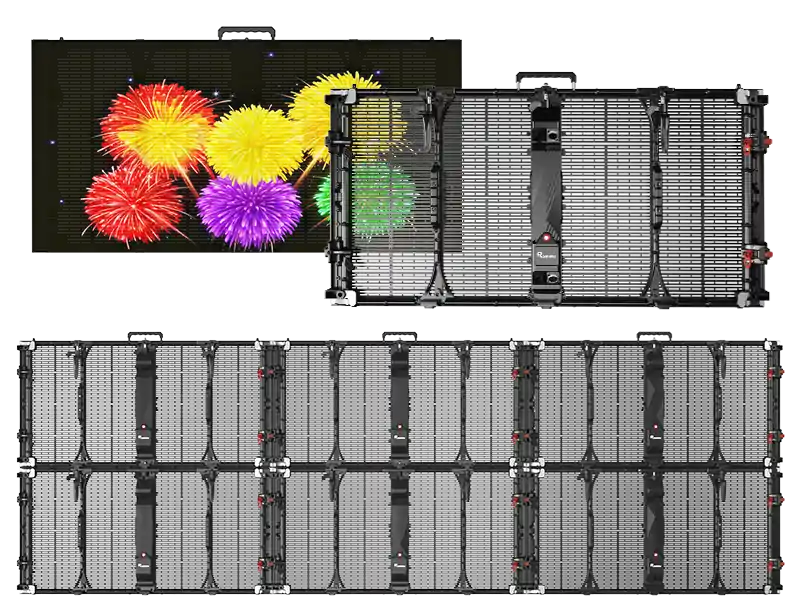
Mesh or grille cabinet screens. Rigid cabinets with horizontal or vertical aluminium bars and gaps between the rows. Transparency 40–70%, brightness higher, serviceable from the front, and structurally self-supporting on a frame. This is what gets used on big facades and stadium wraps. It needs a frame. It weighs something. It also survives being serviced at height.
Glass-replacement / laminated LED glass. The LED elements are inside or on the glass itself — laminated or insulated units that become part of the curtain wall. Highest aesthetic quality, highest cost, longest lead time, and it must be coordinated with the glazing contractor from day one. You are buying into a construction programme, not an AV purchase.
Transparent film / flexible LED film. Ultra-thin, cut-to-shape, can wrap curved glass and irregular shapes. Great for temporary activations and odd geometries. Lower brightness, shorter life expectancy, and the driver electronics still need a hiding place — always ask where the power supplies and receiving cards live, because somebody has to service them.
| Type | Typical transparency | Brightness | Where it wins | Where it fails |
|---|---|---|---|---|
| Glass-adhesive strips | 60–85% | 3,000–6,000 nits | Existing glass, no structural change, fast install | Heat dissipation, hard to service, tied to that pane of glass |
| Mesh / grille cabinets | 40–70% | 5,000–8,000 nits | Large facades, front-serviceable, robust | Needs a frame, heavier, less "invisible" up close |
| LED glass (laminated/IGU) | 50–80% | 4,000–7,000 nits | New build or full reclad, best finish | Cost, lead time, must be designed in with the facade engineer |
| LED film | 70–90% | 2,000–5,000 nits | Curves, shapes, short-term activations | Longevity, lower brightness, PSU placement |
If a supplier does not ask which of these four you need, they are selling a product, not solving a problem. Move on.
A rule we use without thinking: transparency and brightness fight each other. More open area means fewer LEDs per square metre, which means lower resolution and often lower brightness. Anyone promising 90% transparency plus 8,000 nits plus P3 at the same time is either lying or quoting you a product that does not exist yet.
Two proposals can read identically and describe completely different hardware. Once you know what to look for, the gap stops being mysterious.
| What looks the same on paper | What actually differs | Why the price moves |
|---|---|---|
| "80% transparency" | How transparency is measured — open area ratio vs. light transmission | Open area ratio always reads higher; it is the marketing number |
| Same pitch number | Strip width, LED spacing along the strip, actual pixel density | A "P10" can mean very different real resolution on transparent products |
| Same brightness claim | Common-cathode vs. common-anode, drive current, actual measured nits | Common-cathode costs more but cuts power and heat noticeably |
| Same warranty length | Who pays parts, labour, freight, access equipment, response time | A warranty that does not cover the lift or the cherry picker is worth much less |
| Same square metres | What is excluded | Structure, glass survey, electrical, content, commissioning, permits arrive later |
| Same controller spec | Receiving card count, license fees, spare cards included | Controllers scale with resolution; cheap quotes under-spec here |
| IP rating claimed | IP rating of the strip vs. the whole assembly including connectors | Connectors and cable entries are where water gets in, not the PCB |
Two things that catch people specifically with transparent screens. First, the transparency figure is rarely tested by a third party — ask for the test method and, better, measure a sample yourself against a known reference. Second, nobody quotes the structure properly the first time. Transparent panels still need fixing points, still need cable routes, and still need a way for a technician to reach row twelve. The screen is the easy bit. The access is where budgets die.
This filter does more work than anything else in this piece. Most buyers skip it because asking feels slightly awkward. Ask anyway.
Ask for these five items and time how long they take:
Business licence with manufacturing in the registered scope. Sales-only scope means reselling. Simple as that.
ISO 9001 certificate number, verified on the registrar's own website. Not the PDF they sent — the actual lookup result.
A live video walk-through, today. Ask to see the SMT line for transparent strips — this is different from a normal SMT line and you can tell — the aging racks, a panel being assembled, the warehouse. Ask them to hold up a handwritten note with your company name and today's date. Traders stumble here, not always because they are dishonest but because there is no floor to show.
A component list by brand. LED lamp (Nationstar, Kinglight, Cree), driver IC, power supply (Mean Well, Great Power), receiving card (Novastar, Colorlight), adhesive or laminate supplier for glass types. Factories recite this. Traders go vague.
Test reports issued in their own company name. If the FCC or CE report lists a different entity, ask why. Rebranding and parent companies are legitimate reasons — but you want the reason in writing, not discovered at customs.
One more move I do not skip: check exhibition history. ISLE Shenzhen, InfoComm, ISE Barcelona, Dubai, and the retail design shows. Real transparent-screen makers exhibit the same shows year after year. Booth records are harder to fake than a PDF.
And get a physical sample. One square metre of the actual panel tells you more than twenty pages of marketing: the straightness of the strips, the quality of the solder joints, how clean the adhesive edge is, whether the connectors feel like they will survive being plugged and unplugged, and — most telling — how fast they actually ship it.
United States: FCC Part 15 mandatory — Class A for commercial, Class B near residential. UL or ETL is technically voluntary but functionally required for government tenders, many insurers and quite a few landlords. DOE and California Title 20 may apply; Prop 65 labelling in some cases. Confirm lab accreditation and that the SDoC responsible party has a real US address.
EU and UK: CE covering LVD (EN 62368-1), EMC (EN 55032/55035) and RoHS, technical file kept at least ten years. UKCA for Great Britain. RED if wireless is built in.
Middle East: SASO/SABER for Saudi Arabia, plus venue-specific civil defence requirements.
Always ask: ISO 9001, ISO 14001, IP test report at assembly level, EMC Class B if the screen faces offices or homes, and for glass-adhesive types, a statement on adhesive compatibility and thermal behaviour.
Practical bit: ask for the report number and issuing body, then look it up yourself. A scanned certificate with a fuzzy logo proves nothing except that someone owns a scanner.
If the quotation only says "transparent LED screen, 20 m², $X," close it. A serious quote breaks down:
Panel type (adhesive strip / mesh cabinet / LED glass / film), model, dimensions, transparency figure and how it was measured
Pixel arrangement, native resolution, viewing distance recommendation
LED brand and bin, encapsulation, expected L70 life
Driver IC, refresh rate, gray scale, scanning method, common-cathode or not
Power supply brand, rated wattage, measured average consumption at a defined brightness and test pattern
Receiving card and controller brand, number of cards, licenses included, spares included
Material, weight per square metre, IP rating, front or rear service direction
Fixing method, frame details, cable route, location of PSUs and controllers
Spare parts ratio — norm is 3–5% modules or strips, plus spare PSUs and cards
Warranty length and exactly what it covers: parts, labour, freight, access equipment, response time, on-site visits
Packaging, Incoterms, lead time, payment terms
Exclusions: structure, glazing coordination, electrical works, installation, commissioning, content, insurance, duties, local permits
Two traps seen too many times. Bare-screen pricing that grows later with accessory fees, controller licenses, calibration and commissioning charges. And component substitution, where the sample arrives with top-bin LEDs and the production run quietly does not. Lock the exact component list into the purchase order with a clause that any substitution requires written approval, and insist production units match the approved sample. Get that in writing, not over dinner.
Lead time on custom transparent orders typically runs twenty-five to forty days after deposit; LED glass types run much longer and must be sequenced with the glazing programme. Add transit, add commissioning buffer. And plan around Chinese New Year — it wipes out schedules if you do not build it in.
Heat. Transparent panels on existing glass have nowhere to dump heat. Overdriven adhesive strips kill their own power supplies and discolour the adhesive. Ask for measured surface temperature after four hours at full white, and ask what happens to brightness when the panel hits 50 °C. A supplier who has thought about this will have a derating curve. One who has not will change the subject.
Power. Common-cathode designs cut consumption substantially — often quoted in the thirty to fifty percent range depending on content and brightness. At commercial rates and long opening hours, that difference compounds into real money inside three years. Ask for average wattage at a defined brightness and test pattern. Maximum wattage is a marketing number; average wattage is the number you pay.
Content. Transparent screens look terrible with the wrong content. Solid blocks of colour destroy the transparency effect and turn your elegant facade into a glowing billboard. Design content with negative space, let the architecture show through, and test at actual viewing distance before locking anything. This is cheap to fix early and expensive to fix late.
Reflections and daylight. The enemy of a transparent screen is not darkness, it is reflected sky. Ask about anti-reflective treatment, matte vs. glossy finish, and what the screen looks like at noon with direct sun on the glass. A demo video shot in a dark showroom proves nothing.
Maintenance access. How do you reach a failed strip on floor four? If the answer involves a cradle, a permit and three weeks' notice, you need to know that before you buy, because it changes the total cost more than the panel price does.
They will not do a live video call, or they keep rescheduling it.
The certification report names a different company and nobody can explain why.
"Any transparency, any brightness, any price." Real factories have limits and they state them.
Price well below the market band while component specs stay vague.
Transparency claimed without a stated measurement method.
No discussion of heat, fixing method or access. A transparent-screen supplier who never mentions heat is not thinking about your installation.
Warranty says "two years" and says nothing about return freight, response time or who sends the technician.
Payment demanded fully upfront, or into a personal account.
Zero reference projects in your application category, or references that do not answer the phone.
The sample took eight weeks and arrived with uneven strip alignment.
Is transparent LED worth it, or is it just a gimmick? Depends entirely on the content and the viewing distance. Done well — subtle motion, letting the architecture breathe — it is genuinely effective for flagship retail and landmark buildings. Done badly — solid full-colour video at maximum brightness — it looks like a mistake and the client notices first.
Do I need a Tier-1 brand? If the screen is permanent, highly visible and part of a building people care about, probably yes. If it is a short-term activation or a secondary window, a verified mid-tier factory with locked components usually delivers the same result for less.
Can I trust a supplier I have never visited? Yes, if you run the five checks above and order a sample. Physical visits help, but a dated live walk-through plus certificate lookups catch most of the same problems.
Should I pick the finest pitch available? No. Finer pitch on transparent products means less open area, more heat, more power and more cost. Stand back to your actual viewing distance and pick the coarsest pitch that still reads cleanly. That is the right answer ninety percent of the time.
Adhesive strips or mesh cabinets? Existing glass you cannot alter, low-to-mid height, and you need speed — adhesive strips. New build or full reclad, large area, high up, and you need serviceability — mesh cabinets or LED glass. There is an overlap zone in the middle; that is where you pay for a sample and a site visit.
How bright should it be? 3,000–6,000 nits for most glazed retail frontages, higher for unshaded facades. Always with auto-dimming. More important than peak brightness is uniformity, the dimming curve, and whether the thing violates local light-pollution rules or annoys the tenants upstairs.
What about planning permission and building consent? Your local installer or architect should handle it. Confirm in writing before signing, because the supplier will assume you did, and you will assume they did, and meanwhile the panels sit in a crate.
Should I start with a sample? Always. One square metre teaches you more than twenty pages of marketing: strip straightness, solder quality, connector feel, colour consistency, and how quickly they actually ship.
Is common-cathode worth the extra? Mostly yes. It costs more upfront but saves power, runs cooler and extends PSU life. Only accept it if the supplier gives measured consumption, not a theoretical figure.
What happens when a strip fails five years from now? Ask now, not then. Will that strip type still be in production? Will the bin match? Will they ship a single strip or insist on a minimum order? This is where projects quietly become headaches.
I have seen buyers chase the lowest quote and replace power supplies every eighteen months because nobody specified measured power draw. I have also seen buyers overpay for a logo that did nothing for them after handover. The gap between those two outcomes was rarely about the brand. It was about whether someone ran a checklist and wrote things down.
What lasts comes down to three things: component transparency you can verify yourself, test records that exist before you ask for them, and a warranty backed by an address that answers the phone. With transparent screens there is a fourth: a clear answer on heat and access. Get those four right and the rest is detail.
If I had to start over with zero contacts and a real deadline, I would decide which of the four product types fits the site, shortlist three suppliers using the factory-versus-trader filter, demand itemised quotes with locked components and a stated transparency measurement method, verify one certification each myself, order one sample panel, and only then negotiate. Three to four weeks, roughly. It removes most of the risk and costs almost nothing except a bit of patience.
Last thing, and I say it because I wish someone had said it to me: do not skimp on the structural, electrical and access side of the install. The finest transparent screen in the world looks wrong on a frame nobody calculated, and no warranty covers that. Get the fixing right, get the cable routes right, get the permits right, design the content for transparency instead of fighting it — the panel itself is the easy part.
1. Who are the main transparent led display manufacturers? Absen, Unilumin, Leyard, Ledman, LianTronics and Qiangli Jucai lead in China; Planar and Daktronics appear on the international side, alongside European integrators who rebrand Chinese-made transparent panels. Biggest is not automatically best — match the product type to your actual glass and viewing distance.
2. Are transparent LED display manufacturers reliable? The majority of transparent LED panels come from the Shenzhen, Dongguan and Huizhou clusters. Reliability varies by individual supplier and quality system, not by country. Audits, test reports and samples settle it.
3. What is the difference between a manufacturer and a supplier? A manufacturer runs the production line; a supplier may be a manufacturer, distributor or trading company. If you want direct pricing and control over components, insist on a manufacturer.
4. How do I verify a transparent LED factory without travelling? Check the business licence scope, verify the ISO certificate on the registrar's site, run a dated live video walk-through of the transparent-strip SMT line, confirm report numbers with the issuing body, and call a reference customer in your application category.
5. What certifications do I need for the US market? FCC Part 15 is mandatory; UL or ETL is often required in practice. DOE, California Title 20 and Prop 65 may apply depending on category. Verify lab accreditation under current rules.
6. What certifications do I need for Europe? CE covering LVD, EMC and RoHS, with a technical file kept at least ten years. UKCA for Great Britain. RED applies if wireless functions are included.
7. Which is better, adhesive strip or mesh cabinet transparent LED? Existing unalterable glass and moderate height favour adhesive strips; new build, large area, high elevation and serviceability favour mesh cabinets or LED glass. Decide based on the structure, not the render.
8. How transparent should a transparent LED display be? Practical range is 50–85%. Higher transparency means fewer LEDs, lower resolution and often lower brightness. Pick the lowest transparency that still satisfies the architect and the landlord — it will look better and last longer.
9. How bright should it be and does it need dimming? 3,000–6,000 nits for glazed retail, higher for unshaded facades, always with auto-dimming. Uniformity and the dimming curve matter more than peak brightness, and local light-pollution rules may cap you anyway.
10. What warranty should I expect on a transparent LED screen? Two to three years on key components is the norm. The detail that matters is who covers parts, labour, freight, access equipment and on-site visits, what the response window is, and whether the same strip will still be available after year three. Get it in writing.
.jpg "Indoor LED display manufacturers China | how to choose")
.jpg "What Should You Know Before Choosing LED Video Wall Billboard Manufacturers?")