English
You've been searching for "curved LED video wall manufacturers" and what you're finding is a mess of product pages, trade show listings, and factory websites that all look the same. It's frustrating because you need to make a decision, but the information out there doesn't actually help you compare options or understand what separates a quality curved LED wall from one that'll give you headaches six months down the road. I've spent considerable time digging through this space, talking to integrators, visiting factories, and evaluating installations, so let me walk you through what actually matters when you're sourcing curved LED video walls from manufacturers.
Let's start here because a lot of buyers don't realize how fundamentally different curved installations are from standard flat video walls. When you curve an LED display, whether it's a concave inward curve for immersive viewing or a convex outward curve for architectural wrapping, you're introducing engineering challenges that flat panels simply don't have.
The cabinet hinge mechanism is where everything starts. Each cabinet in a curved wall needs to connect to its neighbor at a precise angle, and that angle needs to be consistent across the entire installation. Most quality manufacturers build adjustable hinge systems into their cabinets that allow anywhere from -10° to +10° of angular adjustment per cabinet joint. Some premium models push this to ±15°. The tolerance on these hinges matters enormously, a deviation of even 0.5° per joint across a 12-cabinet curve creates a visible misalignment that ruins the seamless appearance you're paying for.
Then there's the content distortion challenge. When you display standard flat content on a curved surface, the image gets geometrically distorted unless you apply correction. Quality manufacturers provide software tools or work with control system providers like NovaStar and Colorlight to apply geometric correction that compensates for the curve. Without this, text becomes unreadable at the edges and straight lines appear warped.
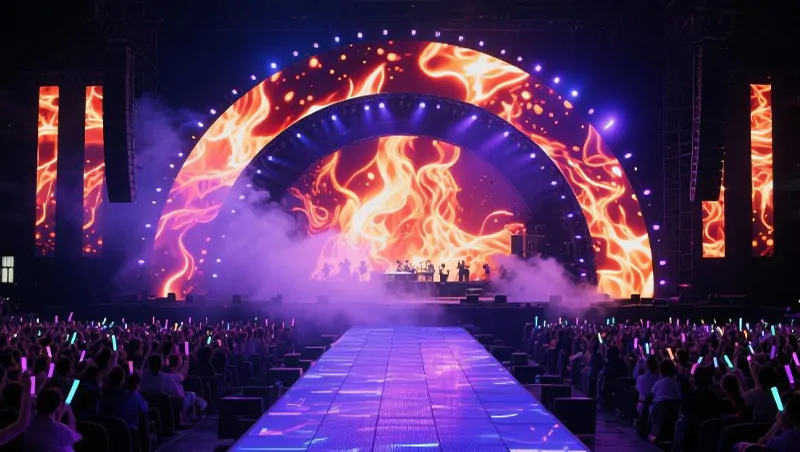
The viewing experience is where curved walls earn their keep. A concave curved wall wraps the viewer's peripheral vision, creating an immersive effect that flat panels can't match. This is why you see them everywhere in corporate lobbies, broadcast studios, control rooms, and high-end retail environments. The curve draws people in and makes the content feel enveloping rather than just displayed.
Let's get into the specific companies that are actually producing curved LED video wall systems at scale, with proven track records you can verify.
Absen has one of the more mature curved LED wall product lines in the industry. Their indoor rental series includes cabinets with built-in adjustable hinges that support both concave and convex configurations. What I appreciate about Absen's approach is that their curved capability isn't an afterthought, it's engineered into the cabinet design from the ground up. Their factory calibration process accounts for the angular positioning of each cabinet, so when you receive the panels, the color and brightness are matched not just for flat mounting but specifically for curved configurations. They offer pixel pitches from P1.5 to P4.8 in curved-capable models, giving you options depending on your viewing distance and resolution requirements.
Unilumin approaches curved walls with both their standard rental cabinet lines and their specialized curved cabinet series. The key differentiator for Unilumin is their manufacturing scale and the consistency that comes with it. When you order 100 curved cabinets, the hinge mechanisms, the LED module alignment, and the color calibration are all held to tight tolerances because their production lines are set up for high-volume precision. Their Upanel series supports curved configurations with adjustable angles, and their COB-based fine-pitch options are particularly well-suited for close-viewing curved installations where surface protection matters.
Leyard brings a different strength to the curved LED wall space, which is their engineering depth in large-scale permanent installations. They've deployed curved LED walls in some of the most demanding environments in the world, including broadcast studios, transportation hubs, and corporate headquarters. Their curved cabinet designs prioritize structural rigidity, because when you're building a large curved wall that needs to hold its shape over years of operation, the cabinet frame has to resist warping and flexing. Leyard's engineering team provides project-specific structural analysis for curved installations, which is valuable when you're dealing with curves that span 10 meters or more.
LianTronics has invested significantly in their curved and flexible display technology. They offer both rigid curved cabinets (with adjustable hinges) and truly flexible LED modules that can bend to custom radii. The flexible modules are interesting because they open up design possibilities that rigid cabinets can't achieve, think wrapping a column, creating a wave pattern, or building a seamless curve with a radius smaller than what rigid cabinets allow. Their flexible modules use specialized FPC (flexible printed circuit) boards and silicone-based encapsulation that protects the LEDs while allowing the module to bend.
RYSE LED focuses on the rental and events market, and their curved LED cabinets are designed with that use case in mind. What makes them stand out is how quickly their curved systems can be deployed. The hinge mechanisms are tool-free, meaning your crew can adjust the curve angle on-site without needing wrenches or special tools. For rental companies that need to reconfigure their curved walls for different events, this speed matters. Their P2.6 and P3.91 curved cabinets are popular in the corporate events space.
Planar (a Leyard brand for the North American market) deserves mention because their CarbonLight CLI Flex series is one of the few truly bendable LED products available from an established manufacturer. These aren't rigid cabinets with adjustable hinges, they're literally flexible LED modules that can be bent to create smooth curves, waves, and even column wraps. The flexibility comes from a specialized PCB and module design that allows continuous bending without visible segmentation.
| Manufacturer | Curve Type | Min. Curve Radius | Pixel Pitch Range | Adj. Angle Per Joint | Best Application |
|---|---|---|---|---|---|
| Absen | Rigid curved | ~2m | P1.5–P4.8 | ±10° | Corporate, broadcast |
| Unilumin | Rigid + COB | ~2m | P1.2–P3.9 | ±10° | Control rooms, rental |
| Leyard | Rigid curved | ~1.5m | P1.2–P4.8 | ±12° | Large permanent installs |
| LianTronics | Rigid + flexible | 0.5m (flex) | P1.5–P3.9 | ±10° / unlimited (flex) | Retail, creative |
| RYSE LED | Rigid curved | ~3m | P2.6–P4.8 | ±10° | Rental, events |
| Planar | Flexible | 0.3m | P1.5–P2.6 | Continuous flex | Architectural, creative |
Specifications vary by specific product line and model year. Confirm current specs directly with manufacturers.
This is the section I wish more buyers would read carefully before placing orders. The difference between a curved LED wall that looks stunning and one that causes ongoing problems comes down to a few specific technical factors.
Hinge mechanism quality and precision. Not all adjustable hinges are created equal. The best systems use CNC-machined aluminum hinge blocks with precision bearings that hold their angle under load. Cheaper implementations use stamped metal hinges with friction locks that can drift over time, especially in installations where the wall experiences vibration from foot traffic or nearby equipment. Ask the manufacturer about the hinge material, the adjustment mechanism type, and whether the angle holds without loosening over extended periods.
Module-to-cabinet alignment on curves. When cabinets are angled relative to each other, the LED modules at the cabinet edges need to maintain consistent pixel spacing. If the module mounting isn't designed for curved configurations, you'll see visible seams or pixel gaps at cabinet boundaries. The best manufacturers use edge-to-edge module designs with minimal bezel, and their curved cabinet frames are engineered so that modules at the edges sit at the correct angle to maintain uniform pixel pitch across the curve.
Geometric correction capability. This is non-negotiable for curved walls. Your content needs to look correct on a curved surface, and that requires geometric correction either at the processor level or the receiving card level. Verify that the manufacturer's recommended control system supports curved screen correction. NovaStar's VX series processors and Colorlight's Z series both offer this capability, but you need to confirm compatibility with your specific cabinet model.
Structural support requirements. A curved LED wall creates unique structural loads. The weight distribution is different from a flat wall, and the curve introduces lateral forces that the supporting structure needs to handle. Quality manufacturers provide structural load calculations and mounting recommendations specific to curved configurations. If a manufacturer can't provide this, that's a red flag.
Curved LED video walls carry a price premium over flat panels, and it's worth understanding why so you can evaluate quotes accurately.
The premium comes from several factors. The hinge mechanisms themselves add cost, precision-machined adjustable hinges aren't cheap. The cabinet frames need to be more rigid to maintain their shape under curved stress, which means more material and more machining. Factory calibration for curved configurations takes additional time because each cabinet needs to be calibrated not just for color and brightness but also for its angular position in the curve.
For rigid curved cabinets in the P2.5 to P3.9 range, expect to pay between $1,800 and $4,000 per square meter depending on the manufacturer and specifications. Fine-pitch curved cabinets at P1.2 to P1.9 run higher, typically $2,500 to $5,500 per square meter. Truly flexible LED modules, the kind that bend to custom radii, carry the highest premium at $4,000 to $8,000+ per square meter because the manufacturing process is fundamentally different and more complex.
| Product Category | Pixel Pitch | Price Range/sqm | Curve Capability |
|---|---|---|---|
| Standard rigid curved | P2.5–P3.9 | $1,800–$3,200 | ±10° per joint |
| Fine-pitch rigid curved | P1.2–P1.9 | $2,500–$5,500 | ±10–12° per joint |
| Flexible LED modules | P1.5–P2.6 | $4,000–$8,000+ | Continuous bend |
| COB curved cabinets | P1.2–P1.9 | $3,000–$6,000 | ±10° per joint |
Prices are approximate for 2026 and vary based on order volume, configuration, and specific manufacturer pricing tiers.
Curved LED walls look simple in renderings but the installation reality has some nuances that trip up even experienced integrators.
The supporting structure needs to match the curve precisely. You can't just mount curved cabinets to a flat wall and expect them to form a smooth curve. The mounting frame or truss structure needs to follow the designed curve, which means custom fabrication in most cases. Some manufacturers provide CAD files for the supporting structure, which saves time and reduces errors.
Cable management is more complex on curved walls. As cables route from cabinet to cabinet along a curve, they need enough slack to accommodate the angular differences without being pulled taut. Using flexible flat cables or ribbon cables designed for curved routing helps prevent connection issues over time.
Calibration after installation is essential. Even with factory-calibrated cabinets, the physical installation process introduces small variations. A qualified calibrator should visit the site after installation to perform final color and brightness matching across the entire curved surface. This is especially important for large curves where small cumulative errors become visible.
After spending a lot of time evaluating curved LED video wall options across multiple manufacturers, here's where I land. The technology has matured significantly, and the gap between what the leading Chinese manufacturers offer and what premium Western brands provide has narrowed considerably. Absen, Unilumin, Leyard, and LianTronics are all producing curved LED systems that hold their own against products costing two to three times as much.
The key is matching the product to your specific application. If you need a permanent curved installation in a corporate lobby or control room where the wall will be viewed up close and needs to look flawless, invest in fine-pitch rigid curved cabinets from an established manufacturer with individual cabinet calibration. If you're in the rental business and need curved walls that can be reconfigured quickly for different events, RYSE LED or similar manufacturers offer practical solutions at accessible price points. And if your project calls for truly organic curves that rigid cabinets can't achieve, the flexible module options from LianTronics or Planar are worth the premium.
What I'd caution against is buying curved LED cabinets from manufacturers who can't provide project-specific engineering support. Curved installations aren't plug-and-play. You need a manufacturer who can provide structural calculations, geometric correction configuration, and installation guidance specific to your curve radius and wall dimensions. If they can't do that, walk away regardless of how attractive the price is.
Q1: What is the minimum curve radius for LED video walls?
A: It depends on the cabinet type. Standard rigid curved cabinets typically support minimum radii of 1.5 to 3 meters depending on pixel pitch and cabinet width. Truly flexible LED modules can achieve radii as small as 0.3 to 0.5 meters. Always confirm the specific minimum radius with your manufacturer for the exact model you're considering.
Q2: Can curved LED video walls display standard flat content?
A: Yes, but geometric correction is required. Without correction, content appears distorted on the curved surface. Most modern LED processors from NovaStar, Colorlight, and Brompton support curved screen correction that remaps the content to display correctly on the curve. The manufacturer or your integrator should configure this during commissioning.
Q3: What is the price difference between curved and flat LED panels?
A: Curved-capable cabinets typically carry a 15-30% premium over equivalent flat panels due to the hinge mechanisms, reinforced frames, and additional calibration. Flexible LED modules carry a much higher premium, often 100-200% more than rigid panels, due to the specialized manufacturing process.
Q4: How long does it take to install a curved LED video wall?
A: Installation time depends on the size and complexity of the curve. A small 3x2 meter curved wall might take 2-3 days for an experienced crew. Larger installations spanning 10+ meters can take 1-2 weeks including structural framing, cabinet mounting, cabling, and post-installation calibration.
Q5: Do curved LED walls require special ventilation?
A: Curved configurations can create pockets where heat accumulates, particularly on the inner radius of concave curves. Most indoor installations with standard brightness levels don't require special ventilation beyond normal room HVAC. For large installations or high-brightness configurations, consult with the manufacturer about thermal management recommendations.
Q6: What pixel pitch should I choose for a curved LED wall?
A: This depends on your viewing distance. For viewing distances of 2-4 meters, P1.5 to P2.5 provides excellent image quality. For 4-8 meter viewing distances, P2.6 to P3.9 is appropriate. For audience distances beyond 8 meters, P3.91 to P4.8 works well. The curve itself doesn't change the pixel pitch calculation, but close-viewing curved installations benefit more from fine pitch because viewers can see individual pixels more easily at the edges.
Q7: Can I convert a flat LED wall to a curved configuration later?
A: In some cases, yes, if the cabinets were designed with adjustable hinges from the factory. Many rental-oriented curved cabinets can switch between flat and curved modes. However, cabinets designed specifically for flat installation typically cannot be converted. If you think you might want curved capability in the future, specify curved-capable cabinets in your initial order.
Q8: What maintenance is required for curved LED video walls?
A: Curved walls require the same basic maintenance as flat walls: periodic cleaning, dead pixel checks, and occasional recalibration. The hinge mechanisms may need occasional inspection to ensure they haven't loosened. For front-access cabinets, maintenance is straightforward. For rear-access installations, ensure adequate clearance behind the curve for service access.
Q9: Are curved LED walls suitable for outdoor use?
A: Yes, several manufacturers offer outdoor-rated curved cabinets with IP65 protection and high brightness (5,000+ nits). However, outdoor curved installations face additional challenges including wind loading on the curved surface, thermal expansion differences across the curve, and water drainage along curved joints. Work with manufacturers who have proven outdoor curved installation experience.
Q10: What warranty do manufacturers typically offer on curved LED cabinets?
A: Established manufacturers typically provide 2-3 years of warranty coverage on curved cabinets, covering manufacturing defects in hinges, LED modules, driver boards, and power supplies. Most include 3-5% spare modules with the order. Some manufacturers offer extended warranty packages. Verify whether the warranty specifically covers the hinge mechanism, as this is the component most unique to curved cabinets.