English
If you have been up late scrolling through china p10 indoor led display manufacturers, you probably already know the feeling I am talking about. Every listing reads the same: factory direct, OEM welcome, high brightness, ten years export experience, CE certified. One quote lands at a price that makes you suspicious, another comes back at nearly three times that, and both claim the same pixel pitch, the same cabinet size, the same "premium LEDs". Nobody explains why the numbers are so far apart. The product photos look like they came from the same catalogue shoot. The certificate thumbnails look like photocopies of photocopies. And not one page tells you which line on the spec sheet decides whether your wall still looks sharp eighteen months later, or whether it has faded into a patchy grey rectangle people walk past without looking.
That is what I want to sort out here. Not a list of company names — names would not help much anyway, because a workshop that does solid work on small rental cabinets is often completely out of its depth when you want a fixed indoor P10 wall that has to run twelve hours a day, stay flat across six metres, and be serviceable by your own technician. This is about how you tell the difference yourself, in about twenty minutes of asking questions that cannot be fudged.
You ask for a P10 indoor screen. The supplier pictures one thing, you meant another, and six weeks later a crate arrives that technically matches the order and misses the point entirely.
| What buyers picture | What often arrives | Where it works | Where it falls apart |
|---|---|---|---|
| Fixed indoor video wall, fine image | Standard P10 modules in thin steel frames | Large halls, churches, gyms, warehouses, transport screens | Viewed closer than 10m it looks coarse, text gets jagged |
| Rental-style cabinet reused indoors | Die-cast box designed for touring, heavy | Stages, events, temporary installs | Overkill on weight, noisy fans, expensive to mount permanently |
| "Indoor" cabinet with no real sealing | Open-back, dust gets in | Dry, clean rooms | Dusty or humid spaces kill the drivers within a year |
| P10 sold as "high resolution" | 10mm pitch is not high resolution at all | Long viewing distance only | Anyone promising sharp detail at 3 metres is selling hope |
A thing worth knowing, and nobody puts it in the brochure: P10 indoors is a distance play. Roughly, comfortable viewing distance in metres sits close to the pitch number. So P10 wants viewers around ten metres away and beyond. Put it in a small retail shop where people stand two metres away and it will look blocky no matter how good the brand of LED is. That is not a quality problem, that is a geometry problem, and no amount of calibration fixes it.
At the same time, P10 indoors has a genuine advantage people undersell: lower pixel density means fewer LEDs per square metre, which means less heat, less power draw, longer life, and a much lower price. For a church hall, a warehouse, a sports hall, a train station concourse, or a large lobby where nobody stands closer than eight metres, P10 is often the smarter buy than chasing P4. You get more square metres for the same money, and the wall lasts longer because it is not cooking itself.
Also worth saying: "indoor" does not mean "no environmental stress". A P10 wall in a humid subtropical climate, or in a gym where the air is wet and salty, or in a factory with dust and oil mist, will fail in ways a clean air-conditioned lobby never does. Tell the supplier the actual room conditions in your first message. If they then recommend the same standard indoor cabinet they would sell to anyone, you have your answer.
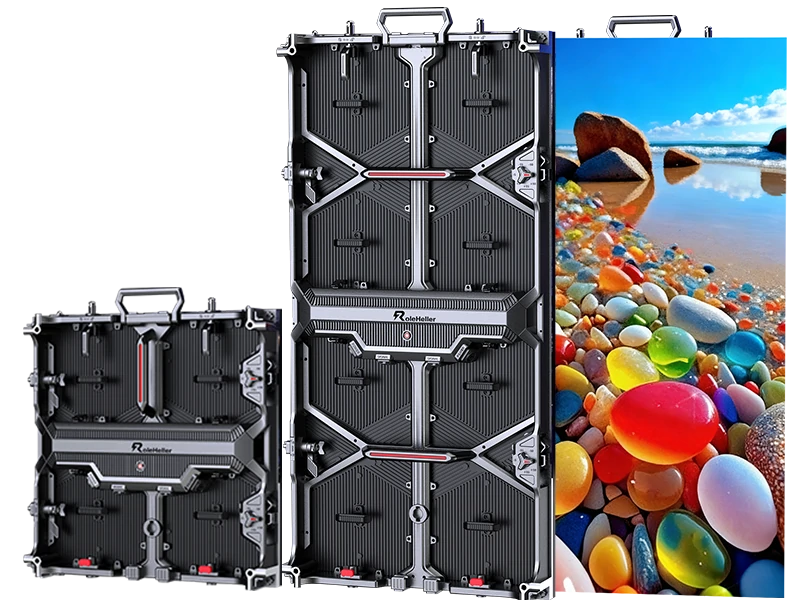
An indoor LED wall is modules and cabinets, a structure that holds them flat, a controller and signal chain, and power with cabling done properly. Four separate disciplines. A maker can build perfectly flat cabinets and still ship you a control system that loses sync every time the building's power dips, or a power layout that leaves you with a voltage drop on the last row of modules.
That is why two quotes look identical on paper and differ by forty percent. The gap lives in the parts nobody photographs.
| Spec item | Budget quote | Decent quote | Why it matters |
|---|---|---|---|
| LED package and bin | Unbranded, mixed batch | Named tier, single batch recorded per order | Mixed batches give patchy colour you cannot fix later |
| Driver IC and refresh rate | Generic, low refresh | Decent IC, stable grey scale, decent refresh | Determines whether phone footage looks banded or smooth |
| Cabinet material and flatness | Thin sheet, loose tolerance | Proper framing, documented flatness tolerance | Flatness errors show up as visible seams across a wide wall |
| Module size and aspect ratio | Whatever is cheap | Sizes that divide cleanly into your wall dimensions | Wrong module size means wasted offcuts and awkward edges |
| Power supply | No-name, running near full load | Branded, derated, fused correctly | The single most common failure point, always |
| Brightness and dimming | Not stated or inflated | Real nits figure, adjustable, auto-dimming option | Too bright indoors causes eye strain; too dim and it looks dead |
| Control system | USB stick only, or locked cloud platform | Local software plus remote option, licence you own | Losing control of the software turns a content change into a three-day wait |
| Certifications | PDF images | Numbers in the supplier's own name, verifiable | Skip this and customs may hold the crate for weeks |
Notice neither table has a price in it. That is deliberate. Price follows spec, and if you let the supplier write the spec you will never know whether you saved money or just bought the wrong thing.
Send these together and watch two things: how fast the reply lands, and how concrete it is. Speed does not prove quality. Vagueness proves quite a lot.
Can I see a live video call of the production floor right now?
Not a recorded tour. Live. Ask them to walk to the ageing test area and read a serial number off a running cabinet. Brokers send PDFs and say the engineer is out today. A real factory can do this during working hours without drama.
Which exact LED brand and driver IC are in this quote?
If the answer is "high quality brand, we can arrange", move on. Factories name parts because they hold purchase orders for them. Trading companies speak in adjectives.
What is the real brightness, and can you show me footage in the actual lighting?
Ask for a video shot on a phone, in a lit room, not a darkened showroom. Indoor screens live or die in ambient light, and a dark-room promo shot hides everything.
Is the control software locked to your platform, and do I own the account?
Some deals tie you to a cloud account the supplier controls, which turns a thirty-second content change into a three-day wait across time zones. Ask for the software name, whether it runs on your own computer, whether there is an annual fee, and whether you hold the login.
Can you give me two customer contacts who have run your screens for more than a year?
Then actually contact them and ask exactly one question: what broke, and how fast did it get fixed. You learn more from that answer than from any certificate image on the website.
Do the certifications sit in their own company name?
CE, RoHS, FCC as relevant. A PDF image proves nothing; the number can be checked on the registrar's site. People skip this and then wonder why the shipment sat in customs for three weeks.
Will you ship a spares kit in the same crate?
Modules from the same production batch, spare power supplies, spare receiving cards, extra cables and the tools to swap them. If they hesitate, treat it as an answer.
Is P10 still worth buying indoors, or should I go finer?
Depends entirely on viewing distance and budget, and this is the question where buyers most often overspend. If your nearest viewers are inside eight to ten metres, P10 is a sensible choice and it will save you a lot of money over P4 or P3, both upfront and in running costs and heat. If people stand four metres away, go finer. There is a middle zone, roughly six to nine metres, where either can work and the decision should be driven by content type — text-heavy content needs more resolution than logo-and-video content. Be honest about what will actually be displayed before you pick.
How bright should an indoor P10 screen be?
Enough to beat the ambient light, and able to dim itself. Indoors you typically want a moderate brightness figure, and crucially you want adjustable brightness with a schedule or a light sensor. Running an indoor screen flat out in a dim room draws complaints, strains eyes, wastes power, and cooks the LEDs. Auto-dimming is not a luxury here, it is what keeps the screen on the wall for years instead of months. Ask whether the dimming curve is adjustable and whether it can be scheduled by time of day.
What about heat and dust in the room?
This is the one that gets underestimated constantly. Even indoors, a sealed cabinet running twelve hours a day builds heat, and heat is what kills LEDs and power supplies. Ask how the cabinet handles heat dissipation, whether the power supplies are oversized, and whether the design allows airflow without letting dust straight in. If the room is a gym, a kitchen-adjacent space, a factory floor, or anywhere with humidity and airborne particles, say so up front and ask what changes in the spec. A supplier who gives you the same answer for a clean lobby and a sweaty sports hall is not thinking about your job.
Does the cabinet need to be die-cast or is steel fine?
For a permanent indoor install, both work; what matters is flatness tolerance and weight. Die-cast tends to hold flatness better and is lighter, which matters when the wall is wide and the fixings are into drywall or lightweight block. Steel is cheaper and heavier. Ask for the flatness tolerance and the weight per panel, and check what the wall can carry. This is the part that determines whether the installer can actually do the job in the time allotted.
Front service or rear service?
Both is ideal, but think about your actual room. In a tight corridor, a fitted lobby wall, or anywhere with no access behind, rear service only means dismantling the whole setup to reach one module. Confirm how much clearance is needed and build that into the plan now, not on installation day. Also confirm whether removing one module forces you to remove its neighbours — I have seen designs where a five-minute job becomes forty minutes.
What controller do I need?
Confirm processor compatibility, input options, whether you need a sending card and receiving cards, cable lengths, and whether there is backup path redundancy if the screen is mission-critical. Also confirm the maximum resolution the controller can drive for your chosen width and height — P10 walls often run wide, and people discover too late that their controller caps out below the pixel count they ordered. Get this written down. Do not assume compatibility.
Should I buy or lease?
Depends on your cash flow and whether you own the site. Buying makes sense when you control the location and plan to run the screen for years. Leasing or revenue-share works better when you are pitching to landlords or operators who will not commit capital. Either way, plan for a failure rate and budget spares accordingly. Expecting zero faults is how these projects run out of money in year two.
Write your usage facts down first. Room dimensions, mounting position and height, nearest and farthest viewer, hours per day, who changes the content, ambient light levels, whether there is direct sun through glass, available fixing points, access from behind, local rules on illuminated signage, and whether it is permanent or temporary. The tighter this list, the more comparable the quotes become. Suppliers who cannot answer properly tend to stop replying, which is useful filtering.
Get three configuration sheets and compare line by line. Compare total price for the same configuration, not total price alone. Two P10 indoor walls with different LEDs, driver ICs, power supplies and controllers can differ by a large margin and look identical in a showroom photo.
Lock the mechanical details early. Cabinet dimensions, weight per panel, total wall weight, fixing method, service clearance, and whether the structure drawing is included. This is the part that determines whether the installer can actually do the job.
Confirm signal and control architecture. Main and backup paths if relevant, processor compatibility, spare cards, cable lengths, remote access method, and whether the software licence expires.
Write the warranty in operational language. Response time, who pays freight on replacement parts, whether labour is covered, whether failed modules are replaced or repaired, and whether support is available in your time zone. Two years warranty with no detail means nothing once you are six time zones apart.
Insist on a spares kit in the same shipment. Same-batch modules, spare power supplies, spare receiving cards, extra cables and swap tools, labelled. A screen going dark on a Friday evening is fixed by a spare sitting in your storeroom, not by an email chain.
Arrange inspection before shipping. A third-party check at the factory catches mislabeled pitch, wrong components, missing spares, dead pixels and weak seals before the crate is sealed. It costs a few hundred and it is the cheapest insurance on the whole project.
Confirm paperwork before shipping, not after. HS code, duty rate, electrical compliance. Electronic displays get questioned at borders more often than expected, and port storage fees pile up faster than arguments resolve.
Test on arrival and again after installation. Run it powered for an extended period, check dead pixels and seams, check brightness under actual room lighting, test the dimming schedule, and actually swap a module using the spares kit to confirm your technician can do it in the time you think they can. Anything found before final acceptance costs the least to fix.
Seams appearing or worsening over time points to cabinet flatness and material quality. That cannot be adjusted away, only replaced. Patchy colour within the first year points to mixed LED batches or no calibration. Panels dimming noticeably by the second summer points to insufficient thermal management or power supplies running hot. Dead rows after a few months usually points to connector and ribbon cable quality rather than the LEDs themselves. Flicker or banding on camera means refresh rate or driver IC was cut. Each symptom maps to a corner that was cut. Knowing the map stops you accepting "just bad luck" as an explanation. It was not bad luck.
A brilliant screen playing dull content looks like a dull screen. Resolution earns about three seconds of attention. The creative decides whether anything sticks. Design for the actual viewing distance, keep text minimal, use high contrast, avoid cluttered layouts. Also plan for changeover — a screen saying the same thing in July as it said in March has stopped working even though it is still switched on. Money spent on the artwork usually beats money spent on chasing one more parameter tier, and it costs far less than an extra square metre of panel.
Give whoever runs the screen a simple template set and a clear routine. The person updating it on a busy weekday should not need to interpret a designer's intentions.
Do not delete the spares kit to save money. It pays for itself the first time it saves a day of downtime.
Do not accept "we will match the colour later" on spare modules. Same-batch spares shipped with the order are the only reliable path to long-term uniformity.
Ask whether the supplier can provide a visit to a local installation or a sample panel before you commit. Seeing and touching the thing beats any amount of brochure reading.
Confirm the minimum dimming level and ask for it to be demonstrated. If they cannot show you the screen at low brightness, they probably have not calibrated it there.
Keep the original packing for at least a month. Shipping a panel back without proper packing is how you turn a warranty claim into an argument about transit damage.
After looking at enough of these projects, the pattern is boringly consistent. The buyers who end up happy wrote down how the screen would actually be used before speaking to a single supplier — viewing distance, hours per day, whether it gets sun through glass, who changes the content, whether the wall can take the weight, whether there is access from behind. The buyers who end up disappointed started with price and worked backwards. Specs can be padded, photos can be borrowed, certificates can be faked, but usage cannot be faked. Lay those facts out first and the wrong manufacturers remove themselves, because they cannot answer properly. The right ones respond with specifics, ask questions back, and sometimes tell you that P10 is the wrong pitch for your room, or that your mounting plan will not work, or that you would be better off with fewer square metres and better content. That last behaviour is the strongest signal in the whole process. A supplier willing to talk you out of a sale is usually the one who has installed enough of them to know where the problems hide.
Trust that instinct more than any badge on a website. And insist on the calibration file, the same-batch spares, and a software licence you actually control. You will thank yourself eventually.
What should I look for in China P10 indoor LED display manufacturers?
Prioritise transparent component specs (LED brand, driver IC, power supply), documented cabinet flatness tolerance, real brightness figures with adjustable dimming, control software you own, verifiable certifications in the supplier's own name, and a documented spares policy. Compare prices on matching configurations only.
Is P10 good for indoor use?
Yes, when the viewing distance is roughly eight to ten metres or more — halls, churches, gyms, warehouses, transport concourses, large lobbies. If viewers stand closer than about six metres, consider a finer pitch. P10 is not a resolution play, it is a value and reliability play.
How bright should an indoor P10 screen be?
Bright enough to read clearly under the room's ambient light, with adjustable brightness and preferably auto-dimming. Running maximum brightness indoors causes eye strain, shortens LED life and attracts complaints.
What is the lifespan of an indoor P10 LED display?
With proper thermal design, derated power supplies and sensible brightness levels, indoor LED displays commonly run for many tens of thousands of hours. The actual life is determined more by heat management and component quality than by the pitch number.
Can I update the content myself?
Yes, provided the controller supports it. Confirm the software name, whether it runs on your own device, whether there is an annual fee, and that you hold the login credentials. Remote control is convenient but should not be the only way to change content.
Do I need a permit for an indoor LED display?
Permanent installations in commercial buildings often require approval from the landlord, building management or local authority, especially for signage facing public areas. Check before ordering — a refused permit does not come with a refund.
What warranty terms should I insist on?
At minimum two years on modules and control system, plus clarity on response time, who pays freight for replacements, whether labour is covered, and whether support is available in your time zone. Negotiate these explicitly.
How long does delivery take from China?
Standard configurations often run several weeks from deposit plus freight time. Custom sizes and unusual aspect ratios take longer, and peak season adds buffer. Plan from the date you need the screen working, not the date you pay.
What spares should come with the order?
Modules from the same production batch, spare power supplies, spare receiving cards, extra cables and locks, and the tools to swap them, all clearly labelled. For commercial installations this is not optional.
How do I know if a supplier is a real factory or a trading company?
Ask for a live video call of the production floor and ageing test area, request component brands named in writing, verify that certificates sit in the company's own name, and ask for references from customers who have run the screens for over a year. Factories name parts and can show the floor; traders speak in adjectives and send PDFs.
.jpg "Where to Find Reliable Wholesale GOB LED Video Wall Manufacturers?")