 English
Short answer: you find reliable china outdoor led video wall manufacturers by locking down your spec sheet before you ever mention price, ordering one sample cabinet and leaving it outside in direct sun for a week, checking CE/RoHS/IP certificate numbers on the issuer's own website instead of trusting a PDF attachment, demanding a live video call of the aging room rather than accepting a pre-recorded factory tour, and writing warranty response time plus a five to eight percent spare-parts kit straight into the contract — expect roughly USD 900 to USD 2,200 per square metre FOB Shenzhen for outdoor P4.8 to P6.6 fixed cabinets, depending on brightness and whether you need IP65 front and rear. Now let us go through the rest properly.
Most people who search for this are already halfway into a problem. A retail facade needs a screen, a sports bar wants to show matches in daylight, a church built a new exterior stage, or a city project needs a perimeter display around a stadium. The opening date is on the calendar, the budget has been signed off, and suddenly you need to know whether the company with the glossy storefront actually builds anything or just photographs other people's factories. That is a fair question. It is answerable, and you do not need to fly to Shenzhen or speak Mandarin. You do need patience and a willingness to ask the boring questions that make salespeople shift in their chairs. We will walk through spec, price, verification, lead time, installation, and the mistakes that keep repeating.
There is a pattern we see constantly. Someone gets handed a site — a building face, a forecourt, a drive-through lane — and sends out five enquiries on a Tuesday, gets five quotes back by Thursday, picks the cheapest because on paper they all look about the same, and then four months later they are standing in front of a wall that looks washed out at noon, trying to figure out what went wrong.
Nothing went wrong exactly. Everything went according to the information they had at the time, which was nearly nothing.
Outdoor punishes cheap decisions differently from indoor. Indoor failures are subtle: seams creep, colour drifts, fans get loud. Outdoor failures are public and expensive: water ingress behind the modules, brightness that cannot beat midday sun, cabinets that warp under thermal cycling, and a local inspector who refuses to sign off because the electrical listing does not exist. Nobody writes a complaint email about a panel that is two hundred nits short. They just stop using it during the day, which is precisely when you needed it.
Outdoor is not simply "indoor but brighter." It is a different engineering job, and the differences show up three years in rather than three weeks.
Brightness. Outdoor needs 5,000 to 7,000 nits for direct sunlight, with automatic light sensor dimming down to a few hundred nits at night. A panel capped at 4,500 nits will look acceptable at 10 AM and invisible at 1 PM. Note also that peak brightness and usable contrast are not the same thing — foggy black LEDs and good masking matter more than the headline number once ambient light is high.
Ingress protection. Front IP65 is the baseline; if the cabinet is installed where rain can reach the rear, or where it is mounted on a freestanding pole with wind-driven spray, you want IP65 front and rear. Ask specifically. Many quotes say "IP65" and mean front only.
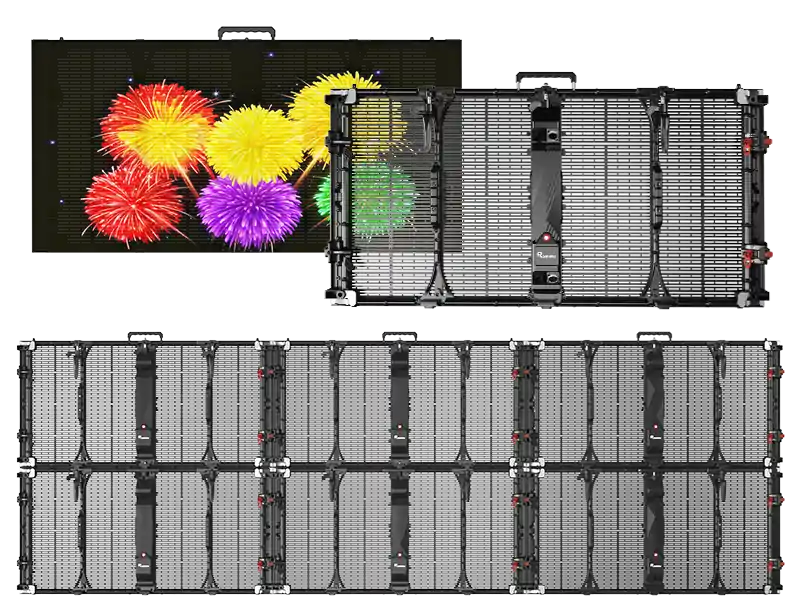
Thermal design. An outdoor cabinet in full sun absorbs serious heat. Die-cast aluminium with proper thermal paths and separate convection channels matters more than an extra thousand nits. Sealed fanless designs reduce dust and moisture entry but run hotter; fan-assisted designs cool better but need filters and maintenance. There is no free lunch here, just a choice about who maintains it.
Cabinet rigidity and finish. Powder coat quality, stainless hardware, and gasket material determine whether the wall looks tired after two summers. Cheap gaskets harden, seals lift, and water finds its way in. This is where the cheapest quote loses money.
Pixel pitch and viewing distance. Outdoor viewers are usually farther away, so going fine-pitch outdoors costs a lot for little gain. P6.6 to P10 is standard for billboards and large facades; P4.8 to P6.6 for retail fronts, stadiums, and stages where people stand within ten to twenty metres.
Service access. If the wall is flush-mounted against a building with no rear access, front-service cabinets are mandatory, not optional. Specify it explicitly, because rear-service is cheaper and some suppliers quietly quote that.
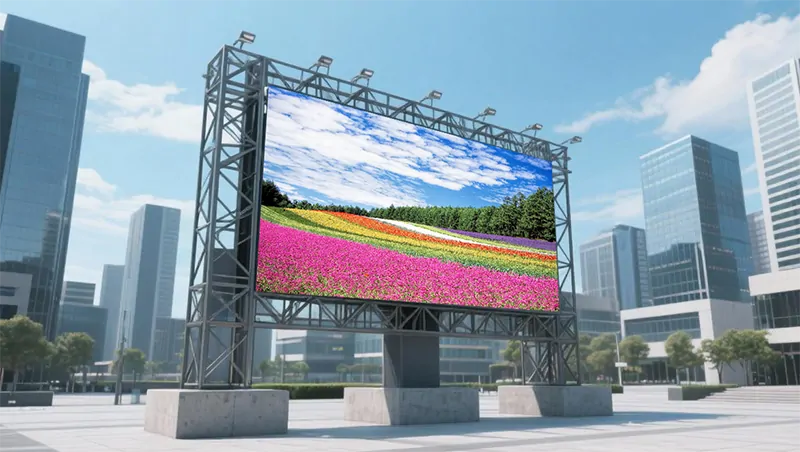
Structure, wind load, and local sign-off. The display is only one line item. The steel, the wind calculation, the foundations, the electrical supply, and the local permit are what actually stall projects. Get a local structural engineer involved early, not after the panels arrive.
| Pitch | Comfortable viewing distance | Typical outdoor use | Typical FOB price per m² |
|---|---|---|---|
| P4.81 | 5–15 m | Retail facades, stadium close-view, stages | USD 1,400–2,400 |
| P6.6 | 7–25 m | Building faces, arenas, transport hubs | USD 1,000–1,700 |
| P8 | 10–40 m | Large facades, plazas | USD 850–1,400 |
| P10 | 15–60 m | Billboards, highway-facing, perimeter boards | USD 700–1,200 |
Those ranges assume IP65 front, die-cast aluminium, and standard refresh. High refresh, high brightness, and front-service all push the number up. And none of it includes structure, freight, duty, installation, or content.
Here is the mistake that causes most of the damage. Buyers ask "how much per square metre" in their first email. Suppliers give them a number. Then both sides act as if that number means something.
It does not mean anything yet. Two suppliers quoting "outdoor P6.6" can be quoting completely different hardware — different LEDs, different driver ICs, different power supplies, different cabinet thickness, different gasket spec. One of them will still look right in year four. The other will have a warm patch in the top corner and a service call every spring.
Write the spec down first. Send the same document to every supplier. Then the quotes become comparable, which is the whole point.
| Parameter | What to write | Why it matters |
|---|---|---|
| Pixel pitch | P4.81/P6.6/P8/P10 confirmed | Drives resolution and cost; cannot change after build |
| Brightness | 5,000–7,000 nits with auto-dimming sensor | Daylight legibility and night-time comfort |
| IP rating | IP65 front; IP65 rear if rear exposed | Water ingress is the number-one field failure |
| Cabinet | Die-cast aluminium, powder coat, stated thickness | Rigidity, heat, corrosion |
| Service | Front-service if no rear access | Otherwise maintenance is impossible |
| LED brand | Nationstar/Kinglight, same bin, batch report | Mixed bins cause colour drift between batches |
| Driver IC | MBI series or equivalent, high PWM | Grayscale and low-brightness performance |
| Refresh rate | ≥3,840 Hz if filmed/broadcast; ≥1,920 Hz otherwise | Scan lines show on camera immediately |
| Operating temp | Stated range for your climate | Gulf summers and Nordic winters are different jobs |
| Control system | Novastar or equivalent, redundancy option | Live events need backup paths |
| Certifications | CE, RoHS; ETL/UL for North America; IP test report | Customs, insurance, local inspection |
| Spares | 5–8% modules + power supplies + receiving cards | Without spares, a warranty is a theory |
One thing worth repeating: ask for the LED bin-matching commitment in writing. It costs the factory almost nothing to do it right, and nothing to promise. But once it is written down, you have something to point at when batch two arrives and the colour does not quite sit next to batch one. For large facades that get extended later, this is the single thing that prevents a mismatched wall.
Numbers, since this is the part everyone scrolls for. Ranges below are typical FOB Shenzhen for standard configuration, excluding controller, structure, crating, freight, duty, installation labour, and content.
| Configuration | Typical price per m² | Notes |
|---|---|---|
| Outdoor P8–P10 fixed install, standard | USD 700–1,400 | Billboards, perimeter boards, large facades |
| Outdoor P6.6, IP65 front/rear | USD 1,000–1,700 | The mainstream facade and arena spec |
| Outdoor P4.81 high brightness, front-service | USD 1,400–2,400 | Retail frontages, stadiums, broadcast |
| Spare kit (5–8%) | USD 60–200 per module | Cheaper than a failed inspection |
| Controller/processor set | USD 400–4,000 | Almost always quoted separately |
| Steel structure, foundations, rigging | Local cost | Often equals or exceeds the panel cost |
Things learned the slightly painful way:
Panel price is usually 45 to 60 percent of the real total. Add structure, electrics, crane or access equipment, freight, duty, installation, commissioning, content, and insurance. Take the screen quote and multiply by roughly 1.7 to 2. Projects stall less when the budget is honest from day one.
A quote arriving inside an hour at the bottom of the range is a placeholder. A serious manufacturer needs width, height, viewing distance, mounting method, rear access, local wind/snow load, refresh rate, and controller brand before pricing properly. Someone quoting USD 600/m² for outdoor P6.6 in the first reply without asking a single technical question is quoting a ghost product.
Volume tiers exist. Most factories move three to eight percent between a 30-square-metre order and a 120-square-metre order. Ask before the first quote, not after, otherwise you negotiate against yourself.
Quotes held unchanged for 60 days are suspicious. LED chips, driver ICs, PCBs, and aluminium fluctuate. Seven to fifteen days is normal. Longer than that and the margin is hiding somewhere you will notice later.
Payment terms matter. Standard is T/T 30 percent deposit, 70 percent before shipment or against copy of bill of lading. LC at sight for larger orders. Never wire 100 percent upfront on a first relationship, and always pay to the company name on the business license.
Shenzhen has thousands of LED businesses and a large share are traders with very good photos. Traders are not automatically bad — some communicate well, consolidate sensibly, and are easier to deal with than a factory that barely speaks English. But when a cabinet leaks in year two, you need to know exactly who answers the email and whether that person can reach the production floor.
The screening sequence takes about a week and costs almost nothing except a bit of awkwardness.
Ask for the business license. Check registered name, establishment date, registered capital, business scope. A company formed fourteen months ago claiming fifteen years of manufacturing experience has an arithmetic problem.
Ask for a live video call, not a video file. Say you want to see the floor at 3 PM their time. During the call, ask them to walk to the aging room and show the cabinets currently running, ideally with your enquiry number written on paper next to them. Pre-recorded tours can be anybody's factory. Traders tend to develop sudden scheduling conflicts when asked for live walkthroughs.
Check product focus. A genuine display maker sells displays, controllers, outdoor cabinets, spare parts. If the same storefront lists solar garden lights, phone chargers, and blenders, you are looking at a general trading account.
Verify certificates yourself. Ask for certificate numbers and issuing bodies, then check on the issuer's own website. Expired certificates, and certificates issued to a different company name, are remarkably common. For North American installs, ETL or UL listing matters for local electrical inspection — confirm this early, not the week before the inspector arrives.
Order one sample cabinet and leave it outside. Yes, the per-square-metre cost will be higher. Do it anyway. Run it for a week in direct sun and overnight rain if you can. Look for uneven patches, dead pixels, seam gaps, condensation inside the module, and whether the auto-dimming actually works. Measure flatness with a straight edge. That one cabinet teaches more than twenty PDFs.
Ask for the aging test protocol. Decent factories run 48 to 72 hours continuous aging plus grayscale and colour calibration before packing. Ask them to film your specific cabinets during that test. Hesitation here is useful information.
Keep a second supplier warm. Not as leverage, as insurance. Supply chains shift, timelines slip, and having a backup quote already warmed up saves weeks when something goes wrong.
Red flags: prices well below market with no explanation, refusal to put warranty response times in writing, no independent QC process, insistence on 100 percent upfront, payment to a personal account, and "our factory is nearby, come visit" with no address provided.
From deposit to shipment, standard lead time is 25 to 35 working days for outdoor cabinets, including aging. Rush orders can sometimes be done in 15 to 20 days with a surcharge. If someone promises ten days on an 80-square-metre outdoor order, they are either pulling stock from another client's allocation or skipping the aging test. Neither outcome helps you.
Sea freight is normal. Get a packing list with dimensions and weights early so your forwarder can quote properly, and confirm the HS code and your local duty rate before finalising the budget — this is the line item that surprises people most often.
Here is the part that actually breaks projects: work backwards from your required on-site date and add four weeks. Every time. Factories fill up, freight gets congested, and customs does not care about your opening night. On top of that, outdoor jobs need structure fabrication, foundations curing, crane or MEWP booking, and local permitting. Any one of those can absorb three weeks without anyone doing anything wrong.
And there is another thing worth saying: commission the screen in daylight. It is tempting to do the final sign-off at night when everything looks impressive. Do the acceptance test at noon with the sun on it, because that is when the weaknesses show. Put the acceptance criteria in writing beforehand — minimum measured nits, uniformity, dead pixel tolerance, and seam gaps — so there is no argument later.
Q: Do I really need 7,000 nits?
Depends on orientation and climate. South-facing walls in hot climates genuinely need the headroom. North-facing walls in overcast climates, or screens viewed mostly after 4 PM, can get away with 5,000 to 5,500. Spending extra on brightness you do not use is money taken from somewhere more useful, like structure or spares.
Q: IP65 front and rear — necessary?
If there is any chance of water reaching the rear, yes. Freestanding poles, roof-mounted installations, and anywhere with wind-driven rain should be IP65 both sides. Flush-mounted against a solid wall with a sealed rear cavity can be front-only. Be honest about the actual site, not the idealised one.
Q: Can we install it ourselves?
Your crew can assemble the cabinets, yes. But the structure, the wind loading, and the electrical supply need local sign-off, and people walk underneath these things. A local engineer's fee is small compared with the alternative. Also confirm electrical capacity early: outdoor walls can draw 600 to 900 W/m² peak, and sites notice.
Q: What about warranty when the supplier is overseas?
This is where the contract matters more than the promise. A usable warranty clause states: response within 24 hours, replacement parts dispatched within 5 to 7 working days, clear statement of who pays freight on replacements, coverage of two to three years, and critically, a spare-parts kit shipped with the original order. Without spares on site, a warranty is a theory. With spares, a failed module is a twenty-minute job.
Q: Will colours match if we extend the wall later?
Reasonably well, if you insist on same-batch LEDs, factory calibration, keep the same cabinet model, and recalibrate on site. Plan for it: buy enough up front to cover likely growth, or get a written commitment that the supplier will hold the same LED bin for future orders. Mixing batches from different suppliers is where colour matching goes to die.
Q: Do we need a video processor?
If you switch between sources — laptop, camera feed, media player, signage player — yes. A processor lets you scale inputs, store presets, and switch cleanly. Some buyers skip it to save money and then wrestle with resolution mismatches for months. Not worth the saving. Also ask whether the control software carries a recurring licence fee; finding that out after installation is a particular kind of annoyance.
Q: How do we handle content for an outdoor wall?
Big type, high contrast, not too much of it. Pixel pitch determines the smallest readable text, and outdoor viewers are moving and distant. Design for five seconds of legibility, not for a brochure. Also plan for brightness scheduling so the screen does not blind people at night — that is how you get complaints and, in some cities, a permit revoked.
The retailer that did it slowly and got it right. A chain with six store fronts started with a sample cabinet mounted on one location for two weeks, checked it at noon and at midnight, verified the auto-dimming curve, then placed a 45-square-metre programme order with P6.6, IP65 front and rear, front-service cabinets, eight percent spares, and a written 24-hour response commitment. Two years later they added three more stores using the same model and everything matched, same spare parts, same remote monitoring setup. Lesson: standardise the cabinet model and do not change it mid-programme. Future-you will be grateful.
The venue that bought on price. Roughly 60 square metres, lowest outdoor P8 quote available. One summer later there were three modules with moisture ingress, the colour had drifted between batches because the second delivery came from a different bin, and the local inspector asked for an electrical listing that did not exist. Getting compliant paperwork retroactively cost more than the original saving. Lesson: confirm certifications and local compliance before payment, keep all cabinets from the same production batch, and get the bin-matching commitment in writing.
Comparing quotes by total instead of by line item. Two quotes at USD 1,200/m² can be completely different products. Demand component brands on the quotation.
Forgetting the controller until installation week. Sending card capacity, receiving cards, processor inclusion — discovering this late adds weeks.
Ignoring the structure budget. Steel, foundations, crane access, and wind calculations often equal the panel cost. Never let cost-saving happen here.
Measuring the site optimistically. Confirm buildable area, sight lines from the side angles, rear access, sun path, and where the power actually comes from.
Skipping the daylight acceptance test. Night-time sign-off hides the exact problem you bought the screen to solve.
No content plan. Pixel pitch and viewing distance determine readable text size. Design accordingly.
Paying fully upfront. Standard terms exist for a reason. Always pay to the company name on the business license.
No maintenance plan. Outdoor means cleaning, gasket checks, filter changes if fan-assisted, and an annual recalibration. Budget for it or the wall degrades faster than the warranty runs out.
If I were buying an outdoor LED wall from China today, I would shortlist three suppliers who can prove they manufacture, pay for a sample cabinet, mount it on-site for two weeks, look at it at noon and again at midnight, then place a modest first order with the winner while keeping the runner-up warm as backup. I would write the warranty response times and spare-parts percentage into the contract, budget roughly double the per-square-metre price for structure, electrics, access equipment, freight, duty, installation, and content, and I would insist on a daylight acceptance test with the criteria written down beforehand. Then I would spend whatever was left making the graphics readable in five seconds, because that is what people actually notice.
It is not the fastest route. It is the route that does not end with you explaining to a board why the screen looks washed out at noon, three months after everyone approved the purchase.
1. What should I look for in China outdoor LED video wall manufacturers?
Look for verified CE and RoHS certificates, IP65 front (and rear if exposed), die-cast aluminium cabinets, named LED and driver IC brands, a documented aging test protocol, willingness to do a live factory video call, and warranty terms written into the contract including a spare-parts kit.
2. How much does an outdoor LED video wall from China cost?
Typically USD 700 to 1,400 per square metre for P8–P10, USD 1,000 to 1,700 for P6.6 IP65 front/rear, and USD 1,400 to 2,400 for P4.81 high-brightness front-service, FOB Shenzhen. Structure, freight, duty, and installation are extra and often substantial.
3. What pixel pitch do I need outdoors?
P10 for billboards and long-distance viewing, P6.6 to P8 for building facades and arenas, P4.81 for retail frontages and stadiums where viewers are within 5 to 15 metres. Finer pitch outdoors costs significantly more for little gain.
4. How bright does an outdoor screen need to be?
5,000 to 7,000 nits for direct sunlight, with automatic dimming for night-time. South-facing walls in hot climates need the upper end; shaded or north-facing walls can use less.
5. Do I need IP65 front and rear?
Front IP65 is the baseline. Add rear IP65 for freestanding poles, roof mounts, and anywhere wind-driven rain can reach the back. Flush-mounted walls with a sealed rear cavity can be front-only.
6. How do I verify a Chinese LED manufacturer is legitimate?
Check the business license and establishment date, request a live video walkthrough of the production and aging floor, verify certificate numbers with the issuing body, review their product range for focus, and order a sample cabinet before committing to volume.
7. What is a realistic lead time?
25 to 35 working days from deposit to shipment, including aging tests. Rush orders can sometimes be done in 15 to 20 days for a fee. Add sea freight, customs clearance, structure fabrication, and installation time.
8. What warranty terms should I insist on?
Two to three years with a written response time, replacement parts dispatched within 5 to 7 working days, clear statement of who pays freight, and a spare-parts kit of 5 to 8 percent extra modules shipped with the original order.
9. Can outdoor cabinets be serviced from the front?
Yes, front-service cabinets are widely available and essential when the wall is flush-mounted with no rear access. Specify this explicitly because rear-service is cheaper and often quoted by default.
10. What is the biggest mistake buyers make?
Choosing on price alone and forgetting the hidden costs: steel structure, foundations, electrical supply, crane or access equipment, spares, freight, duty, installation labour, content, and local permits. Compare line items, not totals, and do the acceptance test in daylight.
.jpg "How to Pick LED Video Display Wall Manufacturers?")
.jpg "Where to Find Reliable Wholesale P2.6 LED Video Wall Manufacturers?")