English
If you have ever typed china led display full color manufacturers into a search bar while trying to price a screen for a storefront, a church, a sports hall or a roadside billboard, you know exactly what happens next. Page one looks like one company wrote it forty times. "Factory direct wholesale price." "OEM/ODM welcome." "High brightness, high refresh rate, CE RoHS FCC." You send the same enquiry to five of them and get four quotes back that look identical on paper yet span a range wide enough to make you nervous. One is so cheap you assume it is a typo. Another is nearly triple. And not a single one explains the gap. Nobody ever does.
The short answer — the bit I wish someone had told me before my first order — is that you do not find a good supplier by reading websites. You find one by asking questions nobody can answer with a brochure, and watching who stops replying. The manufacturers worth your money will give you numbers, name their components, write those names into the proforma invoice, and sometimes tell you that your pixel pitch is wrong for your viewing distance. The rest will send you PDFs and say the engineer is out today.
Here is how I would do it now if I had to source again, and only had twenty minutes per supplier.
Most people go shopping for a pixel pitch. That is like buying a car by choosing the colour. The pitch matters, sure, but the things that decide whether your wall still looks decent in eighteen months live somewhere else entirely — in the cabinet casting, the power supplies, the calibration records, and whether the person on the other end has ever had to fix something after the money changed hands.
| What buyers usually shop for | What actually decides lifespan |
|---|---|
| Pixel pitch and peak brightness | Cabinet flatness tolerance — seams show before resolution does |
| "High refresh rate" claim | Refresh rate at your actual brightness and bit depth (they trade off) |
| Lowest unit price | Power supply derating and batch consistency |
| A certificate thumbnail | Certificates issued in the supplier's own name, verifiable |
| "Two-year warranty" | Response time, who pays freight, whether parts stay available |
There is a thing worth saying plainly: the LEDs are rarely what fails. What kills a full-colour wall is water finding a path outdoors, heat having nowhere to go, frames flexing until modules crack, dust coating the driver ICs, and power supplies running flat out because nobody derated them. Put a brilliant module in a poorly sealed, poorly ventilated cabinet and you will be replacing boards every summer. Put a decent module in a genuinely well-sealed, well-drained cabinet and it just sits there working. I have seen both, and the price difference between them was smaller than the cost of the first round of repairs.
Also — and suppliers almost never volunteer this — "high refresh rate" is often achieved by cutting bit depth or grey scale. A panel can claim 3840Hz and still band badly in dark scenes because the driver IC and sending card were never matched properly. Dark scenes are where weak controllers confess. Always ask for footage shot at the brightness you will actually run, not at showroom settings.
Two quotes, same stated spec, forty percent apart. The gap lives in parts nobody photographs:
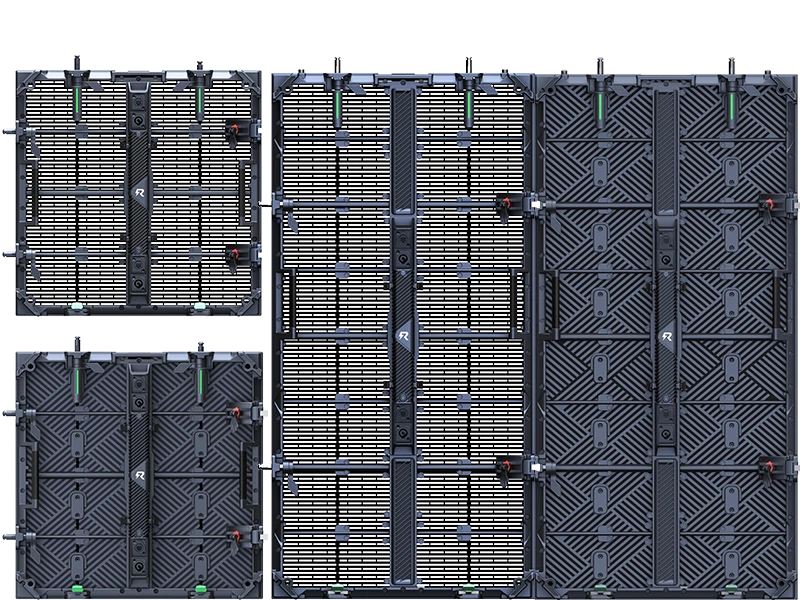
Cabinet material and tolerance. Die-cast aluminium holds flatness better than thin sheet steel dressed up as "aluminium alloy". On a wide wall, flatness errors become visible seams.
Mask quality. UV yellows cheap masks; sun glare kills contrast. A hooded or anti-UV mask costs little at order time and is expensive to retrofit.
Power supply brand and load. A supply running near its limit in a low-airflow install fails faster. Derated, fused, branded supplies cost more and fail less.
Thermal design. An outdoor cabinet in full sun sits at a high internal temperature before the LEDs even switch on. If the cabinet is sealed against water, the heat has to go somewhere — and the designer should be able to tell you where.
Cable entries and sealing. Water usually enters through the back, the joins between cabinets, or unsealed loom entries. "IP65" alone tells you nothing.
Batch records. Colour consistency across production batches matters enormously if you plan to expand later. Ask how they bin LEDs and whether they keep records you can reference.
Spares policy. Same-batch modules shipped with the order are the only reliable path to long-term uniformity. Matching by eye two years later is very difficult.
Notice there is no price in any of that. Price follows these decisions. If you let the supplier write the spec, you will never know whether you saved money or just bought a different product.
Send them as a block. Watch two things: speed and concreteness. Speed proves little. Vagueness proves quite a lot.
Can we do a live video call of the production floor now?
Not a recorded tour. Live. Ask them to walk to the ageing test area and read a serial number off a running cabinet. Brokers send PDFs and say the engineer is out today. A real factory does this during working hours without drama.
Which exact LED brand, driver IC and power supply are in this quote?
And ask them to write it into the proforma. "High quality brand, we can arrange" is not a spec. It is a promise with nothing to hold onto.
Is the IP rating front only, or front and rear, and how are the cable entries sealed?
If they cannot describe where the loom enters and where the seals sit, assume there are no seals.
What is the real brightness, and can you show me footage in actual sunlight?
Ask for a phone-shot video outside in sun, not a darkened showroom. And ask for the auto-dimming curve — an outdoor screen that cannot dim itself is a liability, not an asset.
Who designs the structure, and do the drawings carry a calculation for my wind speed?
Outdoor means wind load, and wind load means someone with a calculator, not a catalogue. "Standard pole included" means you are designing it yourself whether you meant to or not. This is the part that becomes dangerous, not ugly.
Can you give me two customer contacts who have run your cabinets for more than a year?
Then actually contact them and ask one question: what broke, and how fast did it get fixed. Especially ask what happened after the first heavy rain season. You learn more from that answer than from any certificate image on the website.
Will you ship a spares kit in the same crate?
Modules from the same production batch, spare power supplies, spare receiving cards, extra cables and seals, and the tools to swap them. If they hesitate, treat it as an answer.
How bright does an outdoor full-colour cabinet need to be?
Enough to beat ambient light at your site, and able to dim itself down afterwards. But the more important question is whether that brightness is achieved with headroom or by running the LEDs flat out. A cabinet hitting its target nits at eighty percent drive has a life in it. One that only hits the number at full tilt fades noticeably inside two summers. Ask for the drive condition, not just the nits figure.
Die-cast aluminium or steel?
Both work, and the material matters less than the tolerance and the finish. Die-cast tends to hold flatness better and is lighter, which matters when the wall is wide and the facade cannot take much load. Steel is cheaper, heavier, and needs proper corrosion treatment anywhere near the coast. Ask for the flatness tolerance and the weight per panel, and ask what the finish is if you are in a salty atmosphere. That last question separates people who have shipped to your climate from people who have not.
Front service or rear service?
Think about your actual site. Beside a road, against a building face, or under a canopy, there is often no room behind the screen at all. Rear-service-only means dismantling the whole setup to reach one module. Confirm how much clearance is needed now, not on installation day. Also confirm whether removing one module forces you to remove its neighbours — I have seen designs where a five-minute job becomes forty minutes, and that detail only reveals itself when someone is standing on a ladder in the rain.
Does it need a sun shade or hood?
In direct sun, especially on a west-facing facade, yes, it helps more than people expect. Contrast outdoors is killed by glare on the mask, not by lack of brightness. A hooded mask cuts reflected light and lets you run the screen at a lower, cooler drive level. Cheap to add at the order stage, expensive to retrofit.
What about heat?
This is the one that gets underestimated constantly. Ask how the cabinet handles heat dissipation, whether the power supplies are oversized and derated, and whether there is temperature monitoring with automatic dimming or shutdown. A supplier who says "aluminium dissipates heat well" and stops there is reciting a brochure.
Pixel pitch for full-colour work?
Viewing distance is longer outdoors, so the pitch can be coarser than indoors, and going finer costs a lot for little gain. But do not let someone talk you into a pitch that makes your text unreadable at the distance where people actually decide to read it. Work out the nearest viewer who matters and the size of the smallest thing you will display, then pick the pitch. Text-heavy content needs more resolution than logo-and-video content. Be honest about what will actually be shown.
Should I buy cabinets or a full solution?
If you already have a technician, a controller and a structure, buying cabinets alone can save money. If you do not, buying cabinets and hoping the rest works out is how projects stall. Decide early whether you want cabinets only or cabinets plus structure plus control, and compare like with like. Two quotes where one includes a pole and the other does not are not comparable, and the cheaper one is not cheaper.
Water stains or fogging inside after the first wet season points to seal design or unsealed cable entries — only fixable by re-sealing or replacing panels. Seams appearing or worsening points to cabinet flatness and frame rigidity — that cannot be calibrated away, only replaced. Patchy colour within the first year points to mixed LED batches or no calibration record — partially fixable with recalibration. Panels dimming noticeably by the second summer points to thermal management or power supplies running hot — partly fixable with derating and ventilation. Dead rows after a few months usually point to connector and ribbon cable quality rather than the LEDs themselves. Flicker or banding on camera points to a cut refresh rate or mismatched driver IC — not fixable without hardware or controller changes. Structure creaking or moving in wind points to a pole sized from a catalogue — fixable, but requires re-engineering.
Each symptom maps to a corner that was cut. Knowing the map stops you accepting "just bad luck" as an explanation. It was not bad luck.
Write your usage facts down first. Exact location and mounting height, orientation and sun exposure, nearest and farthest viewer, hours per day, local wind speed, salt air or industrial dust, how it will be cleaned, access from behind, local rules on illuminated signage, and who changes the content. The tighter this list, the more comparable the quotes become. Suppliers who cannot answer properly tend to stop replying, which is useful filtering.
Get three configuration sheets and compare line by line. Total price for the same configuration, not total price alone.
Lock the mechanical details early. Cabinet dimensions, weight per panel, total wall weight, fixing method, service clearance, and whether the structure drawing is included.
Confirm signal and control architecture. Processor compatibility, input options, cable lengths, remote access method, and whether the software licence expires. Also confirm the maximum resolution the controller can drive — wide walls catch people out here.
Write the warranty in operational language. Response time, who pays freight on replacement parts, whether labour is covered, whether failed modules are replaced or repaired, and whether support is available in your time zone.
Insist on a spares kit in the same shipment. Same-batch modules, spare power supplies, spare receiving cards, extra cables, seals and swap tools, labelled.
Arrange inspection before shipping. A third-party check at the factory catches mislabeled pitch, wrong components, missing spares, dead pixels and weak seals before the crate is sealed. It costs a few hundred and it is the cheapest insurance on the whole project.
Confirm paperwork before shipping, not after. HS code, duty rate, electrical compliance. Electronic displays get questioned at borders more often than expected, and port storage fees pile up faster than arguments resolve.
Test on arrival and again after installation. Run it powered for an extended period, check dead pixels and seams, check brightness under actual site lighting, test the dimming schedule, spray-test the seals if you can, and actually swap a module using the spares kit to confirm your technician can do it in the time you think they can.
A brilliant screen playing dull content looks like a dull screen. Resolution earns about three seconds of attention; the creative decides whether anything sticks. Outdoors especially, design for the actual viewing distance and speed of the audience: big shapes, high contrast, minimal text, movement slow enough to read at walking or driving speed. Money spent on the artwork usually beats money spent on chasing one more parameter tier, and it costs far less than an extra square metre of panel.
Give whoever runs the screen a simple template set and a clear routine. The person updating it on a busy weekday should not need to interpret a designer's intentions, and definitely should not need to call a supplier in another time zone.
After looking at enough of these projects, the pattern is boringly consistent. The buyers who end up happy wrote down how the screen would actually live before speaking to a single supplier — which way the facade faces, whether it gets afternoon sun, how many hours it runs, whether anyone can reach the back, what the local wind does, what the rainy season is like. The buyers who end up disappointed started with price and worked backwards, and discovered on installation day that there was no access behind the screen and the pole needed redesigning.
Specs can be padded, photos can be borrowed, certificates can be faked, but site reality cannot be faked. Lay those facts out first and the wrong manufacturers remove themselves, because they cannot answer properly. The right ones respond with specifics, ask questions back, and sometimes tell you that your pitch is wrong for the viewing distance, or that your mounting plan will not work, or that you would be better off with fewer square metres and better content. That last behaviour is the strongest signal in the whole process. A supplier willing to talk you out of a sale is usually the one who has stood in front of a blank screen at midnight and knows exactly where the problems hide.
Trust that instinct more than any badge on a website. Insist on the flatness tolerance, the documented seal and drainage details, the same-batch spares, and a software licence you actually control. Do not delete the spares kit to save money — it pays for itself the first time it saves a day of downtime. Keep the original packing for at least a month too; shipping a panel back without proper packing is how you turn a warranty claim into an argument about transit damage. You will thank yourself eventually.
What should I look for in China LED display full colour manufacturers?
Prioritise documented cabinet material and flatness tolerance, front-and-rear IP ratings with sealed cable entries, real brightness figures with auto-dimming, named components (LED brand, driver IC, power supply), structure drawings calculated for your local wind speed, verifiable certifications in the supplier's own name, and a documented spares policy. Compare prices on matching configurations only.
Is IP65 enough for outdoor full-colour use?
IP65 is a good baseline for the front face, but you need to know the rear rating and how the cable entries are sealed. Water usually enters through the back, the joins between cabinets, or unsealed loom entries. In coastal or dusty environments, ask for higher protection and corrosion-treated finishes.
How bright should an outdoor LED cabinet be?
Bright enough to remain readable in direct sunlight at your site, with automatic dimming for lower light. More important than the peak number is whether that brightness is achieved with drive headroom; a screen driven flat out to hit its nits figure will fade faster.
Die-cast aluminium or steel cabinet?
Both work. Die-cast holds flatness better and is lighter, useful for wide walls and weight-limited facades. Steel is cheaper and heavier, and needs proper corrosion treatment near the coast. Ask for flatness tolerance and weight per panel rather than relying on the material name.
Do I need front service or rear service?
Depends on your site. Roadside screens, facade-mounted walls and canopy installs often have no room behind them, making rear service impractical. Confirm the required clearance and whether removing one module forces you to remove others.
What about wind load and the supporting structure?
Outdoor installations must be calculated for local wind speed. Insist on structure drawings with a wind-load calculation and anchor details. A "standard pole" answer means nobody has done the maths for your site.
How long does delivery take from China?
Standard configurations often run several weeks from deposit plus freight time. Custom sizes, unusual aspect ratios and integrated structures take longer, and peak season adds buffer. Plan from the date you need the screen working, not the date you pay.
What spares should come with the order?
Modules from the same production batch, spare power supplies, spare receiving cards, extra cables, seals and swap tools, all clearly labelled. For commercial outdoor installations this is not optional, and same-batch modules matter because colour matching by eye later is very difficult.
What warranty terms should I insist on?
At minimum two years on modules and control system, plus clarity on response time, who pays freight for replacements, whether labour is covered, whether failed units are replaced or repaired, and whether support is available in your time zone. Negotiate these explicitly.
How do I tell a real factory from a trading company?
Ask for a live video call of the production floor and ageing test area, request component brands and model numbers named in writing, verify that certificates sit in the company's own name, and ask for references from customers who have run the cabinets for over a year. Factories name parts and can show the floor; traders speak in adjectives and send PDFs.
.jpg "fine pitch led video wall manufacturers")